Landscape Design Assistant Soren Aalto
Landscape Design Assistant
[email protected] | (503) 555-2334 | Portland, United States
Profile
Landscape design assistant with three years in a Portland design-build practice, producing planting plans, layout drawings and irrigation zoning for residential sites from 4,000 to 20,000 square feet. Draft in Vectorworks Landmark and take drawings from survey to a planting schedule the crew orders from, working under a senior designer. Not a licensed landscape architect and do not use the title; grading, drainage and retaining work on my projects is prepared under the responsible charge of a licensed professional.
Work Experience
02/2024 - Present, Landscape Design Assistant, Willamette Terrace Design Build, Portland, United States
- Produce planting plans, layout drawings and irrigation zoning for residential sites from 4,000 to 20,000 square feet, under a senior designer.
- Draft in Vectorworks Landmark and take drawings from survey to a planting schedule the install crew orders from.
- Prepare residential permit sets for walls, decks and drainage, and track the plan review comments through to approval.
- Run nursery availability checks and substitution requests, and attend two site visits per install.
04/2022 - 01/2024, Install Crew Member, Alder Ridge Landscape Studio, Portland, United States
- Installed planting, drip irrigation and low-voltage lighting on roughly 30 residential projects a season.
- Learned where drawings fail on the ground: grade, drainage and access.
Education
09/2018 - 06/2022, Bachelor of Science, Horticulture, Oregon State University, Corvallis, United States
Plant materials, soils and irrigation, with a landscape design sequence and a senior planting project on a one-acre campus site.
Skills
Vectorworks Landmark, 80
Planting design and succession, 70
Layout and circulation, 70
Irrigation zoning, 70
Planting schedules and specifications, 75
Permit set preparation, 65
Regional plant knowledge and hardiness, 80
Languages
English, native
Finnish, intermediate
Certificates
05/2023, Landscape Industry Certified Technician - Exterior, softscape installation, National Association of Landscape Professionals
Common core plus the softscape installation specialty; hands-on evidence for a designer who has built what they draw.
Summary
A landscape designer resume is a one to two page document that states your scope of practice before it states your style. This guide gives you three adaptable versions, the licensure boundary between designer and licensed landscape architect, what grading and stormwater work triggers a permit, and current Bureau of Labor Statistics pay and outlook.
Landscape Designer resume examples by experience level
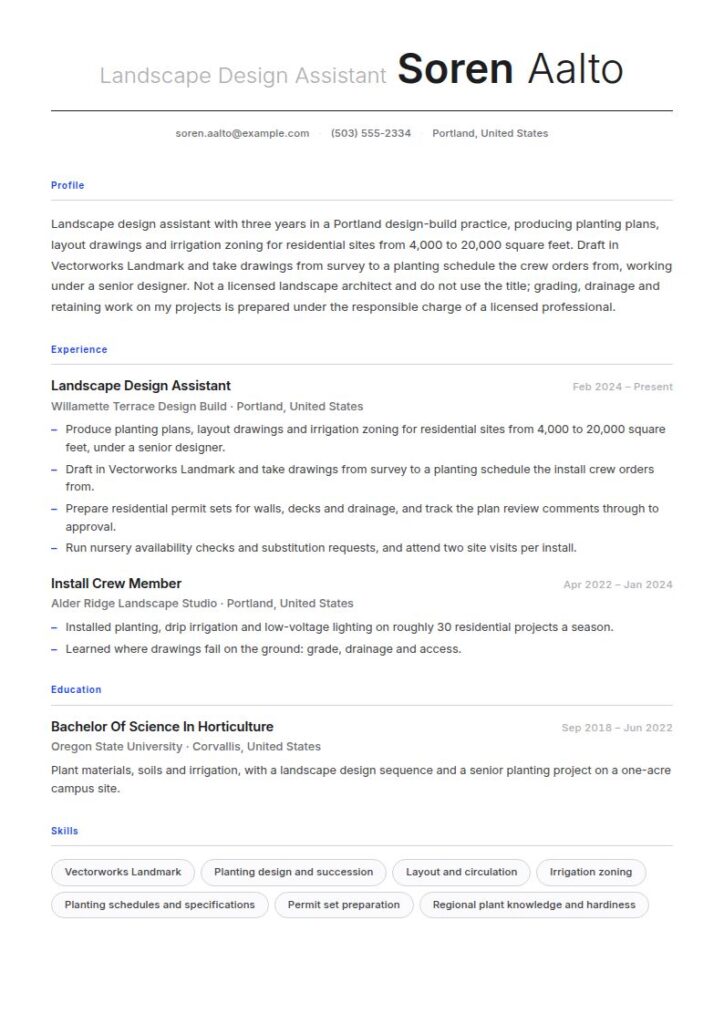
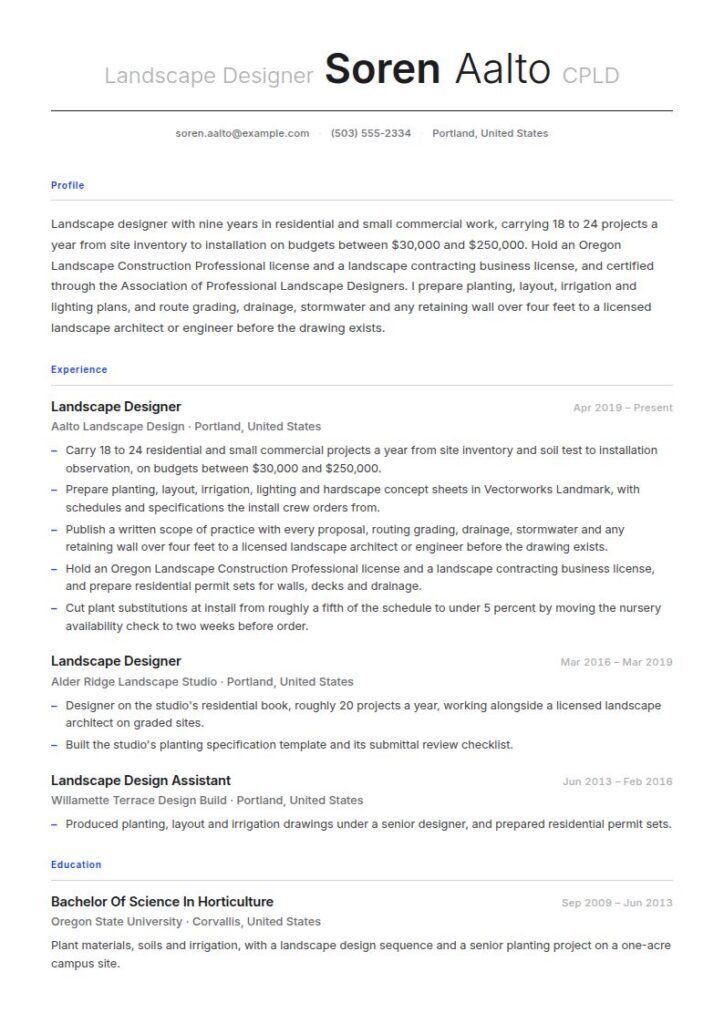
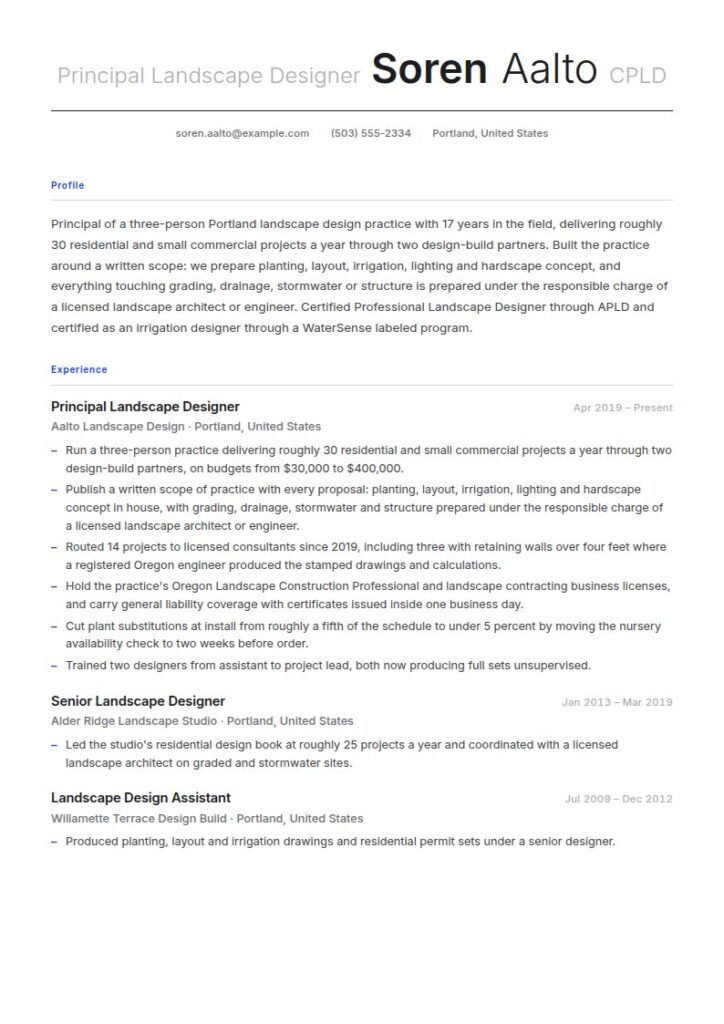
A landscape designer resume is a one to two page document that states what you may legally prepare before it states what your gardens look like.
Landscape designer and landscape architect are not the same title; in fact, the law protects the second. As a result, a file that blurs the two is a liability, and the people who hire designers are the ones most likely to notice. Therefore, write the boundary down, and a reader who knows what you can sign for can picture you on their project.
Resume guide for a landscape designer resume
In particular, this guide and the corresponding landscape designer resume example will cover:
- First, how to write a landscape designer resume, section by section
- Also, where the licensure line sits and how to state which side you are on
- Then three adaptable summaries: design assistant, designer and principal
- In addition, what grading, drainage and stormwater work triggers a permit
- Finally, what the job market looks like and what you can expect to earn
How to write a landscape designer resume
Six sections: contact header, summary, scope of practice block, project experience, skills and software, then education, licenses and certifications. Use one page under five years, then two once you run projects or carry your own clients.
| Section | What it is answering | Where it goes |
|---|---|---|
| Scope of practice | What may this person prepare, and what goes elsewhere? | Directly under the summary |
| Project experience | What sites, at what size and budget, taken how far? | Reverse chronological, with site size |
| Licenses and certifications | What is checkable, and what is the title exactly? | At the foot, with numbers |
Name the title you actually hold, in your first line
Write "Landscape Designer" and not "Landscape Architectural Designer", "Landscape Architect in training" or anything that reads as the protected title with a qualifier bolted on.
Then add the sentence almost nobody writes: what you prepare and what you hand off. "Planting, layout, irrigation and lighting plans for residential sites; grading, drainage and structural work prepared under the responsible charge of a licensed landscape architect or engineer."
Two lines, and they remove the reader's biggest unknown. On a file read by a licensed professional it lands as competence.
Run the finished file through the ATS resume checker first. Design-build firms and municipal parks departments both parse applications, and a wide portfolio-style template is where that breaks.
Choosing the best resume format for a landscape designer resume
Go reverse chronological; in addition, promote the scope of practice block above experience. Keep the portfolio separate and link it from the header: the resume states terms, while the portfolio is where readers view plans at a size that makes sense. Avoid a functional format, because a reader is looking for continuity and for who supervised you. Supervised experience under a licensed professional is the currency of this field whether or not you intend to sit an exam.
Include your contact information
| ✅ Right | ❌ Wrong |
|---|---|
| Soren Aalto | Soren Aalto |
| Landscape Designer: residential planting, layout, irrigation and lighting | Landscape Architectural Designer |
| Oregon Landscape Construction Professional, #LCP-10432 | Licensed landscape professional |
| (503) 555-2334, [email protected], Portland, OR | (503) 555-2334, [email protected] |
Those wrong-column lines are not style problems. In fact, "Landscape Architectural Designer" invites the reader to assume a license you do not hold, while "licensed landscape professional" is vague where the point is precision.
Make use of a summary
Keep it to four lines: the title you hold, what you prepare, the scale of site you work at, and also one credential that de-risks hiring you.
Landscape design assistant with three years in a Portland design-build practice, producing planting plans, layout drawings and irrigation zoning for residential sites from 4,000 to 20,000 square feet. Draft in Vectorworks Landmark and take drawings from survey to a planting schedule the crew orders from, working under a senior designer. Not a licensed landscape architect and do not use the title; grading, drainage and retaining work on my projects is prepared under the responsible charge of a licensed professional.
Landscape designer with nine years in residential and small commercial work, carrying 18 to 24 projects a year from site inventory to installation on budgets between $30,000 and $250,000. Hold an Oregon Landscape Construction Professional license and a landscape contracting business license, and certified through the Association of Professional Landscape Designers. I prepare planting, layout, irrigation and lighting plans, and route grading, drainage, stormwater and any retaining wall over four feet to a licensed landscape architect or engineer before the drawing exists.
Principal of a three-person Portland landscape design practice with 17 years in the field, delivering roughly 30 residential and small commercial projects a year through two design-build partners. Built the practice around a written scope: we prepare planting, layout, irrigation, lighting and hardscape concept, and everything touching grading, drainage, stormwater or structure is prepared under the responsible charge of a licensed landscape architect or engineer. Certified Professional Landscape Designer through APLD and certified as an irrigation designer through a WaterSense labeled program.
Right vs wrong: the same landscape designer summary, twice
| ✅ Right | ❌ Wrong |
|---|---|
| Landscape designer carrying 18 to 24 projects a year on budgets between $30,000 and $250,000. | Creative landscape professional with a love of outdoor spaces. |
| I prepare planting, layout, irrigation and lighting plans. | Experienced in all aspects of landscape design and architecture. |
| Grading, drainage and retaining over four feet go to a licensed professional before the drawing exists. | Work closely with engineers as needed. |
The right column, for example, tells a firm which drawings land on your desk. The left, on the other hand, makes a licensed reader wonder what you think the law lets you do.
Outline your landscape design experience
Firm or client type, role, city and dates, then the remit in one line, then three to five bullets carrying a site size, a budget, a deliverable or a number that moved.
| Instead of | Use |
|---|---|
| Designed beautiful outdoor spaces for clients | Carried 18 to 24 residential projects a year, 4,000 to 40,000 square feet, on $30,000 to $250,000 budgets |
| Created landscape plans | Produced planting, layout, irrigation and lighting sheets in Vectorworks Landmark, with a schedule the crew ordered from |
| Helped with permits | Prepared residential permit sets for walls, decks and drainage, and filed the Construction General Permit notice on a one-acre site |
Principal Landscape Designer, Aalto Landscape Design, Portland, OR, April 2019 to Present. Residential and small commercial design, delivered through two design-build partners.
Deliver roughly 30 projects a year from site inventory and soil test to installation observation, on budgets from $30,000 to $400,000.
Publish a written scope with every proposal: planting, layout, irrigation, lighting and hardscape concept in house, with grading, drainage, stormwater and structure prepared under the responsible charge of a licensed professional.
Cut plant substitutions at install from a fifth of the schedule to under 5 percent by moving the nursery availability check to two weeks before order.
Know which side of the licensure line you are on
This is the section that decides whether a licensed reader trusts your file. States regulate landscape architecture. The American Society of Landscape Architects states that "licensure is required to practice landscape architecture in all 50 states and the District of Columbia" (ASLA, Getting Licensed, retrieved 17 September 2026), and the Council of Landscape Architectural Registration Boards says its "56 member boards regulate the practice of landscape architecture to protect public health, safety and well-being" (CLARB, retrieved 17 September 2026). Landscape designer is generally an unregulated job title, which is why you have to write the boundary down instead of assuming it.
The exam and the route. CLARB administers the Landscape Architect Registration Examination, the L.A.R.E., which it describes as "a four-part, fully computerized exam". Its sections are Inventory, Analysis and Project Management; Planning and Design; Construction Documentation and Administration; and Grading, Drainage and Stormwater Management, and CLARB states that "all four sections must be passed for initial licensure". The route is a degree accredited by the Landscape Architectural Accreditation Board, supervised experience "in the four regulated areas of practice", and the exam, which most boards let you begin while still gaining experience (CLARB, retrieved 17 September 2026). The BLS Occupational Outlook Handbook confirms that all states require landscape architects to be licensed and to pass an exam, but it does not name the L.A.R.E. or CLARB; those come from CLARB's own pages.
What an unlicensed landscape designer may do
What an unlicensed designer may and may not do. California writes the line more plainly than most states. Its Landscape Architects Technical Committee states that "landscape designers are not licensed or regulated by the State of California", and that an unlicensed person may prepare "drawings for the conceptual design and placement of tangible objects and landscape features" for single-family dwellings, but may not prepare "construction documents, details, or specifications for the tangible objects or landscape features", and may not work on sites requiring grading and drainage modifications. Using "landscape architect", "landscape architecture" or "landscape architectural" without a valid California license violates Business and Professions Code section 5640, treated as a misdemeanor (California Landscape Architects Technical Committee, consumer FAQ, retrieved 17 September 2026). Your own state may draw it differently, but that is the shape.
The stamp. You do not have one, and you cannot buy one late. A seal belongs to a licensee and covers work prepared by or under that licensee's responsible charge, so a drawing that will need a stamp goes to the licensed professional before it exists. Write it that way: "prepared under the responsible charge of a licensed landscape architect" is a sentence a licensed reader respects, and "we have an architect stamp our drawings" ends the interview.
Grading and drainage work that triggers a handoff
What triggers the handoff. Grading, drainage, retaining structures and stormwater, and the thresholds are concrete. In Portland a building permit is required when a retaining wall "is more than four (4) feet high, measured from the bottom of the footing to the top of the wall; OR, supports a surcharge", and "an engineer registered in the State of Oregon must provide stamped drawings and calculations for wall(s) over four feet tall" (City of Portland Permitting and Development, retrieved 17 September 2026). For stormwater, the Environmental Protection Agency requires permit coverage for construction disturbing "1 acre or more of land, or less than 1 acre of land, but that is part of a common plan of development or sale that will ultimately disturb 1 or more acres of land", and its 2022 Construction General Permit, which runs to 16 February 2027, requires erosion and sediment controls and stabilization of disturbed areas when work stops for more than 14 days (EPA, stormwater discharges from construction activities, page last updated 10 August 2026).
Contractor licensing and credentials you can hold
The second licensing regime, which people forget. Title protection is not the only statute you sit inside. In Oregon a Landscape Contractors Board license "is required when performing landscape construction work for compensation", and the board's examples include "planning or installing lawns, shrubs, vines, trees, or other nursery stock", "installing or repairing irrigation systems", "planning, installing, maintaining, or repairing arbors, decks, patios, driveways, fences, retaining walls, walkways" and "installing, maintaining, or repairing drainage systems". You need two licenses, an individual Landscape Construction Professional and a landscape contracting business license (Oregon Landscape Contractors Board, retrieved 17 September 2026). Read the word "planning" carefully: in Oregon, planning an irrigation system for a fee is licensed work even if you never lift a shovel.
What you can hold instead. The Association of Professional Landscape Designers issues the Certified Professional Landscape Designer credential, which requires its code of ethics plus either professional membership or an "associate degree (or higher), or 450 contact hours of education, in landscape design or a related field" with "three (3) or more years of professional landscape design experience" (APLD, retrieved 17 September 2026). EPA WaterSense recognizes irrigation certification programs in three categories: auditor, installation and maintenance professional, and irrigation designer, for people who "develop the design of new irrigation systems and/or modifications to existing irrigation systems" (EPA WaterSense, professional certification, page last updated 6 March 2026).
Title: Landscape Designer. Not a licensed landscape architect; I do not use the title and I do not stamp or seal drawings.
Licenses held: Oregon Landscape Construction Professional #LCP-10432 and landscape contracting business license #LCB-9877, both current.
Prepared in house: site inventory and analysis, planting plans and schedules, layout and hardscape concept, irrigation zoning, lighting layout, specifications.
Routed to a licensed professional: grading and drainage on sloped sites, retaining walls over four feet or carrying a surcharge, stormwater facilities, and structural elements. Prepared under the responsible charge of a licensed landscape architect or engineer on 14 projects since 2019.
Permitting: residential permit sets for walls, decks and drainage; Construction General Permit notice filed where disturbance reaches one acre.
Certifications: Certified Professional Landscape Designer, APLD. Irrigation designer certified through a WaterSense labeled program.
Six lines. A principal reads them in ten seconds and knows whether you fit the work on the desk.
Build a snapshot of your key skills
In practice, list ten to fourteen entries in three groups: design, production, and the site and plant knowledge that stops a drawing failing on site.
Design: Site inventory and analysis, Planting design and succession, Layout and circulation, Hardscape concept, Irrigation zoning
Production: Vectorworks Landmark, AutoCAD, SketchUp, Planting schedules and specifications, Permit set preparation, Submittal review
Site and plant: Regional plant knowledge and hardiness, Soil testing, Stormwater facility planting, Native and low-water selection, Nursery sourcing
List your education, licenses and certifications
Licenses first with numbers, then certifications, then degrees. A licensed reader checks this section, so be exact, and state the negative.
Oregon Landscape Construction Professional, #LCP-10432, Oregon Landscape Contractors Board, current. Landscape contracting business license #LCB-9877.
Certified Professional Landscape Designer, Association of Professional Landscape Designers, 2019.
Irrigation designer, certified through an EPA WaterSense labeled program, 2021.
Bachelor of Science, Horticulture, Oregon State University, Corvallis, OR, 2009.
Not a licensed landscape architect. Grading, drainage, stormwater and structural design on my projects is prepared under the responsible charge of a licensed landscape architect or professional engineer.
That last line looks like a disclaimer and works like a credential. Above all, it tells a principal you will not put the firm on the wrong side of a board complaint, and tells a landscape architecture practice that you understand responsible charge.
If you are on the licensure route, say where: the accredited degree, supervised hours logged under a named licensed professional, and which L.A.R.E. sections you have passed. Still, a candidate who has passed two of four is a different hire from one who has not started, and neither is a landscape architect yet.
Choose the right layout and design
Single column, plain type at 11 or 12 point, no portfolio spreads, no site plan as a background image. The instinct here is to design the page, and it costs files. Keep one plain-text portfolio URL in the header, and name the file soren-aalto-landscape-designer-resume.pdf.
Use the exact title you hold. State what you prepare and what is routed to a licensed professional. Give site sizes and budget ranges. Name your contractor licenses with their numbers. Say which software you produce drawing sets in. If you are on the licensure route, name the L.A.R.E. sections you have passed.
Do not write "landscape architectural designer" or any variant of the protected title. Do not say you "stamp" drawings, or that you have them stamped after the fact. Do not claim grading or stormwater design that someone else prepared; say you coordinated it. Do not list a lapsed license as current. Do not use a two-column portfolio template.
Landscape designer job market and outlook
However, BLS publishes no separate profile for landscape designers. Instead, landscape architects is the published occupation the work sits next to, and it is small and licensed.
| Measure | Value |
|---|---|
| Landscape architects employed, 2025 | 23,500 |
| Projected employment, 2035 | 24,500 |
| Projected change, 2025-35 | 4% (+1,000 jobs) |
| Projected annual openings | ~1,700 |
| Typical entry-level education | Bachelor's degree |
| Median annual wage, May 2025 | $79,870 |
Source: U.S. Bureau of Labor Statistics, Occupational Outlook Handbook, landscape architects, page last modified 27 August 2026, May 2025 wage data and 2025 to 2035 projections.
The headline median belongs to a title you may not hold
BLS publishes no separate landscape designer profile, so the industry table below is the closest thing you have to a band, and it is the licensure line drawn in money. Architectural, engineering and related services holds 50 percent of landscape architects at a May 2025 median of $82,290, which is where licensed practice sits. Landscaping services holds 20 percent at $65,150, and that is where most unlicensed designers actually price, roughly $14,700 below the $79,870 headline (BLS Occupational Outlook Handbook, landscape architects, page last modified 27 August 2026).
So do not benchmark against the headline unless you hold the license. Benchmark against $65,150, then show the two things that move you up it: a scope of practice a principal can hand work to without checking, and progress on the licensure route.
Where the jobs sit:
| Industry | Share | Median annual wage (May 2025) |
|---|---|---|
| Architectural, engineering and related services | 50% | $82,290 |
| Landscaping services | 20% | $65,150 |
| Self-employed workers | 17% | Not published |
| Government | 8% | $107,410 |
| Construction | 1% | $71,990 |
Source: U.S. Bureau of Labor Statistics, Occupational Outlook Handbook, landscape architects, May 2025.
What salary you can expect as a landscape designer
For example, the median annual wage for landscape architects was $79,870 a year, or $38.40 an hour, as of May 2025. The lowest 10 percent earned under $54,770 and the highest 10 percent over $130,190 (BLS Occupational Outlook Handbook, landscape architects, page last modified 27 August 2026).
Even so, read that as the licensed profession's band rather than yours. Employers usually pay an unlicensed designer against the landscaping services figure of $65,150, and the gap between that and the architectural and engineering median of $82,290 is what licensure is worth here, before the government work at $107,410 comes into view.
In practice, three things on the page move you inside that range.
A written scope. A principal who can hand you work without checking what you are allowed to prepare gets more from you, and pays accordingly.
Production in a real drawing set. Naming the software and the sheets you produce, planting plan, layout, irrigation, lighting, schedules and specifications, separates a designer from someone making concept renderings.
Licensure progress. The accredited degree, the logged supervised hours and the L.A.R.E. sections passed. It is the only lever here that moves a whole column.
Key takeaways for a landscape designer resume
- First, use the exact title you hold, never a variant of the protected one.
- Then put a scope of practice block under the summary: prepared in house, routed out.
- Also say that grading, drainage, stormwater and structure go to a licensed professional.
- Name the thresholds you work to, such as a retaining wall over four feet.
- Similarly, list contractor licenses with numbers and current status.
- If you are on the licensure route, name the L.A.R.E. sections you have passed.
- Finally, benchmark pay against landscaping services instead of the licensed headline.
Build your landscape designer resume in 15 minutes with our AI resume builder.
Related creative and artistic resume examples
- Floral designer resume
- Visual artist resume
- Illustrator resume
- Artist resume
- Photographer resume
- Fashion designer resume
- Jewelry designer resume
- Costume designer resume
- Wedding photographer resume
- Stage manager resume
- Videographer resume
- Tattoo artist resume
Pair it with a matching landscape designer cover letter.
Landscape designer resume questions, answered
Can I call myself a landscape architect if I design landscapes?
No. ASLA states that "licensure is required to practice landscape architecture in all 50 states and the District of Columbia" (ASLA, Getting Licensed, retrieved 17 September 2026). In California, using "landscape architect", "landscape architecture" or "landscape architectural" without a license violates Business and Professions Code section 5640 and is treated as a misdemeanor (California Landscape Architects Technical Committee, retrieved 17 September 2026). Until you hold the license, write "landscape designer".
What can an unlicensed landscape designer legally prepare?
It depends on the state, and California is the clearest published example: an unlicensed person may prepare "drawings for the conceptual design and placement of tangible objects and landscape features" for single-family dwellings, but not "construction documents, details, or specifications", and not work on sites requiring grading and drainage modifications (California Landscape Architects Technical Committee, retrieved 17 September 2026). Read your own board's statute before you write your scope block.
Do I need a license to design an irrigation system?
Possibly, and not the one you would expect. In Oregon a Landscape Contractors Board license is required "when performing landscape construction work for compensation", and the board lists "installing or repairing irrigation systems" and "planning, installing, maintaining, or repairing" hardscape among the covered work (Oregon Landscape Contractors Board, retrieved 17 September 2026). Contractor licensing is a separate regime from title protection, and it catches designers who only ever draw.
How long should a landscape designer resume be?
One page under five years. Two once you carry projects end to end, hold a contractor license, or run a practice.
What do I put on a landscape designer resume with no professional projects?
Real sites with real constraints, written as jobs: a public garden volunteer plan, a design-build internship, a nursery or install crew season, or a studio project with a named site, its square footage and its drainage problem. Then the software you produce in and any certification in progress. Crew experience is worth more than it looks, because a designer who has installed knows why a drawing fails.