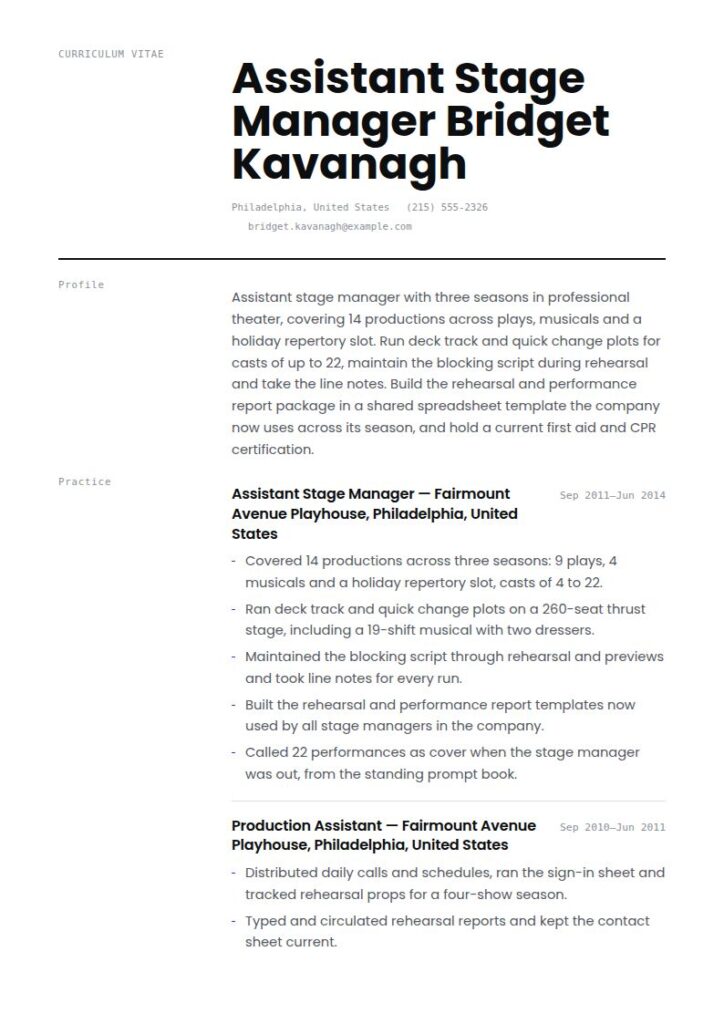
Assistant Stage Manager Bridget Kavanagh
Assistant Stage Manager
[email protected] | (215) 555-2326 | Philadelphia, United States
Profile
Assistant stage manager with three seasons in professional theater, covering 14 productions across plays, musicals and a holiday repertory slot. Run deck track and quick change plots for casts of up to 22, maintain the blocking script during rehearsal and take the line notes. Build the rehearsal and performance report package in a shared spreadsheet template the company now uses across its season, and hold a current first aid and CPR certification.
Work Experience
09/2011 - 06/2014, Assistant Stage Manager, Fairmount Avenue Playhouse, Philadelphia, United States
- Covered 14 productions across three seasons: 9 plays, 4 musicals and a holiday repertory slot, casts of 4 to 22.
- Ran deck track and quick change plots on a 260-seat thrust stage, including a 19-shift musical with two dressers.
- Maintained the blocking script through rehearsal and previews and took line notes for every run.
- Built the rehearsal and performance report templates now used by all stage managers in the company.
- Called 22 performances as cover when the stage manager was out, from the standing prompt book.
09/2010 - 06/2011, Production Assistant, Fairmount Avenue Playhouse, Philadelphia, United States
- Distributed daily calls and schedules, ran the sign-in sheet and tracked rehearsal props for a four-show season.
- Typed and circulated rehearsal reports and kept the contact sheet current.
Education
08/2006 - 05/2010, Bachelor of Arts, Theater Arts, Temple University, Philadelphia, United States
Stage management concentration. Stage managed six main stage productions, including one opera workshop called from score.
Skills
Blocking notation and script maintenance, 80
Deck track and quick change plotting, 85
Rehearsal and performance reports, 85
Line notes, 80
QLab playback, 60
ClearCom and wireless partyline, 70
Google Workspace and shared drive discipline, 80
Languages
English, native
Irish, beginner
Certificates
02/2013, First Aid, CPR and AED, American Red Cross
Renewed on the company schedule each season.
Summary
A stage manager resume is a one to two page document that lists productions, the contract each one ran under, the size of the company and crew, and the paperwork you produced. This guide gives you three adaptable versions, the prompt book section almost nobody includes, and current Bureau of Labor Statistics pay and outlook for the occupation the role sits inside.
Stage Manager resume examples by experience level
In short, a stage manager resume is a one to two page production list that shows what you ran, under which contract, at what scale, and what you handed over at the end of it.
By contrast, every other job in the building makes something an audience sees. The stage manager makes a document. The prompt book is the only deliverable another qualified person could pick up cold and run the show from, and a resume that never mentions it describes the job from the outside.
Resume guide for a stage manager resume
This guide and the corresponding stage manager resume example will cover:
- How to write a stage manager resume, section by section
- Why the production list is the spine of the page and how to format it
- Three adaptable summaries: assistant stage manager, stage manager and production stage manager
- What the prompt book proves, and which parts of it belong on a resume
- What the job market looks like and what you can expect to earn
How to write a stage manager resume
Six sections: contact header, summary, production credits, paperwork and calling record, skills and systems, then training and certifications. Use one page for your first five years, then two once you have a touring credit or a season as production stage manager.
The order follows how a production manager reads: the scale you have worked at, whether you have run under the contract they are hiring on, and whether you can call the kind of show they are mounting.
| Section | What it is answering | Where it goes |
|---|---|---|
| Production credits | What has this person run, at what scale, and how recently? | Directly under the summary, reverse chronological |
| Paperwork and calling record | What did they actually produce, and can they call cues? | Its own block, not implied by job titles |
| Skills and systems | Which console, which paperwork tools, which rehearsal practices? | Grouped, named by product |
| Training and certifications | Union status, first aid, intimacy and fight protocols | Short, at the foot |
Put the contract next to every credit
A production manager reads a credit list for scale, and the contract is the fastest shorthand for scale there is. Actors' Equity Association negotiates 33 contracts and codes, from the Production and Touring agreements down to the small-company and showcase codes, and states that its individual contracts "usually cover jobs in three categories: Principal, Chorus and Stage Manager" (Actors' Equity Association, Contracts and Codes, retrieved 17 September 2026).
So write "Stage Manager, LORT B" or "ASM, Small Professional Theatre code" rather than "Stage Manager, regional theater". The first tells a reader the company size, the rehearsal week, the rest rules and roughly the budget.
If your work has been non-union, give the scale plainly instead: seats, cast size, crew size, performances.
Run the finished file through the ATS resume checker before you submit. Company hiring is increasingly routed through applicant systems, and a two-column credit grid is where parsing breaks.
Choosing the best resume format for a stage manager resume
Go reverse chronological; in addition, promote production credits above everything except the summary. This is a credits occupation, so the page is closer to a production list than to an employment history, but the dates still matter: they are read for recency.
In practice, keep one line per production and hold the columns steady: production, company, contract, director, your role, dates. A functional format hides the one thing being checked, which is whether you have run a show of this size in the last two years.
Include your contact information
| ✅ Right | ❌ Wrong |
|---|---|
| Bridget Kavanagh | Bridget Kavanagh |
| Production Stage Manager: plays, musicals, opera | Organized theater professional who loves live performance |
| Actors' Equity Association member since 2018 | Union member |
| Calls from score and from script. Valid driver license, own reliable transport. | Great at multitasking under pressure |
| (215) 555-2326, [email protected], Philadelphia, PA | (215) 555-2326, [email protected] |
Also, two lines decide bookings, yet almost everyone leaves them off. For example, reading music well enough to call from a score rules you in or out of opera and musicals at a glance, and reliable transport matters to every summer company.
Make use of a summary
Four lines: what you stage manage, at what scale, the contracts you have worked under, and one thing you are known for that is not "organized".
Assistant stage manager with three seasons in professional theater, covering 14 productions across plays, musicals and a holiday repertory slot. Run deck track and quick change plots for casts of up to 22, maintain the blocking script during rehearsal and take the line notes. Build the rehearsal and performance report package in a shared spreadsheet template the company now uses across its season, and hold a current first aid and CPR certification.
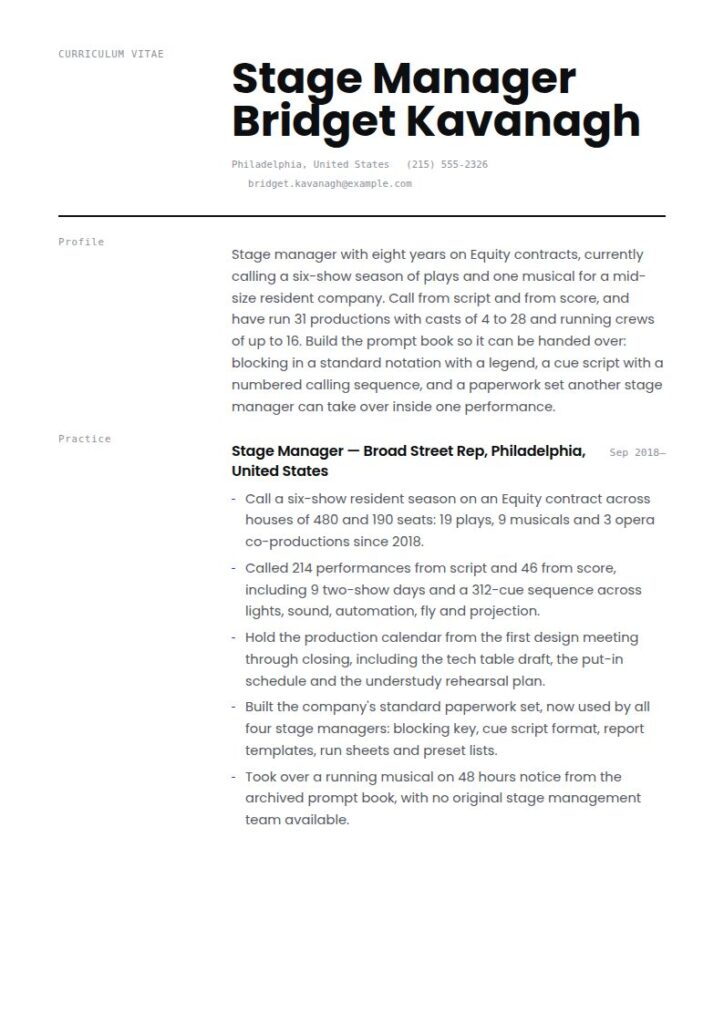
Stage manager with eight years on Equity contracts, currently calling a six-show season of plays and one musical for a mid-size resident company. Call from script and from score, and have run 31 productions with casts of 4 to 28 and running crews of up to 16. Build the prompt book so it can be handed over: blocking in a standard notation with a legend, a cue script with a numbered calling sequence, and a paperwork set another stage manager can take over inside one performance.
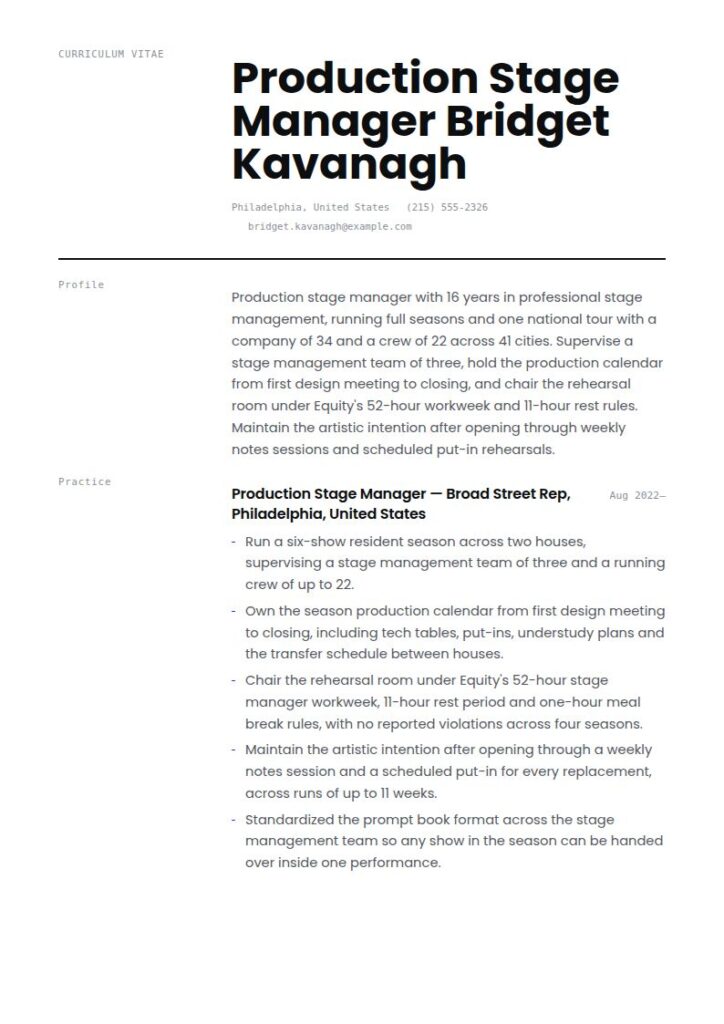
Production stage manager with 16 years in professional stage management, running full seasons and one national tour with a company of 34 and a crew of 22 across 41 cities. Supervise a stage management team of three, hold the production calendar from first design meeting to closing, and chair the rehearsal room under Equity's 52-hour workweek and 11-hour rest rules. Maintain the artistic intention after opening through weekly notes sessions and scheduled put-in rehearsals.
Right vs wrong: the same stage manager summary, twice
| ✅ Right | ❌ Wrong |
|---|---|
| Stage manager with eight years on Equity contracts, 31 productions, casts of 4 to 28. | Experienced stage manager with a strong passion for live theater. |
| Call from script and from score across plays, musicals and one opera. | Comfortable calling a wide variety of shows. |
| Prompt book built so another stage manager can take over inside one performance. | Highly organized with excellent attention to detail. |
The right column, for instance, can be checked against a season calendar. The left column, in contrast, is what every other file in the folder says, and it is not falsifiable, which is the same thing as saying nothing.
Outline your stage management experience
One line per production, then bullets only where a show had something unusual in it. In practice, a page of identical bullets under twelve credits is unreadable.
| Instead of | Use |
|---|---|
| Stage managed several productions | 31 productions since 2018: 19 plays, 9 musicals, 3 opera, casts of 4 to 28 |
| Responsible for running rehearsals and performances | Called 214 performances from script and 46 from score, including 9 two-show days |
| Created rehearsal schedules | Held the production calendar from first design meeting to closing across a six-show season |
| Communicated with the production team | Issued a rehearsal report inside 45 minutes of every call and a performance report before leaving the building |
| Managed backstage crew | Ran a deck crew of 16 on a two-truck automation show with 31 scene shifts |
Stage Manager, Broad Street Rep, Philadelphia, PA, September 2018 to Present. Six-show resident season, LORT contract, houses of 480 and 190 seats.
Call the full season: 19 plays, 9 musicals and 3 opera co-productions since 2018, casts of 4 to 28 and running crews of 6 to 16.
Hold the production calendar from the first design meeting through closing, including the tech table draft, the put-in schedule and the understudy rehearsal plan.
Built the company's standard paperwork set, now used by all four stage managers: blocking key, cue script format, rehearsal and performance report templates, run sheets and preset lists.
Supervise two assistant stage managers a season, including the deck track handover process when a show moves from the main house to the studio.
The prompt book, and what a stage manager can prove with it
However, this is the section almost nobody writes, and it is the one that separates two candidates with similar credit lists.
The prompt book is the show in written form, and the only piece of a production designed to be used by someone who was not there when it was made. In fact, Actors' Equity Association writes the duty into the contract rather than leaving it to habit. Under the stage manager rules in Equity's LORT agreement, it is "the duty of the Stage Manager to assemble and maintain the production script for the actual technical and artistic operation" of the show, and the same rules provide that no one other than the stage manager or an assistant stage manager may be "on book calling the cues of a production" (Actors' Equity Association, LORT stage manager rules, Rule 64, retrieved 17 September 2026). Meanwhile, the current agreement between Equity and the LORT resident companies runs from 13 February 2023 to 27 June 2027 (LORT, collective bargaining agreement with Actors' Equity Association, retrieved 17 September 2026).
Four parts of a stage manager prompt book
Four parts of that book are worth naming, because each answers a different question.
Blocking notation. State the system you use and that you keep a legend with it. Anyone who has tried to restage a show from an inherited book knows what an unlegended shorthand is worth.
The calling script. Say whether you call from script, from score, or both. Calling from score is a separate skill with its own labor market, and most musical and opera work is closed to a stage manager who cannot read one.
The report package. Rehearsal and performance reports are the daily proof that the room ran. Name the turnaround you hold yourself to.
The handover test. The standard is whether another stage manager could take your book and run tomorrow's performance. If you have handed a show over mid-run, or picked one up, write it down.
Calling record: 214 performances called from script, 46 called from score. Largest calling sequence 312 numbered cues across lights, sound, automation, fly and projection.
Blocking: standard grid notation with a page-facing key and a written legend, kept current through previews and archived at closing.
Paperwork set: contact sheet, production calendar, rehearsal schedule and daily call, scene and costume breakdown, line note log, run sheets, preset and shift plots, deck tracks, understudy and put-in plan.
Report turnaround: rehearsal report within 45 minutes of every call; performance report before leaving the building.
Handovers: took over a running musical on 48 hours notice from the archived book, and handed two productions to incoming stage managers with a one-performance shadow.
How Equity rules shape the prompt book
This is also the part of the job Equity regulates. The same rules cap a stage manager's total workweek at 52 hours, require 11 hours of rest between the end of one work day and the start of the next, and give each stage manager and assistant stage manager a meal break of no less than one hour a day (Actors' Equity Association, LORT stage manager rules, Rule 64, retrieved 17 September 2026). They also make maintaining the artistic intentions of the director and the company after opening a named stage manager duty, which includes giving notes and calling rehearsals when necessary. Describing that duty concretely, with a put-in schedule and a notes cadence attached, reads as someone who has held a long run.
Build a snapshot of your key skills
Aim for ten to fourteen entries in three groups: first the room, then the calling booth, and the paperwork. Name products, not categories.
Rehearsal room: Blocking notation and script maintenance, Line notes, Rehearsal scheduling against a company day, Equity rule compliance, Understudy and put-in rehearsal planning
Calling and technical: Calling from script and from score, Cue sequence building, ETC Eos family consoles, QLab playback, ClearCom and wireless partyline systems, Automation and fly cue coordination, Deck track and quick change plotting
Paperwork and systems: Prompt book assembly and archiving, Rehearsal and performance reports, Run sheets and preset lists, Production calendar management, Google Workspace and shared drive discipline, Vectorworks ground plan reading, Propared and StageWrite
List your education and certifications
Finally, keep it short, at the foot, weighted toward what a company can check. Stage management is not a licensed occupation, so union status and safety certifications carry the weight a license carries elsewhere.
Actors' Equity Association, member since 2018.
Bachelor of Arts, Theater Arts, Temple University, Philadelphia, PA, 2010.
Certifications: First aid, CPR and AED, American Red Cross, current through 2027. Mental health first aid, 2024. Fight call and intimacy protocol workshop, 2023. Equity eligible since 2015.
Additional training: Music reading and score calling intensive, 2016.
Union status is the line worth explaining if you are not yet a member. Equity has run Open Access since 2023, which lets anyone who has "worked professionally as an actor or stage manager in a theatrical production" within its jurisdiction apply with contract copies and proof of payment, with at least a $600 initial payment due with the application (Actors' Equity Association, Join, retrieved 17 September 2026). Equity was founded on 26 May 1913 and represents more than 51,000 members (Actors' Equity Association, About Equity, retrieved 17 September 2026). Also, if you are eligible but not joined, write "Equity eligible" instead of leaving the line blank.
Choose the right layout and design
Above all, use one column, plain type at 10.5 to 12 point, one line per credit, consistent column order. Similarly, leave out photographs, production images and ratings. The credit list is dense by nature, so the layout's only job is to keep it scannable.
Put the contract next to every credit, or the seat count and cast size if the work was non-union. Say whether you call from script, from score or both. Give the number of performances called and the largest cue count you have held. Name the consoles and playback systems you have called on. State your report turnaround as a number. Say whether you have handed a show over or picked one up mid-run.
Do not list a production without your role on it, because assistant and stage manager are different jobs and a reader will assume the smaller one. Do not describe yourself as organized, calm under pressure or detail-oriented. Do not build a two-column credit grid for a parsed application. Do not pad a thin list with student productions once you have professional credits. Do not claim a calling credit for a show you covered but never called.
Stage manager job market and outlook
However, the Bureau of Labor Statistics publishes no separate Occupational Outlook Handbook profile for stage managers. Instead, the published occupation the role sits inside is producers and directors, which covers the people who plan and coordinate productions, and stage managers are not named separately on that page. Read the figures below as the neighborhood rather than the job.
| Measure, producers and directors | Value |
|---|---|
| Jobs, 2025 | 181,000 |
| Projected employment, 2035 | 188,300 |
| Projected change, 2025-35 | 4 percent, +7,300 |
| Projected annual openings | About 12,100 |
| Typical entry-level education | Bachelor's degree |
| Median annual wage, May 2025 | $90,360, or $43.44 an hour |
Source: U.S. Bureau of Labor Statistics, Occupational Outlook Handbook, producers and directors, page last modified 27 August 2026, May 2025 wage data and 2025 to 2035 projections.
The headline median is a film number, and stage management is not filmed
Where producers and directors work is the story. BLS puts self-employed workers at 20 percent of the occupation, motion picture and video industries at 19 percent, media streaming and content providers at 13 percent, performing arts, spectator sports and related industries at 9 percent, and television broadcasting at 7 percent (BLS Occupational Outlook Handbook, producers and directors, page last modified 27 August 2026).
The medians follow that split and they are far apart: motion picture and video industries $105,300, media streaming and content providers $98,520, performing arts, spectator sports and related industries $74,240, and television broadcasting $65,230 (BLS, May 2025).
Live theater sits in the $74,240 band, roughly $31,000 below the screen industries in the same published occupation. That gap is about who funds the work, not skill, and it is why so many stage management careers include a screen or corporate events season. If you have worked in both, put both on the page.
One feature of this market shows up in no table: work is contracted by production, not by year, so a full year is assembled out of three to eight engagements and the gaps between them are the real variable.
What salary you can expect as a stage manager
Therefore, with no BLS stage manager profile, the answer comes in two parts: the published occupation the role sits inside, and the contract you are working under.
For producers and directors the median annual wage was $90,360 a year, or $43.44 an hour, as of May 2025. The lowest 10 percent earned less than $45,780 and the highest 10 percent more than $198,540 (BLS Occupational Outlook Handbook, producers and directors, page last modified 27 August 2026). In particular, the relevant line for theater is the industry median: performing arts, spectator sports and related industries paid $74,240, against $105,300 in motion picture and video industries (BLS, May 2025).
Even so, what determines your pay in a given week is the contract. Equity negotiates 33 contracts and codes, and the minimum salary, the rehearsal week, the rest rules and the per diem all move between them (Actors' Equity Association, Contracts and Codes, retrieved 17 September 2026). Moving from a small-company code to a resident or touring agreement is the largest pay change available in this career, and as a result you earn it by accumulating credits at the tier below.
Specifically, three things on the page influence which tier you get called for.
Scale already run. Cast size, crew size, cue count and house size, as numbers. A production manager hiring a 28-person musical wants someone who has held a room that size.
Score calling. It opens musicals and opera. Say it plainly or you will be read as a play-only stage manager.
Touring. A national tour credit shows a run held together across venues, crews and cities rather than in one building.
Key takeaways for a stage manager resume
- First, lead with the production list and put the contract next to every credit.
- Say whether you call from script, from score, or both.
- Then give numbers: performances called, largest cue count, cast and crew sizes.
- Next, write the prompt book as a deliverable, with the blocking system and the report turnaround named.
- Also note any show you handed over or picked up mid-run, because it is the strongest single line here.
- State union status, or "Equity eligible", and your current first aid certification.
- Finally, keep it single column, one line per credit, in the same field order throughout.
Build your stage manager resume in 15 minutes with our AI resume builder.
Related creative and artistic resume examples
- Actor resume
- Musical theater resume
- Costume designer resume
- Choreographer resume
- Film producer resume
- Dance teacher resume
- Cinematographer resume
- Screenwriter resume
- Voice actor resume
- Videographer resume
- Musician resume
- Theater resume
Pair it with a matching stage manager cover letter.
Stage manager resume questions, answered
How long should a stage manager resume be?
One page for your first five years. Two once the credit list is long enough that trimming it would hide the range. If you go to two pages, put the most recent three years on page one and let older credits run over.
Should I list every production I have stage managed?
No. List everything professional, then cut the oldest and smallest until the page holds. Student and community credits come off as soon as you have professional ones to replace them. A reader wants the last three years in full, plus older work that shows a scale or genre the recent work does not.
Do I need to be in Actors' Equity to work as a stage manager?
Not to work, but it decides which work you can take. Equity represents more than 51,000 actors and stage managers and negotiates 33 contracts and codes (Actors' Equity Association, retrieved 17 September 2026). Since 2023 it has run Open Access, which admits anyone who has worked professionally as an actor or stage manager in its jurisdiction, with at least a $600 initial payment due on application.
What goes on a stage manager resume with no professional credits?
Write your training productions as jobs: the company, the venue, your role, the cast and crew size, whether you called it, and how many performances. Then the paperwork you produced, by name, because that part transfers exactly. Add the consoles you have called on, your first aid certification, and whether you read a score.
How do I show results in a job with no sales figures?
Use continuity and load. Performances called, shows handed over and picked up, a paperwork set adopted by a company, a season held without a canceled rehearsal, or a production restaged from your archived book. Each of those can be written as a sentence with a number in it.
Is stage management a growing occupation?
The published occupation it sits inside, producers and directors, is projected to grow 4 percent between 2025 and 2035, adding 7,300 jobs, with about 12,100 openings a year (BLS Occupational Outlook Handbook, page last modified 27 August 2026). Almost all of that growth sits in screen and streaming rather than live performance, so read it as a signal about the wider field, not a forecast for theater hiring.