Choreographer Renata Medeiros Emerging
Choreographer, Commissioned Works
[email protected] | (215) 555-1503 | Philadelphia, United States
Profile
Contemporary choreographer based in Philadelphia with nine commissioned works for casts of 4 to 14, made for a resident company, two university dance programs and a summer festival. Three years dancing professionally before making work, and two seasons as rehearsal assistant setting repertory on new casts. Comfortable building inside a three week rehearsal period and rehearsing to count, to phrase and to live accompaniment.
Work Experience
06/2012 - Present, Choreographer, Commissioned Works, Self-employed, Philadelphia, United States
- Nine commissioned works for casts of 4 to 14, made for a resident company, two university dance programs and a summer festival.
- Rehearsal periods from 8 days to 5 weeks, with cast size and studio hours agreed in writing before the build.
- Recorded every premiere as a video score with a written rehearsal document, so each work can be set again by a second person.
- Cleared recorded music with the publisher on two works where the use was dramatic rather than concert performance.
09/2012 - Present, Company Dancer and Rehearsal Assistant, Wren Hollow Dance Company, Philadelphia, United States
- Company dancer across seven repertory programs a season on a company of 16.
- Two seasons as rehearsal assistant, setting existing repertory on new casts and running understudy calls.
- Taught company class twice a week and covered spacing rehearsals on tour.
Education
08/2008 - 05/2012, Bachelor of Fine Arts, Dance, Coverdale College of the Arts, Philadelphia, United States
Composition sequence across three years, with two studio showings a year and a senior work for a cast of 7. Ballet, modern release technique and partnering as the daily technique load.
Skills
Composition and phrase generation, 70
Contemporary and modern release technique, 85
Classical ballet vocabulary, 80
Setting repertory on new casts, 65
Counting and phrasing to recorded music, 75
Video score and rehearsal documentation, 60
Languages
English, native
Portuguese, native
Spanish, intermediate
Certificates
02/2026, CPR and First Aid, American Red Cross
Summary
A choreographer resume is a two page document listing the works you have made, who commissioned each one, how many dancers were in it, how long you had to make it, and where it has been danced since. This guide gives you three adaptable versions, the commission block that carries the page, and current Bureau of Labor Statistics pay and outlook for choreographers.
Choreographer resume examples by experience level
A choreographer resume is a two page document listing works you have authored: the piece, the company or school that engaged it, the number of dancers, the length of the rehearsal period, and where companies have danced it since the premiere.
That last clause separates a working choreographer from a dancer who has made a few pieces. Other people perform your work; therefore, the evidence that someone can hire you to author it is that somebody paid for a piece, staged it, and in some cases staged it again without you in the room.
Choreographers had a median hourly wage of $26.59 in May 2025, and 40 percent of them are self-employed (BLS Occupational Outlook Handbook, dancers and choreographers, page last modified 27 August 2026). A resume for this occupation is therefore competing for commissions and faculty posts as often as for a salaried job, and it has to read for both.
Resume guide for a choreographer resume
In particular, this guide and the corresponding choreographer resume example will cover:
- How to write a choreographer resume, block by block
- The commission record, and the five facts every entry needs
- Three adaptable summaries: emerging, commissioned and resident or associate
- Restaging, notation and the rights work that sits behind a revival
- What the published figures say about pay, outlook and where the work sits
How to write a choreographer resume
Use seven blocks: contact header, summary, selected choreography, engagements and positions, restaging and repertory, training and education, and finally skills. Two pages is normal; one page is for an emerging artist with fewer than ten works.
The order puts authorship first. After all, a resume opening with a dance employment history reads as a dancer's document with choreography appended.
| Block | What it is answering | Where it goes |
|---|---|---|
| Selected choreography | What have you made, for whom, and at what scale? | Directly under the summary, the longest block |
| Engagements and positions | Who has employed you, in what role, over what period? | Second, reverse chronological |
| Restaging and repertory | Has your work been danced by companies other than the one that commissioned it? | Its own short block |
| Training and lineage | Whose classes and whose company shaped the movement? | Below the work, with named teachers |
Write the cast size and the rehearsal period into every credit
A piece for four dancers made over six weeks and a piece for twenty-two dancers made over eleven days are different jobs, and the second one is the harder one. Almost nobody writes either number down.
Put both in the credit line: "Cast of 18, 11 rehearsal days, premiered May 2025." An artistic director reading that knows immediately whether you can work at their scale and inside their calendar, which is the risk they are actually pricing.
The same two numbers make your fee defensible later. A commissioning conversation that starts from cast size and rehearsal days is a negotiation; one that starts from a flat number is an argument.
If you are also applying for faculty, arts administration or education outreach posts, run the finished file through the ATS resume checker, because university and nonprofit portals parse applications before a person opens them.
Choosing the best resume format for a choreographer resume
Go reverse chronological within each block instead of across the document. In other words, works come first, positions second, and you order each by date inside its own section.
In practice, you will need two versions of this document, and confusing them is the most common error in the field.
| Version | What it is for | Length |
|---|---|---|
| Choreographic CV | Grant applications, university faculty posts, residency panels, fellowship juries | Three to eight pages, every work listed, with premiere dates, venues, funders and press |
| Choreographer resume | A company job, a musical, a school, a studio, a production office | Two pages, selected works only, chosen for the reader |
A funding panel wants completeness, because it is assessing a body of work against a field. A production hiring for a show wants relevance, because it is filling one job in one calendar. For example, sending the eight page CV to a producer signals that you have not worked out which document they asked for.
Include your contact information
| ✅ Right | ❌ Wrong |
|---|---|
| Renata Medeiros | Renata Medeiros |
| Choreographer and Restager, SDC Member | Passionate dance artist and movement creator |
| Philadelphia, PA, available to travel | 1128 Delancey Place, Apt 3R, Philadelphia, PA 19107 |
| (215) 555-1503, [email protected] | (215) 555-1503, [email protected] |
| Reel and work samples: password on request | Instagram handle only |
Put the city and a travel line rather than a street address. Commissions are geographic, and an artistic director in another state needs to know whether you will come.
Name the union if you hold it. The Stage Directors and Choreographers Society charges a $2,400 initiation fee with $240 in annual basic dues for a Member, and $375 with $90 annually for an Associate, and Members file a contract every time they work while Associates do not (SDC, prospective member FAQs, accessed 17 September 2026). "SDC Member" tells a producer which paperwork the engagement runs on.
Make use of a summary
Keep it to four lines: the form you make in, the scale you work at, the number of commissioned works, and also one fact about where the work has traveled.
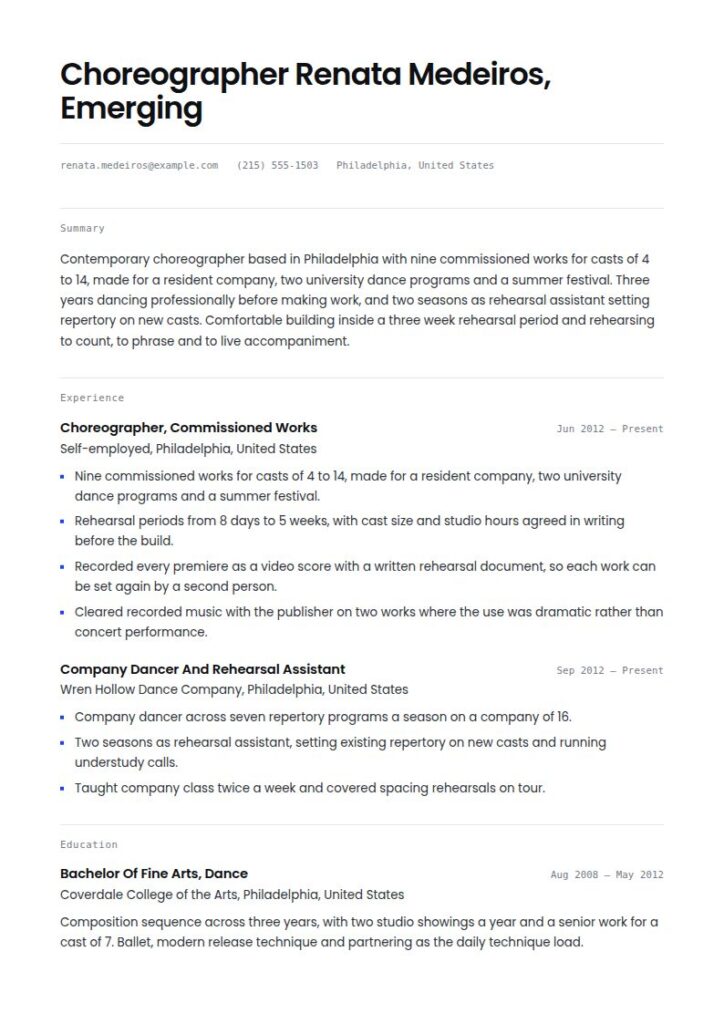
Contemporary choreographer based in Philadelphia with nine commissioned works for casts of 4 to 14, made for a resident company, two university dance programs and a summer festival. Three years dancing professionally before making work, and two seasons as rehearsal assistant setting repertory on new casts. Comfortable building inside a three week rehearsal period and rehearsing to count, to phrase and to live accompaniment.
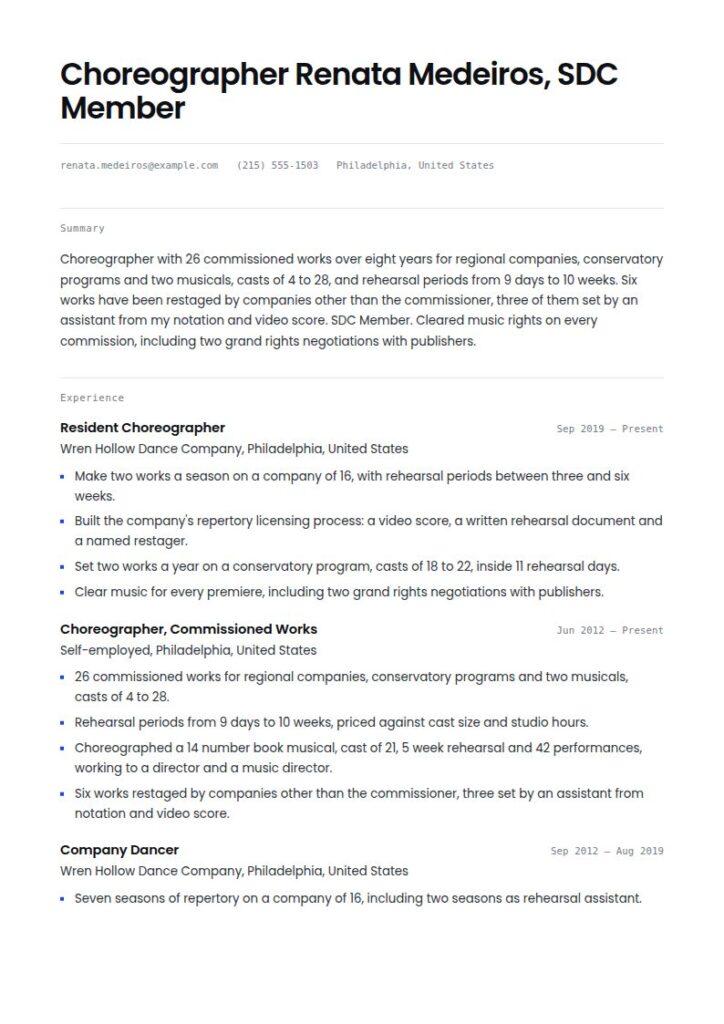
Choreographer with 26 commissioned works over eight years for regional companies, conservatory programs and two musicals, casts of 4 to 28, and rehearsal periods from 9 days to 10 weeks. Six works have been restaged by companies other than the commissioner, three of them set by an assistant from my notation and video score. SDC Member. Cleared music rights on every commission, including two grand rights negotiations with publishers.
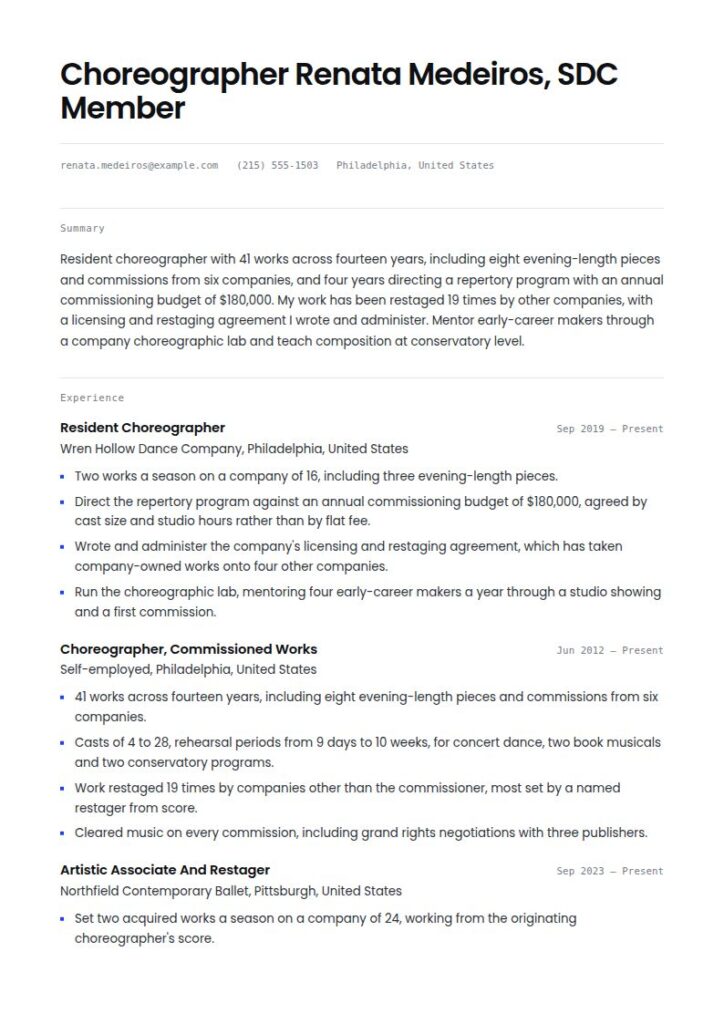
Resident choreographer with 41 works across fourteen years, including eight evening-length pieces and commissions from six companies, and four years directing a repertory program with an annual commissioning budget of $180,000. My work has been restaged 19 times by other companies, with a licensing and restaging agreement I wrote and administer. Mentor early-career makers through a company choreographic lab and teach composition at conservatory level.
Right vs wrong: the same choreographer summary, twice
| ✅ Right | ❌ Wrong |
|---|---|
| 26 commissioned works over eight years for regional companies, conservatory programs and two musicals. | Extensive choreographic experience across many styles and settings. |
| Casts of 4 to 28, rehearsal periods from 9 days to 10 weeks. | Skilled at creating original movement for groups of all sizes. |
| Six works restaged by companies other than the commissioner. | My choreography has been well received by audiences and critics. |
| Cleared music rights on every commission, including two grand rights negotiations. | Collaborative, detail-oriented and deadline-driven. |
Every line on the right, for instance, names a work, a payer or a number. Nothing on the left, on the other hand, survives the question "for whom, and how many dancers?"
Outline your experience
However, two kinds of entry belong on this page, and they are not the same thing. First, a commission is a work you made. A position, in contrast, is a job you held. Separate them, because collapsing the two is what makes a choreographer resume read as a dancer resume.
| Instead of | Use |
|---|---|
| Choreographed numerous original works | 26 commissioned works, casts of 4 to 28, for six regional companies and two conservatory programs |
| Created movement for a modern dance company | Wren Hollow Dance Company, four commissions 2021 to 2025, casts of 9 to 16, three to six week builds |
| Worked with student dancers | Set a 22 dancer work on a pre-professional class in 11 rehearsal days, remounted the following season |
| Choreographed a musical | Choreographed a 14 number book musical, cast of 21, 5 week rehearsal, 42 performances |
| My work has been performed widely | Six works restaged by companies other than the commissioner, three set by an assistant from score |
Resident Choreographer, Wren Hollow Dance Company, Philadelphia, PA, September 2019 to Present
Make two works a season on a company of 16, with rehearsal periods between three and six weeks and a commissioning budget agreed against cast size and studio hours.
Built a repertory licensing process for company-owned works: a video score, a written rehearsal document and a named restager, which has taken six works onto four other companies.
Run the company's choreographic lab, mentoring four early-career makers a year through a studio showing and a first commission.
Clear music for every premiere, working with publishers where the use is dramatic rather than concert performance.
Rehearse understudies and new casts, and set two works on a conservatory program each spring.
The commission record: who engaged the work, at what scale, and where it went next
In fact, this is the block that carries a choreographer resume, and it is the one most people compress into a list of titles. Five facts per work, always in the same order, so the reader can scan down a column.
SELECTED CHOREOGRAPHY
The Long Field, 2025. Commissioned by Northfield Contemporary Ballet. Cast of 18, 11 rehearsal days. Premiered on a main stage season, 6 performances. Restaged 2026 by two university programs from video score.
Weatherglass, 2024. Commissioned by Wren Hollow Dance Company. Cast of 9, 5 week build. Original score by a commissioned composer, rights assigned by written agreement. 14 performances.
Marigold Row, 2024. Choreographer, book musical, Fielder Street Arts Center. Cast of 21, 14 numbers, 5 week rehearsal, 42 performances. Worked to a director and a music director.
Second Person, 2023. Commissioned by a conservatory dance program. Cast of 22 pre-professional dancers, 11 rehearsal days, remounted the following season.
Small Hours, 2022. Self-produced, cast of 4, 8 week build. Toured to three presenters over two seasons.
Specifically, the five facts are title and year, who engaged it, cast size, rehearsal period, and what happened after the premiere. The fifth is the one most resumes miss and the one an artistic director reads hardest, because a work that another company has danced again is a work that survives contact with a different set of bodies.
In addition, restaging is its own skill and deserves its own short block. A piece can only be set again if someone recorded it in a form another person can read. Indeed, dance notation systems exist for exactly this: the Dance Notation Bureau, founded in 1940, maintains a collection of original dance scores and runs a staging from score program alongside its notator training (Dance Notation Bureau, accessed 17 September 2026). Most working choreographers use a video score plus a written rehearsal document rather than full Labanotation, and either is worth naming on the page.
Copyright and music rights for choreographers
The rights work behind a revival also belongs here, in one line, because producers know how much of it there is. Choreographic works are copyrightable in their own right, but the US Copyright Office is specific about the limits: a choreographic work is a related series of dance movements and patterns organized into a coherent whole, and it must be fixed in a tangible medium in enough detail to be performed in a consistent and uniform manner, with notation or video both acceptable. However, social dances, simple routines, commonplace movements and exercise routines are not registrable (US Copyright Office, Circular 52, revised October 2022).
Music is the other half, and it trips up more choreographers than copyright does. Also, a blanket performance license does not cover you. ASCAP states plainly that its license does not authorize dramatic performances of its members' works, and that dramatic or grand rights, which include ballets and any use where music accompanies dance, stage action or visual representation, are licensed by the composer, the publisher or another agent for the work (ASCAP, licensing terms defined, accessed 17 September 2026). If you have cleared a grand rights use, write it down. In short, it is a professional competence, yet very few resumes show it.
Build a snapshot of your key skills
In practice, list twelve to sixteen entries in four groups: forms, making, rehearsal craft, and the production side.
Forms: Contemporary, classical ballet vocabulary, modern release technique, partnering and contact, musical theater jazz, tap fundamentals, social and vernacular forms with credited sources
Making: Composition and structure, phrase generation with dancers, evening-length construction, working to a commissioned score, setting to existing recorded music, restaging from video and written score
Rehearsal craft: Counting and phrasing, spacing for proscenium and thrust, understudy and swing rehearsal, working with a rehearsal director, injury-aware load management across a build
Production: Music rights and grand rights clearance, working with lighting and costume designers, stage management communication, budget against cast size and studio hours, touring and remount documentation
Also credit sources for vernacular and social forms by name. After all, writing "hip hop" without naming who taught you the vocabulary reads badly to anyone who works in those forms.
List your education and certifications
Training is the credential here, and BLS is explicit that the typical route is a high school diploma plus experience as a dancer, with long-term on-the-job training (BLS Occupational Outlook Handbook, dancers and choreographers, page last modified 27 August 2026). A degree helps for faculty posts and not much else, so list training first and let the degree sit under it.
Training: Ballet, six years, named studio and teacher. Modern release technique, four years, named teacher. Composition, two years of studio-based study with a named choreographer. Contact improvisation and partnering, ongoing.
Bachelor of Fine Arts, Dance, 2014
Professional: Stage Directors and Choreographers Society, Member since 2018. Dance notation for restaging, short course, 2023. CPR and first aid, American Red Cross, renewed 2026.
Residencies and awards: two commissioning residencies, one choreographic fellowship, dates and awarding bodies named.
Choose the right layout and design
Above all, use a single column, 11 point, two pages, clear block headings, and no photograph. Set the commission record with tab stops so titles and years line up down the page, rather than as a five column table, which collapses in applicant systems.
Give cast size and rehearsal period on every commission. Name who engaged the work, even if the engager is yourself. Say what happened after the premiere. Keep a full choreographic CV as the master file and cut a two page resume from it. State your union status plainly. Say how your work is recorded for restaging. Put music rights work on the page if you have done it.
Do not list a piece you assisted on as one you made. Do not write "various works" or "multiple companies" where the named list is the evidence. Do not send the eight page CV to a producer who asked for a resume. Do not claim a restaging that was really a remount you rehearsed yourself. Do not name a real production or company you have not actually worked with. Do not describe the work poetically; the reader wants scale, calendar and outcome.
Choreographer job market and outlook
Overall, it is a very small occupation, growing slowly, and self-employed people hold most of the work.
| Measure | Value |
|---|---|
| Choreographer jobs, 2025 | 4,700 |
| Projected choreographer jobs, 2035 | 4,900 |
| Projected change, 2025-35 | 2% (slower than average), +100 |
| Projected annual openings, dancers and choreographers combined | ~2,200 |
| Typical entry-level education | High school diploma, plus experience as a dancer |
| Typical on-the-job training | Long term |
| Median hourly wage, May 2025 | $26.59 |
Source: U.S. Bureau of Labor Statistics, Occupational Outlook Handbook, dancers and choreographers, 2025 to 2035 projections and May 2025 wage data, page last modified 27 August 2026.
Two fifths of choreographers work for themselves
Self-employed workers account for 40 percent of choreographers, educational services for 29 percent, performing arts companies for 23 percent, promoters of performing arts and similar events for 3 percent, and local government excluding education and hospitals for 1 percent (BLS Occupational Outlook Handbook, dancers and choreographers, May 2025).
The pay follows the setting rather than the artistry. Choreographers in performing arts companies had a median of $30.74 an hour in May 2025 against $23.37 an hour in educational services, and part-time work is common across the occupation (same source).
Two things follow for the resume. The largest single category is self-employment, so the document has to sell a commission as much as a post, which is why the commission record replaces an employment history. And because educational services is the second largest employer of choreographers, a page that shows you can set work on students, inside a school calendar, at student skill levels, is addressing nearly a third of the market rather than a side line.
Next, here is where the work sits, and what it pays hourly:
| Setting | Share of choreographer employment | Median hourly wage (May 2025) |
|---|---|---|
| Self-employed workers | 40% | Not published |
| Educational services, state, local and private | 29% | $23.37 |
| Performing arts companies | 23% | $30.74 |
| Promoters of performing arts, sports and similar events | 3% | Not published |
| Local government, excluding education and hospitals | 1% | Not published |
Source: U.S. Bureau of Labor Statistics, Occupational Outlook Handbook, dancers and choreographers, May 2025.
What salary you can expect as a choreographer
Specifically, choreographers had a median hourly wage of $26.59 in May 2025, with the lowest 10 percent under $16.39 an hour and the highest 10 percent above $66.65 an hour (BLS Occupational Outlook Handbook, May 2025 wage data published 27 August 2026). BLS publishes the figure hourly because the work is intermittent, and multiplying it into an annual salary produces a number nobody earns.
For comparison, dancers in the same profile had a median of $24.80 an hour, with the lowest 10 percent under $14.88 and the highest above $52.30 (same source). In other words, the step from dancing to choreographing is a small one in published median terms and a large one in ceiling: the top decile for choreographers sits well above the top decile for dancers, which is the shape of an authorship premium.
Even so, what moves you inside that spread is scale, setting and repeat business. For example, producers pay differently for a commission for a cast of 20 on a main stage than for a studio showing, and a work that gets restaged earns again without a new build. That is why the licensing and documentation line is not administrative detail; it is the part of the career that compounds.
Key takeaways for a choreographer resume
- First, lead with the works you authored instead of an employment history.
- Then give five facts per commission: title and year, who engaged it, cast size, rehearsal period, and what happened next.
- Say where companies have restaged a work and who set it, because that is the proof it survives you.
- Similarly, keep a full choreographic CV and cut a two page resume from it for each application.
- Finally, name your training and your teachers, because artistic directors read lineage.
- Put music rights and grand rights clearance on the page if you have done it.
- State your union status plainly and keep the city and travel line instead of a street address.
Build your choreographer resume in 15 minutes with our AI resume builder.
Related creative and artistic resume examples
- Dance teacher resume
- Musical theater resume
- Actor resume
- Stage manager resume
- Costume designer resume
- Musician resume
- Film producer resume
- Videographer resume
- Cinematographer resume
- Screenwriter resume
- Visual artist resume
- Theater resume
Pair it with a matching choreographer cover letter.
Choreographer resume questions, answered
How long should a choreographer resume be?
Two pages for a working choreographer, one for an emerging artist with fewer than ten works. The separate choreographic CV, used for grants, residencies and university faculty posts, runs longer and lists everything. Decide which document the reader asked for before you attach anything.
What is the difference between a choreographic CV and a choreographer resume?
The CV is complete and the resume is selected. A CV lists every work with premiere date, venue, funder and press, because a funding panel is assessing a body of work. A resume picks the works that match the job in front of you and fits on two pages.
Do I list works I assisted on?
Yes, labeled honestly as assistant, associate or rehearsal assistant, in a separate block. Presenting an assisted piece as your own is the fastest way to lose a reference in a field this small.
Should I mention music rights on a choreographer resume?
If you have cleared them, yes, in one line. ASCAP states that its license does not authorize dramatic performances, and that grand rights covering ballet and other staged uses of music are licensed by the composer, publisher or their agent (ASCAP, licensing terms defined, accessed 17 September 2026). A choreographer who has run that process is a lower risk hire and producers know it.
Can I copyright my choreography, and does that belong on the resume?
You can, within limits, and a registration is worth a short line. The US Copyright Office registers a choreographic work as a related series of dance movements organized into a coherent whole, fixed in enough detail to be performed consistently, with notation or video accepted as fixation; social dances, simple routines and exercise routines are excluded (US Copyright Office, Circular 52, revised October 2022). What belongs on the page is how your work is recorded, since that is what makes a restaging possible.