Renata Medeiros Choreographer, SDC Member Philadelphia, 19107, United States [email protected] · (215) 555-1503
17 September 2026
Ms. Harriet Abbott Artistic Office Northfield Contemporary Ballet Pittsburgh, United States
Commission proposal, 2027 mainstage season, Renata Medeiros
Dear Ms. Abbott,
I am writing about the guest commission on your 2027 mainstage season. I make contemporary work for casts of 8 to 22 and build inside three to six weeks, or inside 11 rehearsal days when a school or a touring calendar requires it, and I would like to be considered for the second slot.
Two pieces show the range. The Long Field was commissioned by Northfield Contemporary Ballet in 2025 for a cast of 18 and made in 11 rehearsal days; it has since been restaged by two university programs from my video score without me in the room. Weatherglass was made for Wren Hollow Dance Company in 2024 for a cast of 9 over a five week build, with an original commissioned score and the rights assigned in writing before the first rehearsal. I clear music on every commission, including grand rights where the use is dramatic.
For your company I would want to make a group work for 12 to 16 on the ensemble rather than on soloists, because your repertory reads as strongest when the whole company is moving and because that is the scale my recent work has been built at. I would ask for four weeks and a designer conversation in week one. If the calendar cannot hold four weeks, I can build the same material for 10 in three.
I am an SDC Member, so the engagement would run on an SDC agreement, and I am available from September 2027. A reel, three full work videos and a one page commission record are attached, and I am glad to send references from two commissioning companies. Thank you for your time.
Sincerely, Renata Medeiros
Summary
A choreographer cover letter is a one page commission proposal. It names the post or the season you are writing about, the scale you work at, two authored works with cast size and rehearsal period, and what you would want to make in their room. This guide gives you a full adaptable letter, the openings that work, and how the letter changes for a company, a school and a musical.
Choreographer cover letter examples by experience level
A choreographer cover letter is a one page letter that tells an artistic director what you would make, for how many dancers, in how long, and what you have already made at that scale.
It is closer to a commission proposal than to a job application, because that is usually what it is. Two fifths of choreographers work for themselves (BLS Occupational Outlook Handbook, dancers and choreographers, page last modified 27 August 2026), so most of these letters ask someone to fund a build rather than to fill a post.
Guide to a choreographer cover letter
In short, this guide and the corresponding choreographer cover letter example will cover:
- First, how to structure the letter, paragraph by paragraph
- Then, why cast size and rehearsal period belong in the first paragraph
- Also, two authored works as evidence, and how to write them in one sentence each
- In addition, how the letter changes for a company, a school and a musical
- Finally, the openings that make a reader finish a proposal
How to write a choreographer cover letter
| Paragraph | Its job | Length |
|---|---|---|
| Opening | The post or season, the scale you work at, and the ask | 2 to 3 sentences |
| Evidence | Two authored works with commissioner, cast size, rehearsal period and what happened next | 4 to 5 sentences |
| Proposal | What you would make in their room, and why it fits their company or students | 3 to 4 sentences |
| Close | Union status, availability, materials attached, thank you | 2 sentences |
Put the calendar in the first paragraph, not the artistry
An artistic director reading commission proposals is holding a season calendar and a budget, and the first question they have is whether you fit inside both.
Write it plainly: "I make work for casts of 8 to 22 and build inside three to six weeks, or inside 11 rehearsal days when the calendar is tight." That sentence answers the operational question before the artistic one, which is the order the reader has them in.
The artistic pitch then lands on a reader who has already decided you are feasible. A letter that opens with what the piece is about reaches the calendar question two paragraphs later, and by then the reader has moved on.
A choreographer cover letter example you can adapt
Dear Ms. Abbott,
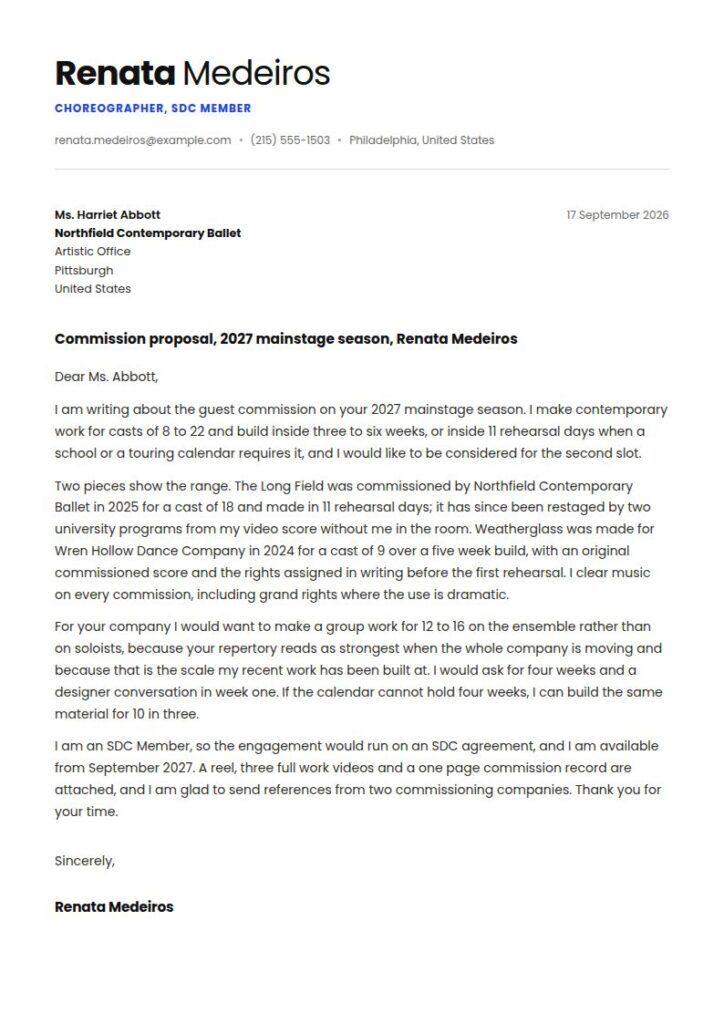
I am writing about the guest commission on your 2027 mainstage season. I make contemporary work for casts of 8 to 22 and build inside three to six weeks, or inside 11 rehearsal days when a school or a touring calendar requires it, and I would like to be considered for the second slot.
Two pieces show the range. The Long Field was commissioned by Northfield Contemporary Ballet in 2025 for a cast of 18 and made in 11 rehearsal days; it has since been restaged by two university programs from my video score without me in the room. Weatherglass was made for Wren Hollow Dance Company in 2024 for a cast of 9 over a five week build, with an original commissioned score and the rights assigned in writing before the first rehearsal. I clear music on every commission, including grand rights where the use is dramatic.
For your company I would want to make a group work for 12 to 16 on the ensemble rather than on soloists, because your repertory reads as strongest when the whole company is moving and because that is the scale my recent work has been built at. I would ask for four weeks and a designer conversation in week one. If the calendar cannot hold four weeks, I can build the same material for 10 in three.
I am an SDC Member, so the engagement would run on an SDC agreement, and I am available from September 2027. A reel, three full work videos and a one page commission record are attached, and I am glad to send references from two commissioning companies. Thank you for your time.
Sincerely, Renata Medeiros
Openings that work
| Instead of | Use |
|---|---|
| I am passionate about creating original movement | I make contemporary work for casts of 8 to 22 and build inside three to six weeks |
| I am writing to express my interest in working with your company | I am writing about the guest commission on your 2027 mainstage season |
| My choreography has been performed at many venues | The Long Field was made for a cast of 18 in 11 rehearsal days and has been restaged twice since |
| I would love the opportunity to collaborate | I would want to make a group work for 12 to 16 on the ensemble rather than on soloists |
Writing an authored work in one sentence
In practice, the letter has room for two works and no more. Each one, therefore, needs four facts and a verb that says you made it.
| Fact | Why the reader needs it |
|---|---|
| Who commissioned it, and when | It separates a commission from a self-produced showing |
| Cast size | It tells them whether you work at their scale |
| Rehearsal period | It tells them whether you fit their calendar |
| What happened after the premiere | A restaging is the proof the work survives a different cast |
A self-produced work also belongs in the letter, as long as you say so. "Self-produced, cast of 4, eight week build, toured to three presenters over two seasons" is honest and it reads as entrepreneurial rather than thin.
How the letter changes by setting
For a company, lead with scale and calendar and pitch to the ensemble you have actually watched. For a school or conservatory, lead with what you can teach a student cast to do inside eleven days and say how you manage load across a build. For a musical, lead with numbers staged, cast size, the director and music director you worked to, and the fact that you take direction inside someone else's production. For a studio or competition setting, lead with age ranges and the number of routines you can set in a season.
Do not open with the theme of the piece; the calendar question comes first. Do not send the same letter to a company and a conservatory, because the risk each one is managing is different. Do not promise a cast size you have never worked with. Do not describe a real production or name a company you have not worked with. Do not attach an eight page choreographic CV when a two page resume was asked for.
Nearly a third of choreographer employment is in education
Educational services account for 29 percent of choreographer employment, second only to self-employment at 40 percent, with performing arts companies at 23 percent (BLS Occupational Outlook Handbook, dancers and choreographers, May 2025, page last modified 27 August 2026).
The pay differs by setting: choreographers in performing arts companies had a median of $30.74 an hour in May 2025 against $23.37 an hour in educational services (same source). Overall the occupation is projected to grow 2 percent between 2025 and 2035, from 4,700 jobs to 4,900, with about 2,200 openings a year projected for dancers and choreographers combined.
What that means for the letter is that a school or conservatory is not the consolation prize; it is nearly a third of the market. A letter that shows you can set a substantial group work on student dancers inside a compressed calendar, and manage rehearsal load so nobody is injured in week two, is addressing the second largest employer of choreographers directly.
Length, format and sending it
One page, four paragraphs, 300 to 400 words, PDF, named for yourself and the engagement: renata-medeiros-2027-commission-proposal.pdf.
Attach what the call asked for and nothing more. Usually that is a reel of three to five minutes, one or two full works with a password, and a one or two page resume. If the company requested a full choreographic CV, send that instead of the resume rather than both.
Address a person by name. Company sites list artistic directors and producers, and a letter addressed to the company rather than a human reads as a mass send.
Use the same works, cast sizes and dates as your resume, so the two agree. Our choreographer resume example is written with the same commission record used here.
Key takeaways
- Above all, treat the letter as a commission proposal, not a job application.
- First, put cast size and rehearsal period in the first paragraph.
- Then give two authored works, each with commissioner, scale, calendar and what happened next.
- Propose something specific for their room, and name the fallback if the calendar shrinks.
- Also, change the letter by setting: a company, a school and a musical are managing different risks.
- State your union status, because it tells the producer which agreement the engagement runs on.
- Finally, address a named person and keep it to one page.
Write your choreographer cover letter in 10 minutes with our AI cover letter builder.
Choreographer cover letter questions, answered
How long should a choreographer cover letter be?
One page, four paragraphs, 300 to 400 words. Artistic directors read commission proposals in batches while planning a season, and a second page does not read as seriousness.
Should I pitch a specific piece in the letter?
Yes, but as a shape rather than a finished concept: the number of dancers, whether it is on the ensemble or on soloists, roughly how long, and why it suits their company. A fully worked concept commits you before the conversation and is easy to say no to.
Do I include a fee in the cover letter?
Not a number, but do include the two variables a fee is built from: cast size and rehearsal period. That invites a conversation about scope rather than a negotiation about price, and it is the reason the first paragraph carries both.
What do I write with only self-produced work?
Write it as self-produced and say so plainly, with cast size, build length and where it was seen. Self-employment is the largest single category in this occupation, at 40 percent of choreographers (BLS Occupational Outlook Handbook, May 2025), so a reader is not surprised by it. What they are looking for is evidence that you finished something and put it in front of an audience.
Should I mention union status?
Yes, in one line at the close. The Stage Directors and Choreographers Society charges a $2,400 initiation fee with $240 in annual basic dues for a Member and $375 with $90 for an Associate, and Members file a contract every time they work (SDC, prospective member FAQs, accessed 17 September 2026). A producer needs to know which agreement applies before they can cost the engagement.