Belen Sifuentes Artist and teaching artist, painting and murals Tucson, 85705, United States [email protected] · (520) 555-1417
17 September 2026
Ms. Delphina Ruiz Education Director Copper Line Arts Tucson, United States
Application for Teaching Artist, Copper Line Arts
Dear Ms. Ruiz,
I am applying for the Teaching Artist post with the Copper Line Arts after-school program. I am a muralist and painter who has taught 180 contact hours a year for the last four years, and I hold a current fingerprint clearance, so I can start on the published date rather than waiting on paperwork.
The class I would point to is an 8 week after-school painting workshop for groups of 18, ages 9 to 14, across two school sites. I wrote the lesson sequence, budgeted materials at $9 per student and finished the term with a wall piece the school kept, which turned out to matter more for attendance than anything I did in week one. Attendance held at 16 of 18 through the final session, which in an optional after-school program is the number I am proudest of.
Alongside teaching I take mural commissions, 14 of them so far with budgets from $2,800 to $36,000, including a city-funded project I ran with a 22 person volunteer crew. That is the part of my background I would want to bring to your program: supervising a group of beginners on a real wall, with a schedule and a budget and a result everyone can see afterward.
I carry commercial general liability insurance, hold an OSHA 10-hour card and lift training, and can supply a W-9 and certificates on request. I am available from the start of the fall term. Thank you for your time.
Sincerely, Belen Sifuentes
Summary
An artist cover letter has to choose. Most working artists have commissions, teaching, an arts job and often a day job running at once, and the letter that works picks one of them as the application and turns the others into evidence. This guide gives you a full adaptable letter, the openings that work, and what to send when the call asks for a packet instead.
Artist cover letter examples by experience level
An artist cover letter is a one page letter that picks one thing you do and makes the rest of your working life the evidence for it.
That is harder than it sounds, because the honest answer to "what do you do" is usually four things. You paint, you teach two afternoons a week, you take commissions, and you have a job somewhere that pays on the fifteenth. A letter that lists all four reads as unfocused. A letter that hides three of them throws away most of your evidence. The way through is to choose the target first and let everything else become support.
Guide to an artist cover letter
This guide and the corresponding artist cover letter example will cover:
- How to structure the letter, paragraph by paragraph
- How to pick the target before you write the first sentence
- What to do with the income streams you are not applying with
- When the call wants a packet rather than a letter and resume
- The openings that make a mixed working life read as range
How to write an artist cover letter
| Paragraph | Its job | Length |
|---|---|---|
| Opening | The post, which kind of artist you are for it, and one matching fact | 2 to 3 sentences |
| Evidence | One project with a scale, a date, a number of people and an outcome | 4 to 5 sentences |
| Fit | Something specific about their program, and a second thing you can carry | 3 to 4 sentences |
| Close | Clearances, insurance, availability, thank you | 2 sentences |
Pick the target before the first sentence, not after the third draft
Read the posting and decide which of your streams is applying. A school program is hiring contact hours, group management and a background check. A commissioning body is hiring square footage, substrates, permits and a maintenance plan. An arts nonprofit is hiring budgets, contracts and the ability to run an evening with two staff. A shop or facilities job is hiring reliability and tools.
Then write the other streams as support, one clause each. Teaching supports a commission letter because it proves you can work with a community on site. Commissions support a teaching letter because they prove you are a practicing artist rather than a lapsed one. A framing job supports both, because it is three years of handling other people's work without damaging it.
What you must not do is give them equal weight. A letter with four topics has no topic.
An artist cover letter example you can adapt
Dear Ms. Ruiz,
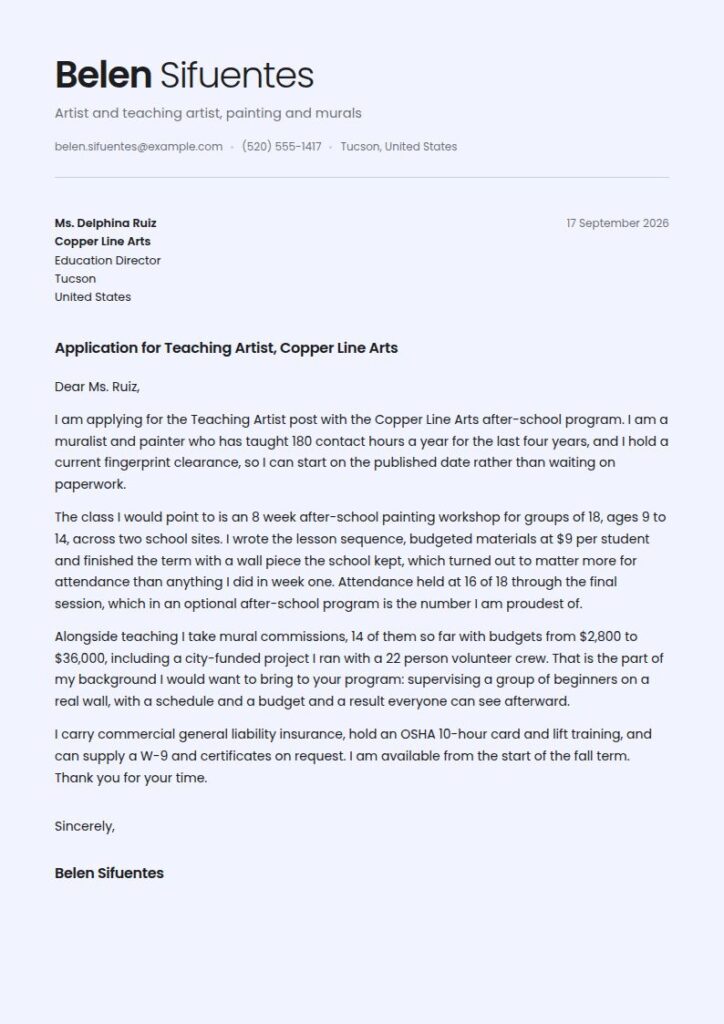
I am applying for the Teaching Artist post with the Copper Line Arts after-school program. I am a muralist and painter who has taught 180 contact hours a year for the last four years, and I hold a current fingerprint clearance, so I can start on the published date rather than waiting on paperwork.
The class I would point to is an 8 week after-school painting workshop for groups of 18, ages 9 to 14, across two school sites. I wrote the lesson sequence, budgeted materials at $9 per student and finished the term with a wall piece the school kept, which turned out to matter more for attendance than anything I did in week one. Attendance held at 16 of 18 through the final session, which in an optional after-school program is the number I am proudest of.
Alongside teaching I take mural commissions, 14 of them so far with budgets from $2,800 to $36,000, including a city-funded project I ran with a 22 person volunteer crew. That is the part of my background I would want to bring to your program: supervising a group of beginners on a real wall, with a schedule and a budget and a result everyone can see afterward.
I carry commercial general liability insurance, hold an OSHA 10-hour card and lift training, and can supply a W-9 and certificates on request. I am available from the start of the fall term. Thank you for your time.
Sincerely, Belen Sifuentes
Openings that work
| Instead of | Use |
|---|---|
| I am a multi-talented creative with experience in many areas | I am a muralist and painter who has taught 180 contact hours a year for four years |
| Art has been my passion since I was a child | I hold a current fingerprint clearance, so I can start on the published date |
| I am seeking any opportunity to work in the arts | I am applying for the Teaching Artist post with your after-school program |
| I have worked on a variety of projects with many different groups | 14 mural commissions, $2,800 to $36,000, one run with a 22 person volunteer crew |
The right column always contains something the reader can check or schedule. That is the entire difference.
What to do with the streams you are not applying with
The temptation is to delete them. Do not, because they are usually where your strongest evidence lives. Demote them instead.
| Stream | How it supports a teaching application | How it supports a commission application |
|---|---|---|
| Commissions | Proof you are a practicing artist, and site experience with groups | The main event |
| Teaching | The main event | Proof you can work with a community and explain the work on site |
| Arts job | Budgets, scheduling and program experience | Contracts, procurement and institutional literacy |
| Day job outside the arts | Reliability, handling, customer work | Tools, schedules and turnaround discipline |
One clause each. "Alongside teaching I take mural commissions, 14 of them so far" is a whole stream compressed into eleven words, and it earns more than a paragraph would.
Name the post and which kind of artist you are for it in the first two sentences. Give one project with a number of people, a scale and a date. Put clearances, insurance and safety cards in the closing line where a coordinator will look for them. Name one specific thing about their program from their own materials. Compress every other income stream into a single clause.
Do not open with your relationship to art. Do not give four streams equal weight. Do not send a letter where the call asked for a qualifications packet and an annotated image list. Do not leave out a day job and then have it appear on the reference check. Do not attach images unless the call asks, and then follow its file specification exactly.
When the call wants a packet, not a letter
Public art and larger commissions are usually procured through a request for qualifications, and the documents they name are specific: a letter of interest, an annotated image list with dimensions, materials, date, budget and location, references from previous commissioning bodies, and sometimes a CV. A cover letter and resume sent into that process answer a question nobody asked, and panels score against the published list.
Grants work the same way. Read the call, build what it names, in the order it names it, and keep your cover letter for jobs.
Most artist income is not a salary, which changes what the letter must prove
BLS publishes no Occupational Outlook Handbook profile under the plain title artist. The closest published profile, craft and fine artists, reports a median annual wage of $55,290 in May 2025, with 58 percent of the occupation self-employed, employment projected to decline 1 percent from 2025 to 2035, and about 4,300 openings a year, nearly all replacements (BLS Occupational Outlook Handbook, craft and fine artists, page last modified 27 August 2026).
The adjacent occupations are paid very differently: $46,080 for craft artists, $55,490 for fine artists including painters, sculptors and illustrators, $62,960 for graphic designers and $102,030 for special effects artists and animators, all May 2025 medians (BLS Occupational Outlook Handbook, pages last modified 27 August 2026).
So the letter is rarely competing for a salaried post against other salaried candidates. Usually it is persuading a coordinator or a commissioning body to engage you as a supplier, which means the questions it must answer are practical: can you be cleared, insured, scheduled and paid. Answer those four in the closing line and you are ahead of most of the folder.
Length, format and sending it
One page, four paragraphs, 250 to 400 words. PDF unless the portal says otherwise, named for yourself and the post: belen-sifuentes-teaching-artist-cover-letter.pdf. Keep a separate file for commission applications rather than sending one letter to both.
Address a person. Program coordinators, education directors and public art managers are named on almost every organization's site, and a named salutation costs you one search.
Keep the numbers identical to your resume. Our artist resume example uses the same figures as the letter above.
Key takeaways
- Choose the target income stream before writing the first sentence.
- Say which kind of artist you are for this post in the opening two sentences.
- Give one project with people, scale, date and outcome.
- Compress every other stream into a single clause, and delete none of them.
- Put clearances, insurance and safety cards in the closing line.
- If the call names a packet, build the packet instead.
- Keep a separate letter file per target rather than one universal letter.
Write your artist cover letter in 10 minutes with our AI cover letter builder.
Artist cover letter questions, answered
How long should an artist cover letter be?
One page, four paragraphs, 250 to 400 words. Coordinators in small arts organizations read every letter and have twenty of them, so the letter that is easy to finish is the one that gets remembered.
Should I include images with the letter?
Only if the call asks, and then exactly as specified: file type, pixel dimensions, count and naming. Otherwise put one plain site address in the first paragraph. Unrequested attachments get stripped by mail systems and annoy the people they reach.
Do I mention that I have a job outside the arts?
Yes, in one clause, without apology. It is normal, it explains your availability honestly, and it usually carries transferable evidence. Leaving it out and having it surface in a reference check is far worse than naming it in eight words.
What do I write if I have never had an arts job?
Write the work you have done, because most of it counts. A commissioned sign, a workshop you assisted, a set painted for a community production, a market stall with its own accounts. Give the scale, the number of people, the budget and the date. First teaching and assistant posts are hired on exactly that kind of evidence.
Is a cover letter worth it for commission work?
For a job posting, yes. For a commission, read the call: public art procurement usually wants a letter of interest and an annotated image list rather than a cover letter, and panels score against the published list. The underlying skill is the same, which is deciding what the reader is actually buying and answering that.