Eleni Petrakis Director of Production Cincinnati, 45202, United States [email protected] · (502) 555-1601
11 September 2026
Ms. Callie Renwick General Manager Kestrel Bay Theater Company Seattle, United States
Application for Director of Production, Kestrel Bay Theater Company
Dear Ms. Renwick,
I am applying for the Director of Production post at Kestrel Bay Theater Company. I currently run a 24-person year-round production department across a 499-seat mainstage and a 140-seat studio, on a nine-production season and a $3.1 million production budget, and I could start with your spring planning cycle rather than mid-season.
The work I would most want to bring is the calendar. When I arrived at Harrow Street, technical weeks were being compressed whenever a build ran late, and the cost was showing up as overtime calls at the end of every process. I rebuilt the production calendar so that a full technical week is fixed before anything else is scheduled against it, and moved the shop deadlines back to protect it. Added overtime calls per production fell from 11 to 3 across two seasons, and the season announcement moved four weeks earlier because production, company management and marketing were finally working from one document.
I have read your last three season announcements and noticed that your studio series has grown from two productions to four while the mainstage count has stayed the same. That is the pattern that breaks a production calendar first, and it is the problem I would want to work on. I also administer agreements with three unions and chair a joint safety committee, both of which appear in your posting.
My first aid, CPR and AED certification is current through 2028, and I hold a fall protection and rigging awareness certificate renewed last year. I can give six weeks' notice. Thank you for your time.
Sincerely, Eleni Petrakis, M.F.A.
Summary
A theater cover letter names the kind of company you have worked for, the contract the work ran under, one number that shows the scale you carried, and the date you are available. This guide gives you a full adaptable letter, what changes between a resident house and a summer company, and the openings that get a strong file read to the end.
Theater cover letter examples by experience level
A theater cover letter is a one-page letter that tells a hiring manager three things before anything else: the scale of company you have worked at, the agreement that work ran under, and the date you can start.
Everything else in the letter is negotiable. Those three are not, because theater hiring runs on a calendar and a budget line, and the person reading is trying to work out whether you fit both. A letter that spends its first paragraph on how much you love live performance has spent it on the one thing the reader already assumes.
Guide to a theater cover letter
This guide and the corresponding theater cover letter example will cover:
- How to structure the letter, paragraph by paragraph
- Why company type, contract and availability belong in the first two sentences
- What counts as evidence when your work is not on stage
- How the letter changes between a resident house, a summer company and a touring production
- The openings that get a strong file read to the end
How to write a theater cover letter
| Paragraph | Its job | Length |
|---|---|---|
| Opening | The post, the scale you have worked at, and when you are free | 2 to 3 sentences |
| Evidence | One season, one number, one thing that changed because of you | 4 to 5 sentences |
| Fit | Something specific about their company, and what you would take on | 3 to 4 sentences |
| Close | Certifications, notice period, thank you | 2 sentences |
Put the scale and the date in the first two sentences
A general manager filling a post nine weeks before the first rehearsal is not reading for enthusiasm. They are reading for whether you have done this at their size and whether you can be in the building by a date.
Write it plainly: "I have managed a six-production LORT D season of 34 Equity contracts, and I am free from the first week of June." That sentence answers the two questions in the reader's head and buys you the rest of the page.
Then add the second function you can cover. The not-for-profit sector's staffs are much smaller than they were, and the candidate who can take a second thing off someone's desk is the one who gets shortlisted.
A theater cover letter example you can adapt
Dear Ms. Renwick,
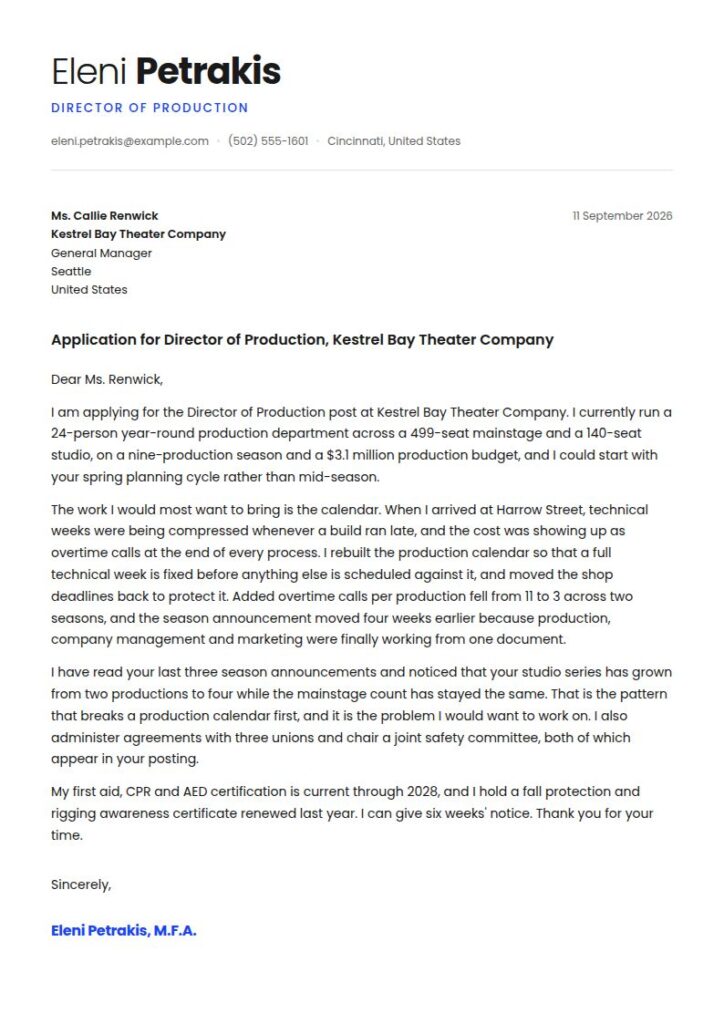
I am applying for the Director of Production post at Kestrel Bay Theater Company. I currently run a 24-person year-round production department across a 499-seat mainstage and a 140-seat studio, on a nine-production season and a $3.1 million production budget, and I could start with your spring planning cycle rather than mid-season.
The work I would most want to bring is the calendar. When I arrived at Harrow Street, technical weeks were being compressed whenever a build ran late, and the cost was showing up as overtime calls at the end of every process. I rebuilt the production calendar so that a full technical week is fixed before anything else is scheduled against it, and moved the shop deadlines back to protect it. Added overtime calls per production fell from 11 to 3 across two seasons, and the season announcement moved four weeks earlier because production, company management and marketing were finally working from one document.
I have read your last three season announcements and noticed that your studio series has grown from two productions to four while the mainstage count has stayed the same. That is the pattern that breaks a production calendar first, and it is the problem I would want to work on. I also administer agreements with three unions and chair a joint safety committee, both of which appear in your posting.
My first aid, CPR and AED certification is current through 2028, and I hold a fall protection and rigging awareness certificate renewed last year. I can give six weeks' notice. Thank you for your time.
Sincerely, Eleni Petrakis, M.F.A.
Openings that work
| Instead of | Use |
|---|---|
| I have always been passionate about the theater | I run a 24-person production department across a 499-seat mainstage and a 140-seat studio |
| I am writing to express my interest in this position | I am applying for the Director of Production post and could start with your spring planning cycle |
| I have extensive experience in theater production | I have managed a six-production LORT D season of 34 Equity contracts and 61 artist engagements |
| I would be a great fit for your organization | Your studio series has grown from two productions to four while the mainstage count has stayed the same |
What counts as evidence in theater
Most theater jobs produce no reviewable artifact, so the letter has to carry one measurement instead.
| Kind of evidence | What it looks like in a sentence |
|---|---|
| Scale | Six-production season, 34 Equity contracts, 61 total artist engagements |
| Calendar | Rebuilt the production calendar so every show holds a full technical week |
| Money | Cut per-contract housing cost 19 percent across an 18-unit portfolio |
| Repeat engagement | Asked back for three consecutive summer seasons across 14 productions |
| Safety | Chair the joint safety committee; no lost-time incident in two seasons |
| People | Trained two company management apprentices a year, both now on staff elsewhere |
Repeat engagement is the one candidates undersell. In a field this small, being asked back is the closest thing to a reference that fits on a page.
Writing to different company types
For a resident or regional house, lead with season size, contract count and budget, and name the LORT category if you know it. For a summer company, lead with availability and housing flexibility, because a ten-week season lives or dies on who can actually be there. For a touring production, lead with road experience, load-in and load-out, and how far ahead you can commit. For a community or academic company, lead with the breadth of what you can cover alone.
Do not send the same letter to a 1,100-seat resident house and a 99-seat independent company; the scale argument reverses. Do not describe unpaid or student work as professional. Do not leave out the date you are available, which is the question the reader will otherwise have to email you to ask. Do not open with a story about the first play you saw.
Half the staff, the same share of the budget
Theatre Communications Group's Theatre Facts 2023, released on 3 March 2025, tracks 137 not-for-profit theaters that reported every year from 2019 to 2023. Average total staff employed fell 47 percent, from 319 in 2019 to 175 in 2023, while payroll still averaged 51 percent of total expenses, and 61 percent of those theaters reported a negative change in unrestricted net assets.
The occupations themselves are flat rather than shrinking. Actors are projected at 0 percent change between 2025 and 2035 with about 6,300 openings a year, and producers and directors at 4 percent with about 12,100 (BLS Occupational Outlook Handbook, pages last modified 27 August 2026).
So the letter is competing inside a field where the jobs got broader rather than fewer. Naming the second function you can cover, with a number attached, is worth more than a paragraph about your commitment to the art form.
Length, format and sending it
One page, four paragraphs, 250 to 400 words. PDF unless the posting says otherwise, named for yourself and the post: eleni-petrakis-director-of-production-cover-letter.pdf.
Address a person. Company leadership is public on almost every theater's website, and a letter addressed to "Dear Hiring Committee" on an otherwise specific file reads as one sent to nine companies.
Use the same numbers as your resume so the two documents agree. Our theater resume examples page is written with the figures used here, and if the posting goes through an applicant system, run both through the free ATS checker first.
Key takeaways
- Name the company type and scale you have worked at in the first two sentences.
- Say which contract or code the work ran under, and label non-union work as such.
- Give the date you are available; it is the question that otherwise costs an email.
- Pick one number with a time frame as your evidence, not three.
- Name one real thing about their season, taken from their own announcements.
- Offer the second function you can cover, because staffs are much smaller than they were.
- Address a named person and keep it to one page.
Write your theater cover letter in 10 minutes with our AI cover letter builder.
Theater cover letter questions, answered
How long should a theater cover letter be?
One page, four paragraphs, 250 to 400 words. Theater hiring managers read these between other jobs, usually in a compressed window around a season announcement, and length does not read as effort.
Do performers need a cover letter?
For casting, no: a submission is a headshot, a resume and a reel or a sung cut. For everything else a performer applies to, including teaching artist work, arts administration, front of house and education programs, yes, and it should be a plain letter that answers the same three questions about scale, agreement and availability.
What do I write if my only theater work was community or academic?
Write it honestly and give it scale. The number of productions, the size of the audience, the crew you led, the budget you were trusted with, and whether you were asked back. Label the work community or academic rather than professional. A candidate who ran a 12-production student season has run more shows than many early professional applicants.
Should I mention the contract I worked under?
Yes, wherever there was one. Equity promulgates over 40 national and local contracts, and its published list names 28 agreements from Production and LORT down to Small Professional Theatre and the Letters of Agreement (Actors' Equity Association, accessed 17 September 2026). Naming yours is the fastest way to describe the week of work you are used to.
When in the year should I send it?
Against the season calendar. Summer companies hire during the winter, resident theaters advertise staff posts around the season announcement and again before the fall, and touring work is booked furthest ahead of anything in the field. A strong letter sent in August for a summer company is a letter sent eight months late.