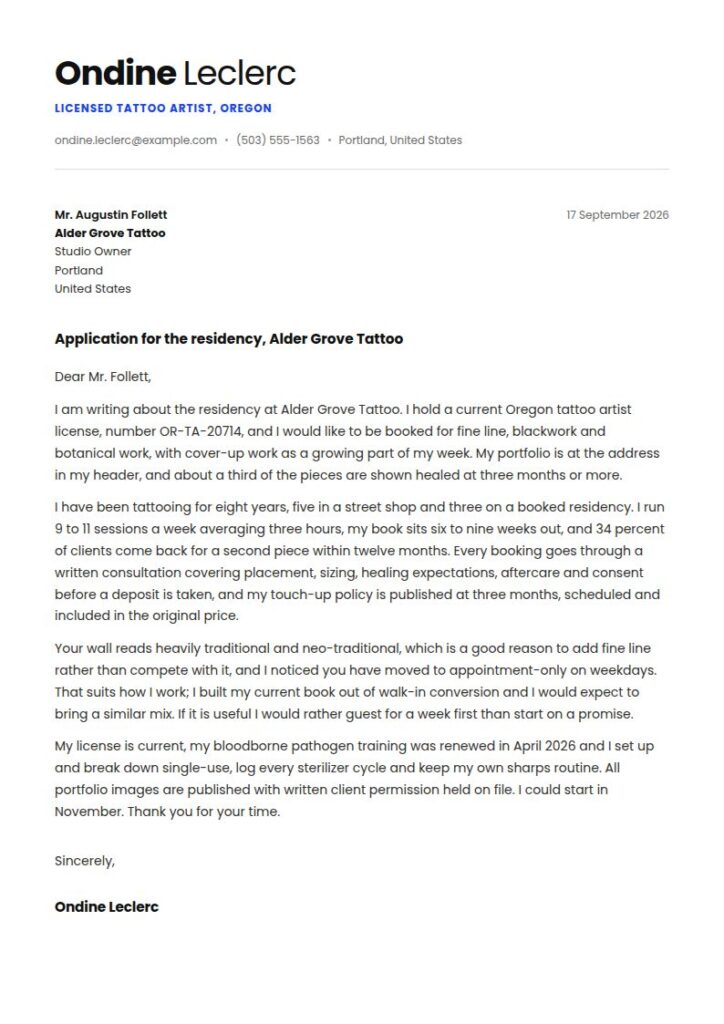
Ondine Leclerc Licensed Tattoo Artist, Oregon Portland, 97214, United States [email protected] · (503) 555-1563
17 September 2026
Mr. Augustin Follett Studio Owner Alder Grove Tattoo Portland, United States
Application for the residency, Alder Grove Tattoo
Dear Mr. Follett,
I am writing about the residency at Alder Grove Tattoo. I hold a current Oregon tattoo artist license, number OR-TA-20714, and I would like to be booked for fine line, blackwork and botanical work, with cover-up work as a growing part of my week. My portfolio is at the address in my header, and about a third of the pieces are shown healed at three months or more.
I have been tattooing for eight years, five in a street shop and three on a booked residency. I run 9 to 11 sessions a week averaging three hours, my book sits six to nine weeks out, and 34 percent of clients come back for a second piece within twelve months. Every booking goes through a written consultation covering placement, sizing, healing expectations, aftercare and consent before a deposit is taken, and my touch-up policy is published at three months, scheduled and included in the original price.
Your wall reads heavily traditional and neo-traditional, which is a good reason to add fine line rather than compete with it, and I noticed you have moved to appointment-only on weekdays. That suits how I work; I built my current book out of walk-in conversion and I would expect to bring a similar mix. If it is useful I would rather guest for a week first than start on a promise.
My license is current, my bloodborne pathogen training was renewed in April 2026 and I set up and break down single-use, log every sterilizer cycle and keep my own sharps routine. All portfolio images are published with written client permission held on file. I could start in November. Thank you for your time.
Sincerely, Ondine Leclerc
Summary
A tattoo artist cover letter names the styles you want to be booked for, points at one portfolio link, and states the license, permit and bloodborne pathogen training that let a studio put you on the floor. This guide gives you a full adaptable letter, the client privacy rule that belongs in it, and the openings that get a file read rather than skimmed.
Tattoo Artist cover letter examples by experience level
In short, a tattoo artist cover letter is a short letter with one job: get the owner to open your portfolio, and make it obvious that a studio could legally put you on the floor next week.
Everything else is secondary. However, a studio owner is not reading for enthusiasm, which every letter in the stack has. They are reading for what clients would book you for, whether your paperwork is current, and whether you will be a problem around the sharps bin.
Guide to a tattoo artist cover letter
That is why this guide and the corresponding tattoo artist cover letter example will cover:
- First, how to structure the letter, paragraph by paragraph
- Then, why the portfolio link belongs in the first two lines
- Also, how to describe your work without ever identifying a client
- Finally, what to say about licensing, permits and bloodborne pathogen training
- The openings that make a reader read a file rather than skim it
How to write a tattoo artist cover letter
| Paragraph | Its job | Length |
|---|---|---|
| Opening | The styles you want booked, the portfolio link, the arrangement you want | 2 to 3 sentences |
| Evidence | Sessions a week, book depth, repeat rate, over a stated period | 4 to 5 sentences |
| Fit | Something real about their studio, and the gap you would fill on the wall | 3 to 4 sentences |
| Close | License, permit and bloodborne pathogen training, availability, thank you | 2 sentences |
Name the styles you want booked, not the ones you can do
Most artists can work in more styles than they want to spend a career in, and a letter that lists all of them reads as an artist with no direction.
A studio owner is filling a gap on a wall. They have three artists doing traditional and nobody doing fine line, or a color artist leaving in October. Name four or five styles, put the one you want to be booked for first, and let the portfolio carry the rest.
"I would like to be booked for fine line and botanical work, with cover-up work as a growing part of my week" is a sentence a manager can act on immediately.
A tattoo artist cover letter example you can adapt
Dear Mr. Follett,
I am writing about the residency at Alder Grove Tattoo. I hold a current Oregon tattoo artist license, number OR-TA-20714, and I would like to be booked for fine line, blackwork and botanical work, with cover-up work as a growing part of my week. My portfolio is at the address in my header, and about a third of the pieces are shown healed at three months or more.
I have been tattooing for eight years, five in a street shop and three on a booked residency. I run 9 to 11 sessions a week averaging three hours, my book sits six to nine weeks out, and 34 percent of clients come back for a second piece within twelve months. Every booking goes through a written consultation covering placement, sizing, healing expectations, aftercare and consent before a deposit is taken, and my touch-up policy is published at three months, scheduled and included in the original price.
Your wall reads heavily traditional and neo-traditional, which is a good reason to add fine line rather than compete with it, and I noticed you have moved to appointment-only on weekdays. That suits how I work; I built my current book out of walk-in conversion and I would expect to bring a similar mix. If it is useful I would rather guest for a week first than start on a promise.
My license is current, my bloodborne pathogen training was renewed in April 2026 and I set up and break down single-use, log every sterilizer cycle and keep my own sharps routine. All portfolio images are published with written client permission held on file. I could start in November. Thank you for your time.
Sincerely, Ondine Leclerc
Openings that get the owner to open the portfolio
| Instead of | Use |
|---|---|
| I have been passionate about art for as long as I can remember | I hold a current Oregon tattoo artist license and I would like to be booked for fine line and botanical work |
| I am writing to express interest in joining your studio | I am writing about the residency, and my portfolio is at the address in my header |
| I am versatile and can work in any style | Four styles, with fine line first, and about a third of the portfolio shown healed at three months |
| I am a hard worker with great attention to detail | I run 9 to 11 sessions a week averaging three hours, with the book six to nine weeks out |
Describing your work without describing a client
This is the part of a tattoo letter that goes wrong quietly, and it matters more than any phrasing choice.
A tattoo sits on a person. In general, any sentence that names a client, describes their circumstances, or would let a reader recognize them belongs nowhere in a letter, a resume or a public portfolio. That also includes the memorial piece with the story behind it, which is the single most common example of a well-meant sentence nobody should have written down.
| Instead of | Use |
|---|---|
| A memorial piece for a client who lost her father | A large-scale memorial commission across the ribs, three sessions |
| A cover-up for a guy with a bad tribal from the nineties | A full forearm cover-up over heavy existing blackwork, four sessions |
| My client is a nurse who wanted something botanical | A botanical half sleeve built from consultation sketches, two sessions |
At the same time, adding one line saying that published images carry written client permission is unusual, takes six words, and tells a studio owner you will not create a problem for them.
Licensing, permits and the line you should not cross
Name the license or permit, its issuing authority, its number and its expiry. Give the date your bloodborne pathogen training was renewed. Say plainly whether the studio permit would be yours or the building's. Describe your single-use setup, sterilizer logging and sharps routine in one sentence. If you are moving states, say you will verify the receiving authority's rules before you start.
Do not assume one state's rules apply anywhere else, because tattoo regulation is state and county public health regulation. Do not give healing, infection or skin advice in the letter; describe your aftercare and touch-up policy and leave clinical questions to a clinician. Do not identify a client. Do not attach images to the letter; send one portfolio link. Do not claim a style your portfolio does not show, because it will be checked within a minute.
No published occupation is called tattoo artist
The Bureau of Labor Statistics Occupational Outlook Handbook publishes no profile for tattoo artists, and the Arts and Design group page lists nothing for tattooing (page last modified 27 August 2026).
The nearest published occupation is craft and fine artists, with a median of $55,290 a year in May 2025, the lowest 10 percent under $31,490 and the highest 10 percent over $131,810, 53,400 jobs in 2025, a projected change of -1 percent, about 4,300 openings a year and 58 percent of workers self-employed (same source).
That absence is worth knowing before you negotiate. There is no national median for anyone to quote at you, so the only numbers in the room are the ones you bring: sessions a week, book depth, repeat rate, and the split or rent on offer.
Sending it: length, format and the file name
One page, four paragraphs, 250 to 400 words. PDF, named for yourself and the studio: ondine-leclerc-tattoo-cover-letter.pdf. One portfolio link, in the header, as a plain URL.
Address a person. Because studios are small, the owner's name is usually on the booking page or the permit frame. "Dear Hiring Manager" on a letter that is otherwise specific reads like a letter sent to eleven studios.
Keep the numbers identical to your resume. Our tattoo artist resume example is written with the same figures used here.
Key takeaways
- First, open with the styles you want booked and the portfolio link.
- Then name the license, its authority and its number, and the permit behind the studio.
- Give the bloodborne pathogen renewal date.
- Also, give sessions a week, book depth and repeat rate over a stated period.
- Similarly, describe work by style, volume and process, never by the client.
- In addition, say that you publish your images with written client permission.
- Finally, offer a guest week; it is the strongest close in this trade.
Write your tattoo artist cover letter in 10 minutes with our AI cover letter builder.
Tattoo artist cover letter questions, answered
How long should a tattoo artist cover letter be?
One page, four paragraphs, 250 to 400 words. It is a covering note for a portfolio rather than a document in its own right, and a studio owner reads it between appointments.
Should I attach images to the letter?
No. Send one portfolio link in the header as a plain URL. Attachments get stripped, inflate the file, and make a manager work to see what you want them to see first.
What do I say about licensing if I am moving to another state?
Say what you hold, and say that you will verify the receiving authority's requirements before you start. Requirements are set by states and counties, not nationally: Oregon licenses individual artists and requires 360 hours of training and 50 supervised procedures (Oregon Health Authority, retrieved 17 September 2026), while New York requires an individual artist permit alongside an operator permit under Public Health Law Article 4-A (New York State Department of Health, retrieved 17 September 2026).
Can I mention a client's story if it makes the work sound better?
No. Describe the commission by scale, placement and session count, never by the person or their circumstances. A memorial piece is "a large-scale memorial commission across the ribs, three sessions." Getting this right protects the client and signals to a studio that you understand it.
Should I offer to guest before joining?
Usually yes. A guest week lets both sides see how you work on a real floor: your setup and breakdown, how you handle a walk-in, and whether your styles fit the wall. Offering it reads as confidence rather than hedging, and it is the fastest route to a residency in most studios.