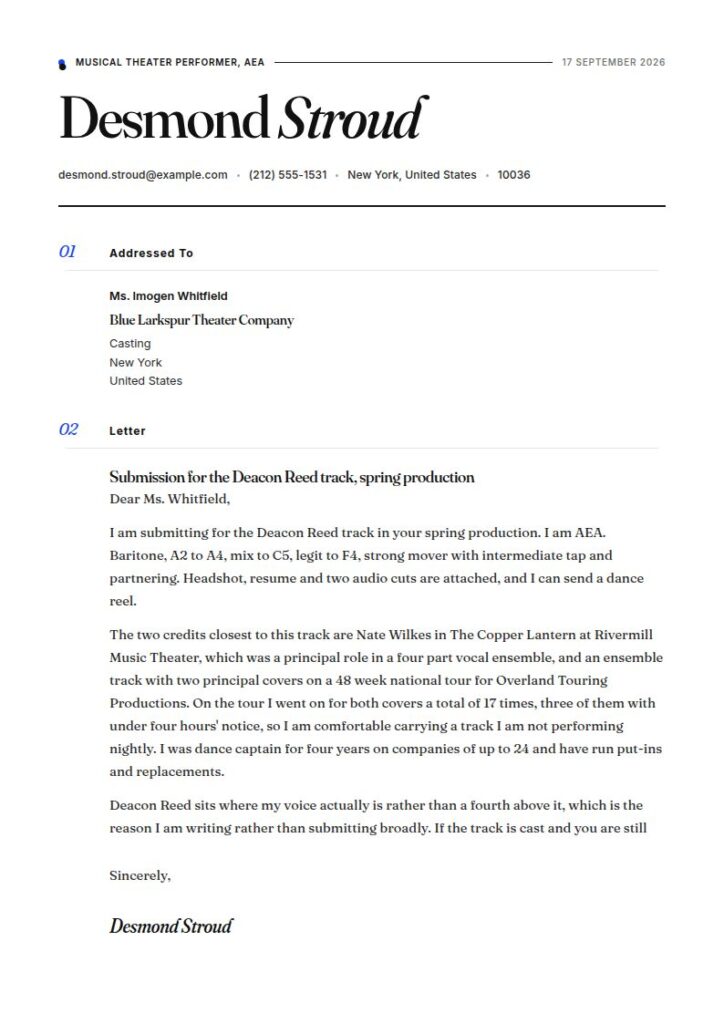
Desmond Stroud Musical Theater Performer, AEA New York, 10036, United States [email protected] · (212) 555-1531
17 September 2026
Ms. Imogen Whitfield Casting Blue Larkspur Theater Company New York, United States
Submission for the Deacon Reed track, spring production
Dear Ms. Whitfield,
I am submitting for the Deacon Reed track in your spring production. I am AEA. Baritone, A2 to A4, mix to C5, legit to F4, strong mover with intermediate tap and partnering. Headshot, resume and two audio cuts are attached, and I can send a dance reel.
The two credits closest to this track are Nate Wilkes in The Copper Lantern at Rivermill Music Theater, which was a principal role in a four part vocal ensemble, and an ensemble track with two principal covers on a 48 week national tour for Overland Touring Productions. On the tour I went on for both covers a total of 17 times, three of them with under four hours' notice, so I am comfortable carrying a track I am not performing nightly. I was dance captain for four years on companies of up to 24 and have run put-ins and replacements.
Deacon Reed sits where my voice actually is rather than a fourth above it, which is the reason I am writing rather than submitting broadly. If the track is cast and you are still building covers, I would be glad to be seen for those, and I can also cover in mix if the production needs the flexibility.
I am available from February and can be in the room on a day's notice. My book holds golden age legit, contemporary, pop-rock and a comedic uptempo, all in marked keys with clean sixteen and thirty-two bar cuts. Thank you for your time.
Sincerely, Desmond Stroud
Summary
A musical theater cover letter is a short submission email or letter that gives a casting office your union status, your voice type and range in notes, the dance level you can hold, and two credits with the house attached. This guide gives you a full adaptable letter, the openings that work, and what changes between a casting submission, an agency query and a teaching artist post.
Musical Theater cover letter examples by experience level
A musical theater cover letter is a short letter or submission email that tells a casting office four things: your union status, your voice type and range in notes, the dance level you can hold in the call, and two credits with the house attached.
It is not a business cover letter and it is not a place for enthusiasm. A casting associate opening a submission folder is checking whether you fit a track that already exists on a breakdown, and everything that is not one of those four things delays the answer.
Guide to a musical theater cover letter
This guide and the corresponding musical theater cover letter example will cover:
- How to structure the letter, paragraph by paragraph
- Why range in notes and union status belong in the first two lines
- Two credits with the house, and why the house does the work
- How the letter changes for casting, an agency query and a teaching artist post
- The openings that get a submission opened rather than filed
How to write a musical theater cover letter
| Paragraph | Its job | Length |
|---|---|---|
| Opening | The production or the ask, union status, voice type and range, dance level | 2 to 3 sentences |
| Evidence | Two credits with role and house, plus one track fact such as covers carried | 3 to 4 sentences |
| Fit | The specific track or role you are right for, and one accurate reason | 2 to 3 sentences |
| Close | Materials attached, availability, thank you | 2 sentences |
Put the range in notes in the first three lines
A casting office holds a breakdown that says something like "Baritone, comfortable to A4, must move well, tap a plus". The only question they have about your submission is whether you match it.
Write it in the same language: "AEA. Baritone, A2 to A4, mix to C5, legit to F4. Strong mover, tap intermediate." Three short sentences answer the breakdown directly, and they can be read in the preview pane before the attachment opens.
Then do not repeat them. Everything after that first block is credits and one accurate reason for writing to this office in particular.
A musical theater cover letter example you can adapt
Dear Ms. Whitfield,
I am submitting for the Deacon Reed track in your spring production. I am AEA. Baritone, A2 to A4, mix to C5, legit to F4, strong mover with intermediate tap and partnering. Headshot, resume and two audio cuts are attached, and I can send a dance reel.
The two credits closest to this track are Nate Wilkes in The Copper Lantern at Rivermill Music Theater, which was a principal role in a four part vocal ensemble, and an ensemble track with two principal covers on a 48 week national tour for Overland Touring Productions. On the tour I went on for both covers a total of 17 times, three of them with under four hours' notice, so I am comfortable carrying a track I am not performing nightly. I was dance captain for four years on companies of up to 24 and have run put-ins and replacements.
Deacon Reed sits where my voice actually is rather than a fourth above it, which is the reason I am writing rather than submitting broadly. If the track is cast and you are still building covers, I would be glad to be seen for those, and I can also cover in mix if the production needs the flexibility.
I am available from February and can be in the room on a day's notice. My book holds golden age legit, contemporary, pop-rock and a comedic uptempo, all in marked keys with clean sixteen and thirty-two bar cuts. Thank you for your time.
Sincerely, Desmond Stroud
Openings that work
| Instead of | Use |
|---|---|
| I am a passionate performer who loves musical theater | I am AEA. Baritone, A2 to A4, mix to C5, legit to F4. Strong mover, tap intermediate |
| I am writing to express my interest in your upcoming production | I am submitting for the Deacon Reed track in your spring production |
| I have performed in many wonderful shows | Nate Wilkes in The Copper Lantern at Rivermill Music Theater, a principal role in a four part ensemble |
| I am a hard worker and a great team member | Went on for both covers 17 times, three with under four hours' notice |
Writing a credit in one sentence
The letter has room for two credits. Each needs the role, the house, and one fact that says what the job actually asked of you.
| Fact | Why the reader needs it |
|---|---|
| Role and whether it was principal, ensemble, u/s or swing | It is the level of the credit |
| The house or producer | House scale tells them company size, rehearsal period and room |
| Vocal demand | Part in the ensemble, tessitura, whether you covered a different voice part |
| Track reliability | Covers carried, times on, notice given |
Track reliability is the fact most performers leave out and the one a production manager values most. A swing who covered six tracks and went on 41 times is telling a casting office something no adjective can.
How the letter changes by purpose
For a casting submission, lead with union status, range and dance level, then two credits, then the specific track. For an agency query, lead with what type you play and what you have booked in the last two years, and say plainly whether you are seeking representation. For a teaching artist or education post, lead with what you teach, the age ranges and the group sizes, and put credits second. For a cruise or theme park contract, lead with contract length availability, vocal part and dance level.
Do not write a top note you cannot hold eight times a week. Do not write "dancer" if you are a strong mover, because the call will settle it in four minutes. Do not write EMC, which has not existed since 2023. Do not describe a real production or name a director you have not worked with. Do not attach five files when the call asked for two.
Three occupations, three brackets, no annual wage in any of them
There is no Bureau of Labor Statistics Occupational Outlook Handbook profile for musical theater performer, because the Handbook covers broad occupations rather than job titles and this career is measured across three at once.
Actors had a median hourly wage of $29.05 in May 2025, musicians and singers $47.80 and dancers $24.80, and BLS publishes no annual median for any of the three because the work is intermittent (BLS Occupational Outlook Handbook, actors, musicians and singers, and dancers and choreographers, May 2025 wage data, all pages last modified 27 August 2026).
All three are flat or nearly flat to 2035: actors 0 percent with about 6,300 openings a year, musicians and singers 0 percent with about 17,400, and dancers and choreographers together 2 percent with about 2,200 (same cycle).
That is why the letter is a matching exercise rather than a persuasion exercise. Openings are replacements, not growth, so the submission that gets read is the one that lines up with a track on a breakdown in the first three lines.
Length, format and sending it
Short. Six to twelve lines in the body of an email, or one page as a letter, 200 to 350 words. Casting submissions are opened in volume and read in a preview pane.
Attach exactly what the call asked for: usually a headshot, a resume and one or two audio cuts, with a dance reel only if requested. Name the files for yourself and the show: desmond-stroud-headshot.jpg, desmond-stroud-resume.pdf.
Address a person where the breakdown names one, and write to the casting office by name where it does not. Use the same range, dance label and credits as your resume so the two agree. Our musical theater resume example is written with the figures used here.
Key takeaways
- Union status, voice type and range in notes, and dance level go in the first three lines.
- Give two credits, each with role, house and one fact about what the job demanded.
- Put track reliability on the page: covers carried, times on, notice given.
- Name the specific track you are right for and one accurate reason.
- Keep it to six to twelve lines in an email body, or one page as a letter.
- Attach only what the call asked for, named for yourself and the show.
- Never inflate the top note or the dance word, because both are tested in minutes.
Write your musical theater cover letter in 10 minutes with our AI cover letter builder.
Musical theater cover letter questions, answered
How long should a musical theater cover letter be?
Six to twelve lines in an email body, or one page as a letter, 200 to 350 words. Casting offices open submissions in batches, and a long letter delays the four facts they are looking for.
Do casting offices actually read cover letters?
They read the first three lines, which is exactly why those lines carry union status, range and dance level rather than an introduction. Treat the rest as material for the reader who is already interested.
Should I include my vocal range in the letter as well as the resume?
Yes. The letter is often read in a preview pane before the resume attachment is opened, so the range in notes has to survive on its own: "Baritone, A2 to A4, mix to C5, legit to F4."
What do I write with no professional credits yet?
Write what you have honestly: training productions with role and school, any summer stock or apprentice contract, and your range and dance level in the same format a professional would use. Then say what is in your book. A prepared book and an accurate dance word are the two things a new performer can be as good at as anyone.
Can I still write EMC in a musical theater submission?
No. The Equity Membership Candidate program was phased out when Actors' Equity introduced Open Access, and Equity states that former candidates may join whenever they are ready, with fees already paid applied to the initiation fee (Actors' Equity Association, EMC page, accessed 17 September 2026). Write AEA if you are a member, and write nothing or "non-union" if you are not.