Renata Calvillo Director of Photography, IATSE Local 600 Albuquerque, 87106, United States [email protected] · (505) 555-1453
11 September 2026
Ms. Harriet Voss Producer Broken Compass Films Albuquerque, United States
Application for Director of Photography, Broken Compass Films
Dear Ms. Voss,
I am applying to shoot the untitled contemporary drama listed for a spring block at Broken Compass Films. I have shot three independent features between 96 and 112 minutes on schedules of 24 to 31 days, leading camera departments of five to six, so a 26-day schedule with a two-camera package is a shape I have finished before rather than one I would be attempting.
The closest comparison is a 104-minute drama I shot last year across 14 practical locations and 4 stage days in 28 days. We ran a two-body large-format package with rehoused vintage spherical primes at 2.39:1, and I led a camera department of six alongside a grip and electric crew of twelve. The part worth telling you about is the prep: the director and I ran a two-day lens test and agreed one show LUT with the colorist before principal photography, which was carried unchanged through dailies, conform and the final grade. We finished on schedule with no camera-department overtime beyond the two days budgeted.
From the material you have posted, the script looks like it lives in small interiors with a lot of practical light, which is the work I like most and the work that most often loses days. I would want to spend prep on the two largest interiors and the night exterior, and I would propose a card-to-dailies pipeline with a checksum-verified offload and a two-hour rushes turnaround, because the productions where post goes wrong are almost always the ones where nobody agreed that in week one.
I am an active member of IATSE Local 600 in the Director of Photography classification, Western Region, and I am available from February. My reel is at renatacalvillo.example.com and I would be glad to talk through the schedule. Thank you for your time.
Sincerely, Renata Calvillo
Summary
A cinematographer cover letter tells a producer what you would shoot their production on, how large a camera department you have run, and how you would arrive at the look before the first shooting day. This guide gives you a full adaptable letter, the openings that get read, and what changes between narrative, commercial and documentary work.
Cinematographer cover letter examples by experience level
A cinematographer cover letter is a one-page letter that answers three questions a producer has before they open your reel: can you shoot this on the format and schedule we have, have you run a department this size, and how would you and the director arrive at the look.
Everything else is decoration. A producer reading applications during prep is short of time and long of problems, and the letter that reads as a proposal rather than an introduction is the one that gets a call.
Guide to a cinematographer cover letter
This guide and the corresponding cinematographer cover letter example will cover:
- How to structure the letter, paragraph by paragraph
- Why the format and the schedule belong in the opening lines
- What department scale sounds like in a sentence
- How narrative, commercial and documentary letters differ
- The sending details that stop a good letter being lost
How to write a cinematographer cover letter
| Paragraph | Its job | Length |
|---|---|---|
| Opening | The production, your rank, and the format and scale you are matching | 2 to 3 sentences |
| Evidence | One comparable credit, with length, days and department size | 4 to 5 sentences |
| Approach | How you would work with this director, and one thing you noticed | 3 to 4 sentences |
| Close | Union standing, availability, reel, thank you | 2 sentences |
Match the schedule before you match the style
Producers are not primarily worried about taste. They are worried about a day count.
Open with the comparison: "I have shot three features on schedules between 24 and 31 days, most recently a 104-minute drama across 14 practical locations in 28 days." A producer looking at a 26-day schedule now knows you have finished one.
Then name the format you would propose and why it fits the plan, not why you like it: a two-body package because of the coverage the schedule demands, a zoom-led documentary build because access is short, film because the production is already budgeting for it. Style arguments belong in the meeting; feasibility belongs in the letter.
A cinematographer cover letter example you can adapt
Dear Ms. Voss,
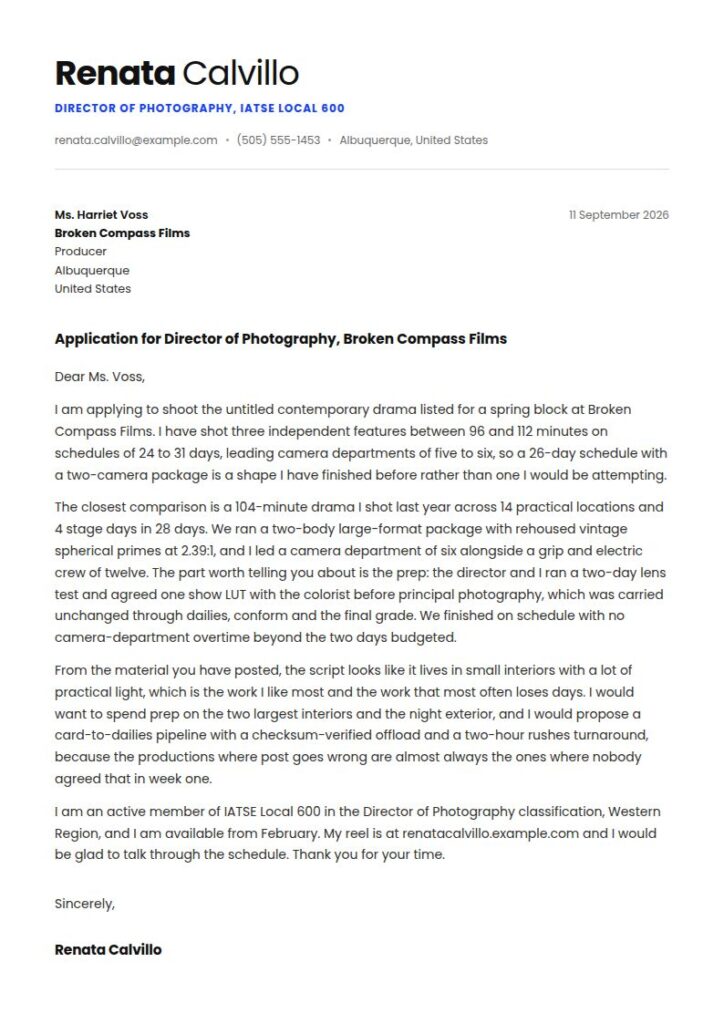
I am applying to shoot the untitled contemporary drama listed for a spring block at Broken Compass Films. I have shot three independent features between 96 and 112 minutes on schedules of 24 to 31 days, leading camera departments of five to six, so a 26-day schedule with a two-camera package is a shape I have finished before rather than one I would be attempting.
The closest comparison is a 104-minute drama I shot last year across 14 practical locations and 4 stage days in 28 days. We ran a two-body large-format package with rehoused vintage spherical primes at 2.39:1, and I led a camera department of six alongside a grip and electric crew of twelve. The part worth telling you about is the prep: the director and I ran a two-day lens test and agreed one show LUT with the colorist before principal photography, which was carried unchanged through dailies, conform and the final grade. We finished on schedule with no camera-department overtime beyond the two days budgeted.
From the material you have posted, the script looks like it lives in small interiors with a lot of practical light, which is the work I like most and the work that most often loses days. I would want to spend prep on the two largest interiors and the night exterior, and I would propose a card-to-dailies pipeline with a checksum-verified offload and a two-hour rushes turnaround, because the productions where post goes wrong are almost always the ones where nobody agreed that in week one.
I am an active member of IATSE Local 600 in the Director of Photography classification, Western Region, and I am available from February. My reel is at renatacalvillo.example.com and I would be glad to talk through the schedule. Thank you for your time.
Sincerely, Renata Calvillo
Openings that work
| Instead of | Use |
|---|---|
| I am a passionate cinematographer with a unique visual style | I have shot three features on schedules of 24 to 31 days, leading departments of five to six |
| I am writing to express my interest in your upcoming feature | I am applying to shoot the untitled contemporary drama listed for a spring block |
| I have extensive experience with a wide range of cameras | The last feature ran a two-body large-format package with rehoused spherical primes at 2.39:1 |
| I would love the chance to bring my vision to your project | I would spend prep on the two largest interiors and the night exterior |
What counts as evidence when the reel already exists
The reel shows the images. The letter has to show that the images were repeatable, on a schedule, with people you were responsible for.
| Kind of evidence | What it looks like in a sentence |
|---|---|
| Schedule | Shot a 104-minute feature in 28 days across 14 practical locations |
| Department | Led a camera department of six and coordinated a grip and electric crew of twelve |
| Format | Two-body large-format package, rehoused spherical primes, 2.39:1 |
| Method | Agreed one show LUT with the colorist in prep and carried it to final grade |
| Pipeline | Checksum-verified offload with a two-hour rushes turnaround, no media faults |
| Discipline | Finished on schedule with no camera overtime beyond the budgeted days |
The money follows the setting, not the title
Camera operators in television, video and film had a median annual wage of $74,990 in May 2025, with the lowest 10 percent under $38,520 and the highest 10 percent over $135,180 (BLS Occupational Outlook Handbook, page last modified 27 August 2026).
The spread inside the occupation is driven by setting. Employment services paid a median of $110,570 and motion picture and video industries $93,940, against $61,980 in publishing, broadcasting and content providers (BLS Occupational Outlook Handbook, May 2025). Across the combined film and video editors and camera operators profile there were 72,000 jobs in 2025, growth of 3 percent projected to 2035, and about 5,600 openings a year.
Thirty-five percent of camera operators are self-employed (BLS Occupational Outlook Handbook, page last modified 27 August 2026), which is the real reason this letter matters. For more than a third of the occupation there is no posting, no recruiter and no application form. There is a producer, a schedule and an email, and the letter is the whole application.
Narrative, commercial and documentary letters are not the same letter
For narrative, lead with schedule, department size and the prep you would run. For commercial and branded work, lead with turnaround, deliverable count and how you work with an agency in the room, since the day is short and the approvals are many. For documentary, lead with access: the package you can move alone, low-light capability, sound-sensitive operating and how long you can shoot without support. Name your union classification and region in all three.
Do not describe your visual style in adjectives; describe the decisions that produced it. Do not claim a rank you did not hold on a named production. Do not attach stills; the reel is the place for images. Do not write one letter and send it to narrative and commercial producers unchanged, because they are reading for different risks.
Length, format and sending it
One page, four paragraphs, 250 to 400 words, sent as a PDF unless a portal says otherwise and named for yourself and the rank: renata-calvillo-director-of-photography-cover-letter.pdf.
Put the reel URL in the letter as well as the resume. A producer who reads the letter on a phone in a scout van will click one link and will not go looking for a second attachment.
Address a person. On a production, that is usually the producer, the line producer or the director, and all three are normally findable. Use the same numbers as your resume so the two documents agree. Our cinematographer resume example is written with the figures used here.
Key takeaways
- Open with the format and the schedule, matched to the production in front of you.
- Say how many people have reported to you, by role.
- Give one comparable credit with length, days and department size.
- Describe the look as a method, with the prep and the LUT named.
- Name one real thing about the material or the plan.
- State your union classification, your region and your availability.
- Keep the reel link in the letter and keep the letter to one page.
Write your cinematographer cover letter in 10 minutes with our AI cover letter builder.
Cinematographer cover letter questions, answered
How long should a cinematographer cover letter be?
One page, four paragraphs, 250 to 400 words. Producers read these during prep, alongside a schedule that is already moving, and a long letter reads as somebody who has not worked to a deadline.
Do I need a cover letter if I am sending a reel?
Yes, and it should be short. The reel proves the images. The letter proves that the images were made on a schedule, with a crew, inside a budget, and that you can describe how. Most reels arrive without that, which is exactly why the letter separates you.
Should I name the camera and lenses I would use?
Name a package and a reason tied to the plan, not a wish list. "A two-body large-format package because the coverage the schedule demands needs a second camera on the interiors" is a proposal. A list of gear with no schedule attached to it is a preference.
How do I write to a production when I am not in the union yet?
Say what you are, plainly, and say where you are in the process. Local 600 takes applications through three regions, with the Western Region routing applicants to roster placement through the Contract Services Administration Trust Fund and the Eastern and Central Regions taking applications through their member services offices (International Cinematographers Guild, retrieved 17 September 2026). A great deal of commercial, documentary and independent work is not covered by an agreement at all, and that is where most careers start.
What do I write when I have shorts and spots but no feature?
Write the shorts and spots properly: running lengths, shooting days, department size, format, and what you finished on time. Then be direct about the step you are asking for. A producer hiring a first feature knows they are hiring a first feature; what they need is evidence you have run a small department well rather than a claim that scale makes no difference.