Second Assistant Camera Renata Calvillo
Second Assistant Camera
[email protected] | (505) 555-1453 | Albuquerque, United States
Profile
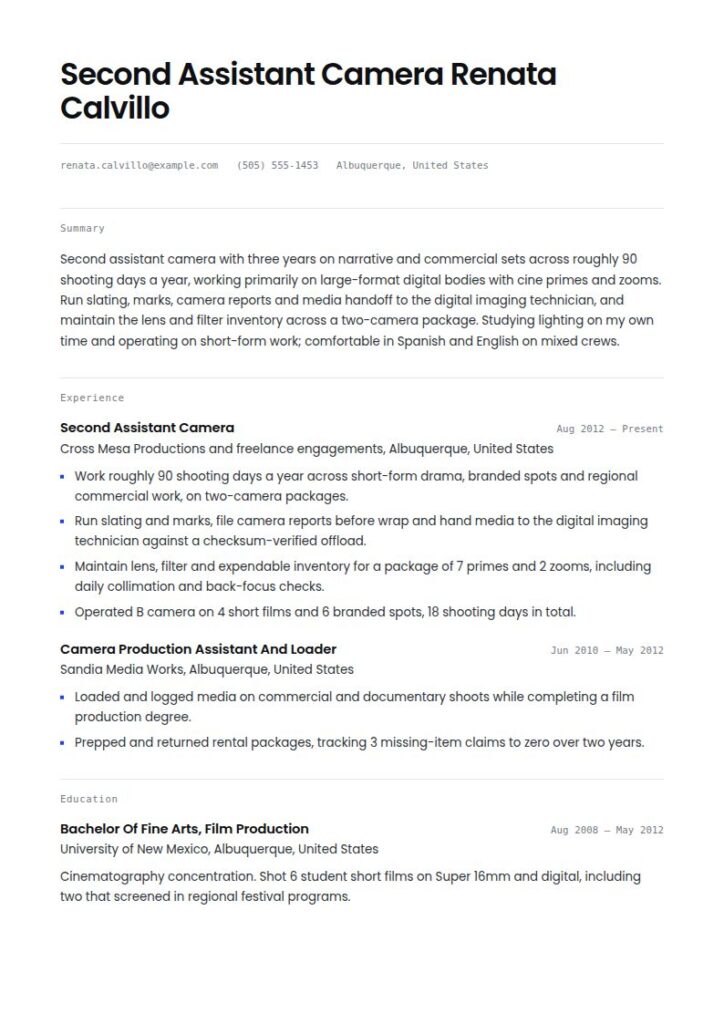
Second assistant camera with three years on narrative and commercial sets across roughly 90 shooting days a year, working primarily on large-format digital bodies with cine primes and zooms. Run slating, marks, camera reports and media handoff to the digital imaging technician, and maintain the lens and filter inventory across a two-camera package. Studying lighting on my own time and operating on short-form work; comfortable in Spanish and English on mixed crews.
Work Experience
08/2012 - Present, Second Assistant Camera, Cross Mesa Productions and freelance engagements, Albuquerque, United States
- Work roughly 90 shooting days a year across short-form drama, branded spots and regional commercial work, on two-camera packages.
- Run slating and marks, file camera reports before wrap and hand media to the digital imaging technician against a checksum-verified offload.
- Maintain lens, filter and expendable inventory for a package of 7 primes and 2 zooms, including daily collimation and back-focus checks.
- Operated B camera on 4 short films and 6 branded spots, 18 shooting days in total.
06/2010 - 05/2012, Camera Production Assistant and Loader, Sandia Media Works, Albuquerque, United States
- Loaded and logged media on commercial and documentary shoots while completing a film production degree.
- Prepped and returned rental packages, tracking 3 missing-item claims to zero over two years.
Education
08/2008 - 05/2012, Bachelor of Fine Arts, Film Production, University of New Mexico, Albuquerque, United States
Cinematography concentration. Shot 6 student short films on Super 16mm and digital, including two that screened in regional festival programs.
Skills
Slating, marks and camera reports, 85
Media offload and checksum verification, 80
Lens prep, collimation and back focus, 75
Large-format and Super 35 digital acquisition, 70
Super 16mm film handling, 60
Handheld and dolly support, 65
Set safety and department communication, 80
Languages
English, native
Spanish, professional
Certificates
09/2012, CPR, First Aid and AED, American Red Cross
Renewed on a two-year cycle for work on location units.
Summary
A cinematographer resume is a one to two page document listing credits by production type and running length, the format and lenses behind each one, and the size of the camera department that reported to you. This guide gives you three adaptable versions, the credit block producers actually read, and current Bureau of Labor Statistics pay and outlook for the published occupations it sits between.
Cinematographer resume examples by experience level
In short, a cinematographer resume is a one to two page document that lists credits by production type and running length, names the format you shot each one on, and states how many people reported to you in the camera department.
That last clause is what makes this a different document from every other camera resume. A cinematographer is a department head. The producer reading it is deciding whether to hand you a crew, a rental order and a schedule, and the question under every line is whether you have run something that size.
Resume guide for a cinematographer resume
To start, this guide and the corresponding cinematographer resume example will cover:
- First, how to write a cinematographer resume, section by section
- How to lay out credits so format, length and scale read in one pass
- Then, three adaptable summaries: camera assistant, operator and director of photography
- Also, what union classification and roster standing mean on a hiring decision
- Finally, what the job market looks like and what you can expect to earn
How to write a cinematographer resume
Six sections: contact header with a reel link, summary, selected credits, department and scale, skills and formats, then education and union standing. In general, one page in the assistant ranks, two once you are shooting long-form and carrying a crew.
In practice, the order follows how a producer reads. Credits come first because they are the only proof that exists. Department and scale come second, because a three-person commercial crew and a fourteen-person camera and lighting department are different jobs under the same title.
| Section | What it is answering | Where it goes |
|---|---|---|
| Selected credits | What have you shot, at what length, in what form? | Directly under the summary |
| Department and scale | Who reported to you, in which roles, on what budget tier? | Its own block, never folded into bullets |
| Skills and formats | Can you work the cameras, glass and pipeline on this show? | Grouped by camera, lens, lighting, workflow |
| Union standing | Can you be hired on this agreement, in this region? | Short, with the classification named |
Put the running length beside every credit
A credit without a length is unreadable. "Director of Photography, drama" could be a 4-minute short shot over a weekend or a 104-minute feature shot over 28 days, and those are different professions.
Write every credit as form plus length plus schedule: "Feature, 104 minutes, 28 shooting days" or "Branded spot, 60 seconds plus four cutdowns, 2 days". Add the production company, and the delivery if a reader can verify it.
A producer scanning ten reels wants to know whether you have survived a schedule like theirs. Length and days answer that; a genre label does not.
Run the finished file through the ATS resume checker before you send it. Studios, networks and production companies collect postings through parsing systems, and those systems fail on exactly the designer templates cinematographers reach for.
Choosing the best resume format for a cinematographer resume
As a rule, reverse chronological, with the credit list promoted above employment history. In fact, almost nobody in this occupation has a conventional employment record: the work arrives as a sequence of engagements, and a list of production companies in date order hides what the reader is assessing, which is the scale and form of what you have shot.
Therefore, functional and skills-first formats fail badly here: a camera resume that leads with adjectives reads as a resume with no credits. Also keep the reel and the file as two objects joined by one short URL. After all, a producer watches the reel first and opens the file only to check what rank you held on it.
Include your contact information
| ✅ Right | ❌ Wrong |
|---|---|
| Renata Calvillo | Renata Calvillo |
| Director of Photography: narrative and commercial | Passionate visual storyteller and creative eye |
| IATSE Local 600, Director of Photography classification, Western Region | Union member |
| Reel: renatacalvillo.example.com | Reel available on request |
| (505) 555-1453, [email protected], Albuquerque, NM | (505) 555-1453, [email protected] |
Above all, name the classification, not just the union. Local 600 represents directors of photography, camera operators, assistants, loaders, utilities, digital imaging technicians, video controllers, still photographers and publicists (International Cinematographers Guild, retrieved 17 September 2026). "Union member" does not tell a coordinator which box on the crew list you belong in.
Similarly, put the city on the page too. Local 600 runs Western, Eastern and Central regions with published state lists, and a production office building an incentive-qualified crew list reads your location before your work.
Make use of a summary
For the summary, four lines: your rank, the forms you shoot, the scale of department you have run, and one thing about how you work that a director would care about.
Second assistant camera with three years on narrative and commercial sets across roughly 90 shooting days a year, working primarily on large-format digital bodies with cine primes and zooms. Run slating, marks, camera reports and media handoff to the digital imaging technician, and maintain the lens and filter inventory across a two-camera package. Studying lighting on my own time and operating on short-form work; comfortable in Spanish and English on mixed crews.
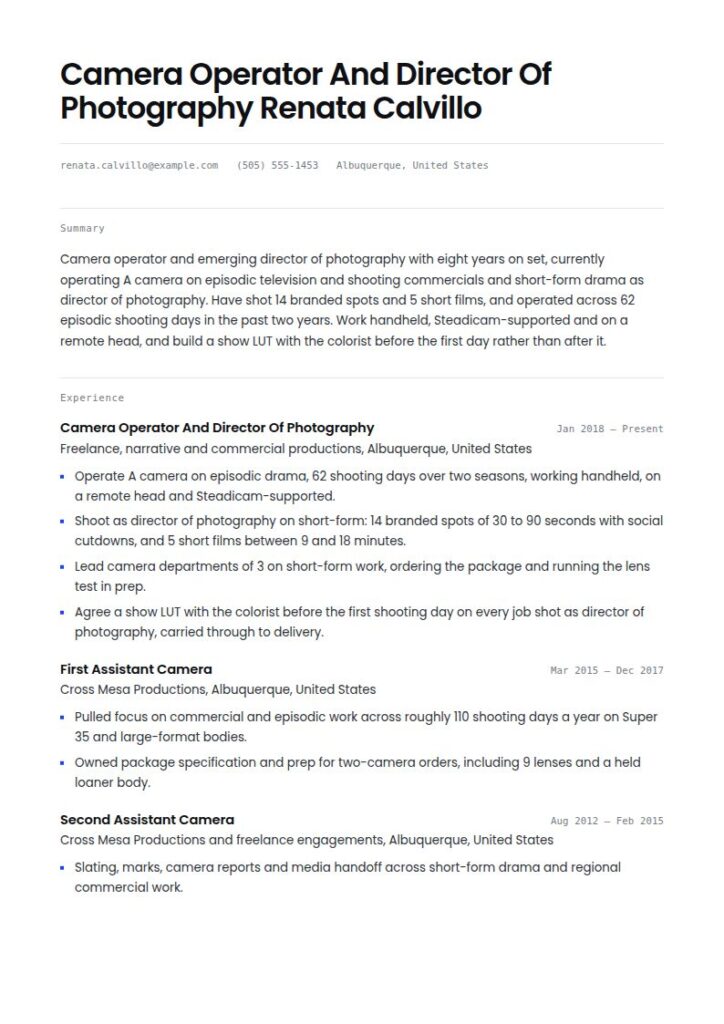
Camera operator and emerging director of photography with eight years on set, currently operating A camera on episodic television and shooting commercials and short-form drama as director of photography. Have shot 14 branded spots and 5 short films, and operated across 62 episodic shooting days in the past two years. Work handheld, Steadicam-supported and on a remote head, and build a show LUT with the colorist before the first day rather than after it.
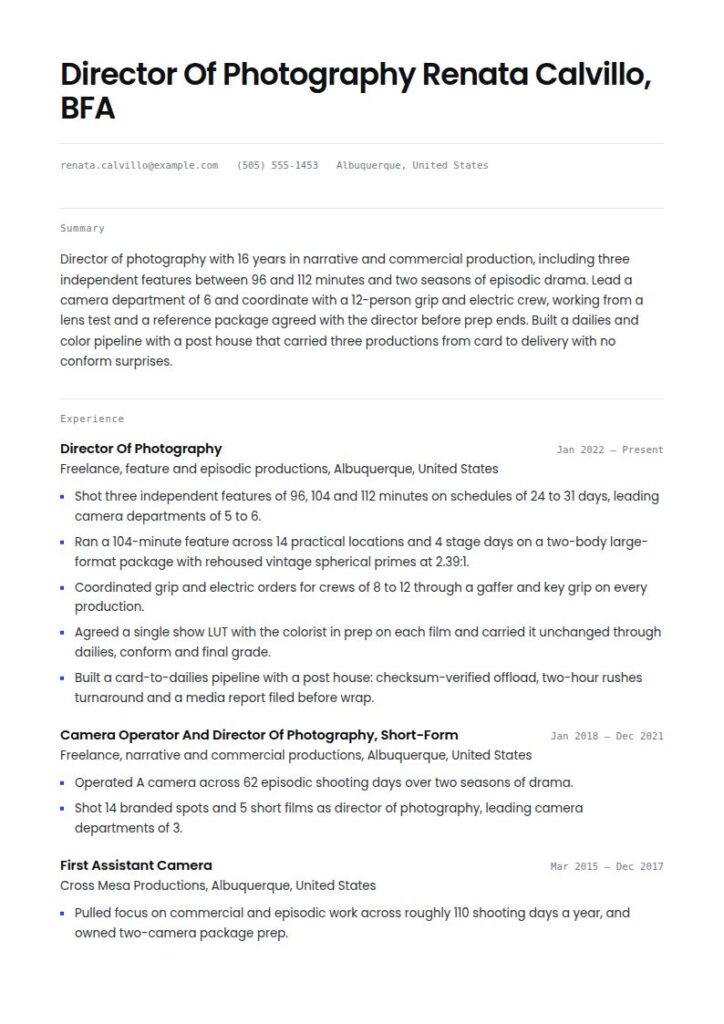
Director of photography with 16 years in narrative and commercial production, including three independent features between 96 and 112 minutes and two seasons of episodic drama. Lead a camera department of 6 and coordinate with a 12-person grip and electric crew, working from a lens test and a reference package agreed with the director before prep ends. Built a dailies and color pipeline with a post house that carried three productions from card to delivery with no conform surprises.
Right vs wrong: the same cinematographer summary, twice
| ✅ Right | ❌ Wrong |
|---|---|
| Director of photography with three independent features between 96 and 112 minutes and two seasons of episodic drama. | Award-winning cinematographer with a passion for visual storytelling. |
| Lead a camera department of 6 and coordinate with a 12-person grip and electric crew. | Experienced leading crews on a variety of productions. |
| Build a show LUT with the colorist before the first day rather than after it. | Skilled in color grading and post-production workflows. |
For instance, a producer can schedule and budget from the right column. Meanwhile, the left column describes a temperament, and nobody hires a temperament for 28 days.
Outline your experience on set
For each credit line, give production type, your rank, the production company, the dates, and the remit in one line. Then three to five bullets, each carrying a number: days, department size, camera count, or a delivery that happened.
| Instead of | Use |
|---|---|
| Shot a feature film | Director of photography, 104-minute independent feature, 28 shooting days, 6-person camera department |
| Worked with the director on the visual style | Ran a two-day lens test with the director, settling on rehoused vintage spherical glass and a single show LUT used through delivery |
| Responsible for lighting the set | Ordered and led a 12-person grip and electric package across 14 practical locations and 4 stage days |
| Handled camera equipment | Specified and managed a two-body large-format package with 7 primes and 2 zooms, plus a loaner body held for the schedule |
| Delivered footage to post | Built the card-to-dailies pipeline with the post house: 2-hour turnaround on rushes, checksum-verified transfer, no reshoots from media faults |
Director of Photography, independent feature, Ridgeline Picture Company, Albuquerque, NM, March 2025 to May 2025
Shot a 104-minute contemporary drama over 28 days across 14 practical locations and 4 stage days, on a two-body large-format digital package.
Led a camera department of 6, comprising an A and B camera operator, two first assistants, a second assistant and a digital imaging technician, and ordered the grip and electric package for a crew of 12.
Ran a two-day lens test with the director in prep and agreed a single show LUT with the colorist before principal photography, which was carried unchanged through dailies, conform and final grade.
Built the card-to-dailies pipeline with the post house: checksum-verified offload, two-hour rushes turnaround and a daily media report filed before wrap.
Finished on schedule with no camera-department overtime days beyond the two built into the budget.
Your credit list: format, length and the department you ran
This is the block that decides whether a producer reads you as a cinematographer or as somebody who owns a camera, and almost nobody formats it properly.
In other words, a credit has four parts, and dropping any of them costs you the credit. First, the form and length say what kind of production it was. Second, the format says what you can work on. The rank says what you were actually responsible for. Third, the department size says what scale you can carry.
Selected credits
Nine Mile Bend, feature, 104 minutes, 2025. Director of photography. 28 shooting days, 6-person camera department. Large-format digital, rehoused vintage spherical primes, 2.39:1.
Low Season, limited series, 4 episodes at 48 minutes, 2024. Additional photography, 11 days. Two-camera Super 35 digital, zoom-led, 16:9.
The Salt Line, short film, 18 minutes, 2023. Director of photography. 6 days, 3-person camera department. Super 16mm, hard front anamorphic, 2.39:1.
Commercial and branded: 14 spots since 2022, 30 to 90 seconds with social cutdowns, 1 to 3 shooting days each, crews of 4 to 9.
Department led: A and B camera operators, first and second assistants, loader, digital imaging technician. Grip and electric package coordinated with a gaffer and key grip across crews of 8 to 12.
Together, three things in that block do work that a reel cannot do on its own.
The format line proves range without argument. Super 16mm, large format and Super 35 across three credits says more about adaptability than any sentence could. If you have shot film, name the gauge, because a production considering film wants someone who has already exposed it.
The rank line keeps you hired. Additional photography, second unit, B camera operator and director of photography are different credits, and the community is small enough that overclaiming is found out.
The department line is the scale argument. A producer's real anxiety is whether someone who has run a crew of three can run a crew of twelve. Naming the roles that reported to you answers it in one line, and it is the most common omission on these resumes.
Then add the look, once, as a method rather than a feeling. "Agreed a single show LUT with the colorist in prep and carried it unchanged through delivery" is a working sentence. "Created a moody, cinematic aesthetic" is a caption.
Build a snapshot of your key skills
For skills, list twelve to sixteen entries in four groups: camera, lens and support, lighting, and workflow. Group them, because a producer checks the group that matches their package rather than reading the list.
Camera: Large-format and Super 35 digital acquisition, Super 16mm film, Multi-camera coverage, High frame rate, Remote head and technocrane
Lens and support: Spherical and anamorphic primes, Rehoused vintage glass, Zoom-led documentary coverage, Handheld, Steadicam-supported operating, Dolly and slider
Lighting: Large-source soft units, Practical-led interiors, Day exterior negative fill and control, Color temperature control across mixed sources, LED volume and pixel-mapped sources
Workflow: Lens and camera testing, Show LUT design with a colorist, On-set color management, Checksum-verified offload and media reports, Dailies pipeline design, ACES-based delivery
Keep software out of this section unless you cut or grade. Listing an editing suite as a headline skill reads as a one-person operation, which is a real job and a different one; the videographer resume is written for it.
List your education, union standing and certifications
Keep education short, at the foot, and weighted toward what a production coordinator can verify. Notably, there is no license to be a cinematographer, and the typical entry-level education for the published camera occupation is a bachelor's degree in film or broadcasting (BLS Occupational Outlook Handbook, film and video editors and camera operators, page last modified 27 August 2026).
Active member, IATSE Local 600, International Cinematographers Guild, Director of Photography classification, Western Region, since 2019.
Bachelor of Fine Arts, Film Production, University of New Mexico, Albuquerque, NM, 2012.
CPR, first aid and AED, American Red Cross, renewed 2026.
Languages: English and Spanish, both working on set.
State union standing precisely, because it is a gate rather than a compliment. Local 600 is a national guild, formed in 1996 out of the previously separate New York, Los Angeles and Chicago organizations, and represents more than 9,000 members across features, television, streaming, commercials, news, documentaries and industrials. Its Western Region, covering thirteen states including New Mexico, California and Washington, directs applicants to roster placement through the Contract Services Administration Trust Fund, while the Eastern and Central Regions take applications through their own member services offices (International Cinematographers Guild, retrieved 17 September 2026).
However, the American Society of Cinematographers is a different thing, and people confuse the two. The ASC was chartered in California on 8 January 1919, says it is neither a labor union nor a guild but an educational, cultural and professional organization, and admits active members by invitation only, extended to directors of photography with distinguished credits; it reports more than 440 active members worldwide (American Society of Cinematographers, retrieved 17 September 2026). You do not apply; moreover, post-nominals you have not been given cost you a producer's trust.
Choose the right layout and design
Single column, plain type at 11 or 12 point, no frames, no stills, no logos. The reel is the visual work; the resume is the document that a production office parses, prints and passes around. Keep the reel URL in plain text as well as hyperlinked, and name the file for yourself and the rank: renata-calvillo-director-of-photography-resume.pdf.
Write every credit as form, length, rank and department size. Name the acquisition format and aspect ratio. Say who reported to you, by role. State your union classification and region. Keep one plain-text reel URL in the header.
Do not claim a rank you did not hold; credits are checkable. Do not use a two-column or image-led template for a parsed application. Do not write "award-winning" without naming the award and the year. Do not use post-nominals for a society that admits by invitation.
Cinematographer job market and outlook
In addition, the Bureau of Labor Statistics publishes no Occupational Outlook Handbook profile under the title cinematographer. The Handbook covers broad occupations rather than job titles, and this one sits inside a profile combining two: film and video editors, and camera operators, television, video and film.
Instead, bracket it between the published occupations the role draws on. Camera operators is where the craft sits; producers and directors, by contrast, is the department-head bracket budgets use for a director of photography.
| Measure | Film and video editors and camera operators | Producers and directors |
|---|---|---|
| Employment, 2025 | 72,000 | 181,000 |
| Projected change, 2025-35 | 3% growth, 1,900 jobs | 4% growth, 7,300 jobs |
| Projected annual openings | ~5,600 | ~12,100 |
| Typical entry-level education | Bachelor's degree | Bachelor's degree |
| Median annual wage, May 2025 | $75,100 | $90,360 |
Source: U.S. Bureau of Labor Statistics, Occupational Outlook Handbook, pages last modified 27 August 2026, May 2025 wage data and 2025 to 2035 projections.
Where camera work is actually paid
Within the combined profile, camera operators in television, video and film had a median annual wage of $74,990 in May 2025, with the lowest 10 percent under $38,520 and the highest 10 percent over $135,180 (BLS Occupational Outlook Handbook, page last modified 27 August 2026).
The industry spread inside that one occupation is wider than the spread between occupations. Employment services paid a median of $110,570, motion picture and video industries $93,940, professional, scientific and technical services $75,510, and publishing, broadcasting and content providers $61,980 (BLS Occupational Outlook Handbook, May 2025).
Employment services sits at the top because much production work is payrolled through staffing companies, and the gap between it and broadcast is about 78 percent for work using the same bodies and glass. Naming the setting on each credit is the line a producer uses to place you in a band.
Where camera operators work:
| Setting | Share of employment |
|---|---|
| Self-employed workers | 35% |
| Motion picture and video industries | 21% |
| Publishing, broadcasting and content providers | 14% |
| Professional, scientific and technical services | 8% |
| Employment services | 4% |
Source: U.S. Bureau of Labor Statistics, Occupational Outlook Handbook, camera operators, television, video and film, page last modified 27 August 2026.
BLS projects about 5,600 openings a year across the combined occupation, against modest growth, so most of what opens is replacement (BLS Occupational Outlook Handbook, 2025 to 2035 projections). With 35 percent self-employed, much of the work is not a posted job, which is why the credit list has to work as a proposal as well as a history.
What salary you can expect as a cinematographer
As a result, no published median exists for the title. For example, the closest is camera operators in television, video and film, at a median annual wage of $74,990 as of May 2025, with the lowest 10 percent under $38,520 and the highest over $135,180. Budgets band a director of photography carrying a department closer to producers and directors, median $90,360 in May 2025, lowest 10 percent under $45,780 and highest over $198,540 (BLS Occupational Outlook Handbook, pages last modified 27 August 2026).
Yet neither figure describes how productions structure the money. Instead, productions engage work at a daily or weekly rate against a defined workday, and negotiate prep and travel separately. Where a production works under an IATSE agreement, collective bargaining sets classifications and contribution rates rather than individual deals, so what your resume moves is which classification the production hires you into.
Even so, three lines on the page do that work.
The classification. Being hired as a director of photography rather than an operator is a different agreement line before any negotiation starts.
The department size. A producer pricing a crew reads scale before rate. Credits showing a six-person department reach jobs that never come to an operator.
The format range. Productions shooting film, large format or anamorphic pay for people who have done it before, because the alternative is discovering the problem on day one.
Key takeaways for a cinematographer resume
- Lead with credits, written as form, length, rank and shooting days.
- Name the acquisition format and aspect ratio on every credit.
- State the size of the camera department that reported to you, by role.
- Give your union classification and region; it is a gate, not a compliment.
- Describe the look as a method, not as an adjective.
- Keep the reel separate and link it in plain text as well as hyperlinked.
- Keep the file single column, since production offices parse and print it.
Build your cinematographer resume in 15 minutes with our AI resume builder.
Related creative and artistic resume examples
- Videographer resume
- Photographer resume
- Wedding photographer resume
- Film producer resume
- Screenwriter resume
- Actor resume
- Stage manager resume
- Costume designer resume
- Visual artist resume
- Illustrator resume
- Voice actor resume
- Musician resume
Pair it with a matching cinematographer cover letter.
Cinematographer resume questions, answered
How long should a cinematographer resume be?
One page while you are in the assistant ranks. Two once you have features, episodic or a long commercial list, and a department that reports to you. The reel is a separate object and does not count toward the page limit.
Should I list every credit I have?
No. List selected credits, ordered by relevance to the job in hand, and label them "selected" so the reader knows the list is curated. Keep form, length, rank, format and department size on every one you keep. A short list of complete lines beats a long list of bare titles.
Do I need to be in the union to work as a cinematographer?
Not to work, but it decides which productions can hire you. Local 600 represents camera and publicist classifications nationally through three regions, with the Western Region routing applicants through roster placement at the Contract Services Administration Trust Fund (International Cinematographers Guild, retrieved 17 September 2026). Non-union commercial, documentary and independent work is large, and both can sit on one resume.
Can I put ASC after my name?
Only if the American Society of Cinematographers has invited you. Active membership is by invitation only and is extended to directors of photography with distinguished credits; the society reports more than 440 active members worldwide and describes itself as an educational and professional organization rather than a union or a guild (American Society of Cinematographers, retrieved 17 September 2026).
What goes on a cinematographer resume with no features yet?
Everything you have shot, to the same standard: shorts with running lengths, spots with durations and cutdown counts, documentary days. Then your assistant and operating credits with the rank stated plainly, because time on a large crew is evidence you can run one.
How do I show a look I created without pasting stills?
Describe the decisions: the glass and why, the aspect ratio, the lighting approach for a named condition such as night exteriors, the LUT and where it was built, and whether it survived the final grade. The reel shows the images; the resume shows that they came from a process you can repeat.