Photography Assistant and Second Shooter Malik Farouk
Photography Assistant and Second Shooter
[email protected] | (312) 555-2278 | Chicago, United States
Profile
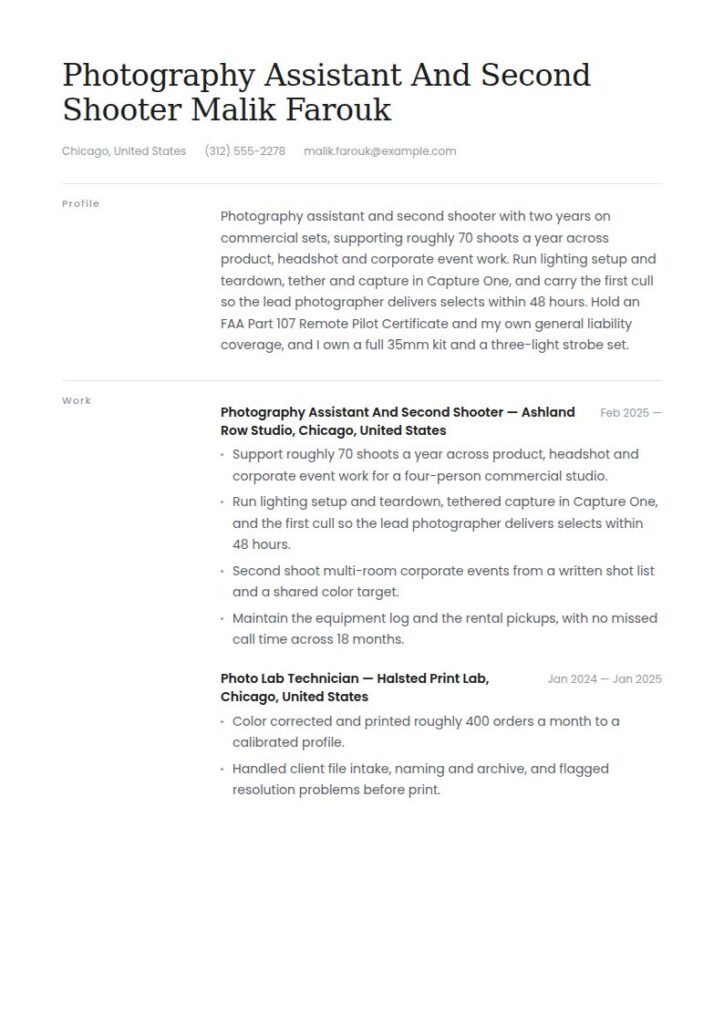
Photography assistant and second shooter with two years on commercial sets, supporting roughly 70 shoots a year across product, headshot and corporate event work. Run lighting setup and teardown, tether and capture in Capture One, and carry the first cull so the lead photographer delivers selects within 48 hours. Hold an FAA Part 107 Remote Pilot Certificate and my own general liability coverage, and I own a full 35mm kit and a three-light strobe set.
Work Experience
02/2025 - Present, Photography Assistant and Second Shooter, Ashland Row Studio, Chicago, United States
- Support roughly 70 shoots a year across product, headshot and corporate event work for a four-person commercial studio.
- Run lighting setup and teardown, tethered capture in Capture One, and the first cull so the lead photographer delivers selects within 48 hours.
- Second shoot multi-room corporate events from a written shot list and a shared color target.
- Maintain the equipment log and the rental pickups, with no missed call time across 18 months.
01/2024 - 01/2025, Photo Lab Technician, Halsted Print Lab, Chicago, United States
- Color corrected and printed roughly 400 orders a month to a calibrated profile.
- Handled client file intake, naming and archive, and flagged resolution problems before print.
Education
08/2019 - 05/2023, Bachelor of Fine Arts, Photography, Columbia College Chicago, Chicago, United States
Studio lighting, color management and a senior thesis series of 40 images shot over one semester.
Skills
Studio strobe and modifier lighting, 70
Capture One tethered capture, 80
Lightroom Classic catalog management, 75
Photoshop retouching, 60
Color management to a shared target, 70
Set and gear logistics, 85
Languages
English, native
Arabic, native
Spanish, beginner
Certificates
09/2024, FAA Part 107 Remote Pilot Certificate, Federal Aviation Administration
Recurrent training current; renewed every 24 calendar months.
06/2025, CPR and First Aid, American Red Cross
Summary
A photographer resume is a one to two page document that describes the deliverable rather than the shoot: turnaround, how many images at what resolution, the usage license and its term, whether an assistant is included, and the insurance certificate a venue will ask for. This guide gives you three adaptable versions and current Bureau of Labor Statistics pay and outlook.
Photographer resume examples by experience level
In short, a photographer resume is a one to two page document that describes what you deliver, not what you do on the day.
Yet almost every photographer writes the second thing, and "photographed corporate events and headshots" tells a buyer nothing they can plan around. Instead, what they buy is a specification: images by a date, at a count and a resolution, licensed for a stated use over a stated term, shot by a named crew, and covered by an insurance certificate their building manager will accept.
Resume guide for a photographer resume
To start, this guide and the corresponding photographer resume example will cover:
- First, how to write a photographer resume, section by section
- Then, how to state a deliverable: turnaround, count, resolution, license and crew
- Also, three adaptable summaries: assistant, working photographer and studio lead
- Next, who owns the copyright by default, and the narrow exception that changes it
- Finally, what the job market looks like and what you can expect to earn as a photographer
How to write a photographer resume
Six sections: contact header with a portfolio link, summary, deliverable specification, experience, skills and gear, then education and certifications. In general, one page under five years, two once you hire crew and carry your own insurance. In practice, the order follows the buyer's questions: can you shoot this, can you deliver it when I need it, what may I do with the files, and will my venue let you in the door.
| Section | What it is answering | Where it goes |
|---|---|---|
| Deliverable specification | What do I receive, by when, and what may I do with it? | Directly under the summary |
| Experience | Who has paid for this, at what volume, over how long? | Reverse chronological, with shoot counts |
| Skills and gear | Can this person work in my conditions with their own kit? | Grouped, with the workflow named |
| Education and certifications | Anything a procurement team has to tick? | Short, at the foot, with insurance and permits |
Put a turnaround time on the page and treat it as a promise
The most common reason a repeat client leaves is late delivery, and the fastest way to look professional in writing is to state the turnaround before anyone asks.
Write it as a range with a condition attached: "Culled selects within 48 hours, full gallery in 10 business days, rush delivery in 72 hours at an agreed surcharge." That tells an art director whether you fit a print deadline and a marketing manager whether you fit a campaign launch. Then add the number that proves you hold it: "94 shoots in 2025, all galleries delivered inside the quoted window".
Run the file through the ATS resume checker before you submit. In-house and agency photography posts are collected through parsing systems, and a two-column designer template is where those break.
Choosing the best resume format for a photographer resume
As a rule, reverse chronological, with the deliverable specification promoted above experience. That inversion is deliberate: two thirds of this occupation is self-employed, so most photographers have a thin list of employers and a thick list of clients, and leading with employment misrepresents the career. By contrast, a skills-based format fails here for the reason it fails for every trade: what a buyer reads dates for is recency and volume. Also, keep the resume and the portfolio as separate objects, connected by one short URL in the header.
Include your contact information
| ✅ Right | ❌ Wrong |
|---|---|
| Malik Farouk | Malik Farouk |
| Commercial and editorial photographer: portrait, product, event | Passionate visual storyteller capturing life's moments |
| Portfolio: malikfarouk.example.com | Portfolio available upon request |
| Certified Professional Photographer, PPA. FAA Part 107 Remote Pilot. | Certified photographer, drone qualified |
| (312) 555-2278, [email protected], Chicago, IL | (312) 555-2278, [email protected] |
Name the genres you take bookings in. "Photographer" covers everything from newborn portraits to industrial inspection, and a buyer who cannot tell which you are will pass rather than guess.
Make use of a summary
For the summary, four lines: what you shoot, at what annual volume, what the deliverable looks like, and one credential that de-risks hiring you.
Photography assistant and second shooter with two years on commercial sets, supporting roughly 70 shoots a year across product, headshot and corporate event work. Run lighting setup and teardown, tether and capture in Capture One, and carry the first cull so the lead photographer delivers selects within 48 hours. Hold an FAA Part 107 Remote Pilot Certificate and my own general liability coverage, and I own a full 35mm kit and a three-light strobe set.
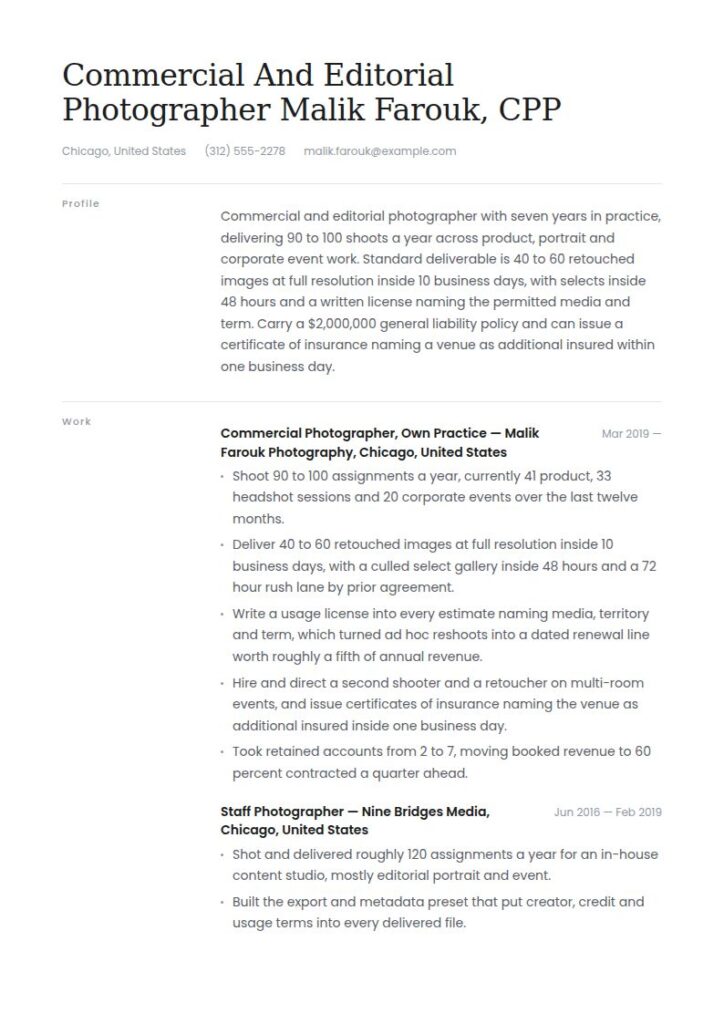
Commercial and editorial photographer with seven years in practice, delivering 90 to 100 shoots a year across product, portrait and corporate event work. Standard deliverable is 40 to 60 retouched images at full resolution inside 10 business days, with selects inside 48 hours and a written license naming the permitted media and term. Carry a $2,000,000 general liability policy and can issue a certificate of insurance naming a venue as additional insured within one business day.
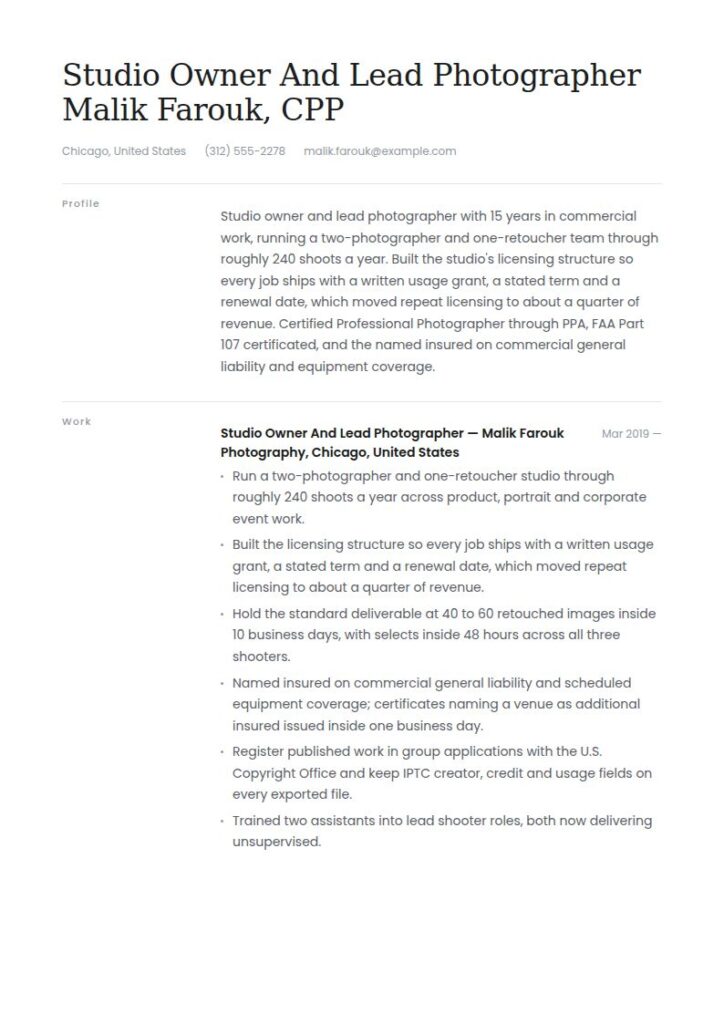
Studio owner and lead photographer with 15 years in commercial work, running a two-photographer and one-retoucher team through roughly 240 shoots a year. Built the studio's licensing structure so every job ships with a written usage grant, a stated term and a renewal date, which moved repeat licensing to about a quarter of revenue. Certified Professional Photographer through PPA, FAA Part 107 certificated, and the named insured on commercial general liability and equipment coverage.
Right vs wrong: the same photographer summary, twice
| ✅ Right | ❌ Wrong |
|---|---|
| Commercial and editorial photographer delivering 90 to 100 shoots a year across product, portrait and corporate event work. | Creative photographer with an eye for capturing authentic moments. |
| Standard deliverable is 40 to 60 retouched images at full resolution inside 10 business days. | Fast turnaround and high-quality edits every time. |
| Written license naming the permitted media and term, and a certificate of insurance inside one business day. | Fully insured and professional. |
Clearly, the right column can be put into a purchase order. The left column says nothing about what lands in the folder, or when.
Outline your photography experience
For each entry, give client or employer, your role, dates and the remit in one line. Then three to five bullets, each carrying a volume, a deliverable or a result.
| Instead of | Use |
|---|---|
| Photographed a variety of events and portraits | Shot 94 assignments in 2025: 41 product, 33 headshot sessions, 20 corporate events |
| Edited photos using Adobe software | Ran a Capture One to Lightroom Classic catalog with a fixed color pipeline, 40 to 60 retouched deliverables per job |
| Delivered images on time | Delivered selects in 48 hours and full galleries in 10 business days across 94 jobs |
Commercial Photographer, own practice, Chicago, IL, March 2019 to Present. Product, portrait and corporate event work for regional brands and agencies.
Shoot 90 to 100 assignments a year, currently 41 product, 33 headshot sessions and 20 corporate events across the last twelve months.
Deliver 40 to 60 retouched images at full resolution inside 10 business days, with a culled select gallery inside 48 hours and a rush lane at 72 hours by prior agreement.
Write a usage license into every estimate naming media, territory and term, which turned an ad hoc reshoot problem into a renewal line worth roughly a fifth of annual revenue.
Hire and direct a second shooter and a retoucher on multi-room events, and issue certificates of insurance naming the venue as additional insured inside one business day.
Write the deliverable, not the shoot
In fact, this is the section nobody includes, and it is the one that turns a portfolio into a quote.
A photographer is hired against a specification, whether or not it is written down. When it is not, the argument happens afterward: how many images were promised, whether the client may run them on a billboard, and who pays for the reshoot.
Standard deliverable
Turnaround: culled selects within 48 hours, full retouched gallery within 10 business days, rush lane at 72 hours by prior agreement.
Volume and format: 40 to 60 retouched images per shoot day at full resolution, 16-bit TIFF masters plus sRGB JPEG web sizes, through a client gallery archived for 24 months.
License: written usage grant naming media, territory and term. Standard grant is web and social, North America, two years, with print, out of home and paid media quoted separately.
Crew: solo for product and headshots; second shooter and digital tech quoted for multi-room events and anything over six hours.
Insurance: $2,000,000 commercial general liability plus scheduled equipment coverage. Certificate of insurance naming the venue as additional insured issued within one business day.
Five lines, five questions, each a thing a buyer has been burned on before.
The license line is the one worth getting right, because the default sits with you. Under U.S. copyright law, "the copyright in a work initially belongs to the author(s) who created that work", and protection "exists automatically from the moment the original work of authorship is fixed" (U.S. Copyright Office, Circular 1, Copyright Basics, revised September 2021). You press the shutter, you own the copyright, and the client buys a license. Most clients do not know that.
Work made for hire and copyright registration
The exception is work made for hire, and it is narrower than clients assume. It applies to an employee working within the scope of employment, or to a commissioned work where both parties have signed an express written agreement calling it a work made for hire and the work falls into one of nine listed categories: a contribution to a collective work, part of a motion picture or other audiovisual work, a translation, a supplementary work, a compilation, an instructional text, a test, answer material for a test, or an atlas (U.S. Copyright Office, Circular 1, revised September 2021). A standalone commissioned photograph is not one of those nine, so if you are not an employee and have not signed such an agreement, the copyright is still yours.
If you register, register in groups. The Copyright Office allows up to 750 photographs in a single group application, with published photographs all published in the same calendar year (U.S. Copyright Office, Circular 42, revised March 2021). Registration does not create the copyright, but the Office states that "you will have to register, however, if you wish to bring a lawsuit for infringement of a U.S. work", and that registered works may be eligible for statutory damages and attorney's fees (U.S. Copyright Office, Copyright FAQ, retrieved 17 September 2026).
Build a snapshot of your key skills
For skills, list ten to fourteen entries in three groups: what you can shoot, the workflow that gets it out the door, and the kit you bring.
Shooting: Studio strobe and modifier lighting, Location and mixed-light work, Tabletop and product, Headshot and environmental portrait, Corporate event coverage
Workflow and post: Capture One tethered capture, Lightroom Classic catalog management, Photoshop compositing and frequency separation retouching, Color management to a shared target, Metadata and IPTC rights fields
Business and compliance: Estimating and scope writing, Usage licensing and renewals, Model and property releases, Certificate of insurance issuance, Permit applications, Group copyright registration
Kit: Two full-frame bodies with a loaner held, 24-70mm, 70-200mm, 35mm and 85mm primes, 100mm macro, three-light strobe set, tethering cart, calibrated monitor
List your education and certifications
Keep education short, at the foot, and weighted toward what a buyer or a venue can check. Photography is not a licensed occupation, and the typical entry-level education is a high school diploma or equivalent with moderate-term on-the-job training (BLS Occupational Outlook Handbook, photographers, page last modified 27 August 2026), so a degree is optional and checkable credentials carry unusual weight.
Certified Professional Photographer, Professional Photographers of America, 2021, renewed 2024.
FAA Part 107 Remote Pilot Certificate, Federal Aviation Administration, 2022, recurrent training current.
Bachelor of Fine Arts, Photography, Columbia College Chicago, Chicago, IL, 2011.
Memberships: American Society of Media Photographers since 2018; Professional Photographers of America since 2019.
Insurance: commercial general liability $2,000,000 per occurrence with scheduled equipment coverage, certificates issued on request.
In particular, PPA's Certified Professional Photographer credential earns its space because it is an objective test rather than a portfolio opinion. Candidates pass six module exams of 8 to 25 multiple-choice questions each at a minimum 70 percent, submit three required images reviewed by trained evaluators against an objective checklist, and renew every three years with either 15 continuing education units or re-examination plus a $100 recertification fee (Professional Photographers of America, retrieved 17 September 2026).
Drone work is regulated rather than optional. The FAA requires a remote pilot to be at least 16 years old, pass the Unmanned Aircraft General knowledge test at an FAA-approved knowledge testing center, clear a TSA security background check, and complete online recurrent training every 24 calendar months (Federal Aviation Administration, Become a Drone Pilot, page last modified 9 June 2026). If you fly for a client, the certificate number belongs on the page.
Location access has its own paperwork. The National Park Service does not require a permit for still photography involving eight or fewer people in areas open to the public, using hand-carried equipment only and not requiring exclusive use of a site (National Park Service, Filming, Still Photography, and Audio Recording, page last updated 17 March 2025). Above that, permits and fees apply: National Mall and Memorial Parks charges a $90 non-refundable application processing cost before any location fee (National Park Service, page last updated 3 June 2026).
Choose the right layout and design
Single column, plain type at 11 or 12 point, generous margins, no photograph of yourself, no image thumbnails. Photographers are the profession most tempted to design the resume as a portfolio object and the one that can least afford it: the images belong on a site where they can be seen properly, and the resume has to survive being parsed. Write the portfolio URL in plain text as well as hyperlinking it, because a printed copy loses every link. Name the file for yourself and the post: malik-farouk-commercial-photographer-resume.pdf.
State turnaround, image count, resolution and license term as a standard deliverable. Give shoot counts per year and per genre. Say what insurance you carry and how fast you can issue a certificate. Put your FAA certificate number on if you fly. Keep one plain-text portfolio URL in the header.
Do not embed images or use a two-column designer template for a parsed application. Do not write "fully insured" without the coverage type and limit. Do not promise unlimited revisions or unlimited usage. Do not name a client whose work is under an embargo; give the category instead. Do not describe yourself as a visual storyteller.
Photographer job market and outlook
A slightly shrinking occupation with heavy replacement demand and the highest self-employment share of any creative occupation BLS covers in detail.
| Measure | Value |
|---|---|
| Photographers employed, 2025 | 145,000 |
| Projected employment, 2035 | 144,000 |
| Projected change, 2025-35 | -1% (decline), -1,000 jobs |
| Projected annual openings | ~10,700 |
| Typical entry-level education | High school diploma or equivalent |
| Median annual wage, May 2025 | $44,660 |
Source: U.S. Bureau of Labor Statistics, Occupational Outlook Handbook, photographers, page last modified 27 August 2026, May 2025 wage data and 2025 to 2035 projections.
Two thirds of this occupation has no employer to apply to
BLS puts self-employed workers at 67 percent of photographers, with photographic services at 17 percent, publishing, broadcasting and content at 4 percent, arts, entertainment and recreation at 3 percent, and retail trade at 2 percent (BLS Occupational Outlook Handbook, photographers, page last modified 27 August 2026).
Read that against the openings figure. About 10,700 openings a year are projected against a declining employment level, so nearly all of them are replacements rather than new posts, and most of the work in the occupation is not a post at all.
So your resume does two jobs at once. Half the time a hiring manager is filling one of those posts; the other half a client is comparing suppliers with a budget rather than a headcount. A written deliverable satisfies both readers; adjectives satisfy neither.
Next, here is where the employed third sits, and what those industries pay by the hour:
| Industry | Share of employment | Median hourly wage (May 2025) |
|---|---|---|
| Self-employed workers | 67% | Not published |
| Photographic services | 17% | $18.84 |
| Publishing, broadcasting and content | 4% | $30.04 |
| Arts, entertainment and recreation | 3% | $18.47 |
| Retail trade | 2% | $18.82 |
Source: U.S. Bureau of Labor Statistics, Occupational Outlook Handbook, photographers, May 2025.
For instance, publishing, broadcasting and content pays a median of $30.04 an hour against $18.84 in photographic services, roughly 60 percent more for work that uses the same lenses. If you are salaried and want to move, that is the direction the data points.
What salary you can expect as a photographer
On pay, the median wage for photographers was $44,660 a year, or $21.47 an hour, as of May 2025. The lowest 10 percent earned less than $14.82 an hour and the highest 10 percent more than $44.14 an hour (BLS Occupational Outlook Handbook, photographers, page last modified 27 August 2026).
However, note what BLS publishes and what it does not. The top and bottom of that distribution are published as hourly figures rather than annual ones, which is a signal about the work: hours are irregular, seasons uneven, and annualizing here would describe a year almost nobody has.
Because 67 percent of the occupation is self-employed, the median matters less here than almost anywhere else. In other words, for two thirds of photographers there is no salary band, only a day rate, a licensing fee, a cost of doing business and a utilization rate. As a result, four lines on the page move the first two.
Four lines that raise a photographer’s rate
The license term. A two-year web and social grant instead of a perpetual buyout is the difference between one fee and a renewal conversation on a date already in your calendar.
The deliverable ceiling. Naming 40 to 60 retouched images per shoot day makes anything above it a quoted add-on rather than an unbilled evening. Unbounded delivery is how a good day rate becomes a poor hourly one.
The crew line. Quoting a second shooter and a digital tech for multi-room events prices the job at what it costs and makes you available for work a solo photographer has to refuse.
The insurance certificate. A venue that requires a certificate naming it as additional insured will not let an uninsured supplier through the loading dock. It is a gate rather than a selling point, and most applicants do not know it is there. For the salaried third, the lever is the industry table above.
Key takeaways for a photographer resume
- Above all, lead with the deliverable: turnaround, image count, resolution, license term and crew.
- Then put shoot counts by year and by genre in the experience bullets.
- State the copyright default; it is yours unless a narrow exception applies.
- Similarly, quote the license as media, territory and term, with renewals dated.
- Also name your insurance type and limit and how fast you can issue a certificate.
- Put checkable credentials on the page: PPA certification, FAA Part 107, memberships.
- Keep the file single column and parseable, and leave the pictures on your site.
Build your photographer resume in 15 minutes with our AI resume builder.
Related creative and artistic resume examples
- Videographer resume
- Cinematographer resume
- Wedding photographer resume
- Visual artist resume
- Illustrator resume
- Film producer resume
- Artist resume
- Fashion designer resume
- Jewelry designer resume
- Stage manager resume
- Modeling resume
- Tattoo artist resume
Pair it with a matching photographer cover letter.
Photographer resume questions, answered
How long should a photographer resume be?
One page under five years. Two once you carry your own insurance, hire crew and have a client list long enough to be the point. The portfolio is separate and does not count toward the page limit.
Should I put images on my photographer resume?
No. Put one plain-text portfolio URL in the header and hyperlink it. Embedded thumbnails are compressed to nothing by a parser and show your work at a size that flatters nobody. The resume's job is to state terms; the site's job is to show the pictures.
Who owns the copyright in photographs I take for a client?
You do, by default. Copyright initially belongs to the author who created the work and exists automatically from the moment it is fixed (U.S. Copyright Office, Circular 1, revised September 2021). The client buys a license. The exception is work made for hire: employees within the scope of employment, or commissioned work where there is an express signed written agreement and the work falls into one of nine listed categories that does not include a standalone photograph.
What do I put on a photographer resume with no paid clients yet?
Assisting work written as a job, with numbers: the shoots you supported, what you ran on set, what you delivered. Then personal projects described as briefs with a scope, because a 40-image series shot over eight weeks reads as work while "personal projects" does not. Add the FAA certificate, your kit list and the insurance you carry; those make you bookable when a lead photographer is short.
How do I show results when a client will not let me share the work?
Describe the category and the shape of the engagement rather than the brand: "retained product photography for a regional grocery client, 41 shoots in 2025, catalog and web use, renewed twice". Volume, cadence, use and renewal are yours to state, and a renewed retainer is more persuasive than a logo nobody will check.