Actor, SAG-AFTRA Eligible Elena Marchetti
Actor, Theater
[email protected] | (323) 555-2276 | Los Angeles, United States
Profile
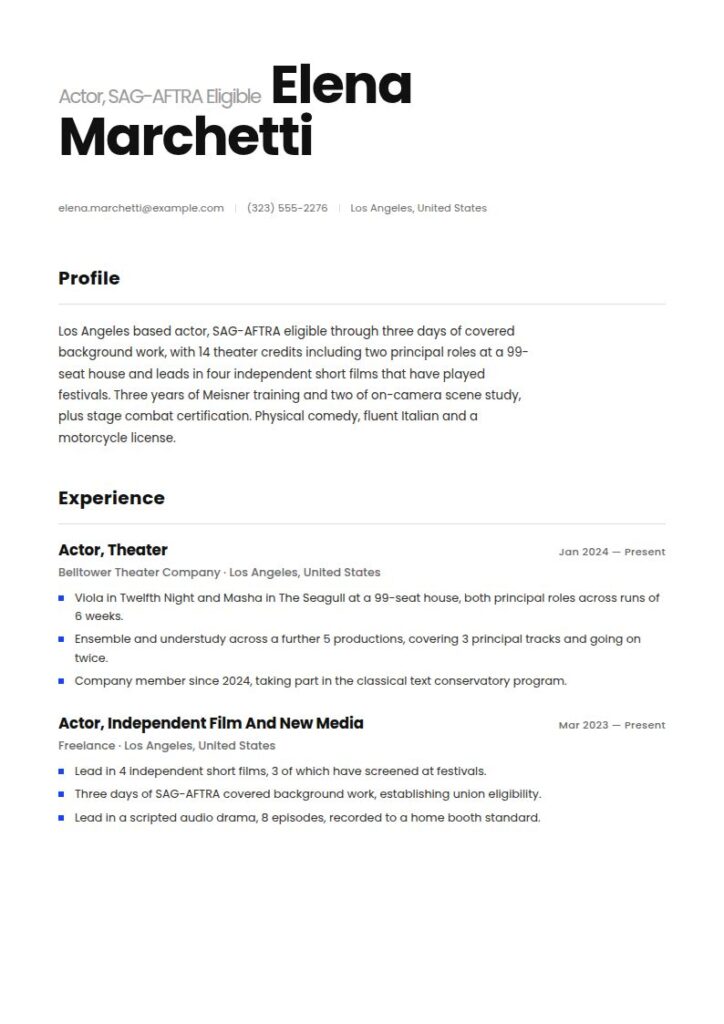
Los Angeles based actor, SAG-AFTRA eligible through three days of covered background work, with 14 theater credits including two principal roles at a 99-seat house and leads in four independent short films that have played festivals. Three years of Meisner training and two of on-camera scene study, plus stage combat certification. Physical comedy, fluent Italian and a motorcycle license.
Work Experience
01/2024 - Present, Actor, Theater, Belltower Theater Company, Los Angeles, United States
- Viola in Twelfth Night and Masha in The Seagull at a 99-seat house, both principal roles across runs of 6 weeks.
- Ensemble and understudy across a further 5 productions, covering 3 principal tracks and going on twice.
- Company member since 2024, taking part in the classical text conservatory program.
03/2023 - Present, Actor, Independent Film and New Media, Freelance, Los Angeles, United States
- Lead in 4 independent short films, 3 of which have screened at festivals.
- Three days of SAG-AFTRA covered background work, establishing union eligibility.
- Lead in a scripted audio drama, 8 episodes, recorded to a home booth standard.
Education
08/2012 - 05/2016, Bachelor of Fine Arts, Acting, California State University, Long Beach, Long Beach, United States
Conservatory-style acting program with classical text, movement and voice.
Skills
Meisner technique, 80
On-camera scene study, 70
Stage combat, unarmed and rapier, 75
Classical verse and text, 75
Physical comedy, 80
Self-tape recording and editing, 80
Languages
English, native
Italian, native
Spanish, intermediate
Certificates
04/2025, Stage Combat, unarmed and rapier and dagger, Society of American Fight Directors
Skills proficiency test passed.
06/2023, Meisner Technique, three-year program, Ravenswood Studio
Summary
An actor resume is a one page document trimmed to 8x10 and stapled to the back of a headshot, and its format is not a style choice: credits grouped by medium, role type rather than character name, a union status line, a training block and special skills you can perform on request. This guide gives you three adaptable versions and current Bureau of Labor Statistics figures for actors.
Actor resume examples by experience level
An actor resume is a one page document, trimmed to 8 by 10 inches and attached to the back of your headshot, listing credits by medium, your union status, your training and the skills you can actually do if someone asks you to do them in the room.
In fact, it is the one resume in this library that does not follow the ordinary rules. In other words, no summary paragraph, no bullets describing responsibilities, no reverse chronological employment history with dates, no home address. Sending a standard business resume to a casting office marks you as new before anyone reads a line, which is why the format section here is the longest one.
Actors had a median hourly wage of $29.05 in May 2025, and the Bureau of Labor Statistics publishes no annual median for the occupation because the work is intermittent (BLS Occupational Outlook Handbook, actors, last modified 27 August 2026). As a result, that fact shapes everything else on the page.
Resume guide for an actor resume
To start, this guide and the corresponding actor resume example will cover:
- First, how to build an actor resume to the format casting expects
- Then, credits by medium, role type, and why the character name comes off
- Also, three adaptable profiles: pre-union, union working actor and series level
- Next, union status, and how SAG-AFTRA and Equity eligibility works
- Finally, what the published figures say about pay, and what they cannot say
How to write an actor resume
Six blocks, in this order: name and union status, contact and representation, physical statistics if asked, credits by medium, training, and special skills. One page, always, trimmed rather than printed small.
The order is not a preference. A reader in a casting office is holding a stack of headshots, turning each over and deciding in seconds whether to keep it. Therefore, the union line and the top credits have to be where their eye already is.
| Block | What it is answering | Where it goes |
|---|---|---|
| Name and union status | Which agreements can this person be hired under? | Top, with the name |
| Representation | Who do I call to book them? | Under the name, with the agency |
| Credits by medium | What have they done, at what level, for whom? | The body, grouped and ordered |
| Training | Who taught them, and what technique? | Below credits, with named studios |
| Special skills | Can they ride, fence, tumble, speak that? | Last block, one or two lines |
Role type is a casting fact; the character name is not
On a film or television credit, write the role type rather than the character's name: Lead, Supporting, Principal, Featured, Series Regular, Recurring, Guest Star, Co-Star. On a theater credit the convention flips and the character name goes in, because a reader who knows the play knows the size of the part immediately.
The reason is size. A character name tells a casting director nothing unless they have seen the film. "Supporting" tells them where you sat on the call sheet, which is the information they are trying to extract.
Do not inflate. Role type is easy to verify, and a co-star written as a supporting is the kind of error remembered by an office you will be submitting to for years.
Run the finished file through the ATS resume checker if you are also applying for teaching, theater administration or brand work, where applications are parsed before a person sees them. You do not build the casting version for a parser, and it does not need to suit one.
Choosing the best resume format for an actor resume
One page, portrait, cut to 8 by 10 inches so it sits flush with the headshot you attach it to. Then staple in all four corners, or print it on the reverse.
Instead, you group credits by medium and order them by strength within each group, not by date. A guest star from three years ago belongs above a co-star from last month, because the reader is measuring level rather than recency.
The usual groups:
| Group | What goes in it |
|---|---|
| Film | Feature and short film, with role type and production company |
| Television | Series and episodic work, with role type and network |
| Theater | Production, character name, and theater or company |
| Commercial | Not listed individually. Write "Conflicts available upon request" |
| New media and voice | Web series, podcast drama, games, audiobooks, animation |
However, commercials are the exception that surprises everyone. In short, you do not list them, because a competing brand's casting office does not want to know which categories you are conflicted in. Instead, the line "Conflicts available upon request" is the whole entry, and it is what a working commercial actor writes.
Include your contact information
| ✅ Right | ❌ Wrong |
|---|---|
| Elena Marchetti | Elena Marchetti |
| SAG-AFTRA, AEA | Aspiring actress, passionate about storytelling |
| Represented by Calder Talent, (323) 555-2276 | 4411 Vineland Avenue, Apt 8, Los Angeles, CA 91602 |
| [email protected] | [email protected], DOB 14 June 1994 |
| Height 5'6", Hair brown, Eyes hazel | Height 5'6", Weight 128 lb, Age 32, Dress size 6 |
Above all, never put your home address on an actor resume. After all, you hand this document to strangers in volume, they leave it on tables and photograph it, and no casting process needs your street.
Similarly, leave age and date of birth off too. Casting asks for an age range when it wants one, and a number narrows you for no benefit. Under 18 is different, because work permits and trust accounts make age a legal fact rather than a casting one.
With representation, for example, the agency's contact goes on the page and yours may not. Without it, on the other hand, use a professional email and a phone number you will answer.
Make use of a summary
Of course, the casting version has no summary; the credits are the summary. But you will be asked for a profile paragraph constantly: on casting platforms, in an agency query, in a submission for teaching artist or corporate work, and in the bio a theater program prints. Even so, write it once, properly, in three versions.
Los Angeles based actor, SAG-AFTRA eligible through three days of covered background work, with 14 theater credits including two principal roles at a 99-seat house and leads in four independent short films that have played festivals. Three years of Meisner training and two of on-camera scene study, plus stage combat certification. Physical comedy, fluent Italian and a motorcycle license.
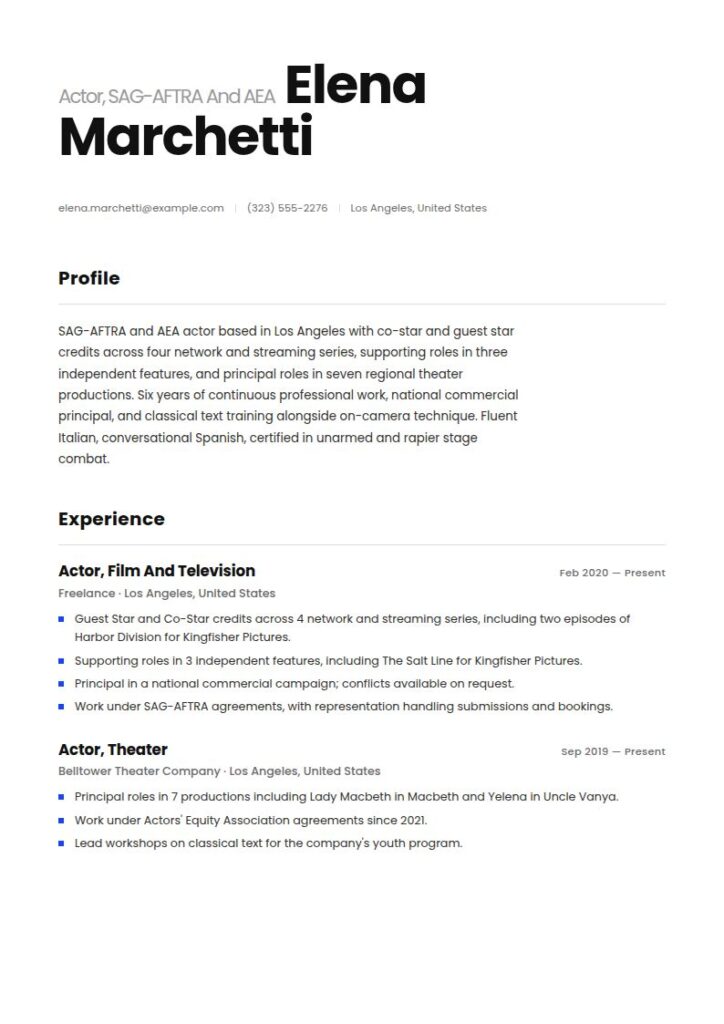
SAG-AFTRA and AEA actor based in Los Angeles with co-star and guest star credits across four network and streaming series, supporting roles in three independent features, and principal roles in seven regional theater productions. Six years of continuous professional work, national commercial principal, and classical text training alongside on-camera technique. Fluent Italian, conversational Spanish, certified in unarmed and rapier stage combat.
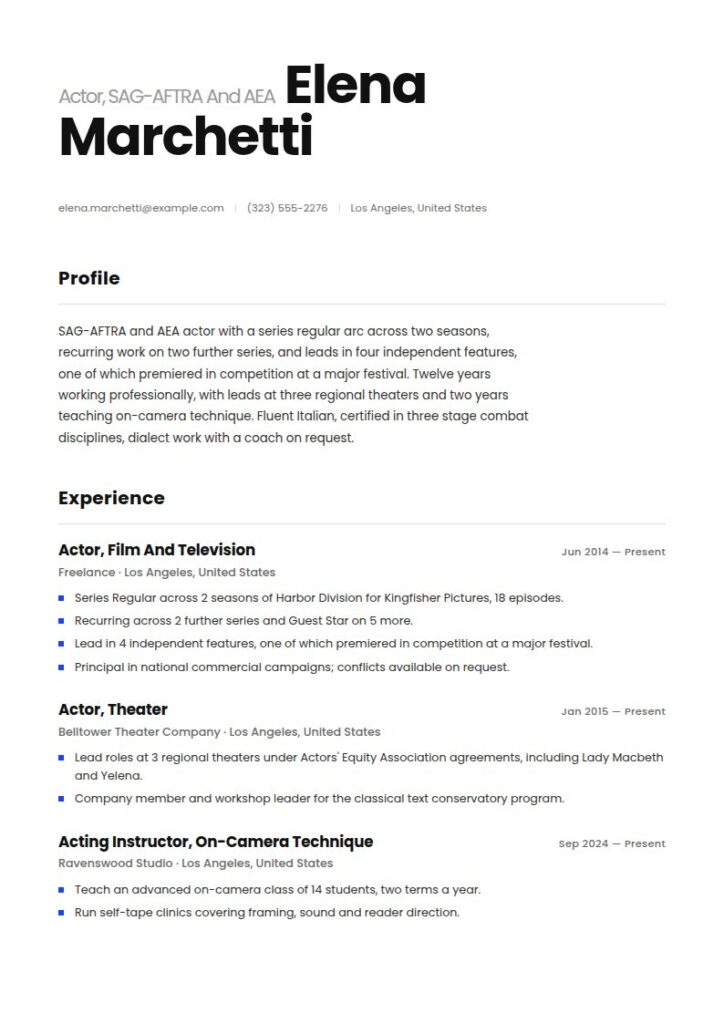
SAG-AFTRA and AEA actor with a series regular arc across two seasons, recurring work on two further series, and leads in four independent features, one of which premiered in competition at a major festival. Twelve years working professionally, with leads at three regional theaters and two years teaching on-camera technique. Fluent Italian, certified in three stage combat disciplines, dialect work with a coach on request.
Right vs wrong: the same actor profile, twice
| ✅ Right | ❌ Wrong |
|---|---|
| SAG-AFTRA and AEA actor based in Los Angeles. | Passionate and versatile actress with a love of the craft. |
| Co-star and guest star credits across four network and streaming series. | Extensive experience in film, television and theater. |
| Principal roles in seven regional theater productions. | Has worked with many talented directors on a variety of projects. |
| Fluent Italian and certified in unarmed and rapier stage combat. | Quick learner, team player, willing to travel. |
By contrast, the right column gives four checkable facts about what casting can hire you to play. Meanwhile, the left could describe anyone who has taken a class.
Outline your credits
In fact, this is the body of the document, replacing the employment history every other resume has. Four columns, no bullets, no dates.
| Column | Film and television | Theater |
|---|---|---|
| 1 | Production title | Production title |
| 2 | Role type (Lead, Guest Star, Co-Star) | Character name |
| 3 | Production company or network | Theater or company |
| 4 | Director | Director |
| Instead of | Use |
|---|---|
| The Salt Line, Miranda, 2023 | The Salt Line, Supporting, Kingfisher Pictures |
| Harbor Division, appeared as a nurse | Harbor Division, Co-Star, Kingfisher Pictures |
| Various commercials for national brands | Commercial, conflicts upon request |
| Community theater production of Macbeth | Macbeth, Lady Macbeth, Belltower Theater Company |
| Background work on several TV shows | (omit once you have principal credits) |
FILM The Salt Line, Supporting, Kingfisher Pictures Nine Bright Hours, Lead, independent feature Every Third Winter, Supporting, independent feature
TELEVISION Harbor Division, Guest Star, Kingfisher Pictures Harbor Division, Co-Star, Kingfisher Pictures Ashfall County, Co-Star, independent streaming series
THEATER Macbeth, Lady Macbeth, Belltower Theater Company Uncle Vanya, Yelena, Belltower Theater Company Twelfth Night, Viola, regional repertory production
COMMERCIAL Conflicts available upon request
NEW MEDIA AND VOICE The Quiet Hour, Lead, scripted audio drama
Also, background and extra work comes off the moment you have principal credits. It is not shameful and it pays rent, but listing it tells a casting office that principal work is not yet your level. Keep it on your casting platform profile, where it is a booking record rather than a claim.
The actor resume is its own document, and the format rules are the job
Everything above has been format, and that is not an accident. For most occupations, of course, formatting is presentation and the content carries the hire. Here the format is a competence test, because these conventions are the ones a working actor absorbs in their first two years and a new one has never been told. In practice, five rules do most of the sorting.
One page, trimmed to 8×10. A resume printed on letter paper and stapled to a headshot overhangs by an inch on two sides. It folds, it tears, and the office notices.
Credits by medium, ordered by strength. Never one chronological list. Film, television, theater, commercial, new media, each a block, each ordered by the size of the credit rather than the date.
Role type, not character name, on screen credits. Lead, Supporting, Principal, Featured, Series Regular, Recurring, Guest Star, Co-Star. Theater keeps the character name.
Union status on the first line. Write exactly what you hold: SAG-AFTRA, AEA, SAG-AFTRA eligible, or nothing. Do not write "eligible" unless you are, because the office can check it in one call.
Special skills you can perform on request. That block is a promise, not a wish list.
SAG-AFTRA status on an actor resume
The union line deserves its own paragraph, because it is a legal fact rather than a description. SAG-AFTRA represents approximately 160,000 performers and media professionals across 25 locals (SAG-AFTRA, membership page last updated 12 March 2026). There are three routes in: proof of covered employment as a principal performer or recording artist, which can be a single day; proof of three days of covered employment as a background actor; or one year in an affiliated performers' union with paid work as a principal performer (SAG-AFTRA, steps to join, accessed 17 September 2026). However, the union does not accept background vouchers alone as proof; it asks for pay stubs, a performer contract or a payroll printout. Moreover, joining is not free: the national initiation fee is $3,121, with annual base dues of $246.14 plus work dues of 1.575 percent of covered earnings (SAG-AFTRA, membership costs, accessed 17 September 2026).
Stage work, however, runs through a different union. Actors' Equity Association represents more than 51,000 professional actors and stage managers (Actors' Equity Association, about Equity, accessed 17 September 2026), and since it made Open Access permanent on 8 February 2023 any theater worker who can demonstrate professional work as an actor or stage manager in Equity's jurisdiction can join, with a contract copy and proof of pay and at least a $600 initial payment due with the application (Actors' Equity Association, announcement of 8 February 2023, and join page accessed 17 September 2026).
Write whichever applies and nothing more. "Union eligible, willing to join" belongs in an email, not on the document.
A flat occupation where almost every opening is a replacement
Employment of actors was 67,500 in 2025 and is projected to be 67,500 in 2035, a change of 0 percent, with about 6,300 openings projected each year over the decade (BLS Occupational Outlook Handbook, actors, 2025 to 2035 projections published 27 August 2026).
The work is also dispersed. Self-employed workers account for 23 percent of actors, theater companies and dinner theaters for 10 percent, accounting, tax preparation, bookkeeping and payroll services for 8 percent, amusement parks and arcades for 7 percent, and educational services for 4 percent (same source, May 2025). That third category is payroll companies, which is how much production work is administered.
Two things follow. There is no growth to ride, so every booking displaces someone else, which is why format literacy matters at all. And the industries paying for acting are broader than film and television, so theme park performance, educational theater and voice work belong on the page rather than hidden.
Build a snapshot of your special skills
One or two lines at the bottom, and it is the block casting offices read closely, because it is where a solution to a specific problem appears.
Special skills: Stage combat (unarmed, rapier and dagger, broadsword, SAFD certified 2025), fluent Italian, conversational Spanish, standard and RP English dialects, mezzo-soprano (belt to E5), classical piano, horseback riding (English), manual transmission, motorcycle license, competitive swimming, teleprompter, improv (long form).
In practice, casting offices enforce the rule in the room. Again, everything in this block is something you can do on request, immediately, without practice. In other words, not something you did at school, not something you would enjoy learning. If a casting director asks you to demonstrate it and you cannot, that is the last thing they will remember about the meeting.
Likewise, accents and dialects belong here only if you can hold them under pressure, and anything with a certification behind it should name the disciplines and the certifying body rather than saying "stage combat experience".
List your training and education
Training goes on the resume, although a degree may or may not. BLS gives the typical entry-level education for actors as some college with no degree plus long-term on-the-job training (BLS Occupational Outlook Handbook, last modified 27 August 2026), which reflects the real route: a conservatory, a studio, a technique teacher and years of class.
Name the teacher. For this reason, casting directors and agents know the studios and teachers in their city, and the name tells them what kind of actor your training has made you.
TRAINING
Meisner Technique, three years, Ravenswood Studio, Los Angeles
On-Camera Scene Study, two years, Ravenswood Studio, Los Angeles
Classical Text and Verse, one year, Belltower Theater Company conservatory program
Voice and Speech, ongoing, private coach
Stage Combat, unarmed, rapier and dagger, broadsword, certified 2025
Bachelor of Fine Arts, Acting, 2016
Put ongoing training on the page. An actor in class this year reads differently from one whose training block stops a decade ago, and it is the cheapest signal that you are still working at it.
Choose the right layout and design
As for layout, plain, legible, one typeface, 10 to 12 point, name at the top in a larger size. Also align columns with tab stops rather than typed spaces, because misaligned columns are the most common tell on a new actor's resume. No graphics, no borders, no photograph on the resume itself, since the headshot is already on the other side.
Save two versions. In short, the casting version is the trimmed 8×10 this page describes. The second, by contrast, is a plain document for teaching posts, theater administration, corporate work and grant applications, where a system reads it first.
Trim the page to 8×10 and attach it to the headshot. Put union status on the first line and keep it accurate. Group credits by medium and order them by strength. Use role type on screen credits and character names in theater. Write "conflicts available upon request" for commercials. Name your teachers and studios. Update the file every time a credit lands.
Do not put your home address, age, date of birth or weight on the page. Do not list background work once you have principal credits. Do not inflate a co-star into a supporting role. Do not list a skill you would need a week to prepare. Do not include a summary paragraph or bullets describing responsibilities. Do not send the casting version into an applicant tracking system.
Actor job market and outlook
Overall, a small, flat occupation with intermittent work, a wide earnings spread and no published annual wage.
| Measure | Value |
|---|---|
| Actor jobs, 2025 | 67,500 |
| Projected change, 2025-35 | 0% (little or no change), 0 |
| Projected annual openings | ~6,300 |
| Typical entry-level education | Some college, no degree |
| Typical on-the-job training | Long term |
| Median hourly wage, May 2025 | $29.05 |
| Annual median wage | Not published; work is intermittent |
Source: U.S. Bureau of Labor Statistics, Occupational Outlook Handbook, actors, 2025 to 2035 projections and May 2025 wage data, page last modified 27 August 2026.
Here, then, is where the work sits, and what it pays hourly:
| Industry | Share of employment | Median hourly wage (May 2025) |
|---|---|---|
| Self-employed workers | 23% | Not published |
| Theater companies and dinner theaters | 10% | $25.53 |
| Accounting, tax preparation, bookkeeping and payroll services | 8% | $29.92 |
| Amusement parks and arcades | 7% | $18.70 |
| Educational services | 4% | $22.34 |
Source: U.S. Bureau of Labor Statistics, Occupational Outlook Handbook, May 2025.
What you can expect to earn as an actor
BLS publishes no annual median wage for actors, and the Handbook states the reason plainly: the work is intermittent, so nobody can multiply an hourly figure into a year. Any site showing you an annual salary for actors has done that multiplication anyway, and the number is an invention.
Instead, what BLS publishes is the hourly spread, and it is wide. For instance, the median hourly wage was $29.05 in May 2025, with the lowest 10 percent under $16.50 an hour and the highest 10 percent above $143.68 an hour (BLS Occupational Outlook Handbook, May 2025 wage data published 27 August 2026).
Consequently, your resume is not selling a salary band; it is selling castability and reliability. What moves your earnings is the mix: how many union days you work in a year, whether your credits are principal rather than background, whether commercial and voice work is part of it, and whether you hold the second and third skills that let a production cast one person instead of two. That last one is why special skills is not decoration.
Key takeaways for an actor resume
- In summary, one page, trimmed to 8×10, attached to the back of the headshot.
- Next, union status on the first line, exactly as it stands.
- In addition, credits grouped by medium and ordered by strength, never by date.
- Similarly, role type on screen credits; character names in theater.
- Likewise, commercials are one line: conflicts available upon request.
- Name your teachers and studios, and show training you are still doing.
- Finally, special skills are only things you can perform on request, and no home address, age or weight goes on the page.
Build your actor resume in 15 minutes with our AI resume builder.
Related creative and artistic resume examples
- Voice actor resume
- Musical theater resume
- Stage manager resume
- Screenwriter resume
- Film producer resume
- Videographer resume
- Cinematographer resume
- Choreographer resume
- Dance teacher resume
- Musician resume
- Costume designer resume
- Theater resume
Pair it with a matching actor cover letter.
Actor resume questions, answered
How long should an actor resume be?
One page, without exception, trimmed to 8 by 10 inches. With more credits than fit, cut the weakest rather than adding a second page. An edited page reads as a career with a shape; two pages reads as someone who cannot tell which credits matter.
Should I put my age or date of birth on an actor resume?
No. Casting asks for an age range when it needs one, and a number on the page narrows you for nothing in return. Under 18 is the exception, because work permits and trust account rules make age a legal requirement rather than a casting preference.
What do I put on an actor resume with no professional credits?
Training first, then student films, short films, showcases, staged readings and university productions, in the same format as professional credits but honestly labeled. Add the special skills block, which costs nothing and occasionally books the job on its own. Never invent a credit; the community is small and it gets checked.
Do I list commercials on my actor resume?
No, not individually. Write "Conflicts available upon request" as the whole commercial section. Listing brands tells a competing advertiser which categories you are conflicted in, which can cost you an audition.
How do I show union status if I am eligible but have not joined?
Write "SAG-AFTRA eligible" and nothing more. Eligibility comes from covered employment: one day as a principal performer or recording artist, three days as a background actor, or a year in an affiliated union with paid principal work (SAG-AFTRA, steps to join, accessed 17 September 2026). Joining costs a $3,121 national initiation fee plus base dues, so eligibility without membership is a normal position to hold.