Alterations Specialist Yusuf Demirci
Alterations Specialist
[email protected] | (216) 555-2330 | Cleveland, United States
Profile
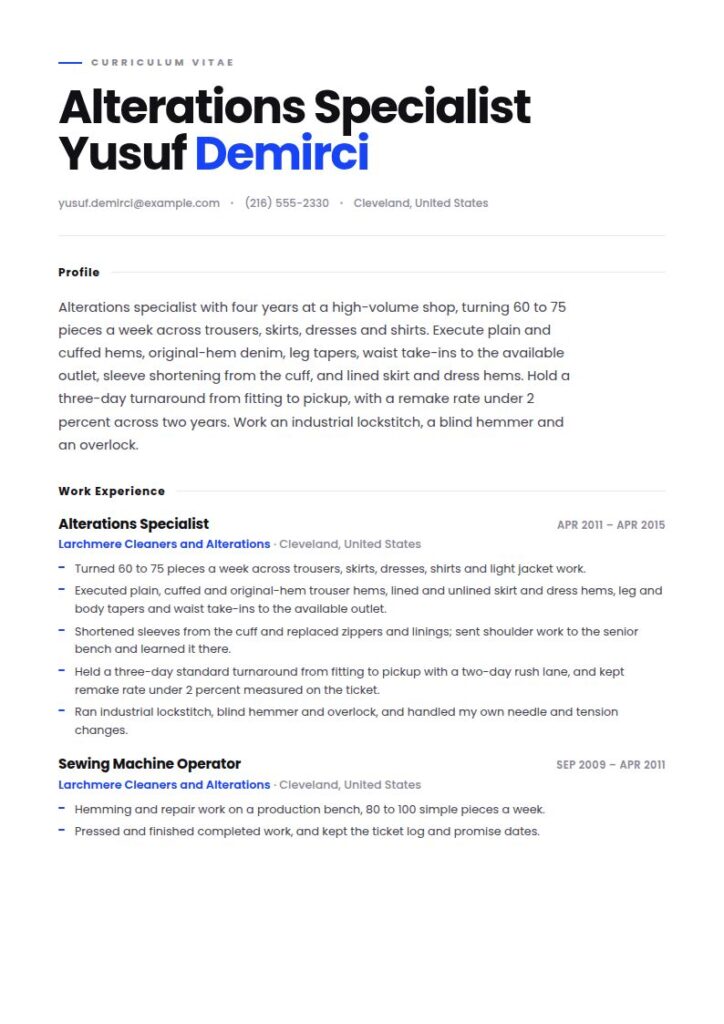
Alterations specialist with four years at a high-volume shop, turning 60 to 75 pieces a week across trousers, skirts, dresses and shirts. Execute plain and cuffed hems, original-hem denim, leg tapers, waist take-ins to the available outlet, sleeve shortening from the cuff, and lined skirt and dress hems. Hold a three-day turnaround from fitting to pickup, with a remake rate under 2 percent across two years. Work an industrial lockstitch, a blind hemmer and an overlock.
Work Experience
04/2011 - 04/2015, Alterations Specialist, Larchmere Cleaners and Alterations, Cleveland, United States
- Turned 60 to 75 pieces a week across trousers, skirts, dresses, shirts and light jacket work.
- Executed plain, cuffed and original-hem trouser hems, lined and unlined skirt and dress hems, leg and body tapers and waist take-ins to the available outlet.
- Shortened sleeves from the cuff and replaced zippers and linings; sent shoulder work to the senior bench and learned it there.
- Held a three-day standard turnaround from fitting to pickup with a two-day rush lane, and kept remake rate under 2 percent measured on the ticket.
- Ran industrial lockstitch, blind hemmer and overlock, and handled my own needle and tension changes.
09/2009 - 04/2011, Sewing Machine Operator, Larchmere Cleaners and Alterations, Cleveland, United States
- Hemming and repair work on a production bench, 80 to 100 simple pieces a week.
- Pressed and finished completed work, and kept the ticket log and promise dates.
Education
08/2004 - 05/2006, Associate of Applied Science, Fashion Design and Apparel Technology, Cuyahoga Community College, Cleveland, United States
Pattern drafting, industrial machine operation and garment construction. Completed a five-year traditional tailoring apprenticeship before emigrating, finishing in 2002.
Skills
Plain, cuffed and original-hem trouser hems, 95
Lined and unlined skirt and dress hems, 90
Leg and body tapers, 90
Waist take-in and let-out to the outlet, 85
Sleeve shortening from the cuff, 85
Industrial single-needle lockstitch, 90
Blind hemmer, 90
Overlock and serger, 85
Zipper and lining replacement, 85
Languages
English, fluent
Turkish, native
Certificates
06/2002, Traditional tailoring apprenticeship, five years, Master tailor supervision, Istanbul
Pattern drafting, canvas construction, hand finishing and bespoke trousers.
Summary
A tailor resume is a one to two page document that lists the alterations you can execute at the bench, the turnaround you hold from fitting to pickup, your remake rate, and the machines and hand skills you own. This guide gives you three adaptable versions and explains why there is no federal wage figure for the occupation and what to price against instead.
Tailor resume examples by experience level
In short, a tailor resume is a one to two page document that says which operations you can execute, how fast, and how often the garment comes back.
However, almost every tailor resume says "experienced in all types of alterations". A shop owner learns nothing from that, because the distance between hemming trousers and recutting the chest of a canvassed coat is most of the trade.
Resume guide for a tailor resume
In particular, this guide and the corresponding tailor resume example will cover:
- How to write a tailor resume, section by section
- The alteration ladder, and how to say where you sit on it
- Three adaptable summaries: alterations specialist, tailor and, finally, master tailor
- Turnaround, remake rate and capacity, and why all three belong on the page
- What the job market looks like, and what to price against with no federal wage figure
How to write a tailor resume
Six sections: contact header, summary, alteration capability, experience, machines and hand skills, then training and certifications. Use one page for your first five years, then two once you take bespoke or bridal work and run a bench.
The order follows what a shop owner needs before putting you on a ticket: what you can cut into, how fast you turn it, and what it costs them when you are wrong.
| Section | What it is answering | Where it goes |
|---|---|---|
| Alteration capability | Which operations can this person execute unsupervised? | Directly under the summary |
| Experience | At what volume, in what kind of shop, on what garments? | Reverse chronological, with weekly piece counts |
| Machines and hand skills | Can they work my bench, and what do they bring? | Grouped, named by machine type |
| Training and certifications | Anything checkable in an unlicensed trade | Short, at the foot |
Say what you can cut into, not what you have seen
The most useful line on a tailor's resume is a boundary. "I take jackets to the shoulder, including sleeve pitch and collar gap. I do not recut canvassed chests." A shop owner can staff around that immediately, and it reads as someone who knows a repair from a rebuild.
The opposite line, "all alterations", forces a trial that costs the shop a garment. Write the boundary, then write the thing just above it that you are working toward. That is a hiring conversation rather than a claim.
Run the finished file through the ATS resume checker before you submit. Retail chains, uniform contractors and bridal groups recruit through applicant systems even for bench roles.
Choosing the best resume format for a tailor resume
Go reverse chronological; in addition, promote the alteration capability block above experience. A tailor is hired for a skill ceiling rather than a career arc, and the capability list is the fastest way to state it.
Keep the timeline visible anyway. After all, shops care about volume, and volume is a function of years at a bench. For this reason, a format that hides dates reads as someone covering a gap, which in a trade that runs on trust is expensive.
Include your contact information
| ✅ Right | ❌ Wrong |
|---|---|
| Yusuf Demirci | Yusuf Demirci |
| Tailor: menswear, bridal, bespoke trousers and jackets | Skilled seamster with years of experience |
| Take jackets to the shoulder. Recut canvassed chests. Bridal bustles and lace. | All types of alterations |
| Own industrial lockstitch, blind hemmer and overlock; hand pad-stitch and pick stitch | Very good with a sewing machine |
| (216) 555-2330, [email protected], Cleveland, OH | (216) 555-2330, [email protected] |
Also, two lines belong in the header, yet nobody puts them there. The garment types you take, because menswear, bridal, leather and uniform are four different shops. And whether you bring machines, because a tailor with their own blind hemmer changes what a small shop can offer.
Make use of a summary
Keep it to four lines: the garments you take, the top of your capability ladder, your weekly volume and turnaround, and finally one number about quality.
Alterations specialist with four years at a high-volume shop, turning 60 to 75 pieces a week across trousers, skirts, dresses and shirts. Execute plain and cuffed hems, original-hem denim, leg tapers, waist take-ins to the available outlet, sleeve shortening from the cuff, and lined skirt and dress hems. Hold a three-day turnaround from fitting to pickup, with a remake rate under 2 percent across two years. Work an industrial lockstitch, a blind hemmer and an overlock.
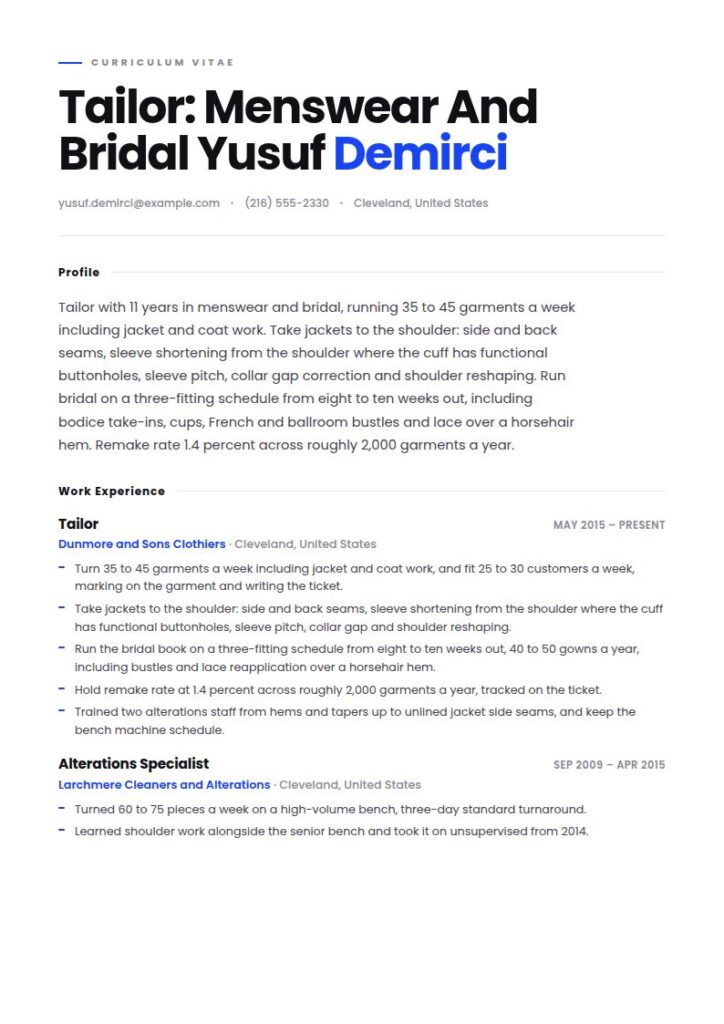
Tailor with 11 years in menswear and bridal, running 35 to 45 garments a week including jacket and coat work. Take jackets to the shoulder: side and back seams, sleeve shortening from the shoulder where the cuff has functional buttonholes, sleeve pitch, collar gap correction and shoulder reshaping. Run bridal on a three-fitting schedule from eight to ten weeks out, including bodice take-ins, cups, French and ballroom bustles and lace over a horsehair hem. Remake rate 1.4 percent across roughly 2,000 garments a year.
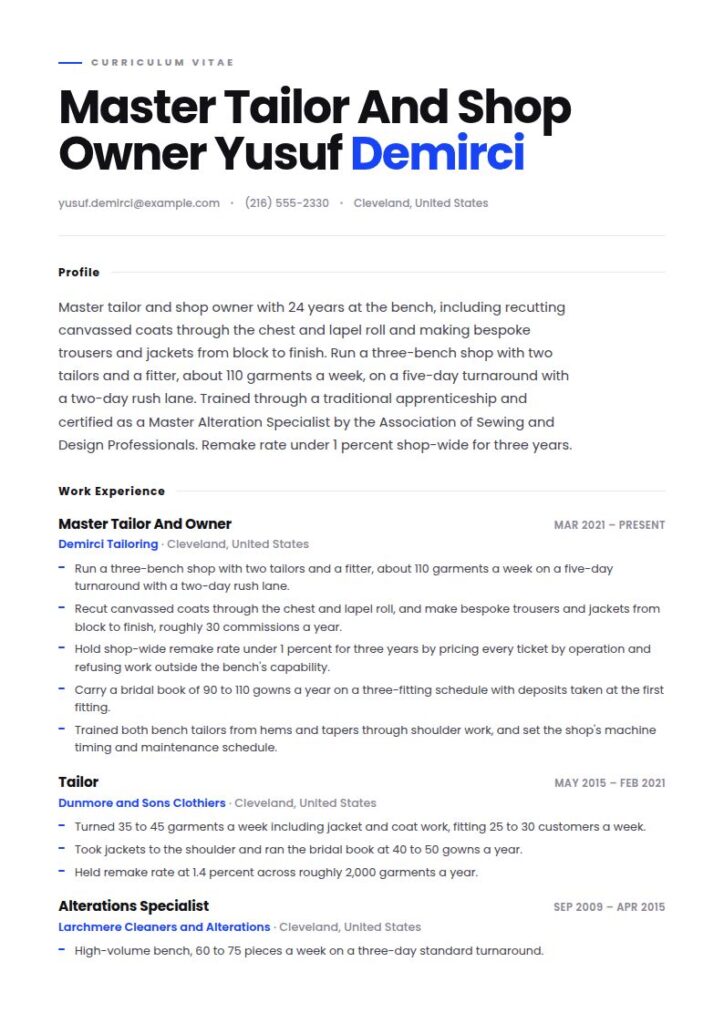
Master tailor and shop owner with 24 years at the bench, including recutting canvassed coats through the chest and lapel roll and making bespoke trousers and jackets from block to finish. Run a three-bench shop with two tailors and a fitter, about 110 garments a week, on a five-day turnaround with a two-day rush lane. Trained through a traditional apprenticeship and certified as a Master Alteration Specialist by the Association of Sewing and Design Professionals. Remake rate under 1 percent shop-wide for three years.
Right vs wrong: the same tailor summary, twice
| ✅ Right | ❌ Wrong |
|---|---|
| Tailor with 11 years in menswear and bridal, 35 to 45 garments a week including jacket work. | Experienced seamster skilled in all types of clothing alterations. |
| Take jackets to the shoulder: sleeve pitch, collar gap, shoulder reshaping. | Able to handle even the most difficult alterations. |
| Remake rate 1.4 percent across roughly 2,000 garments a year. | Known for excellent quality and attention to detail. |
The right column, for example, can go on a work schedule this week. The left, in contrast, has to be tested on a customer's garment, a cost the shop would rather not carry.
Outline your tailoring experience
Then list the shop, the kind of work it takes, and dates. Then three to five bullets, each with a volume, an operation or a quality number in it.
| Instead of | Use |
|---|---|
| Performed alterations on a wide range of garments | Turned 60 to 75 pieces a week: trousers, skirts, dresses, shirts, light jacket work |
| Worked with bridal gowns | Ran bridal on a three-fitting schedule from eight weeks out, 40 to 50 gowns a year |
| Maintained high quality standards | Remake rate 1.4 percent across roughly 2,000 garments a year |
| Used various sewing machines | Ran industrial lockstitch, blind hemmer, overlock and keyhole buttonhole machine, and did my own timing |
Tailor, Dunmore and Sons Clothiers, Cleveland, OH, May 2015 to Present. Menswear retailer with an in-house bench, plus bridal by appointment.
Turn 35 to 45 garments a week including jacket and coat work, and fit 25 to 30 customers a week, marking on the garment and writing the ticket myself.
Take jackets to the shoulder: side and back seams, sleeve shortening from the shoulder where the cuff has functional buttonholes, sleeve pitch, collar gap and shoulder reshaping.
Run the bridal book on a three-fitting schedule from eight to ten weeks out, 40 to 50 gowns a year: bodice take-ins, cups, French and ballroom bustles, lace reapplication over a horsehair hem.
Hold remake rate at 1.4 percent across roughly 2,000 garments a year, tracked on the ticket.
Trained two alterations staff from hems and tapers up to unlined jacket side seams, and keep the bench machine schedule.
The alteration ticket, and what you can execute at the bench
However, this is the section that decides the hire, and almost every tailor resume is missing it.
An alteration ticket is a contract written in operations: what was bought, what the fitting agreed, what will be cut, what it costs and when it is ready. A shop owner staffing a bench is asking which tickets they can hand you without checking, so write the ladder and mark where you sit on it.
Level one, the hem and the taper. Plain and cuffed trouser hems, original-hem denim, lined and unlined skirt and dress hems, leg and shirt body tapers, waist take-in and let-out to the available outlet. This is the volume of most shops, judged on speed and on the hem being invisible from the face.
Level two, the sleeve. Shortening from the cuff is routine. Shortening from the shoulder is the operation that separates an alterations hand from a tailor: it is required when the cuff carries functional buttonholes or the sleeve has a defined head, and it means detaching the sleeve, re-setting the pitch and rebuilding the head. Say which of the two you do.
Jacket, canvas and bridal tailoring skills
Level three, the jacket body. Side seams, back seam, collar gap correction, sleeve pitch and shoulder reshaping. Here you work against a canvas and shapes the maker built in, and the risk of an unfixable result rises sharply.
Level four, recutting a canvassed coat. Opening the chest, working the canvas and padding, rebuilding the lapel roll. Few alterations people do this and every shop wants to know whether you are one of them.
Bridal, which is its own ladder. Bodice take-ins, cups and boning, French, American and ballroom bustles, lace reapplication so the pattern still reads, and hems over horsehair. Bridal runs on a schedule and a deposit rather than a same-week turnaround, which changes how you book the bench.
Execute unsupervised: plain, cuffed and original-hem trouser hems; lined and unlined skirt and dress hems; leg and body tapers; waist take-in and let-out to the outlet; sleeve shortening from the cuff and from the shoulder; jacket side and back seams; collar gap; sleeve pitch; shoulder reshaping; zipper and lining replacement.
Take on with time booked: recutting a canvassed coat through the chest and lapel roll; bespoke trousers from block to finish; leather taper and lining.
Bridal: three-fitting schedule from eight to ten weeks out. Bodice take-in, cups and boning, French, American and ballroom bustles, lace reapplication, horsehair hems. Deposit at the first fitting, balance at pickup.
Turnaround: three-day standard from fitting to pickup, two-day rush lane, seven days on jacket work with a shoulder operation.
Volume and quality: 35 to 45 garments a week, 25 to 30 fittings, remake rate 1.4 percent across roughly 2,000 garments a year.
In practice, three numbers in that block do most of the work. Turnaround tells a shop whether you fit their promise date. Similarly, weekly volume tells them what you cost per piece. The remake rate is the one nobody quotes and the one an owner cares most about, because a remake costs the labor twice.
Build a snapshot of your key skills
In practice, list ten to fourteen entries grouped by machines, hand skills, fitting and the commercial side of a bench. Name machine types, because a shop is deciding whether you can sit at theirs on day one.
Machines: Industrial single-needle lockstitch, Blind hemmer, Overlock and serger, Keyhole and straight buttonhole machines, Bar tack, Walking foot for leather, Industrial steam press and puff iron, Own timing and tension changes
Hand skills: Pad stitching a canvas and lapel, Pick stitch and hand felling, Hand-set sleeve and pitch correction, Invisible hemming, Hand-finished buttonholes, Bridal lace and beading repair
Fitting and pattern: Marking on the garment, Fitting for posture and stance, Pattern drafting for trousers and jackets, Grading
Shop and commercial: Writing the operations ticket, Pricing by operation, Promise dates and bench scheduling, Bridal deposits and fitting calendars
List your education and certifications
Short, at the foot. Tailoring is not licensed anywhere in the United States, so anything checkable is worth its space.
Master Alteration Specialist, Association of Sewing and Design Professionals, 2019.
Associate of Applied Science, Fashion Design and Apparel Technology, Cuyahoga Community College, Cleveland, OH, 2006.
Traditional tailoring apprenticeship, five years, completed 2002: pattern drafting, canvas construction, hand finishing, bespoke trousers.
Additional: Bridal fitting and bustle workshop, 2021.
The two national credentials worth knowing about both come from the Association of Sewing and Design Professionals. The Master Alteration Specialist program tests five competency areas, Fabrics, Alteration Techniques, Alteration Fit, Alteration Overview and Professional Practices, while the Master Sewing and Design Professional program covers seven, adding Design, Fashion Illustration and Pattern Development; both are national performance-based programs open to anyone with a sewing-related business (Association of Sewing and Design Professionals, certification programs, retrieved 17 September 2026). ONET, sponsored by the U.S. Department of Labor, records the Master Sewing and Design Professional credential as an advanced certification requiring more than two years of post-secondary training and more than two years of work experience, renewed annually through continuing professional development (ONET OnLine, certification record, retrieved 17 September 2026). The American Tailors and Sewing Association separately lists a four-part Certified Professional Tailor series covering men's alterations, with a Certified Bridal Tailor program opening in fall 2026 (American Tailors and Sewing Association, certifications, retrieved 17 September 2026).
None is required to work. Above all, every one is checkable, which in a trade with no license is the point.
Choose the right layout and design
Also use a single column, 11 or 12 point, plain headings, and no photograph, fabric swatches or garment images. Keep the capability list as plain text, because the operation names are the keywords a shop or a chain searches on.
Name the operations you execute unsupervised, in trade words. Say where your ceiling is and what sits just above it. Give weekly garment and fitting counts. State turnaround from fitting to pickup and your rush lane. Quote a remake rate and say how you measured it. List machine types and say which you own.
Do not write "all types of alterations"; it reads as untested. Do not claim shoulder work if you shorten from the cuff only. Do not describe yourself as detail-oriented or a perfectionist. Do not put customer names or photographs of their garments on the page. Do not leave out bridal if you do it, since it is booked and priced differently and shops hire for it specifically.
Tailor job market and outlook
The U.S. In fact, the Bureau of Labor Statistics publishes no current Occupational Outlook Handbook profile for tailors, dressmakers and custom sewers. Indeed, the Handbook's production occupations index, last modified 27 August 2026, lists sixteen profiles and none covers the trade, while the only per-occupation wage pages still reachable belong to a retired, older cycle too stale to put in front of anyone deciding what to ask for. So this page quotes no tailor wage, and names the published occupations that bracket the work instead.
| Bracketing occupation, BLS published | Median annual wage, May 2025 | Why it brackets tailoring |
|---|---|---|
| Retail sales workers | $35,560, or $17.10 an hour | Where alterations attached to a store or a dry cleaner price out |
| Jewelers and precious stone and metal workers | $52,540, or $25.26 an hour | The closest published bench craft: hand skill, custom work, sold through retail |
| Fashion designers | $80,960, or $38.92 an hour | The design end of the same trade, where bespoke and pattern work lands |
Source: U.S. Bureau of Labor Statistics, Occupational Outlook Handbook, May 2025 wage data, pages last modified 27 August 2026.
Among them, the closest bracket in daily shape is jewelers and precious stone and metal workers, and therefore its detail is the most useful reference available.
| Measure, jewelers and precious stone and metal workers | Value |
|---|---|
| Jobs, 2025 | 32,800 |
| Projected employment, 2035 | 31,800 |
| Projected change, 2025-35 | -3 percent, -1,100 |
| Projected annual openings | About 3,700 |
| Median annual wage, May 2025 | $52,540, or $25.26 an hour |
| Typical entry-level education | High school diploma or equivalent, with long-term on-the-job training |
Source: U.S. Bureau of Labor Statistics, Occupational Outlook Handbook, jewelers and precious stone and metal workers, page last modified 27 August 2026.
A small bench craft with a long training path
Jewelers and precious stone and metal workers are projected to decline 3 percent between 2025 and 2035, losing 1,100 jobs while still generating about 3,700 openings a year: a replacement market rather than a growth one (BLS Occupational Outlook Handbook, page last modified 27 August 2026). The retail bracket is flat on a far larger base, with retail salespersons projected at 0 percent change from 4,271,400 jobs, about 550,600 openings a year and a median of $17.03 an hour (BLS, May 2025).
Training is where tailoring differs from the retail end. ONET, sponsored by the U.S. Department of Labor, reports that among people working as tailors, dressmakers and custom sewers, 58 percent give a high school diploma or equivalent as the education required, 17 percent less than a high school diploma and 16 percent a post-secondary certificate (ONET OnLine, 51-6052.00, retrieved 17 September 2026).
Read those together and the resume strategy follows. Formal education is not the screen. What you can execute is, and in a replacement market the shops hiring are usually replacing someone who could do jacket work.
What salary you can expect as a tailor
For this reason, with no current federal wage figure for tailors, treat the three bracketing occupations above as the band an offer sits inside, and where you sit on the alteration ladder as what moves you within it.
For example, at the lower end, hem-and-taper work attached to a dry cleaner or a retail floor prices close to the retail bracket, where retail sales workers had a median of $35,560 a year, or $17.10 an hour (BLS, May 2025). That is piece-rate or hourly work judged on throughput.
In the middle sits bench tailoring proper, which behaves like the other published bench crafts: jewelers and precious stone and metal workers had a median of $52,540 a year, or $25.26 an hour, with the lowest 10 percent under $35,580 and the highest 10 percent over $87,540 (BLS, May 2025). Both are hand skills learned through long on-the-job training and sold through a retail front.
Above that the money changes shape rather than scale. Bespoke making, pattern drafting and shop ownership sit closer to the design end, where fashion designers had a median of $80,960 a year, or $38.92 an hour (BLS, May 2025), though that income is labor, materials margin and returning customers rather than a wage.
Four ways a tailor can earn more
Four things on a resume move you up that band.
Shoulder work. The hinge of the whole ladder. A shop pays differently for someone who does not have to send jackets out.
Bridal. Booked weeks ahead, priced per gown rather than per operation, and carrying a deposit, it stabilizes a bench that would otherwise live on walk-ins.
Your own machines. A tailor who brings a blind hemmer and times their own lockstitch changes what a small shop can take in.
A measured remake rate. It is the only quality figure in this trade an owner can convert directly into money.
Key takeaways for a tailor resume
- First, replace "all alterations" with a named list of operations you execute unsupervised.
- Then say where your ceiling is, and name the operation just above it.
- Next, distinguish sleeve shortening from the cuff from shortening at the shoulder.
- Also give weekly garment and fitting counts, not years alone.
- Similarly, state turnaround from fitting to pickup, plus your rush lane.
- In addition, quote a remake rate and say how you measured it.
- Finally, list machines by type and say which you own.
Build your tailor resume in 15 minutes with our AI resume builder.
Related creative and artistic resume examples
- Fashion designer resume
- Costume designer resume
- Fashion buyer resume
- Jewelry designer resume
- Barber resume
- Floral designer resume
- Visual artist resume
- Artist resume
- Illustrator resume
- Photographer resume
- Modeling resume
- Tattoo artist resume
Pair it with a matching tailor cover letter.
Tailor resume questions, answered
How long should a tailor resume be?
One page for your first five years. Two once you take bespoke or bridal work, run a bench, or have a capability list long enough that cutting it would hide a level of the ladder.
Why is there no BLS salary figure for tailors?
Because the Bureau of Labor Statistics publishes no current Occupational Outlook Handbook profile for tailors, dressmakers and custom sewers. The production occupations index, last modified 27 August 2026, lists sixteen profiles and the trade is not among them, and the older per-occupation wage pages have been retired. Quoting one would mean quoting a figure two cycles out of date, so this guide brackets the work instead.
Do I need a certification to work as a tailor?
No. Tailoring is not licensed anywhere in the United States. Two national certifications exist and are worth listing if you hold one: the Master Alteration Specialist and the Master Sewing and Design Professional, both performance-based programs from the Association of Sewing and Design Professionals (retrieved 17 September 2026).
What is the most important thing on a tailor resume?
The capability boundary: a named list of what you execute unsupervised, ending with the operation just above your ceiling. It is the only part of the page that lets a shop owner schedule you without a trial garment, and most applicants replace it with "all types of alterations".
What do I put on a tailor resume with no shop experience?
Write your training as production: the garments you made, from block or from a commercial pattern, the constructions you completed, and the machines you have run. Then the operations you can execute now, honestly bounded. A shop hiring at the bottom of the ladder is hiring hems and tapers, and a candidate who says exactly that is more employable than one who claims everything.