Assistant Buyer, Women's Apparel Naomi Sterling
Assistant Buyer, Women's Apparel
[email protected] | (614) 555-2328 | Columbus, United States
Profile
Assistant buyer with three years in women's apparel, supporting a $22M open-to-buy across denim, knit tops and dresses for 214 doors and ecommerce. Build and maintain the range plan and the size curve by store cluster, cut and track purchase orders against the vendor ship window, and run the weekly selling recap that drives the markdown meeting. Reduced late deliveries on a 46-vendor base from 17 percent to 6 percent of purchase orders across two seasons by chasing ship windows at the four-week gate.
Work Experience
02/2016 - 02/2019, Assistant Buyer, Women's Apparel, Halsted Apparel Group, Columbus, United States
- Supported a $22M open-to-buy across denim, knit tops and dresses for 214 doors plus ecommerce, 340 to 380 active SKUs a season.
- Built and maintained the range plan and the size curve by store cluster, and agreed pack profiles with allocation before each purchase order cut.
- Cut and tracked purchase orders against vendor ship windows; late purchase orders fell from 17 percent to 6 percent across two seasons.
- Ran the weekly selling recap by class, door cluster and size that set the agenda for the markdown meeting.
- Prepared market and line review packs for four seasons a year, including cost sheet and landed cost comparisons across 46 vendors.
07/2013 - 01/2016, Merchandise Allocation Analyst, Halsted Apparel Group, Columbus, United States
- Allocated seasonal receipts to 214 doors in four clusters and managed in-season size replenishment.
- Rebuilt the cluster definitions after a size and fit review, reducing size-driven markdowns on core denim.
Education
08/2007 - 05/2011, Bachelor of Science, Fashion and Retail Studies, The Ohio State University, Columbus, United States
Retail merchandising concentration, with coursework in retail math, buying and textiles.
Skills
Assortment and range planning, 75
Size curve and pack profile setting, 80
Purchase order management and EDI flow, 85
Sell-through reporting by week and door cluster, 80
Excel with Power Query, 85
Oracle Retail Merchandising, 70
Vendor ship window chase, 80
Languages
English, native
Spanish, intermediate
Certificates
06/2013, Buyer Training Rotation, Halsted Apparel Group
Allocation, planning and assistant buying across three classifications.
Summary
A fashion buyer resume is a one to two page document built on the department you own and the numbers that judge it: open-to-buy, sell-through by week, weeks of supply, markdown rate and gross margin return on inventory. This guide gives you three adaptable versions and current Bureau of Labor Statistics pay for retail buying, including the industry gap nobody mentions.
Fashion Buyer resume examples by experience level
In short, a fashion buyer resume is a one to two page document that names the department you own, the money you commit each season, and what happened to the merchandise after it landed.
That last part is the job. Anyone can pick a good jacket. A buyer is judged on whether the right number of them arrived in the right sizes at the right stores in the right week, sold at full price long enough, and left the building before the markdown clock ran out.
Resume guide for a fashion buyer resume
This guide and the corresponding fashion buyer resume example will cover:
- How to write a fashion buyer resume, section by section
- The open-to-buy block that turns a duty list into a department a reader can size
- Three adaptable summaries: assistant buyer, buyer and divisional merchandise manager
- Sell-through, weeks of supply, markdown rate and GMROI, and how to write each one
- What the job market looks like and what you can expect to earn
How to write a fashion buyer resume
Six sections: contact header, summary, department and open-to-buy profile, experience, skills and systems, then education and certifications. Use one page for your first five years, then two once you own a division and can cite multi-season results.
The order follows how a divisional merchandise manager reads a file: size of the book first, because a $4M assistant buyer and a $61M divisional are both called buyers and are not the same hire.
| Section | What it is answering | Where it goes |
|---|---|---|
| Department and open-to-buy profile | How much money does this person commit, in what, across how many doors? | Directly under the summary |
| Experience | What did the merchandise do after it landed? | Reverse chronological, a number in every bullet |
| Skills and systems | Which planning system, which allocation tool, which reporting? | Grouped and named by product |
| Education and certifications | Merchandising training, and anything a retailer screens on | Short, at the foot |
Write the season, not the year
Retail buying runs on a calendar that has nothing to do with the one on the wall. Your work for next autumn is largely finished before this summer is on the floor, and a resume written in calendar years hides that entirely.
Write in seasons and name the gates: "Own the fall and holiday buy for women's denim, committed at market in February, purchase orders cut by 15 March, in-distribution-center by 1 July, floorset 24 July, first markdown week 11."
That line says you ran the calendar rather than reacted to it, and it is unusual enough to be remembered.
Run the finished file through the ATS resume checker before you submit. Retail head offices screen through applicant systems, and the numbers have to survive parsing.
Choosing the best resume format for a fashion buyer resume
Go reverse chronological, and then lift the open-to-buy and department profile above experience. Titles in retail buying mean little across companies: an associate buyer at one chain runs more money than a buyer at another, and the only way a reader can size you is if you say so.
A skills-based format fails here. After all, buying is judged on seasons, and seasons are dates. Hide the timeline and a reader assumes you ran one good year rather than four.
Include your contact information
| ✅ Right | ❌ Wrong |
|---|---|
| Naomi Sterling | Naomi Sterling |
| Buyer: women's denim, bottoms and outerwear | Fashion-obsessed retail professional with a great eye |
| $18M annual open-to-buy across 214 doors and ecommerce | Experienced in buying and merchandising |
| (614) 555-2328, [email protected], Columbus, OH | (614) 555-2328, [email protected] |
Specifically, put the department and the open-to-buy in the header. It is the only fact that places you before a reader reaches a single bullet, and it is the first thing a screening call asks anyway.
Make use of a summary
Keep it to four lines: the classification you buy, the open-to-buy you commit, the door count, and finally one result with a season attached.
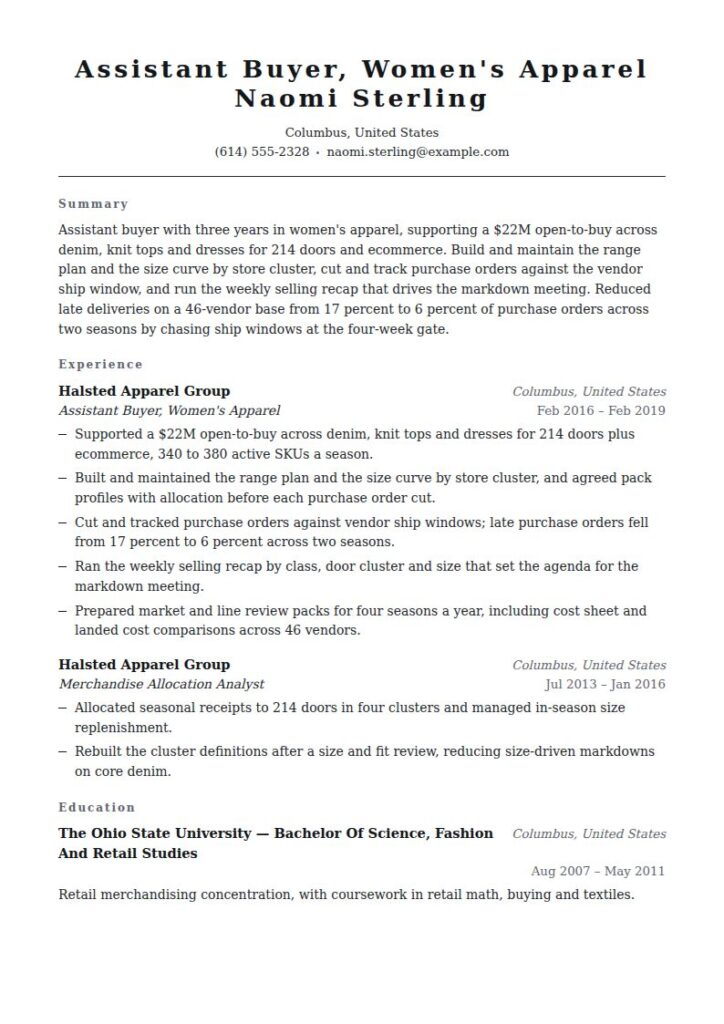
Assistant buyer with three years in women's apparel, supporting a $22M open-to-buy across denim, knit tops and dresses for 214 doors and ecommerce. Build and maintain the range plan and the size curve by store cluster, cut and track purchase orders against the vendor ship window, and run the weekly selling recap that drives the markdown meeting. Reduced late deliveries on a 46-vendor base from 17 percent to 6 percent of purchase orders across two seasons by chasing ship windows at the four-week gate.
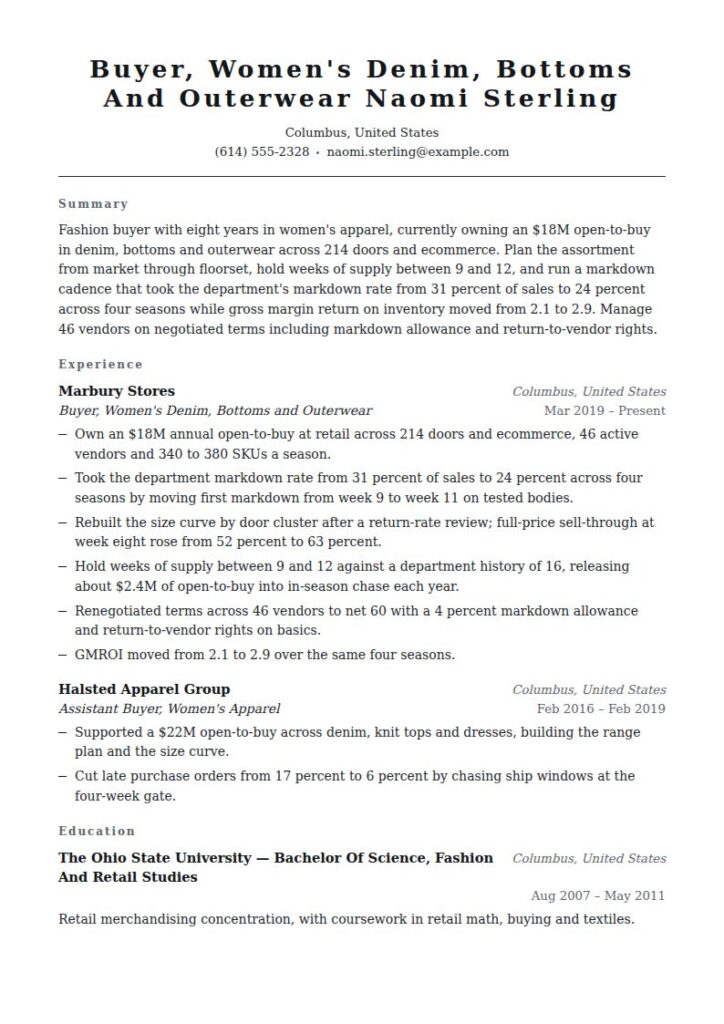
Fashion buyer with eight years in women's apparel, currently owning an $18M open-to-buy in denim, bottoms and outerwear across 214 doors and ecommerce. Plan the assortment from market through floorset, hold weeks of supply between 9 and 12, and run a markdown cadence that took the department's markdown rate from 31 percent of sales to 24 percent across four seasons while gross margin return on inventory moved from 2.1 to 2.9. Manage 46 vendors on negotiated terms including markdown allowance and return-to-vendor rights.
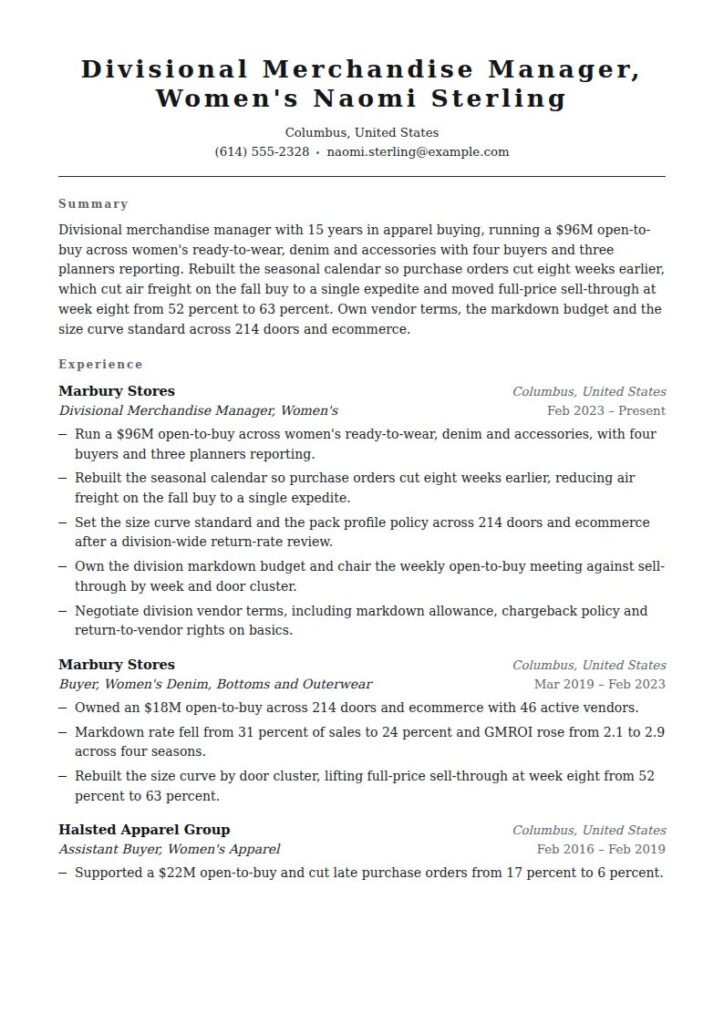
Divisional merchandise manager with 15 years in apparel buying, running a $96M open-to-buy across women's ready-to-wear, denim and accessories with four buyers and three planners reporting. Rebuilt the seasonal calendar so purchase orders cut eight weeks earlier, which cut air freight on the fall buy to a single expedite and moved full-price sell-through at week eight from 52 percent to 63 percent. Own vendor terms, the markdown budget and the size curve standard across 214 doors and ecommerce.
Right vs wrong: the same fashion buyer summary, twice
| ✅ Right | ❌ Wrong |
|---|---|
| Buyer owning an $18M open-to-buy in denim, bottoms and outerwear across 214 doors and ecommerce. | Creative buyer with a passion for fashion and a strong eye for trend. |
| Markdown rate moved from 31 percent of sales to 24 percent across four seasons. | Consistently delivered strong results and exceeded targets. |
| Weeks of supply held between 9 and 12; GMROI from 2.1 to 2.9. | Skilled at inventory management and vendor negotiation. |
The right column, for example, can be checked against a merchandise plan. The left column, in contrast, is what a general manager reads twenty times in an afternoon, and none of it distinguishes anybody.
Outline your buying experience
Then give the company, your department, the door count and dates in one line. Then three to five bullets, each one a number attached to a season and a baseline.
| Instead of | Use |
|---|---|
| Selected merchandise for the women's department | Owned an $18M open-to-buy in denim, bottoms and outerwear across 214 doors and ecommerce |
| Worked closely with vendors to negotiate pricing | Renegotiated terms with 46 vendors to net 60 with a 4 percent markdown allowance and return-to-vendor rights on basics |
| Analyzed sales data to inform buying decisions | Ran a weekly selling recap by class, door cluster and size, and moved first markdown from week 9 to week 11 on tested bodies |
| Managed inventory levels | Held weeks of supply between 9 and 12 through the season, against a department history of 16 |
| Improved profitability | Markdown rate fell from 31 percent of sales to 24 percent over four seasons and GMROI rose from 2.1 to 2.9 |
Buyer, Women's Denim, Bottoms and Outerwear, Marbury Stores, Columbus, OH, March 2019 to Present. 214 doors plus ecommerce, $18M annual open-to-buy, 46 active vendors.
Plan and commit the buy across four seasons a year, from market through line review, purchase order cut, distribution center receipt and floorset.
Took the department markdown rate from 31 percent of sales to 24 percent across four seasons by moving first markdown from week 9 to week 11 on tested bodies and holding the promotional calendar against merchandising pressure.
Rebuilt the size curve by door cluster after a return-rate review, which lifted full-price sell-through at week eight from 52 percent to 63 percent and reduced size-driven markdowns on core denim.
Hold weeks of supply between 9 and 12 against a department history of 16, releasing roughly $2.4M of open-to-buy into in-season chase on two winning bodies a season.
Renegotiated terms across 46 vendors to net 60 with a 4 percent markdown allowance and return-to-vendor rights on basics, and cut late purchase orders from 17 percent to 6 percent.
Put your open-to-buy and the markdown clock on the page
However, this is the block that separates a merchandise buyer from a purchasing agent, and almost nobody writes it.
Open-to-buy. The money you are still allowed to spend. Planned sales plus planned end-of-month inventory plus planned markdowns, less beginning-of-month inventory, gives the open-to-buy for the month, and every in-season decision you make is bounded by it. Write it as an annual figure with the classification and the door count attached, and say whether it is at cost or at retail.
The seasonal calendar. Name the gates you hold: market, line review, purchase order cut, vendor ship window, distribution center receipt, floorset, first markdown, clearance. A buyer who can name their own gate dates has run the calendar rather than been run by it.
Sell-through and the fashion markdown clock
Sell-through and weeks of supply. Sell-through is only honest with a week attached, because 70 percent at week eight and at week twenty are opposite outcomes. Weeks of supply tells a reader whether you buy tight and chase or buy deep and mark down.
The markdown clock. Every unit has a date after which it costs you margin to keep. State the cadence you run and what you changed about it, because moving first markdown by two weeks on a tested body is worth real money and is a decision only a buyer makes.
GMROI. Gross margin dollars divided by average inventory at cost. It judges a buyer on margin and turn at once, and quoting it reads as someone who has sat in an open-to-buy meeting.
Department: women's denim, bottoms and outerwear. 214 doors in four clusters plus ecommerce.
Open-to-buy: $18M annual at retail, committed across four seasons, with roughly 12 percent held back for in-season chase.
Vendors: 46 active, 9 on long-term terms, top 8 carry 71 percent of the buy. Terms net 60, 4 percent markdown allowance, return-to-vendor on basics.
Assortment: 340 to 380 active SKUs a season, size curve set by door cluster, pack profiles agreed with allocation before the purchase order cuts.
Performance: full-price sell-through 63 percent at week eight, weeks of supply held 9 to 12, markdown rate 24 percent of sales, GMROI 2.9.
Calendar gates owned: market, line review, purchase order cut, ship window chase at four weeks, distribution center receipt, floorset, first markdown week 11, clearance week 18.
Why these buying numbers matter more now
Two outside numbers explain why that block matters more than it used to. Meanwhile, e-commerce reached 17.1 percent of total U.S. retail sales in the second quarter of 2026, at $340.2 billion (U.S. Census Bureau, Quarterly Retail E-Commerce Sales, released 18 August 2026), so a size curve and a pack profile now have to work for a warehouse and a store floor at once. And returns are a buying problem rather than an operations one: the National Retail Federation put total U.S. merchandise returns at $849.9 billion in 2025, or 15.8 percent of annual sales, with the online return rate at 19.3 percent (National Retail Federation, 2025 Retail Returns Landscape, 15 October 2025). A buyer who has changed a size curve or dropped a fit because of return data has done something a purchasing agent never does.
Build a snapshot of your key skills
In practice, list ten to fourteen entries in three groups: merchandise planning, commercial, and systems. Name only what you could be examined on in a case interview, because retail buying interviews usually are one.
Merchandise planning: Open-to-buy management, Assortment and range planning, Size curve and pack profile setting, Weeks of supply and stock-to-sales planning, Markdown cadence and clearance planning, In-season chase and reorder
Commercial: Vendor negotiation and terms, Markdown allowance and chargeback handling, Return-to-vendor agreements, Cost sheet and landed cost review, Market and line review preparation, Private label development briefs
Systems and reporting: Oracle Retail Merchandising and Retail Planning, SAP Retail, Excel to an advanced level with Power Query, Power BI selling dashboards, EDI purchase order flow, PLM for private label
Analysis: Sell-through by week and door cluster, GMROI, Return rate by fit and size, Competitive shop reporting
List your education and certifications
Degree, institution, city and state, year. Then anything a retailer screens on, which in buying is usually a merchandising program, a planning system certification, or a formal buyer training rotation.
Bachelor of Science, Fashion and Retail Studies, The Ohio State University, Columbus, OH, 2011.
Buyer training rotation, Halsted Apparel Group, 2011 to 2013: allocation, planning and assistant buying across three classifications.
Systems: Oracle Retail Merchandising Foundation, administrator training, 2019. Power BI data analysis, 2023.
Additional: Retail math and open-to-buy workshop, 2022. Textile and fit fundamentals for buyers, 2018.
A bachelor's degree is the typical entry-level education for buyers and purchasing agents, though BLS notes that some employers hire candidates with a high school diploma, and purchasing managers typically need several years of related work experience on top of it (BLS Occupational Outlook Handbook, purchasing managers, buyers and purchasing agents, page last modified 27 August 2026). Fashion buying is not a licensed occupation, so the training rotation line does real work: it is the closest thing this career has to a verifiable credential.
Choose the right layout and design
Above all, use a single column, 10.5 to 12 point, month and year dates, and no photograph, product images or rating bars. Every figure in plain digits so it parses: $18M, 214 doors, 63 percent, 2.9.
Put the open-to-buy and the classification in the header. Give the door count and say whether ecommerce is included. Attach every sell-through figure to a week number. State weeks of supply as a range you held, not a target you were given. Name the planning system and the modules. Say what you changed about the markdown cadence and what it was worth.
Do not write sell-through with no week attached; it is meaningless. Do not claim a department you assisted on as one you owned. Do not describe yourself as trend-driven, fashion-forward or commercially minded. Do not list brands you bought if your employer treats the vendor list as confidential; give the classification and the vendor count instead. Do not use a two-column designer template for a head office portal.
Fashion buyer job market and outlook
Overall, expect a growing occupation with heavy replacement demand, and a pay structure that depends almost entirely on which industry you buy for.
| Measure, purchasing managers, buyers and purchasing agents | Value |
|---|---|
| Jobs, 2025 | 604,400 |
| Projected employment, 2035 | 638,800 |
| Projected change, 2025-35 | 6 percent, +34,400 |
| Projected annual openings | About 53,600 |
| Typical entry-level education | Bachelor's degree |
| Median annual wage, buyers and purchasing agents, May 2025 | $77,710 |
Source: U.S. Bureau of Labor Statistics, Occupational Outlook Handbook, purchasing managers, buyers and purchasing agents, page last modified 27 August 2026, May 2025 wage data and 2025 to 2035 projections.
However, BLS does not publish a fashion buyer profile. The published occupation is buyers and purchasing agents, which BLS describes as including wholesale and retail buyers who purchase goods for resale to consumers, naming clothing among the examples. So the outlook above is the whole buying profession, and the apparel part of it moves with its own demand cycle: sales at clothing and clothing accessories stores were $28,353 million in August 2026, up 4.3 percent on August 2025 (U.S. Census Bureau, Advance Monthly Retail Trade Report, released 16 September 2026), while the apparel index of the Consumer Price Index rose 3.6 percent over the twelve months to August 2026 (U.S. Bureau of Labor Statistics, Consumer Price Index, released 11 September 2026).
Retail trade is the lowest-paid place to be a buyer, by a distance
Buyers and purchasing agents are spread across industries, and apparel buying sits in the one that pays least. BLS puts manufacturing at 22 percent of the occupation, wholesale trade at 14 percent, government at 13 percent, management of companies and enterprises at 8 percent and retail trade at 7 percent (BLS Occupational Outlook Handbook, page last modified 27 August 2026).
The medians are far apart: government $95,780, management of companies and enterprises $83,990, manufacturing $77,890, wholesale trade $71,640 and retail trade $57,840 (BLS, May 2025).
Retail trade is the lowest of the five, and it is $19,870 below the median for the occupation as a whole. That is the gap a fashion buyer is negotiating inside. It is not an argument for leaving retail. It is an argument for two things on the page: the size of your open-to-buy, and results in margin terms rather than taste terms, because those move you up inside the band and into the merchandise management track.
What salary you can expect as a fashion buyer
The median annual wage for buyers and purchasing agents was $77,710 as of May 2025, with the lowest 10 percent under $48,380 and the highest 10 percent over $128,870 (BLS Occupational Outlook Handbook, May 2025 wage data, page last modified 27 August 2026). Across the whole profile, including purchasing managers, the median was $81,670 a year, or $39.27 an hour.
Now the number that matters more. The median in retail trade, where apparel buying actually happens, was $57,840 (BLS, May 2025). In other words, a fashion buyer reading the $77,710 headline and asking for it is quoting a figure built largely on manufacturing, government and wholesale buying. Therefore, the honest starting point is $57,840, and the interesting question is what moves you above it.
Three things do.
Size of the open-to-buy. It is the cleanest proxy for responsibility in this job, and it is why the figure belongs in the header rather than buried in a bullet.
Margin results rather than volume results. Markdown rate, sell-through at a stated week and GMROI describe a buyer who protected margin. Sales growth alone can be bought with markdown, and every merchandise manager knows it.
The management track. Purchasing managers had a median of $148,080, with the lowest 10 percent under $92,490 and the highest 10 percent over $223,280 (BLS, May 2025), and BLS notes the role typically requires several years of related work experience rather than another degree. In apparel that track is the divisional merchandise manager route, and it is walked by buyers who can show they ran a calendar and a markdown budget, not just a good season.
Key takeaways for a fashion buyer resume
- First, put the classification, the open-to-buy and the door count in the header.
- Next, write the season and name your calendar gates instead of the calendar year.
- Also, attach every sell-through number to a week, or leave it off.
- Similarly, give weeks of supply as a range you held, against the department's history.
- Finally, quote markdown rate and GMROI, because they are what separate a buyer from a purchaser.
- Say what you changed about the size curve, and why, especially if returns drove it.
- Keep it single column with figures in plain digits, so a head office portal parses them.
Build your fashion buyer resume in 15 minutes with our AI resume builder.
Related creative and artistic resume examples
- Fashion designer resume
- Tailor resume
- Costume designer resume
- Jewelry designer resume
- Modeling resume
- Illustrator resume
- Photographer resume
- Visual artist resume
- Artist resume
- Floral designer resume
- Wedding photographer resume
- Film producer resume
Pair it with a matching fashion buyer cover letter.
Fashion buyer resume questions, answered
How long should a fashion buyer resume be?
One page for your first five years, two once you own a division or can cite results across four or more seasons. The second page earns its place only if it carries seasons, not adjectives.
What is the most important number on a fashion buyer resume?
The open-to-buy you commit, with the classification and door count next to it. Everything else on the page is read in proportion to it. The second most important is full-price sell-through at a stated week, because it is the only figure that shows whether the merchandise worked before the markdown did.
How is a fashion buyer different from a purchasing agent?
A purchasing agent buys inputs the business consumes and is judged on cost, availability and supplier performance. A fashion buyer buys goods for resale and is judged on what the customer did with them: sell-through, margin after markdown, return rate. The overlap is negotiation; the difference is markdown risk.
Do I need a fashion degree to become a buyer?
No. A bachelor's degree is the typical entry-level education for buyers and purchasing agents, and BLS notes some employers hire candidates with a high school diploma (BLS Occupational Outlook Handbook, page last modified 27 August 2026). Most buyers come through allocation or planning, and a buyer training rotation on your resume is worth more than the subject of the degree.
How do I write results if my employer will not let me publish figures?
Use percentages and ratios rather than dollars, and describe scale in doors and SKU counts. "Markdown rate down 7 points across four seasons" and "sell-through at week eight up 11 points" tell a hiring manager everything without disclosing a plan.
Is fashion buying a growing occupation?
The occupation it sits inside is projected to grow 6 percent between 2025 and 2035, adding 34,400 jobs, with about 53,600 openings a year (BLS Occupational Outlook Handbook, page last modified 27 August 2026). Growth is strongest outside retail, and within apparel the pressure is on buyers who can plan for stores and ecommerce together, since online sales reached 17.1 percent of all retail in the second quarter of 2026 (U.S. Census Bureau, released 18 August 2026).