Illustrator, packaging and surface design Vesna Hallgren
Junior Illustrator
[email protected] | (503) 555-1405 | Portland, United States
Profile
Illustrator with two years in a packaging and licensing studio, producing roughly 90 finished pieces a year across labels, gift and stationery, working to an in-house style guide and a fixed sketch-and-revision cycle. Deliver layered files with line work and color kept separate, CMYK at 300 ppi with bleed, plus vector where the artwork goes to a cutting path. Work from a written brief and take two rounds of revisions without redrawing from scratch.
Work Experience
09/2014 - Present, Junior Illustrator, Blue Sedge Studio, Portland, United States
- Produce roughly 90 finished pieces a year across labels, gift wrap, stationery and seasonal ranges, all to an in-house style guide.
- Deliver layered working files with line work and color separated, flattened CMYK at 300 ppi with bleed, and vector artwork where a cutting path is involved.
- Work a fixed cycle of thumbnails, approved sketch and final, with two revision rounds taken at sketch stage rather than on the finished piece.
- Prepare artwork against supplied dielines on a named layer; 20 of 22 label SKUs in the last range released on first proof.
01/2014 - 06/2014, Illustration Intern, Blue Sedge Studio, Portland, United States
- Built pattern repeats and spot art from art director sketches, working inside the studio file naming convention.
- Kept the studio artwork library and prepared print-ready exports for supplier review.
Education
09/2010 - 06/2014, Bachelor of Fine Arts, Illustration, Pacific Northwest College of Art, Portland, United States
Concentration in editorial and narrative illustration, with elective coursework in printmaking and production for print.
Skills
Ink and brush line work, 80
Gouache and digital painting, 70
Vector drawing and pattern repeats, 75
Working to a written brief and style guide, 85
CMYK delivery at 300 ppi with bleed, 80
Dielines and cutting paths, 65
Languages
English, native
Swedish, intermediate
Certificates
04/2015, Packaging artwork and prepress workshop, Blue Sedge Studio
Dielines, bleed and total ink limits for label and carton artwork.
Summary
An illustrator resume is a one page document read next to a portfolio, and the thing that separates two good portfolios is the commission record behind them: the market, the brief, the revision terms, the delivery specification and the rights the client bought. This guide gives you three adaptable versions and current Bureau of Labor Statistics pay and outlook.
Illustrator resume examples by experience level
An illustrator resume is a one page document that sits next to a portfolio and answers the questions a portfolio cannot: who commissioned the work, what the brief asked for, what you handed over, and what the client was allowed to do with it afterward.
That last question is the business. An illustration is not sold the way a chair is sold: a client buys a defined use, described by media, term, territory and exclusivity, and everything outside that description is still yours to sell again. In fact, art buyers, editors and game producers all know this. As a result, a resume that says nothing about it reads as an illustrator who has never negotiated a license.
Resume guide for an illustrator resume
In particular, this guide and the corresponding illustrator resume example will cover:
- How to write an illustrator resume, section by section
- The five markets that commission illustration, and why each reads a resume differently
- Three adaptable summaries: junior, working illustrator and senior
- How to write a rights and licensing line without writing a contract
- What the job market looks like and what you can expect to earn
How to write an illustrator resume
Use six blocks: first a contact header carrying the portfolio link, then a summary, commissioned work grouped by market, a rights and delivery block, skills, and education. One page, always. In other words, the portfolio carries the pictures; the resume carries the evidence that you are commissionable. Put a plain readable portfolio address in the header, because an art buyer shortlisting against a Friday deadline will not hunt for it.
| Section | What it is answering | Where it goes |
|---|---|---|
| Portfolio link | Can I see the range now, and is it the range I need? | Header, under your name |
| Commissioned work | Who briefed this person, in what market, at what volume? | Grouped by market |
| Rights and delivery | Do they understand usage, and will the files arrive usable? | Its own block, above skills |
| Skills | Media, process and production, grouped and short | Six to eight lines |
Name the market before you name the client
Illustration is not one job. Editorial commissions a picture on a two day turnaround. Trade and children's publishing commissions a book, sometimes thirty spreads, across nine months. Advertising commissions a campaign with a legal review attached. Packaging commissions artwork that has to survive a dieline and a press. Games commission concept and production art inside someone else's pipeline.
Each buyer is hiring against a different risk: speed and a point of view in editorial, a file that will not come back from prepress in packaging, someone else's style guide in games. Group your experience under market headings and let each reader find their own risk handled.
Run the finished file through the ATS resume checker before you send it. In-house creative teams and studios route applications through the same parser as the rest of the business, and a layout you designed yourself is where that parsing usually breaks.
Choosing the best resume format for an illustrator resume
Go reverse chronological in structure, then group by market inside it: one page, single column. Most illustrators are self-employed, so the honest shape is a market-grouped commission record rather than a list of employers, with dates visible and recent work first.
However, do not set the resume as a piece of illustration. After all, a studio principal comparing eight files wants the same facts in the same place each time, and a hand-lettered header arrives in an applicant system as a blank.
Include your contact information
| ✅ Right | ❌ Wrong |
|---|---|
| Vesna Hallgren | Vesna Hallgren |
| Illustrator, editorial and children's publishing | Freelance creative and visual storyteller |
| vesnahallgren.com | Portfolio link in bio |
| (503) 555-1405, [email protected], Portland, OR | (503) 555-1405, [email protected] |
The second line names the markets you want to be briefed in, which tells an art buyer in one glance whether to keep reading. Finally, the third is a plain domain, readable on paper, not a request.
Make use of a summary
Keep it to four lines: what you illustrate, for which markets, at what volume and turnaround, and also one fact about how you license it.
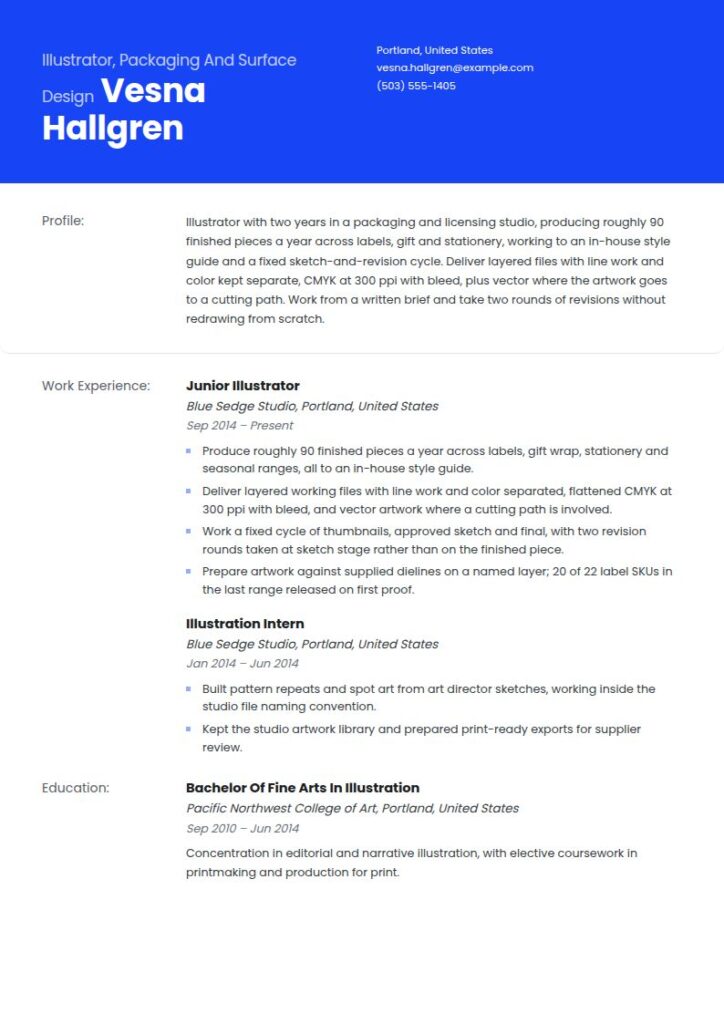
Illustrator with two years in a packaging and licensing studio, producing roughly 90 finished pieces a year across labels, gift and stationery, working to an in-house style guide and a fixed sketch-and-revision cycle. Deliver layered files with line work and color kept separate, CMYK at 300 ppi with bleed, plus vector where the artwork goes to a cutting path. Work from a written brief and take two rounds of revisions without redrawing from scratch.
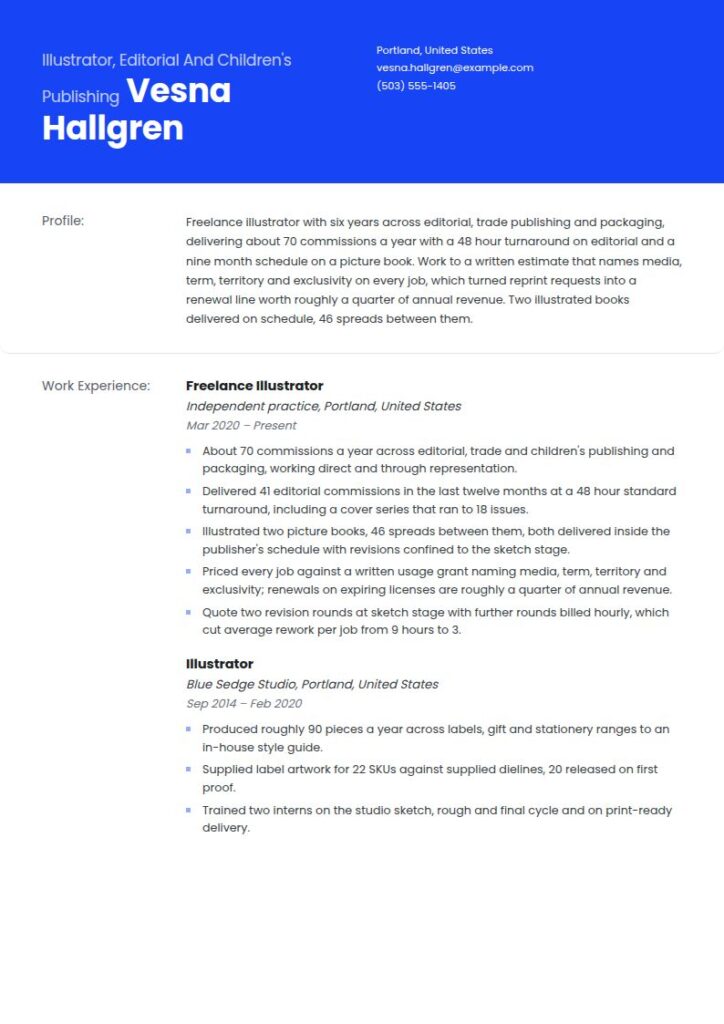
Freelance illustrator with six years across editorial, trade publishing and packaging, delivering about 70 commissions a year with a 48 hour turnaround on editorial and a nine month schedule on a picture book. Work to a written estimate that names media, term, territory and exclusivity on every job, which turned reprint requests into a renewal line worth roughly a quarter of annual revenue. Two illustrated books delivered on schedule, 46 spreads between them.
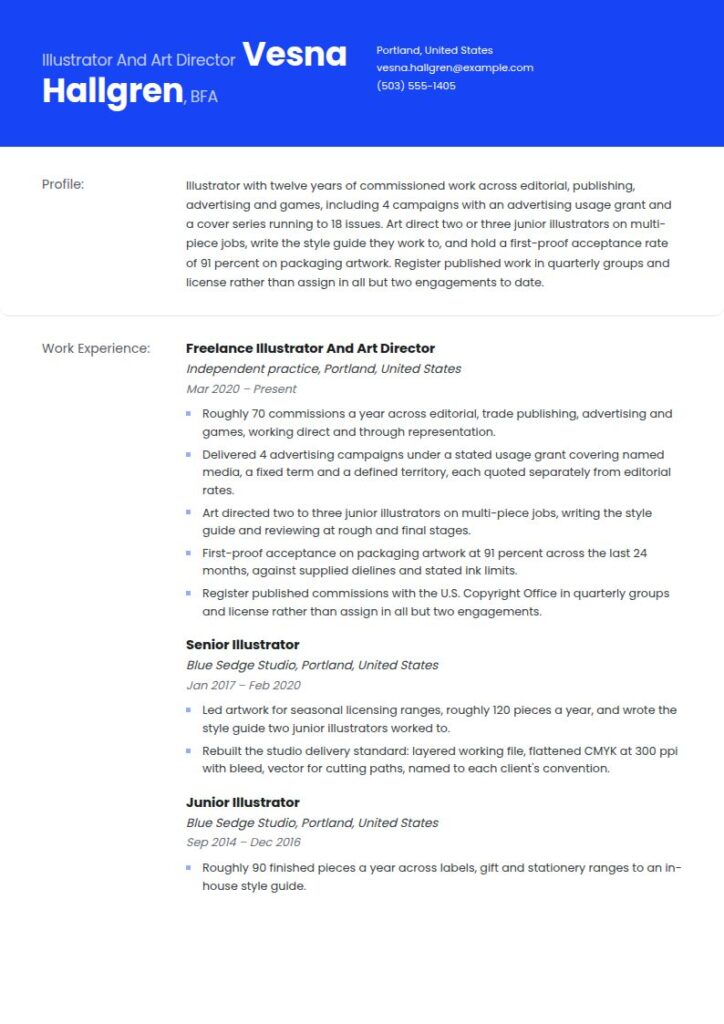
Illustrator with twelve years of commissioned work across editorial, publishing, advertising and games, including 4 campaigns with an advertising usage grant and a cover series running to 18 issues. Art direct two or three junior illustrators on multi-piece jobs, write the style guide they work to, and hold a first-proof acceptance rate of 91 percent on packaging artwork. Register published work in quarterly groups and license rather than assign in all but two engagements to date.
Right vs wrong: the same illustrator summary, twice
| ✅ Right | ❌ Wrong |
|---|---|
| Delivers about 70 commissions a year, 48 hour turnaround on editorial. | Creates bold, imaginative illustrations for a wide range of clients. |
| Estimates name media, term, territory and exclusivity on every job. | Experienced in all aspects of freelance illustration. |
| Two illustrated books delivered on schedule, 46 spreads between them. | Passionate about bringing stories to life through images. |
The right column, for example, tells an art buyer what happens after they email you. The left, in contrast, is what every other file in the folder already says.
Outline your illustration experience
Market, role, dates, and one line on what the work actually was. Then three to five bullets, each carrying a count, a turnaround or a rights fact.
| Instead of | Use |
|---|---|
| Created illustrations for a variety of clients | Delivered 41 editorial commissions in twelve months at a 48 hour standard turnaround, 3 at same-day rates |
| Illustrated a children's book | Illustrated a 32 page picture book: 14 spreads, 2 rounds of revisions at sketch stage, delivered to the publisher's template 3 weeks early |
| Worked on packaging designs | Produced label artwork for 22 SKUs, supplied as layered files with the dieline on its own layer, 20 released on first proof |
| Worked with clients on revisions | Quoted two revision rounds at sketch stage with further rounds billed hourly, which cut average rework per job from 9 hours to 3 |
Freelance Illustrator, Portland, OR, March 2020 to Present
Editorial, trade publishing, packaging and games, roughly 70 commissions a year, working direct and through representation.
Delivered 41 editorial commissions in the last twelve months at a 48 hour standard turnaround, including a cover series that ran to 18 issues.
Illustrated two picture books, 46 spreads between them, both delivered inside the publisher's schedule.
Priced every job against a written usage grant naming media, term, territory and exclusivity, which made expiring licenses a renewal conversation rather than a lost fee.
Art directed two junior illustrators on a 68 piece production art milestone, writing the style guide and reviewing at rough and final.
What rights you sold with the illustration
However, this is the section that separates an illustrator from someone who draws, and almost nobody puts it on the page. In practice, every commission grants a use, and the four coordinates are the same in every market:
Media. Where the artwork may appear. One print run is not the same grant as print plus web plus paid social, and a packaging grant that quietly includes out of home is a campaign you gave away.
Term. A term that ends is a date in your calendar; a perpetual grant is a fee you will never see twice.
Territory. A US trade edition is a different sale from world rights in all languages, and publishers ask for the second while budgeting for the first.
Exclusivity. Whether anyone else may commission something similar in that window, and in what category. Exclusivity is worth money because it stops you working, so it belongs in the price.
Write these as a standard rather than a negotiation. A block showing that you already work this way is more persuasive than any sentence about professionalism.
Standard license: named media, stated term, stated territory, non-exclusive unless quoted. Typical editorial grant is one print edition plus the publisher's website and social channels, North America, 12 months. Advertising, packaging and out of home quoted separately.
Reproduction: original artwork and copyright retained unless a buyout is negotiated and priced.
Revisions: two rounds at sketch stage included; changes after approved sketch billed hourly. Cancellation after sketch approval carries a stated fee.
Delivery: layered working file plus flattened CMYK at 300 ppi with bleed for print, RGB at 2x for screen, vector where a cutting path or dieline is involved, named to the client's convention.
Registration: published commissions registered with the U.S. Copyright Office in quarterly groups.
Two legal points sit underneath that block, and both are worth stating accurately because illustration is unusually exposed to them.
Work made for hire and the illustrator
Work made for hire is a live risk here, not a theoretical one. The U.S. Copyright Office explains that a work made for hire is either a work prepared by an employee within the scope of employment, or a specially ordered or commissioned work falling within one of nine listed categories and covered by a signed written agreement saying so, and that in either case "the employer or the party that specially ordered or commissioned that work is the initial owner of the copyright in the work" unless a written agreement states otherwise (U.S. Copyright Office, Circular 30, Works Made for Hire, revised August 2024). Two of the nine describe ordinary illustration work: "a contribution to a collective work", which is what a magazine or anthology piece is, and "a supplementary work", which the Office defines as a work prepared for publication as a secondary adjunct to a work by another author, serving purposes such as illustrating or explaining it. A commissioned illustration can therefore fall inside that definition where many other commissioned works cannot.
Transfers, licenses and the signed writing
A transfer needs a signed writing, and a license does not. The Copyright Office states that copyright "initially belongs to the author(s) who created that work", and that a transfer of rights "generally must be made in writing and signed by the owner of the rights conveyed or the owner's authorized agent", while "transferring a right on a nonexclusive basis does not require a written agreement" (U.S. Copyright Office, Circular 1, Copyright Basics, revised September 2021).
Registration is the other half: before an infringement suit may be filed in court, registration or refusal is necessary for a U.S. work, and where registration is made before the infringement or within three months after publication, the owner becomes eligible for statutory damages, attorneys' fees and costs (U.S. Copyright Office, Circular 1, revised September 2021). That three month window is why working illustrators register in batches on a schedule rather than when something goes wrong.
Even so, none of this is legal advice, and a resume is not the place to argue law. Get your own advice before you sign. What belongs on the page instead is evidence that you know the vocabulary and already work inside it.
Build a snapshot of your key skills
In practice, list twelve to sixteen entries in four groups: media and technique, markets, production and delivery, and the business of commissioned work.
Media and technique: Ink and brush line work, Gouache and watercolor, Digital painting, Vector drawing, Hand lettering, Character design
Markets: Editorial, Trade and children's publishing, Packaging and surface design, Advertising, Games concept art
Production and delivery: Working to a brief and style guide, Sketch and rough stages, CMYK and RGB delivery, 300 ppi files with bleed, Layered handoff, Dielines and cutting paths, File naming conventions
Commission practice: Estimating and scope writing, Usage licensing by media, term, territory and exclusivity, Revision and cancellation terms, Group copyright registration, Renewals
Keep software to one line. Everyone applying has the same applications; therefore, what separates you is the delivery specification you can meet with them.
List your education and certifications
Finally, keep it short, at the foot, and honest about what it is worth. After all, illustration is not a licensed occupation and no certification is checked. BLS notes that most fine artists pursue postsecondary education to improve their skills and job prospects, while a formal credential is typically not needed to be a craft artist (BLS Occupational Outlook Handbook, craft and fine artists, page last modified 27 August 2026).
Bachelor of Fine Arts, Illustration, Pacific Northwest College of Art, Portland, OR, 2018
Continuing study: packaging artwork and prepress workshop, 2024; concept art for production pipelines, 2025
Representation: represented for advertising and packaging commissions since 2023; editorial and publishing handled direct
Practice: quarterly group copyright registration; standard estimate naming media, term, territory and exclusivity
Those last two lines earn their space: representation tells a buyer who negotiates, and a registration habit tells them you have a routine rather than a grievance.
Choose the right layout and design
Single column, 10 to 12 point, one typeface, no illustration on the page, no thumbnails, no skill rating bars. Put the portfolio URL in plain text as well as hyperlinking it, because a printed copy loses every link. Name the file for yourself and the market: vesna-hallgren-editorial-illustrator-resume.pdf.
Group commissions by market so a buyer finds their own kind of work first. Give counts and turnarounds, not adjectives. State your standard license in one line: media, term, territory, exclusivity. Say how many revision rounds are included and what happens after. Name the delivery specification, including color space, resolution and layer structure. Keep one plain-text portfolio URL in the header.
Do not set the resume as an illustrated artifact; it parses as nothing. Do not list clients as a wall of names with no market, volume or date attached. Do not claim a piece that was killed before publication without saying so. Do not promise unlimited revisions or unlimited usage. Do not write "all rights" into your own summary as though it were a selling point.
Illustrator job market and outlook
BLS publishes no Occupational Outlook Handbook profile under the title illustrator, so no single figure describes the job. Instead, the closest match sits inside the craft and fine artists profile, which reports "fine artists, including painters, sculptors, and illustrators" at a median annual wage of $55,490 in May 2025 (BLS Occupational Outlook Handbook, craft and fine artists, page last modified 27 August 2026). Meanwhile, illustrators in animation or games sit closer to special effects artists and animators; illustrators employed in studios often sit under graphic designers, median $62,960 in May 2025 (BLS, May 2025). Read all three and place yourself.
| Measure | Craft and fine artists | Special effects artists and animators |
|---|---|---|
| Employment, 2025 | 53,400 | 51,900 |
| Projected employment, 2035 | 53,000 | 51,800 |
| Projected change, 2025 to 2035 | -1 percent, -300 jobs | 0 percent, -100 jobs |
| Projected annual openings | ~4,300 | ~4,200 |
| Self-employed workers | 58 percent | 63 percent |
| Median annual wage, May 2025 | $55,290 | $102,030 |
Source: U.S. Bureau of Labor Statistics, Occupational Outlook Handbook, craft and fine artists and special effects artists and animators, pages last modified 27 August 2026, May 2025 wage data and 2025 to 2035 projections.
Most of this occupation has no employer to apply to
BLS puts self-employed workers at 58 percent of craft and fine artists and at 63 percent of special effects artists and animators (BLS Occupational Outlook Handbook, pages last modified 27 August 2026). Among the employed minority of craft and fine artists, independent artists, writers and performers account for 7 percent, federal government for 6 percent, personal care services for 4 percent and motion picture and sound recording industries for 2 percent (BLS, May 2025).
Employment in craft and fine artists is projected to decline 1 percent from 2025 to 2035, and BLS still projects about 4,300 openings a year on average over the decade, almost none of them new posts (BLS Occupational Outlook Handbook, 2025 to 2035 projections).
So the page has two readers: occasionally a hiring manager filling one of the few salaried posts, more often an art buyer choosing a supplier and reading the same document as a capability statement. A commission record with markets, counts, turnarounds and a license line answers both.
Next, where the employed minority sits, and what those industries pay:
| Industry | Share of employment | Median annual wage, May 2025 |
|---|---|---|
| Self-employed workers | 58% | Not published |
| Independent artists, writers and performers | 7% | $49,100 |
| Federal government, excluding postal service | 6% | $115,150 |
| Personal care services | 4% | $38,790 |
| Motion picture and sound recording industries | 2% | $132,950 |
Source: U.S. Bureau of Labor Statistics, Occupational Outlook Handbook, craft and fine artists, May 2025.
What salary you can expect as an illustrator
Craft and fine artists had a median annual wage of $55,290 in May 2025, the lowest 10 percent earning less than $31,490 and the highest 10 percent more than $131,810 (BLS Occupational Outlook Handbook, craft and fine artists, page last modified 27 August 2026). Within that profile, fine artists including illustrators had a median of $55,490 and craft artists $46,080 (BLS, May 2025).
That spread is enormous for one occupation; however, the industry table above explains most of it: the same drawing skill is paid $38,790 a year in personal care services and $132,950 in motion picture and sound recording industries. In short, illustrators who can work inside a production pipeline reach the second number; illustrators selling one piece at a time do not.
For the self-employed majority there is no salary band at all, only a fee per commission and what you did with the rights afterward. Four things move it. The license you quote: a twelve month single media grant at a proper fee is a different business from a buyout at a slightly higher one, because the first has renewals in it. The market mix: editorial pays modestly and often, advertising and packaging pay several times more per piece for narrower usage, and a working year usually needs both. For example, on revision terms, two rounds at sketch stage with hourly billing after is the most effective clause an illustrator can hold. Secondary rights: reprints, foreign editions and product licensing are income from work you already did, and they exist only if you did not assign everything at the start.
Key takeaways for an illustrator resume
- First, put a plain portfolio URL in the header and name your markets in the line under your name.
- Group commissions by market, because each market is hiring against a different risk.
- Then give counts and turnarounds: pieces a year, spreads, SKUs, milestones, revision rounds.
- Also write one standard license line covering media, term, territory and exclusivity.
- Similarly, name the delivery specification: color space, resolution, bleed, layers, vector, file naming.
- In addition, read the work made for hire paragraph in every contract, and get your own advice.
- Finally, keep the resume to one page, single column, and let the portfolio be the portfolio.
Build your illustrator resume in 15 minutes with our AI resume builder.
Related creative and artistic resume examples
- Visual artist resume
- Artist resume
- Tattoo artist resume
- Jewelry designer resume
- Fashion designer resume
- Costume designer resume
- Photographer resume
- Videographer resume
- Screenwriter resume
- Film producer resume
- Cinematographer resume
- Floral designer resume
Pair it with a matching illustrator cover letter.
Illustrator resume questions, answered
How long should an illustrator resume be?
One page. The portfolio carries the work, so a second page can only repeat claims the images already make better. The rare exception is a long production career across several markets, where the second page is a licensing record rather than more projects.
Do I need a resume if I have a portfolio and an agent?
Yes, for the situations a portfolio does not cover: a salaried or studio post, a publisher or agency that wants one with a proposal, and any client whose procurement process wants a document. The portfolio shows what you can draw; the resume shows that you can be briefed, scheduled and licensed.
Should I list client names?
List them where you are permitted to, always with the market, the year and what you delivered. A wall of logos says nothing about deadlines or rights. Where a commission is under embargo, write the category instead: "national grocery brand, 22 label SKUs" is informative and safe.
How do I show work that was commissioned but never published?
Say so plainly. Killed jobs are ordinary in editorial and advertising, and the honest line is "commissioned and delivered; publication canceled". Presenting unpublished work as published is what art directors notice and remember, and the field is small.
Is illustration a shrinking career?
BLS publishes no separate illustrator projection. The nearest profile, craft and fine artists, is projected to decline 1 percent from 2025 to 2035 while still producing about 4,300 openings a year, nearly all replacements, with 58 percent of the occupation self-employed (BLS Occupational Outlook Handbook, page last modified 27 August 2026). Salaried posts are scarce and commissioned work is not counted as a post at all, which is why a capability-shaped resume beats a job-shaped one.
What should a junior illustrator put on a resume with almost no commissions?
Volume, brief and delivery, from wherever you have them. A student publication, a studio internship, two local businesses, a self-published zine with a print run: each has a piece count, a deadline and a file specification in it. Write them as commissioned work and state the license terms you offer. That reads stronger than six pages of unbriefed personal work.