Vesna Hallgren Illustrator, editorial and children's publishing Portland, 97214, United States [email protected] · (503) 555-1405
17 September 2026
Ms. Halle Brannigan Art Director Greylock Editions Portland, United States
Application for Staff Illustrator, Greylock Editions
Dear Ms. Brannigan,
I am applying for the Staff Illustrator post at Greylock Editions. I work in editorial and children's publishing, with packaging as a third market, and my portfolio is at vesnahallgren.com. Six years of that has been freelance, so I am used to holding several schedules at once.
The commission closest to your list was a 32 page picture book delivered last spring: 14 spreads plus cover and endpapers, sketches approved in two rounds, finals delivered three weeks inside the publisher's schedule. I keep revisions at the sketch stage rather than on finished art, which is why that book did not slip, and it is the habit I would bring to a list with fixed pub dates. Alongside it I delivered 41 editorial commissions in twelve months at a 48 hour standard turnaround, including a cover series that ran to 18 issues.
I have read your last two seasons and the thing I would want to work on is the middle grade line, because those are the books where a cover has to do the work of a whole shelf. I can also cover interior spot art and chapter openers, which tends to be the work that gets outsourced late and expensively.
I supply layered working files with line and color separate, flattened CMYK at 300 ppi with bleed for print, and vector where a cutting path is involved. I am available from November and happy to start on a single title. Thank you for reading.
Sincerely, Vesna Hallgren
Summary
An illustrator cover letter is a one page letter that tells an art buyer which market you work in, what you can deliver and by when, and how you license the result. This guide gives you a full adaptable letter, the openings that work, what changes between an editorial pitch and an in-house application, and how to handle a brief you have not been shown yet.
Illustrator cover letter examples by experience level
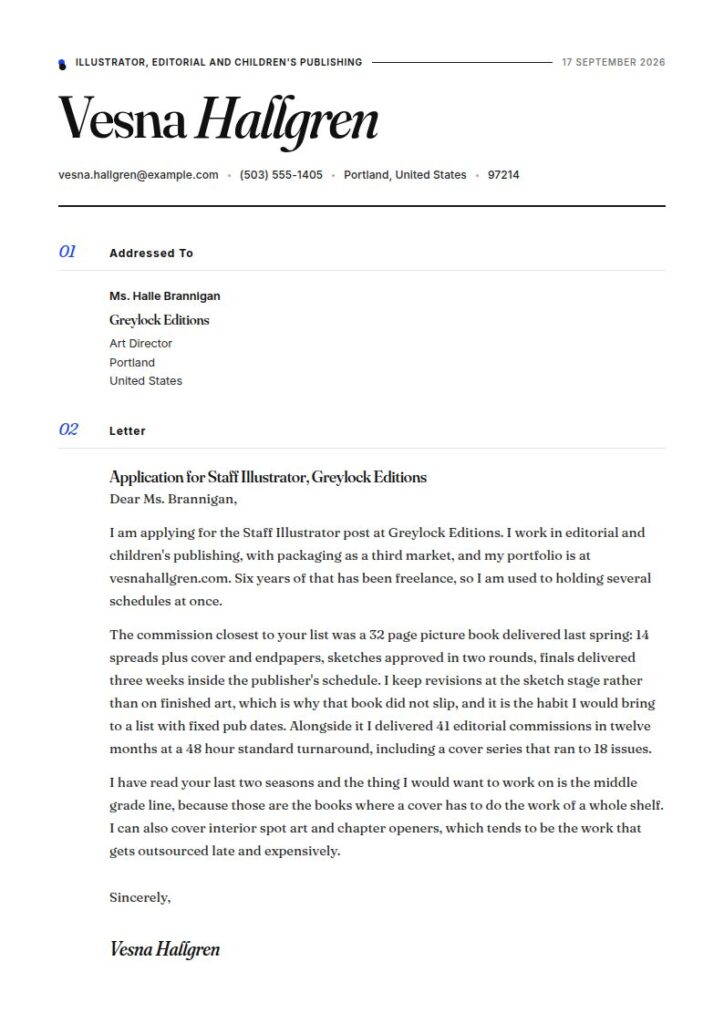
An illustrator cover letter is a one page letter to the person who will have to brief you. It names your market, the volume and turnaround you can hold, one commission that went the way theirs needs to go, and the terms you license on.
However, most illustrator letters address the wrong reader: an imagined audience wanting to hear about influences and process. The actual reader is an art director with eleven pieces to place before Thursday, or a publisher weighing a schedule against a list date.
Guide to an illustrator cover letter
That is why this guide and the corresponding illustrator cover letter example will cover:
- First, how to structure the letter, paragraph by paragraph
- Then, why the market and the turnaround belong in the first two sentences
- Also, what to say about rights without sounding like a contract
- Finally, how an editorial pitch differs from an in-house application
- The openings that get a portfolio actually opened
How to write an illustrator cover letter
| Paragraph | Its job | Length |
|---|---|---|
| Opening | The post or the commission, your market, and the portfolio address | 2 to 3 sentences |
| Evidence | One commission: brief, volume, turnaround, what shipped | 4 to 5 sentences |
| Fit | Something specific about their list, title or product, and what you would take on | 3 to 4 sentences |
| Close | Terms, availability, thank you | 2 sentences |
Put the portfolio address in the first paragraph, in plain text
The letter is not the work. Its job is to get the portfolio opened, then answer the two questions an art director has once they like what they see: can this person hit a date, and will the files be usable.
So the first paragraph carries three things and nothing else: the post or commission, your market, and where the work lives. Write the address as text rather than hiding it behind a hyperlink, because letters get printed and forwarded. Then spend the rest on the two questions. "41 editorial commissions in the last twelve months at a 48 hour standard turnaround" answers the first; your delivery specification answers the second.
An illustrator cover letter example you can adapt
Dear Ms. Brannigan,
I am applying for the Staff Illustrator post at Greylock Editions. I work in editorial and children's publishing, with packaging as a third market, and my portfolio is at vesnahallgren.com. Six years of that has been freelance, so I am used to holding several schedules at once.
The commission closest to your list was a 32 page picture book delivered last spring: 14 spreads plus cover and endpapers, sketches approved in two rounds, finals delivered three weeks inside the publisher's schedule. I keep revisions at the sketch stage rather than on finished art, which is why that book did not slip, and it is the habit I would bring to a list with fixed pub dates. Alongside it I delivered 41 editorial commissions in twelve months at a 48 hour standard turnaround, including a cover series that ran to 18 issues.
I have read your last two seasons and the thing I would want to work on is the middle grade line, because those are the books where a cover has to do the work of a whole shelf. I can also cover interior spot art and chapter openers, which tends to be the work that gets outsourced late and expensively.
I supply layered working files with line and color separate, flattened CMYK at 300 ppi with bleed for print, and vector where a cutting path is involved. I am available from November and happy to start on a single title. Thank you for reading.
Sincerely, Vesna Hallgren
Openings that work
| Instead of | Use |
|---|---|
| I have always loved drawing and telling stories | I work in editorial and children's publishing; my portfolio is at vesnahallgren.com |
| I am writing to express my interest in your illustration opportunities | I am applying for the Staff Illustrator post, and I can cover interior spot art as well as covers |
| I have a unique visual voice and a passion for character | 41 editorial commissions in twelve months at a 48 hour standard turnaround |
| I would love the chance to work with your team | I have read your last two seasons and would want to work on the middle grade line |
The pattern is the same in all four rows: replace a feeling with a fact the reader can act on before lunch.
What to say about rights, and what to leave out
The letter is not the contract, and an illustrator who negotiates in paragraph one reads as difficult before anyone discusses the work. In practice, one sentence is enough, at the end.
State your standard grant in a single clause: named media, a stated term, a stated territory, non-exclusive unless quoted. Say that advertising, packaging and out of home are quoted separately, because that is normal practice rather than a demand. Mention group registration only if you are asked about rights handling. Keep the tone of someone describing a routine, not defending a position.
Do not attach your terms and conditions to a first letter. Do not use the phrase "all rights" about your own work as though it were a service you offer. Do not open a negotiation about a buyout before you know what the job is. Do not lecture a publisher about copyright; their contracts department has heard it, and the letter is not where that conversation goes.
A staff post is different again. The U.S. Copyright Office explains that in a work made for hire "the employer or the party that specially ordered or commissioned that work is the initial owner of the copyright in the work" unless a written agreement states otherwise (U.S. Copyright Office, Circular 30, Works Made for Hire, revised August 2024). That is ordinary for a salaried job and not something to argue in a cover letter. It does matter for outside commissions you intend to keep taking, so ask about that clause at offer stage and get your own advice.
Editorial pitch, publishing application, in-house post
Three different letters wear the same clothes.
| Reader | What they are deciding | What the letter must carry |
|---|---|---|
| Editorial art director | Can this person turn a piece around this week and do something interesting with a dull subject | Turnaround, recent commission count, a link, and range in two lines |
| Publisher or agent | Can this person carry a book across nine months without slipping | One book delivered on schedule, spread count, revision discipline |
| In-house or studio hiring manager | Can this person work inside a style guide and a file tree | Style guide experience, delivery specification, volume, team fit |
For example, an editorial pitch can be four sentences. A publishing application needs schedule evidence. On the other hand, an in-house application is the only one that reads like a conventional job letter, and the one where the delivery specification earns most.
Most illustration work is not a job, which changes what the letter is for
BLS publishes no Occupational Outlook Handbook profile under the title illustrator. The closest published figures sit inside craft and fine artists, where BLS reports "fine artists, including painters, sculptors, and illustrators" at a median annual wage of $55,490 in May 2025, an occupation median of $55,290, and 58 percent of the occupation self-employed (BLS Occupational Outlook Handbook, craft and fine artists, page last modified 27 August 2026).
Employment there is projected to decline 1 percent from 2025 to 2035, with about 4,300 openings a year on average, nearly all of them replacements (BLS Occupational Outlook Handbook, 2025 to 2035 projections). Illustrators working in animation and games sit closer to special effects artists and animators, median $102,030 in May 2025 and 63 percent self-employed (BLS Occupational Outlook Handbook, page last modified 27 August 2026).
So most of the time this letter is not an application for a post at all. It is a supplier introduction, and it will be read by someone deciding whether to send you a brief rather than whether to add you to payroll. Write it so that it works as both: a post has a hiring manager, a brief has a deadline, and the same four facts satisfy each.
Length, format and sending it
One page, four paragraphs, 250 to 400 words. PDF unless the form says otherwise, named for yourself and the post: vesna-hallgren-staff-illustrator-cover-letter.pdf. Never send the letter as an image, however beautifully it is lettered.
Address a person. Also, mastheads, team pages and the credits of the work you are writing about name art directors and commissioning editors, and "Dear Sir or Madam" on an otherwise specific application reads as one of forty.
Keep the numbers identical to your resume. Our illustrator resume example uses the same figures as the letter above.
Key takeaways
- First, name the post or commission, the market and the portfolio address in the first paragraph.
- Write the address in plain text, because people print and forward letters.
- Then give one commission with the brief, the volume, the turnaround and what shipped.
- In addition, say where revisions happen in your process; sketch stage is the answer that sells.
- Also, name one real thing about their list, product or title.
- Finally, close with the delivery specification and your availability.
- In short, keep terms to one sentence and leave the contract for the contract.
Write your illustrator cover letter in 10 minutes with our AI cover letter builder.
Illustrator cover letter questions, answered
How long should an illustrator cover letter be?
One page, four paragraphs, 250 to 400 words. For a cold editorial pitch, shorter: four or five sentences and a link. The reader is deciding in seconds whether to click through, and length has never been what persuades them.
Should I attach images to the letter?
No. Attach nothing heavier than the letter and the resume, and put the portfolio address in the first paragraph. Inline images inflate the file, break in some mail clients, and replace a curated portfolio with three pieces you guessed at. If a submission form asks for samples, follow its specification exactly.
What do I write if I have no published commissions yet?
Write the work you have done as commissioned work, because most of it was. A student publication, a local business, a self-published run: each had a brief, a deadline and a destination. Give the piece count and the turnaround, state what you delivered, and name the market you want to work in. Do not apologize for the scale.
Do I mention rates or licensing in the letter?
Rates, no. Licensing, one sentence at the end, described as how you normally work: named media, stated term, stated territory, with advertising and packaging quoted separately. A letter that opens a negotiation before the job is described gets answered late or not at all.
Is a cover letter worth writing when most work comes through a portfolio site?
Yes, because the letter turns a portfolio view into a brief. BLS reports 58 percent of craft and fine artists as self-employed (BLS Occupational Outlook Handbook, page last modified 27 August 2026), so most of your correspondence is with buyers rather than employers, and buyers need your turnaround, delivery specification and availability. The portfolio answers none of the three.