Yusuf Demirci Tailor: Menswear and Bridal Cleveland, 44120, United States [email protected] · (216) 555-2330
17 September 2026
Mr. Ikenna Okafor Owner Okafor Tailoring and Alterations Cleveland, United States
Application for Tailor, Okafor Tailoring and Alterations
Dear Mr. Okafor,
I am applying for the tailor position at your Shaker Square shop. I work in menswear and bridal and I take jackets to the shoulder: side and back seams, sleeve shortening from the shoulder where the cuff has functional buttonholes, sleeve pitch, collar gap and shoulder reshaping. I do not recut canvassed chests yet, and I would like to learn that under someone who does.
At Dunmore and Sons I turn 35 to 45 garments a week and fit 25 to 30 customers, marking on the garment and writing the ticket myself. My remake rate is 1.4 percent across roughly 2,000 garments a year, tracked on the ticket rather than estimated, and I hold a three-day turnaround from fitting to pickup with a two-day rush lane and seven days on jacket work with a shoulder operation. I also run the bridal book, 40 to 50 gowns a year on a three-fitting schedule from eight to ten weeks out, including French and ballroom bustles and lace reapplication over a horsehair hem.
I noticed your shop advertises same-week jacket alterations and that bridal is by appointment only. The bench work I would take off you first is the shoulder queue, since that is usually what pushes a promise date, and I could pick up the bridal calendar without changing how you book it. I am comfortable training an alterations hand up from hems and tapers, which I have done twice.
I bring my own blind hemmer and do my own machine timing, and I hold the Master Alteration Specialist certification from the Association of Sewing and Design Professionals. I can start with two weeks notice. Thank you for your time.
Sincerely, Yusuf Demirci
Summary
A tailor cover letter tells a shop owner which operations you execute unsupervised, the turnaround you hold from fitting to pickup, your measured remake rate, and the machines you bring to the bench. This guide gives you a full adaptable letter, the openings that work, the figures that stand in for a portfolio you cannot show, and what to write while you are still climbing the alteration ladder.
Tailor cover letter examples by experience level
A tailor cover letter is a one-page letter that tells a shop owner exactly which tickets they could hand you on your first morning.
That is a narrower question than it sounds. A bench runs on knowing who can take a jacket to the shoulder and who cannot, and a letter that answers it in the first paragraph is doing something almost no other applicant does.
Guide to a tailor cover letter
This guide and the corresponding tailor cover letter example will cover:
- How to structure the letter, paragraph by paragraph
- Why your capability boundary belongs in the opening
- What turnaround and remake rate prove that adjectives do not
- What to write while you are still climbing the alteration ladder
- The openings that get you a bench trial rather than a polite reply
How to write a tailor cover letter
| Paragraph | Its job | Length |
|---|---|---|
| Opening | The post, the garments you take, and where your ceiling is | 2 to 3 sentences |
| Evidence | Weekly volume, turnaround, remake rate and one operation you own | 4 to 5 sentences |
| Fit | Something specific about their shop, and what you would take off their bench | 3 to 4 sentences |
| Close | Machines you bring, availability, thank you | 2 sentences |
Name the boundary in the first paragraph
A shop owner reading applications has one practical worry: giving a customer's garment to someone who cannot finish it. Every vague letter increases that worry, which is why "experienced in all alterations" reads as a risk rather than a qualification.
Write the boundary instead: "I take jackets to the shoulder, including sleeve pitch and collar gap. I do not recut canvassed chests, though I would like to learn."
That sentence is unusual enough that it tends to be the reason the letter is remembered, and it gives the owner something to schedule around on day one.
A tailor cover letter example you can adapt
Dear Mr. Okafor,
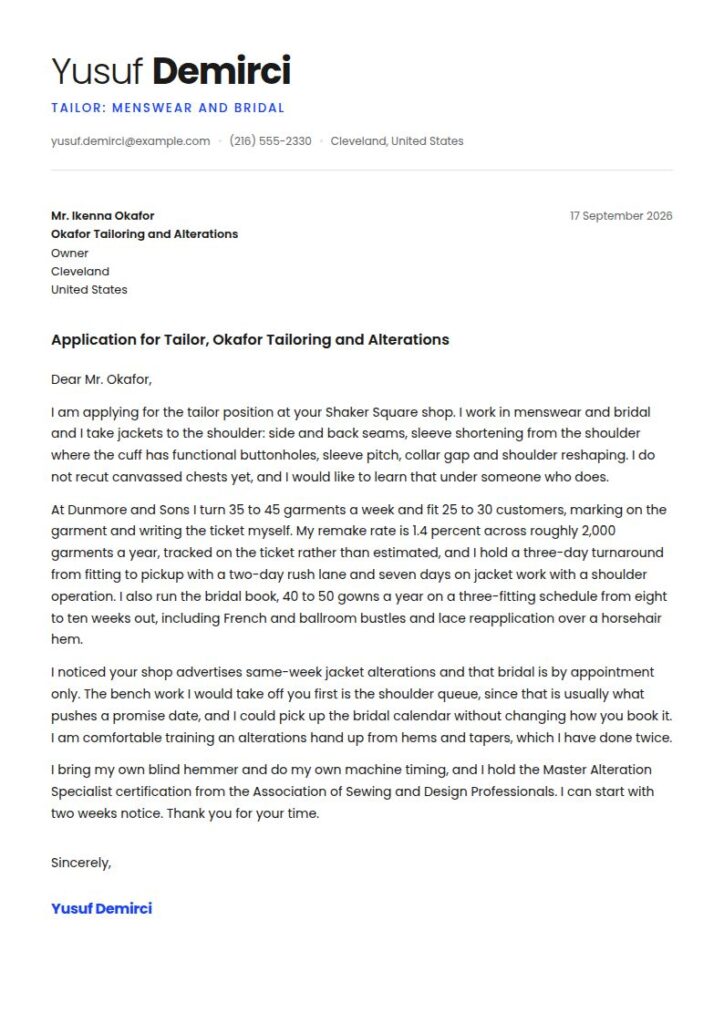
I am applying for the tailor position at your Shaker Square shop. I work in menswear and bridal and I take jackets to the shoulder: side and back seams, sleeve shortening from the shoulder where the cuff has functional buttonholes, sleeve pitch, collar gap and shoulder reshaping. I do not recut canvassed chests yet, and I would like to learn that under someone who does.
At Dunmore and Sons I turn 35 to 45 garments a week and fit 25 to 30 customers, marking on the garment and writing the ticket myself. My remake rate is 1.4 percent across roughly 2,000 garments a year, tracked on the ticket rather than estimated, and I hold a three-day turnaround from fitting to pickup with a two-day rush lane and seven days on jacket work with a shoulder operation. I also run the bridal book, 40 to 50 gowns a year on a three-fitting schedule from eight to ten weeks out, including French and ballroom bustles and lace reapplication over a horsehair hem.
I noticed your shop advertises same-week jacket alterations and that bridal is by appointment only. The bench work I would take off you first is the shoulder queue, since that is usually what pushes a promise date, and I could pick up the bridal calendar without changing how you book it. I am comfortable training an alterations hand up from hems and tapers, which I have done twice.
I bring my own blind hemmer and do my own machine timing, and I hold the Master Alteration Specialist certification from the Association of Sewing and Design Professionals. I can start with two weeks notice. Thank you for your time.
Sincerely, Yusuf Demirci
Openings that work
| Instead of | Use |
|---|---|
| I am writing to express my interest in your tailoring position | I take jackets to the shoulder: sleeve pitch, collar gap and shoulder reshaping |
| I am experienced in all types of alterations | I do not recut canvassed chests yet, and I would like to learn that here |
| I have excellent attention to detail | My remake rate is 1.4 percent across roughly 2,000 garments a year |
| I am a hard worker who learns quickly | I turn 35 to 45 garments a week and fit 25 to 30 customers |
What proves quality when there is no portfolio
A tailor cannot send photographs of other people's clothes. These are the figures that work instead.
| Kind of evidence | What it looks like in a sentence |
|---|---|
| Volume | 35 to 45 garments a week, 25 to 30 fittings a week |
| Turnaround | Three days from fitting to pickup, two-day rush, seven days on shoulder work |
| Remake rate | 1.4 percent across roughly 2,000 garments a year, tracked on the ticket |
| Capability | Jackets to the shoulder, including sleeve pitch and collar gap |
| Bridal | 40 to 50 gowns a year on a three-fitting schedule from eight weeks out |
| Machines | Own blind hemmer, own timing and tension changes |
There is no federal wage figure to negotiate against
The Bureau of Labor Statistics publishes no current Occupational Outlook Handbook profile for tailors, dressmakers and custom sewers. The Handbook's production occupations index, last modified 27 August 2026, lists sixteen profiles and the trade is not among them, and the older per-occupation pages have been retired.
So the honest reference points are the published occupations that bracket the work, all May 2025: retail sales workers at a median of $35,560 a year, jewelers and precious stone and metal workers at $52,540, and fashion designers at $80,960 (BLS Occupational Outlook Handbook, pages last modified 27 August 2026).
Where you land inside that band is decided by the capability boundary rather than by years. That is why the boundary goes in the letter's first paragraph rather than being saved for a bench trial.
While you are still climbing the ladder
Say exactly what you execute unsupervised today, and name the operation just above it that you want to learn. Give a weekly piece count even if the pieces are simple. Say what turnaround you have held. Mention any machine you own. Offer a bench trial in your own words, because it removes the owner's risk. Read what the shop advertises and name one queue you would take off them.
Do not write "all types of alterations". Do not claim shoulder work if you shorten from the cuff only, because it will be found out on the first jacket. Do not describe yourself as a perfectionist or as detail-oriented. Do not send photographs of customers' garments. Do not leave out bridal or leather work if you do it, since shops hire for those specifically.
Length, format and sending it
One page, four paragraphs, 250 to 400 words. PDF if you are emailing, or printed and handed in if it is a neighborhood shop, which is still how much of this trade hires. Name the file for yourself and the post: yusuf-demirci-tailor-cover-letter.pdf.
Address a person. Small shops are owner-operated and the name is usually on the door or the website, and using it separates your letter from the ones sent to every shop in the county.
Keep the numbers identical to your resume so the two agree. Our tailor resume example uses the same figures as the letter above.
Key takeaways
- Put your capability boundary in the first paragraph, in trade words.
- Name the operation just above your ceiling that you want to learn.
- Give a weekly garment count and a weekly fitting count.
- State turnaround from fitting to pickup and your rush lane.
- Quote a remake rate and say how it was measured.
- Say which machines you bring and whether you do your own timing.
- Name one queue you would take off their bench, and address a real person.
Write your tailor cover letter in 10 minutes with our AI cover letter builder.
Tailor cover letter questions, answered
How long should a tailor cover letter be?
One page, four paragraphs, 250 to 400 words. Many shops are owner-operated and the letter is read between fittings, so the capability sentence has to come first or it may not be read at all.
Do I need a cover letter for a small alterations shop?
Yes, and it matters more there than at a chain. A small shop has no way to test you except by risking a customer's garment, so a letter that states exactly what you execute unsupervised is doing the risk assessment for them.
What do I write with no shop experience?
Write your training as production: the garments you made, from block or from a commercial pattern, the constructions you completed, and the machines you have run. Then the operations you can execute now, honestly bounded, and an offer of a bench trial. Shops hire at the bottom of the ladder constantly, and hems and tapers said plainly beat everything claimed vaguely.
Should I mention certification?
If you hold one, yes, in the closing line. The Association of Sewing and Design Professionals runs the Master Alteration Specialist and Master Sewing and Design Professional programs, both performance-based and open to anyone with a sewing-related business (Association of Sewing and Design Professionals, retrieved 17 September 2026). Nothing is required to work in this trade, which is exactly why a checkable credential stands out.
How do I write to a shop I have never been into?
Go in first. Look at what they advertise, what the promise dates on the counter say, whether bridal is by appointment, and whether jacket work is done on site or sent out. One accurate sentence about which queue you would take off their bench is worth more than a paragraph about their reputation.