Cedric Amponsah Designer and Bench Jeweler Asheville, 28801, United States [email protected] · (828) 555-1575
17 September 2026
Ms. Imogen Vance Bench Manager Kiln Street Fine Jewelry Asheville, United States
Application for Designer and Bench Jeweler, Kiln Street Fine Jewelry
Dear Ms. Vance,
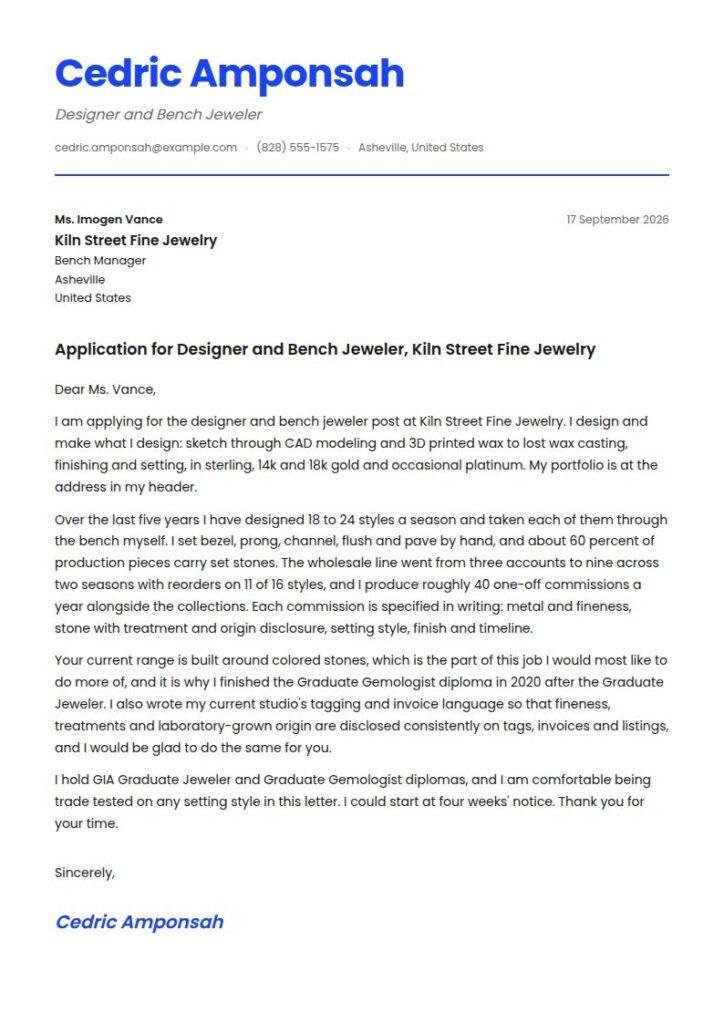
I am applying for the designer and bench jeweler post at Kiln Street Fine Jewelry. I design and make what I design: sketch through CAD modeling and 3D printed wax to lost wax casting, finishing and setting, in sterling, 14k and 18k gold and occasional platinum. My portfolio is at the address in my header.
Over the last five years I have designed 18 to 24 styles a season and taken each of them through the bench myself. I set bezel, prong, channel, flush and pave by hand, and about 60 percent of production pieces carry set stones. The wholesale line went from three accounts to nine across two seasons with reorders on 11 of 16 styles, and I produce roughly 40 one-off commissions a year alongside the collections. Each commission is specified in writing: metal and fineness, stone with treatment and origin disclosure, setting style, finish and timeline.
Your current range is built around colored stones, which is the part of this job I would most like to do more of, and it is why I finished the Graduate Gemologist diploma in 2020 after the Graduate Jeweler. I also wrote my current studio's tagging and invoice language so that fineness, treatments and laboratory-grown origin are disclosed consistently on tags, invoices and listings, and I would be glad to do the same for you.
I hold GIA Graduate Jeweler and Graduate Gemologist diplomas, and I am comfortable being trade tested on any setting style in this letter. I could start at four weeks' notice. Thank you for your time.
Sincerely, Cedric Amponsah
Summary
A jewelry designer cover letter says which parts of a piece you design and which you make yourself, names the bench operations you can run tomorrow, and describes metal and stones the way the trade is legally required to. This guide gives you a full adaptable letter, the openings that get a portfolio opened, and what to say when you send work out.
Jewelry Designer cover letter examples by experience level
A jewelry designer cover letter is a one page letter that tells a studio what you design, what you personally make, and which bench operations they could hand you on your first morning.
That sounds prosaic next to the work itself; however, it is exactly why it works. In practice, every letter in the stack says the writer loves the craft. However, very few say "I set bezel, prong, channel, flush and pave, and I cast in house from 3D printed patterns," which is the sentence a bench manager is actually reading for.
Guide to a jewelry designer cover letter
In short, this guide and the corresponding jewelry designer cover letter example will cover:
- First, how to structure the letter, paragraph by paragraph
- Then, why the maker against designer split belongs in the first paragraph
- Also, how to write materials accurately under the rules the trade works to
- What to say when part of the work goes to an outside shop
- Finally, the openings that get a reader to open a portfolio
How to write a jewelry designer cover letter
| Paragraph | Its job | Length |
|---|---|---|
| Opening | The role, what you design, and how much of it you make yourself | 2 to 3 sentences |
| Evidence | Operations by name, one collection or production number, one commercial result | 4 to 5 sentences |
| Fit | Something real about their work, and the gap you would fill at the bench | 3 to 4 sentences |
| Close | Credentials, portfolio link, availability, thank you | 2 sentences |
Answer the maker question before they ask it
A studio reading applications is sorting for one thing: how much of the object does this person make?
A designer who also casts and sets replaces two roles. A designer who sends everything out is a different, equally valid hire, and the studio needs to know which one is arriving so they can plan the bench around it.
Write it in the first paragraph, without hedging. "I design and fabricate in house, including casting and setting" or "I design in house, cast with an outside shop and set in house" both read as professional. What reads badly is a letter that lets the reader assume the first and discover the second at a trade test.
A jewelry designer cover letter example you can adapt
Dear Ms. Vance,
I am applying for the designer and bench jeweler post at Kiln Street Fine Jewelry. I design and make what I design: sketch through CAD modeling and 3D printed wax to lost wax casting, finishing and setting, in sterling, 14k and 18k gold and occasional platinum. My portfolio is at the address in my header.
Over the last five years I have designed 18 to 24 styles a season and taken each of them through the bench myself. I set bezel, prong, channel, flush and pave by hand, and about 60 percent of production pieces carry set stones. The wholesale line went from three accounts to nine across two seasons with reorders on 11 of 16 styles, and I produce roughly 40 one-off commissions a year alongside the collections. Each commission is specified in writing: metal and fineness, stone with treatment and origin disclosure, setting style, finish and timeline.
Your current range is built around colored stones, which is the part of this job I would most like to do more of, and it is why I finished the Graduate Gemologist diploma in 2020 after the Graduate Jeweler. I also wrote my current studio's tagging and invoice language so that fineness, treatments and laboratory-grown origin are disclosed consistently on tags, invoices and listings, and I would be glad to do the same for you.
I hold GIA Graduate Jeweler and Graduate Gemologist diplomas, and I am comfortable being trade tested on any setting style in this letter. I could start at four weeks' notice. Thank you for your time.
Sincerely, Cedric Amponsah
Openings that make a reader open the portfolio
| Instead of | Use |
|---|---|
| I have always been passionate about jewelry and beautiful materials | I design and make what I design, from sketch through CAD and casting to setting |
| I am writing to express my interest in the designer position | I am applying for the designer and bench jeweler post, and my portfolio is in the header |
| I am experienced in a wide range of jewelry making techniques | I set bezel, prong, channel, flush and pave by hand, under magnification below 2mm |
| I have contributed to successful collections | The wholesale line went from three accounts to nine, with reorders on 11 of 16 styles |
Materials: write them the way the trade has to
Someone who deals with disclosure complaints reads a jewelry letter, so the way you name metal and stones is itself evidence.
The Federal Trade Commission's Guides for the Jewelry, Precious Metals, and Pewter Industries at 16 CFR Part 23 make it unfair or deceptive to misrepresent any material aspect of a product (16 CFR 23.1). Among the specifics: the word gold unqualified is deceptive unless a correct karat fineness designation immediately precedes it (23.3(b)(2)); sterling silver means at least 925/1,000ths pure silver and coin silver at least 900/1,000ths (23.5); unqualified platinum requires at least 950 parts per thousand (23.6); treatments must be disclosed where they are not permanent, create special care requirements or significantly affect value (23.24); and an unqualified stone name is deceptive unless preceded by "laboratory-created," "laboratory-grown" or "imitation" (23.25(b)). All retrieved 17 September 2026.
Of course, you will not cite a regulation in a cover letter. Instead, you will simply write "14k gold with laboratory-grown sapphires, treatment disclosed on the tag" instead of "gold and sapphire jewelry," and a trade reader will notice.
What to say when part of the work goes out
Say in the first paragraph how much of the piece you make. Name the operations you run, including the setting styles. Give one collection or production number and one commercial result. Offer to be trade tested; it is the fastest way to end the question. Name the credential if you hold one, because gemology certification is optional in this trade rather than required. Describe stones and metals precisely.
Do not imply bench skills you cannot demonstrate under test. Do not describe a stone in a way the FTC guides would not allow. Do not name a client, a gallery or a retailer without permission. Do not attach images; send one portfolio link. Do not treat sending casting or setting out as something to hide, because it is a normal and respectable way to run a line.
A small trade, and almost every opening is a replacement
Jewelers and precious stone and metal workers held 32,800 jobs in 2025, projected to fall to 31,800 by 2035, a change of -3 percent and -1,100 jobs, with about 3,700 openings a year (BLS Occupational Outlook Handbook, page last modified 27 August 2026).
The median wage was $52,540 a year, or $25.26 an hour, in May 2025, with the lowest 10 percent under $35,580 and the highest 10 percent over $87,540. Thirty-two percent of the occupation is self-employed, and entry is typically a high school diploma with long-term on-the-job training (same source).
An occupation this size hires by word of mouth and by trade test rather than by volume recruitment. A letter that names operations and offers a test is written for how the trade actually fills a bench.
Sending it: length, format and the file name
One page, four paragraphs, 250 to 400 words. PDF, named for yourself and the role: cedric-amponsah-jewelry-designer-cover-letter.pdf. One portfolio link in the header, as a plain URL, and no images in the letter itself.
Address a person. Studios and independent retailers are small, and the site usually names the owner or bench manager. Keep the numbers identical to your resume so the two agree; our jewelry designer resume example uses the same figures as this letter.
Key takeaways
- To begin with, say how much of the piece you make yourself in the first paragraph.
- Name the bench operations, including the setting styles you run.
- Give one collection or production number and one commercial result.
- Also, describe metal and stones precisely, with treatment and origin disclosed.
- Offer a trade test; it ends the question faster than any adjective.
- Name the GIA credential if you hold one, because it is optional and so it stands out.
- Finally, one portfolio link in the header, no attached images.
Write your jewelry designer cover letter in 10 minutes with our AI cover letter builder.
Jewelry designer cover letter questions, answered
How long should a jewelry designer cover letter be?
One page, four paragraphs, 250 to 400 words. The portfolio carries the visual argument and the resume carries the detail; this letter only has to establish what you make and get the portfolio opened.
Should I admit that I send casting or setting out?
Yes, in the first paragraph. Plenty of strong designers work that way and studios plan around it. What damages an application is discovering the limit at a trade test after the letter implied otherwise.
Do I need a GIA credential to apply?
No. BLS describes gemology certifications as optional rather than required, with entry typically at a high school diploma and long-term on-the-job training (Occupational Outlook Handbook, page last modified 27 August 2026). If you do hold one, name it, because most applicants will not.
How do I describe materials without overclaiming?
Use the fineness and the disclosure. "18k gold, natural sapphire, heat treatment disclosed" and "sterling silver, laboratory-grown diamond" are both precise and both match the language the FTC Jewelry Guides require (16 CFR Part 23, retrieved 17 September 2026). Vague phrasing such as "gold and gemstone pieces" reads as inexperience to anyone in the trade.
What if I mostly sell my own work rather than working for a studio?
Say so, and give the channel split. "About 55 percent wholesale, 25 percent direct, 20 percent commission" tells a studio owner you have run a business, priced for margin and delivered to deadlines, which is a stronger claim than most employed applicants can make. Around 32 percent of this occupation is self-employed, so the reader will recognize the shape of it immediately (BLS Occupational Outlook Handbook, page last modified 27 August 2026).