Nia Broussard Television Writer, One Hour Drama Atlanta, 30312, United States [email protected] · (404) 555-2280
11 September 2026
Ms. Marit Hjelm Series Development Cloudbreak Features Los Angeles, United States
Application for Staff Writer, Cloudbreak Features one hour drama
Dear Ms. Hjelm,
I am writing about the staff writer opening on your new one hour drama. I am currently a story editor on a twelve-episode order, with three solo teleplay credits and one co-written, and I write one hour drama and features.
On my current series I delivered a 58 page teleplay on a nine day turnaround during a compressed production block, broke the back half of the season with four other writers, and covered set as the writer on two episodes. Before that I staffed for two seasons on the same show and spent a year as its writers' assistant, so I have seen the same room from three different chairs. I became a WGA West member in 2024.
The sample I would send is "Marrow County", an original one hour pilot, drama, 61 pages, finished this year. It was a quarterfinalist in a national screenwriting competition and it is registered with the WGAW Registry and filed with the Copyright Office. If you would rather read a feature, I have one at 104 pages that two literary managers requested.
I can send either as a PDF the day you ask, and I am available for a room start on four weeks' notice. Thank you for reading.
Sincerely, Nia Broussard
Summary
A screenwriter cover letter exists to earn one thing: a read. This guide gives you a full adaptable letter built on the form and length of your material, the third-party reads behind it and the staffing rung you have reached, plus what changes between a staffing submission and a query to a manager.
Screenwriter cover letter examples by experience level
In short, a screenwriter cover letter has one job: to get someone to open the script.
As a result, nothing else in it matters: not your love of film, not the story of how you started writing, not what the project means to you. After all, the reader has a stack and two free hours, and your letter is competing for those hours against twenty other letters and against going home. So give them the form, the length, the read behind it and your rung, and get out of the way.
Guide to a screenwriter cover letter
To help, this guide and the corresponding screenwriter cover letter example will cover:
- First, how to structure the letter, paragraph by paragraph
- Next, why the form and page count belong in the first two sentences
- Then, what a third-party read is, and why it beats any adjective
- Also, how the letter changes between a staffing submission and a manager query
- Finally, the openings that get a reader to open a script
How to write a screenwriter cover letter
| Paragraph | Its job | Length |
|---|---|---|
| Opening | The post or the ask, your rung, and the form you write | 2 to 3 sentences |
| Credits | What you have been paid to write, and the turnaround you held | 3 to 4 sentences |
| Material | One script: title, form, page count, and the read behind it | 3 to 4 sentences |
| Close | Availability, registration status, thank you | 2 sentences |
Lead with the rung, then the pages
Two facts place you faster than a paragraph of description: the rung you last staffed at, and the length and form of the script you want read.
"I am a story editor coming off a twelve-episode one hour order, with three solo teleplay credits" tells a showrunner exactly where you sit. "My original pilot is a 61 page one hour drama" tells them what tonight would cost.
If you have no credits, invert it. Lead with the material and the read: "My original one hour pilot, 61 pages, was a quarterfinalist in a national screenwriting competition this year." The read is doing the work the credit would have done.
A screenwriter cover letter example you can adapt
Dear Ms. Hjelm,
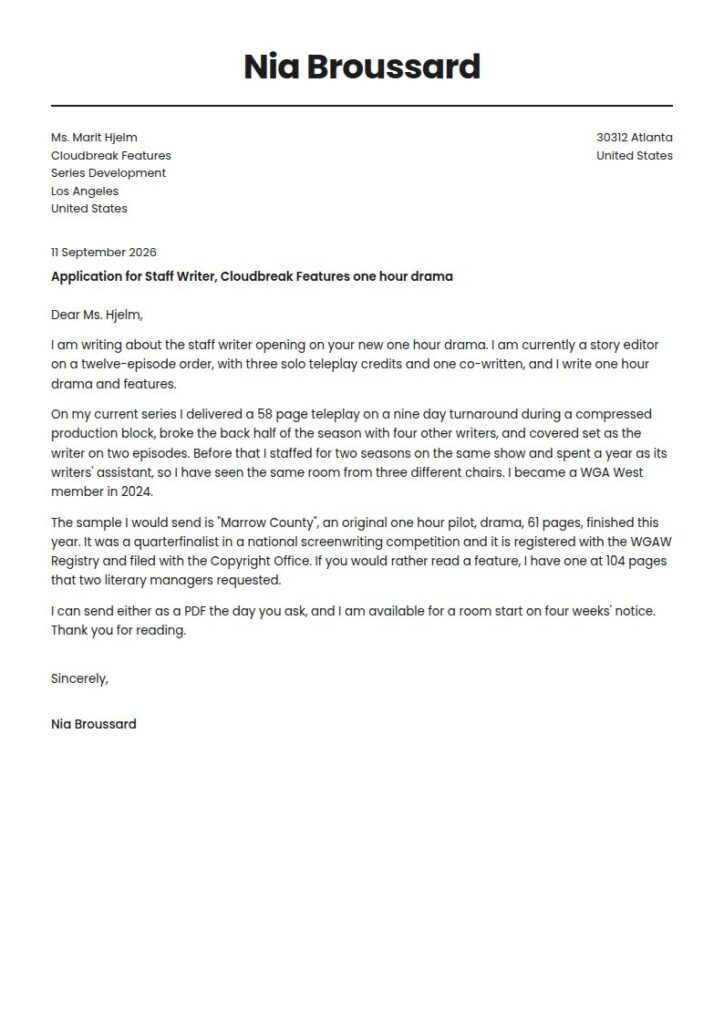
I am writing about the staff writer opening on your new one hour drama. I am currently a story editor on a twelve-episode order, with three solo teleplay credits and one co-written, and I write one hour drama and features.
On my current series I delivered a 58 page teleplay on a nine day turnaround during a compressed production block, broke the back half of the season with four other writers, and covered set as the writer on two episodes. Before that I staffed for two seasons on the same show and spent a year as its writers' assistant, so I have seen the same room from three different chairs. I became a WGA West member in 2024.
The sample I would send is "Marrow County", an original one hour pilot, drama, 61 pages, finished this year. It was a quarterfinalist in a national screenwriting competition and it is registered with the WGAW Registry and filed with the Copyright Office. If you would rather read a feature, I have one at 104 pages that two literary managers requested.
I can send either as a PDF the day you ask, and I am available for a room start on four weeks' notice. Thank you for reading.
Sincerely, Nia Broussard
Openings that work
| Instead of | Use |
|---|---|
| I have been passionate about storytelling since I was a child | I am a story editor on a twelve-episode one hour order, with three solo teleplay credits |
| I am writing to submit my screenplay for your consideration | My original one hour pilot is 61 pages and was a competition quarterfinalist this year |
| I believe my unique voice would be a great fit for your show | I have written one hour drama in a five-writer room for four seasons |
| I have several projects in development | I have two completed scripts ready to send today, a 61 page pilot and a 104 page feature |
What a third-party read is, and why it beats an adjective
In practice, an experienced reader discounts everything you say about your own script to zero. By contrast, everything somebody else said about it keeps its value.
| Kind of read | What it looks like in a sentence |
|---|---|
| Competition placement | Quarterfinalist, national screenwriting competition, 2026 |
| Fellowship or lab | Selected for a studio writers' program, 2023 |
| Request | Requested by two literary managers after a query |
| Production | Co-writer on a 14 page short, produced and screened at two regional festivals |
| Staged read | Table read at a regional theater company |
| Credit | Three solo teleplay credits on a twelve-episode order |
The Academy Nicholl Fellowships show why placements carry weight: up to five $35,000 fellowships a year, entry limited to writers whose lifetime motion picture and television writing earnings are under $25,000, and scripts accepted only between 70 and 160 pages (Academy of Motion Picture Arts and Sciences, retrieved 17 September 2026). Competitions publish the rules and announce the rounds, so anyone can check the claim in a way they cannot check "award-winning".
Staffing submission or manager query
In practice, the two letters share most of their content and differ in what they lead with.
For a staffing submission, lead with the rung and the credits, then the sample, because a showrunner is filling a seat. For a manager query, lead with the material and the read, because a manager is buying a career rather than a week. In both, name the form and the page count, say the script is registered and filed, and say how fast you can send it.
Do not attach the script unless it was requested. Do not pitch the plot; a logline goes in only if the posting asked for one. Do not claim a credit you did not receive or a rung you have not held. Do not describe your script as a guaranteed hit or a franchise. Do not send the same letter to a showrunner and a manager.
Two facts that explain the whole ladder
WGA West Current membership takes 24 units of credit inside three years. A screenplay for a feature-length theatrical motion picture, or a teleplay of 90 minutes or longer, is worth all 24 on its own, while each complete week of employment within the Guild's jurisdiction is worth 2 and a polish earns a quarter of the units (Writers Guild of America West, How to Become a Member, retrieved 17 September 2026).
Writers and authors as an occupation are flat: 140,300 employed in 2025, a projected 139,900 in 2035, about 11,900 openings a year, and 65 percent self-employed (BLS Occupational Outlook Handbook, writers and authors, page last modified 27 August 2026).
Together those explain why the letter matters more here than in most jobs. There is no steady flow of posted vacancies to answer. Most screen work is reached through a read, and the letter decides whether the read happens.
Length, format and sending it
For length, aim for one page, four paragraphs, 200 to 350 words, because the reader's next action is opening a 61 page document and your letter is the toll on the way.
PDF, named for yourself and the ask: nia-broussard-staff-writer-cover-letter.pdf. Address a person. Anyone can find the names of showrunners, executives and managers, and a letter addressed to nobody reads as one sent to everybody.
Use the same credits and page counts as your resume so the two agree. Our screenwriter resume example is written with the material used here.
Key takeaways
- In short, the letter exists to earn a read; everything else is decoration.
- Lead with your staffing rung if you have one, and the material if you do not.
- To start, give form, length and year for the script you want opened.
- Then attach a third-party read: a placement, a request, a production, a staged read.
- Also, say in four words that you have registered and filed the material.
- However, never attach a script nobody requested.
- Finally, one page, four paragraphs, to a named person.
Write your screenwriter cover letter in 10 minutes with our AI cover letter builder.
Screenwriter cover letter questions, answered
How long should a screenwriter cover letter be?
One page, four paragraphs, 200 to 350 words. Shorter than most cover letters, because the reader's next action is a 61 page script and a long letter spends attention you need them to save.
Should I include a logline in my query letter?
Only if the posting or the manager's guidelines asked for one. A logline on the page is a second thing to judge you on before anyone reads a scene, and an adequate logline has killed scripts that would have sold themselves in ten pages. Say the form, the length and the read, and offer the logline.
Do I attach the script to the email?
Never unless it was requested. An unrequested attachment is the fastest way into a spam folder and, in some companies, into a legal policy that means nobody may open it. Say you can send a PDF the same day, then do it when asked.
What do I write if I have no credits at all?
Invert the structure. Lead with the material and the read: title, form, page count, year, and whatever third party has spent time on it. Then support work, written as a job with what you ran. Then the registration line. A writer with a 61 page pilot, a competition placement and a year of coordinating scripts has more to say than most letters manage.
Should I mention that my script is registered?
Yes, in four words at the end, as a fact rather than a warning. "WGAW registered, copyright filed" tells a business affairs department that you understand the difference between the two, since the WGAW Registry states that registration "does NOT take the place of registering with the Library of Congress, U.S. Copyright Office" (WGAW Registry, retrieved 17 September 2026). A paragraph about protecting your idea says the opposite thing.