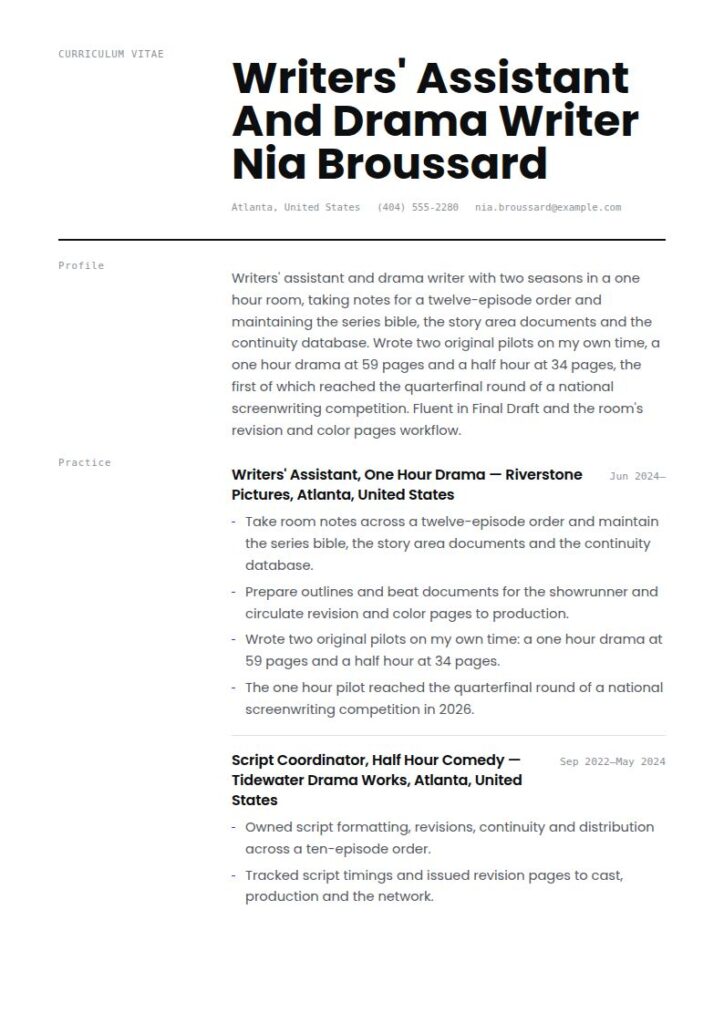
Writers' Assistant and Drama Writer Nia Broussard
Writers' Assistant, one hour drama
[email protected] | (404) 555-2280 | Atlanta, United States
Profile
Writers' assistant and drama writer with two seasons in a one hour room, taking notes for a twelve-episode order and maintaining the series bible, the story area documents and the continuity database. Wrote two original pilots on my own time, a one hour drama at 59 pages and a half hour at 34 pages, the first of which reached the quarterfinal round of a national screenwriting competition. Fluent in Final Draft and the room's revision and color pages workflow.
Work Experience
06/2024 - Present, Writers' Assistant, one hour drama, Riverstone Pictures, Atlanta, United States
- Take room notes across a twelve-episode order and maintain the series bible, the story area documents and the continuity database.
- Prepare outlines and beat documents for the showrunner and circulate revision and color pages to production.
- Wrote two original pilots on my own time: a one hour drama at 59 pages and a half hour at 34 pages.
- The one hour pilot reached the quarterfinal round of a national screenwriting competition in 2026.
09/2022 - 05/2024, Script Coordinator, half hour comedy, Tidewater Drama Works, Atlanta, United States
- Owned script formatting, revisions, continuity and distribution across a ten-episode order.
- Tracked script timings and issued revision pages to cast, production and the network.
Education
08/2014 - 05/2018, Bachelor of Arts, Film and Media, Georgia State University, Atlanta, United States
Screenwriting workshop sequence, production practicum and a senior thesis short produced in 2018.
Skills
Final Draft, 90
Series bible and story area documents, 80
Revision and color pages, 85
Outlining to a beat sheet, 70
Continuity tracking in Airtable, 80
Script timing, 75
Languages
English, native
French, intermediate
Certificates
04/2019, WGAW Registry, registered material, Writers Guild of America West Registry
Original pilots and features registered; copyright filed separately with the U.S. Copyright Office.
Summary
A screenwriter resume is a one page document carrying a credits line and a material line: what you have written, at what length and in what form, and who has read it. This guide gives you three adaptable versions, the staffing ladder, what WGA registration does and does not do, and current Bureau of Labor Statistics pay and outlook for writers and authors.
Screenwriter resume examples by experience level
A screenwriter resume is a one page document with two payloads: a credits line and a material line.
The credits line is what you have been paid to write and where it went. The material line is what you have written on your own, at what length and in what form, and who outside your own circle has read it. An executive, showrunner or manager is deciding whether to spend two hours on your script, and both lines answer whether that is a good use of the two hours.
Resume guide for a screenwriter resume
This guide and the corresponding screenwriter resume example will cover:
- How to write a screenwriter resume, section by section
- How to write credits and material: form, length, and who has read it
- Three adaptable summaries: assistant, staffed writer and senior writer
- What WGA registration does, and what copyright registration does instead
- What the job market looks like and what you can expect to earn
How to write a screenwriter resume
Five sections: contact header with representation if you have it, summary, credits, material, then support roles and skills. One page, because this is one of the few jobs where a second page reads as a warning. The order follows the reader's decision: have you been paid, at what tier and by whom, and if not, what have you written and who vouches for it.
| Section | What it is answering | Where it goes |
|---|---|---|
| Credits | Has anyone paid this person to write, and at what level? | Directly under the summary |
| Material | What can I read right now, and how long is it? | Immediately after credits |
| Support roles | Do they know how a room and a production run? | Below material, with dates |
| Skills and software | Can they turn a draft around in our format? | Short, at the foot |
Put the page count on every piece of material
A reader's first question about a script is not what it is about but how long it is, because that decides which evening it fits into.
Write the form and the length together: "Feature, drama, 108 pages", "Original pilot, one hour, 61 pages", "Original pilot, half hour, 34 pages". A one hour pilot at 61 pages reads as someone who knows the format; the same pilot at 82 pages tells the reader something before they open it.
Then attach the read. A competition placement, a fellowship shortlist, a produced short, a staged read, a manager's request: any of those turns your claim into somebody else's.
Run the file through the ATS resume checker before you submit. Assistant, coordinator and staff writer applications at studios and streamers go through a parsing system before a human sees them.
Choosing the best resume format for a screenwriter resume
Reverse chronological within each block, with credits above material and both above employment. That is not the standard resume shape and it is the right one here: a screenwriter with two produced episodes and four years of assistant work is hired on the two episodes.
Functional formats fail for the usual reason: they hide recency, and recency is the question. A writer whose last credit is from 2019 and whose last new script is from 2021 is a different candidate from one who finished a pilot in March. Keep it to one page: development executives read these in stacks, and the discipline is itself a signal in a job whose craft is compression.
Include your contact information
| ✅ Right | ❌ Wrong |
|---|---|
| Nia Broussard | Nia Broussard |
| Screenwriter: one hour drama, features | Aspiring screenwriter and creative visionary |
| Represented by a literary manager, Los Angeles | Seeking representation |
| WGA West member, 2024 | Guild affiliated |
| (404) 555-2280, [email protected], Atlanta, GA | (404) 555-2280, [email protected] |
If you have representation, name that you have it and where, not the individual. If you do not, leave the line off rather than announcing you are seeking it. The absence says the same thing without sounding like a request.
Make use of a summary
Four lines: the form you write, the credits you hold, the material you have ready now, and the verifiable read behind it.
Writers' assistant and drama writer with two seasons in a one hour room, taking notes for a twelve-episode order and maintaining the series bible, the story area documents and the continuity database. Wrote two original pilots on my own time, a one hour drama at 59 pages and a half hour at 34 pages, the first of which reached the quarterfinal round of a national screenwriting competition. Fluent in Final Draft and the room's revision and color pages workflow.
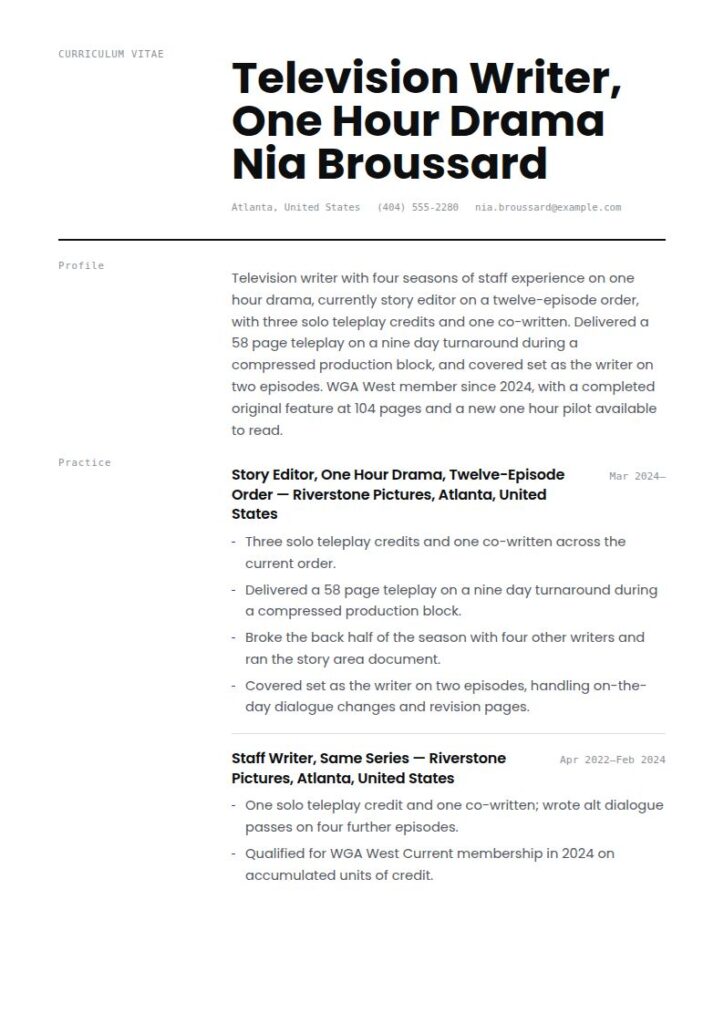
Television writer with four seasons of staff experience on one hour drama, currently story editor on a twelve-episode order, with three solo teleplay credits and one co-written. Delivered a 58 page teleplay on a nine day turnaround during a compressed production block, and covered set as the writer on two episodes. WGA West member since 2024, with a completed original feature at 104 pages and a new one hour pilot available to read.
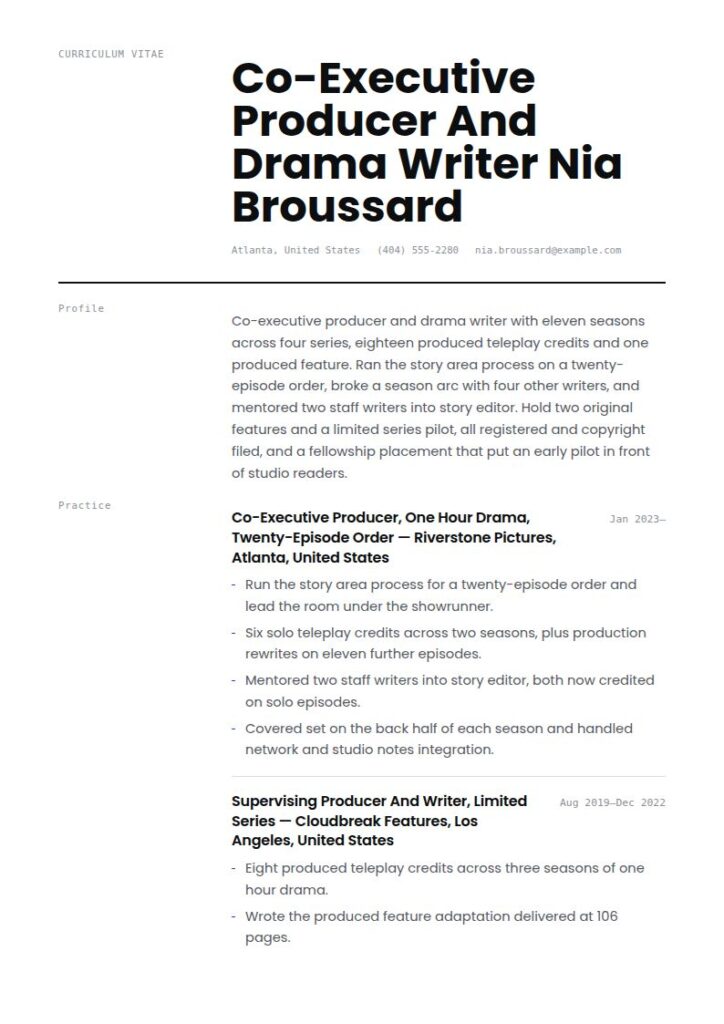
Co-executive producer and drama writer with eleven seasons across four series, eighteen produced teleplay credits and one produced feature. Ran the story area process on a twenty-episode order, broke a season arc with four other writers, and mentored two staff writers into story editor. Hold two original features and a limited series pilot, all registered and copyright filed, and a fellowship placement that put an early pilot in front of studio readers.
Right vs wrong: the same screenwriter summary, twice
| ✅ Right | ❌ Wrong |
|---|---|
| Television writer with four seasons on one hour drama, currently story editor, three solo teleplay credits and one co-written. | Creative screenwriter with a passion for telling powerful stories. |
| Delivered a 58 page teleplay on a nine day turnaround during a compressed production block. | Skilled at writing under tight deadlines and working well with others. |
| Completed original feature at 104 pages and a new one hour pilot available to read. | Several original screenplays in development. |
The right column tells a showrunner what tier you staff at and what they can read tonight. The left is what every other unstaffed writer has written.
Outline your screenwriting experience
Series or project, your title, the order size, dates and form in one line. Then two to four bullets carrying credits, turnarounds and what you owned.
| Instead of | Use |
|---|---|
| Wrote episodes for a television series | Three solo teleplay credits and one co-written across a twelve-episode one hour order |
| Collaborated with the writing team | Broke a season arc in a five-writer room and ran the story area document through the break |
| Worked under tight deadlines | Delivered a 58 page teleplay on a nine day turnaround during a compressed production block |
Story Editor, one hour drama, twelve-episode order, Riverstone Pictures, Atlanta, GA, 2024 to Present.
Three solo teleplay credits and one co-written; delivered a 58 page teleplay on a nine day turnaround during a compressed production block.
Broke the back half of the season with four other writers and ran the story area document.
Covered set as the writer on two episodes, handling on-the-day dialogue changes and revision pages.
Staff Writer, same series, 2022 to 2024. One solo teleplay credit and one co-written; wrote alt dialogue passes on four further episodes.
Writers' Assistant, same series, 2021 to 2022. Room notes, series bible and continuity database.
The credits and material line: what you have written, at what length, and who has read it
This is the section that decides everything, and most screenwriter resumes get it wrong by treating writing as one undifferentiated activity. A feature, an original pilot and a produced episode are three different jobs. A reader who cannot tell which you have done cannot place you.
Credits
Story Editor, one hour drama, Riverstone Pictures, 2024 to present. Three solo teleplay credits, one co-written, twelve-episode order.
Staff Writer, same series, 2022 to 2024. One solo credit, one co-written.
Co-writer, short film, 14 pages, produced 2021, screened at two regional festivals.
Material
"Marrow County", original one hour pilot, drama, 61 pages, 2026. Quarterfinalist, national screenwriting competition. WGAW registered, copyright filed.
"Wardline", original feature, drama, 104 pages, 2025. Requested by two literary managers. WGAW registered, copyright filed.
"Sable Creek Station", original half hour pilot, comedy drama, 34 pages, 2024. Table read at a regional theater company.
Loglines available on request; material sent as a PDF the same day it is asked for.
Three habits make that block work.
Name the form and the page count. Feature, original pilot, episode, short. One hour or half hour. Pages. Those facts place you in about six seconds, and they are the ones everyone leaves out.
Attach a third-party read wherever you can. Your own opinion of your script is worth nothing on a resume. A placement, a fellowship shortlist, a manager's request, a produced short, a staged read: each is somebody else saying they spent time on it. The Academy Nicholl Fellowships are the clearest checkable placement, awarding up to five $35,000 fellowships a year, open only to writers whose total lifetime earnings for motion picture and television writing do not exceed $25,000, and accepting scripts no shorter than 70 pages and no longer than 160 (Academy of Motion Picture Arts and Sciences, Academy Nicholl Fellowships, retrieved 17 September 2026).
Keep the logline off the page and ready in a sentence. A resume with three loglines on it has become a pitch document. One line saying loglines are available on request does the work.
What WGA registration does, and what it does not
These two get conflated constantly, and the distinction is worth a line on your resume because it signals you have read a contract.
The WGAW Registry has operated since 1927 and documents the claim of authorship of a written work, creating a dated record it can produce as evidence if legal action begins. Its own page states that registration "does NOT take the place of registering with the Library of Congress, U.S. Copyright Office", and you need not be a Guild member to use it (Writers Guild of America West Registry, retrieved 17 September 2026).
Copyright is the other half. Your script is protected "the moment it is created and fixed in a tangible form", but the Copyright Office is explicit that "you will have to register, however, if you wish to bring a lawsuit for infringement of a U.S. work", and that registered works may be eligible for statutory damages and attorney's fees (U.S. Copyright Office, Copyright FAQ, retrieved 17 September 2026). Registration is the remedy; the Registry is the timestamp. Writing "WGAW registered, copyright filed" after a title costs four words and says you are someone business affairs will not have to educate.
The staffing ladder, and where you sit on it
Television writing has a named ladder, and the right rung is how a showrunner reads your level without asking.
| Rung | What it usually means |
|---|---|
| Writers' assistant | In the room, taking notes, not writing episodes |
| Script coordinator | Owns formatting, revisions, continuity and distribution |
| Staff writer | First writing rung, typically one credit in a season |
| Story editor and executive story editor | More episodes and more of the break |
| Co-producer and producer | Writer-producer titles; more production duty |
| Supervising producer and co-executive producer | Senior room leadership under the showrunner |
Do not inflate. A writers' assistant listed as a staff writer is caught by the first person who asks which episode, and the industry is small enough that the question comes.
Guild membership sits on top of the same ladder and is earned by unit, not by application. The WGA West requires 24 units of credit within three years for Current membership: a screenplay for a feature-length theatrical motion picture or a teleplay of 90 minutes or longer is worth 24 units, each complete week of employment within the Guild's jurisdiction is 2 units, a teleplay under 30 minutes is 6 units, a rewrite earns half the units and a polish a quarter. The initiation fee on qualification is $2,500, and writers below the threshold can take Associate membership at $100 a year for up to three years (Writers Guild of America West, How to Become a Member, retrieved 17 September 2026). If you are accumulating units, the count is a precise resume line.
Build a snapshot of your key skills
Eight to twelve entries in three groups: the forms you write, the room and production craft, and the software.
Forms: One hour drama, Half hour comedy drama, Original pilot, Feature, Short film, Series bible and story areas
Room and production: Breaking story, Outlining to a beat sheet, Alt dialogue passes, Revision and color pages, Script timing, Covering set, Notes integration
Software: Final Draft, Scrivener, Airtable and Google Workspace for continuity tracking, Slack and Zoom rooms
List your education and certifications
Short, at the foot. A bachelor's degree is the typical entry-level education for writers and authors, with long-term on-the-job training expected (BLS Occupational Outlook Handbook, writers and authors, page last modified 27 August 2026), and in screenwriting the degree is the least load-bearing line on the page. Fellowships and labs outrank it, because they come with a read.
Bachelor of Arts, Film and Media, Georgia State University, Atlanta, GA, 2018.
Programs: Quarterfinalist, national screenwriting competition, 2026. Selected for a studio writers' program, 2023. Regional theater staged read, 2024.
Memberships: Writers Guild of America West since 2024. WGAW Registry, material registered since 2019.
Choose the right layout and design
Single column, 11 or 12 point, no photograph, no columns, no title cards, no attempt to make the resume look like a screenplay. The Courier joke has been made, and the parsing system will not laugh. Name the file for yourself and the post: nia-broussard-television-writer-resume.pdf. Send material as a PDF the same day it is requested; the gap between "can I read something" and the file arriving is the most avoidable way writers lose momentum.
Separate credits from material and put both above employment. Give form, length and year for every script. Attach a third-party read wherever one exists. Use the correct rung of the staffing ladder. Write "WGAW registered, copyright filed" after titles you have protected. Keep it to one page.
Do not list loglines, synopses or a treatment on the resume. Do not inflate your rung or claim a credit you did not receive. Do not say "in development" for a script nobody has optioned. Do not name an executive or manager as a reference without asking. Do not describe yourself as an aspiring screenwriter. Do not send a script before it is requested.
Screenwriter job market and outlook
BLS publishes no separate screenwriter profile. Screenwriters sit inside writers and authors, a flat occupation with steady replacement demand and a very high self-employment share.
| Measure | Value |
|---|---|
| Writers and authors employed, 2025 | 140,300 |
| Projected employment, 2035 | 139,900 |
| Projected change, 2025-35 | 0% (little or no change), -500 jobs |
| Projected annual openings | ~11,900 |
| Typical entry-level education | Bachelor's degree |
| Median annual wage, May 2025 | $76,910 |
Source: U.S. Bureau of Labor Statistics, Occupational Outlook Handbook, writers and authors, page last modified 27 August 2026, May 2025 wage data and 2025 to 2035 projections.
The bounded field is why a placement is worth a resume line
Screen work is a lottery with a published denominator, which is unusual and useful. For the 2026 to 2027 Academy Nicholl cycle, submissions through the Black List closed on 6 July 2026 or at 2,500 entries, whichever came first, and through the Writers Guild Foundation on 20 July 2026 or at 2,000 entries, for up to five fellowships (Academy of Motion Picture Arts and Sciences, retrieved 17 September 2026).
Set that against the union ladder. WGA West Current membership takes 24 units of credit inside three years, a single feature-length screenplay is worth all 24, and a week of covered employment is worth 2 (Writers Guild of America West, retrieved 17 September 2026).
Read together, those facts describe the whole career. One sold feature moves you from outside to inside in a single step, while assistant work moves you two units at a time. That is why the material line carries as much weight as the credits line, and why a checkable placement on an unsold script is not decoration.
What those industries pay:
| Industry | Median annual wage (May 2025) |
|---|---|
| Religious, grantmaking, civic and professional organizations | $80,480 |
| Professional, scientific and technical services | $77,860 |
| Information | $74,590 |
| Educational services | $72,610 |
Source: U.S. Bureau of Labor Statistics, Occupational Outlook Handbook, writers and authors, May 2025.
Information is the line that matters for screen work, since film, television and streaming sit inside it, and it is not the best paid. Screenwriting is not chosen because the median is high, but because the top sits so far from the middle.
What salary you can expect as a screenwriter
The median annual wage for writers and authors was $76,910 as of May 2025, or $36.98 an hour, with the lowest 10 percent under $44,310 and the highest 10 percent over $139,870 (BLS Occupational Outlook Handbook, writers and authors, page last modified 27 August 2026).
Two features of screen work make that distribution behave differently from the rest of the occupation.
Income arrives in blocks, not in months. A staffed writer is employed for the weeks a room runs, and the WGA unit table reflects it: employment is counted in complete weeks within the Guild's jurisdiction (Writers Guild of America West, retrieved 17 September 2026). Two good rooms in a year and none the next is an ordinary shape, which is why annual figures describe screenwriters poorly.
The ladder, not the market, sets the tier. Staff writer, story editor, co-producer and co-executive producer are pay tiers as well as titles. Moving one rung is worth more than any negotiation inside a rung, and the resume's job is to make your rung unambiguous.
With 65 percent of writers and authors self-employed (BLS Occupational Outlook Handbook, writers and authors, 27 August 2026), most people writing scripts are not on a payroll. For them the resume competes not for a salary band but for a read, and a read is the only thing that converts into a sale or a staffing meeting.
Key takeaways for a screenwriter resume
- Split credits from material, and put both above employment history.
- Give form, length and year for every script: feature, pilot, one hour, half hour, pages.
- Attach a third-party read to as much material as you can.
- Use the correct staffing rung and never inflate it.
- Write "WGAW registered, copyright filed" where it is true; the two do different jobs.
- Track your WGA units; the threshold is exact.
- Keep it to one page and have the PDF ready the day it is requested.
Build your screenwriter resume in 15 minutes with our AI resume builder.
Related creative and artistic resume examples
- Film producer resume
- Cinematographer resume
- Videographer resume
- Actor resume
- Voice actor resume
- Stage manager resume
- Musician resume
- Musical theater resume
- Costume designer resume
- Visual artist resume
- Artist resume
- Theater resume
Pair it with a matching screenwriter cover letter.
Screenwriter resume questions, answered
How long should a screenwriter resume be?
One page, always. This is the one occupation where a two page resume is read as a failure of judgment, because compression is the craft being hired. If credits and material will not fit, cut the oldest material rather than the formatting.
Should I put loglines on my screenwriter resume?
No. Title, form, length, year and the read. A weak logline kills a script that the sample itself would have sold. Write "loglines available on request" and have three good ones ready.
Is WGA registration the same as copyrighting my script?
No. The WGAW Registry creates a dated record of your claim to authorship and its own page states that it "does NOT take the place of registering with the Library of Congress, U.S. Copyright Office" (WGAW Registry, retrieved 17 September 2026). Copyright exists from the moment the script is fixed, but registration is what lets you sue for infringement of a U.S. work and claim statutory damages and attorney's fees (U.S. Copyright Office, retrieved 17 September 2026). Do both.
What do I put on a screenwriter resume with no credits?
Write the material section first and make it the page. Two or three completed scripts with form, length and year, each with whatever third-party read you can attach: a competition round, a staged read, a produced short, a requested script. Then put support roles underneath as jobs, with what you ran. A writers' assistant who maintained a series bible across a twelve-episode order has shown something a reader can use.
Do I need to be in the WGA to get staffed?
No. Most first staffing jobs are how writers become eligible rather than something eligibility unlocks. Current membership takes 24 units of credit inside three years, with a feature-length screenplay worth 24 units and each complete week of covered employment worth 2, and the initiation fee is $2,500 on qualification (Writers Guild of America West, retrieved 17 September 2026). Track the units as you accumulate them; the count is a clean, checkable resume line.