Saxophonist, doubling flute and clarinet Abel Kirchner
Freelance Saxophonist, doubling flute and clarinet
[email protected] | (816) 555-1623 | Kansas City, United States
Profile
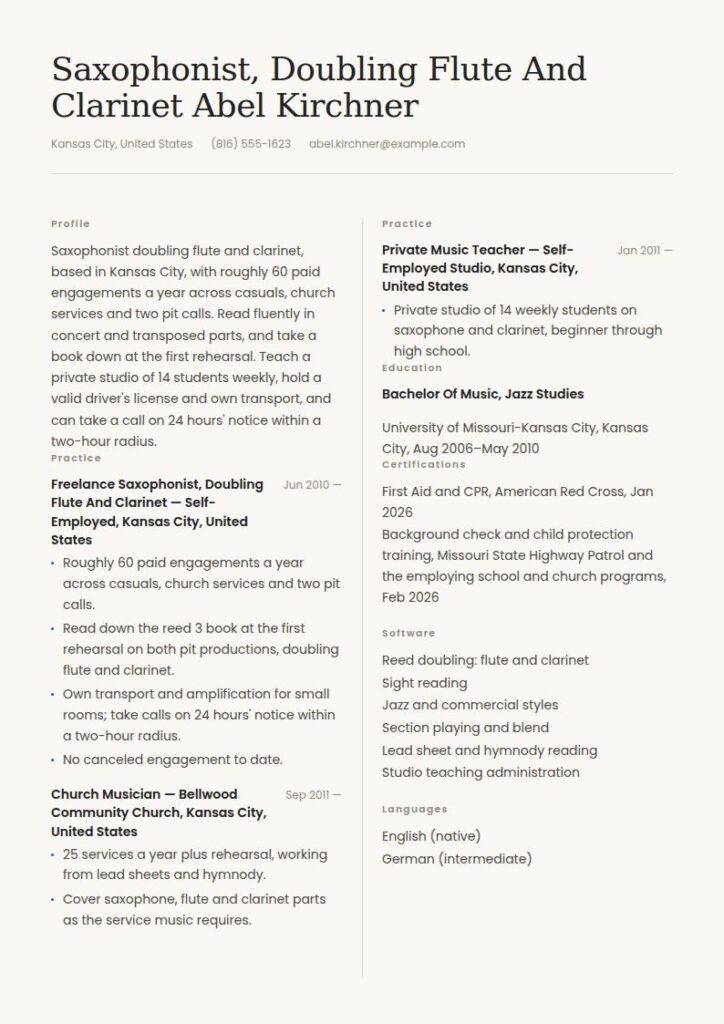
Saxophonist doubling flute and clarinet, based in Kansas City, with roughly 60 paid engagements a year across casuals, church services and two pit calls. Read fluently in concert and transposed parts, and take a book down at the first rehearsal. Teach a private studio of 14 students weekly, hold a valid driver's license and own transport, and can take a call on 24 hours' notice within a two-hour radius.
Work Experience
06/2010 - Present, Freelance Saxophonist, doubling flute and clarinet, Self-employed, Kansas City, United States
- Roughly 60 paid engagements a year across casuals, church services and two pit calls.
- Read down the reed 3 book at the first rehearsal on both pit productions, doubling flute and clarinet.
- Own transport and amplification for small rooms; take calls on 24 hours' notice within a two-hour radius.
- No canceled engagement to date.
09/2011 - Present, Church Musician, Bellwood Community Church, Kansas City, United States
- 25 services a year plus rehearsal, working from lead sheets and hymnody.
- Cover saxophone, flute and clarinet parts as the service music requires.
01/2011 - Present, Private Music Teacher, Self-employed studio, Kansas City, United States
- Private studio of 14 weekly students on saxophone and clarinet, beginner through high school.
Education
08/2006 - 05/2010, Bachelor of Music, Jazz Studies, University of Missouri-Kansas City, Kansas City, United States
Principal study saxophone, secondary study flute and clarinet.
Skills
Reed doubling: flute and clarinet, 70
Sight reading, 80
Jazz and commercial styles, 75
Section playing and blend, 75
Lead sheet and hymnody reading, 80
Studio teaching administration, 65
Languages
English, native
German, intermediate
Certificates
01/2026, First Aid and CPR, American Red Cross
Current through 2028.
02/2026, Background check and child protection training, Missouri State Highway Patrol and the employing school and church programs
Kept current for school outreach and church work.
Summary
A musician resume is a one to two page document listing the instruments you play and double on, how well you read, the gigs and sessions behind you by type and volume, and the ensembles, teaching and union standing that fill the year. This guide gives you three adaptable versions, the instrument and reading block a contractor needs, and current Bureau of Labor Statistics pay and outlook.
Musician resume examples by experience level
In short, a musician resume is a one to two page document that names every instrument you play, every instrument you double on, how well you read, and how many gigs and sessions of each type are behind you.
That is what a contractor is reading for. The person hiring a player has a chair to fill on a date, with a book in front of them, and the only questions that matter are whether you can cover the part, whether you can read it, and whether you will be there. In other words, recordings prove the sound; the page proves the logistics, and the logistics decide the call.
Resume guide for a musician resume
In particular, this guide and the corresponding musician resume example will cover:
- How to write a musician resume, section by section
- The instrument, doubles and reading block a contractor needs before calling you
- Three adaptable summaries: early career, working player and bandleader
- How to count gigs, sessions, ensembles and teaching on a page
- What the job market looks like and what the published figures say about pay
How to write a musician resume
Six sections: contact header with a listening link, summary, the instruments and reading block, work by type, teaching and ensembles, then education and union standing. Use one page for your first five years, then two once the gig and session record earns its own block.
In practice, the hiring decision shapes the order. Instruments first, because they are a yes or no. Then volume, because it is the proof. Everything else supports those two.
| Section | What it is answering | Where it goes |
|---|---|---|
| Instruments and doubles | Can you physically cover this chair, and the doubles in the book? | Directly under the summary |
| Reading | Can you play it down at the first rehearsal, or at the session? | With the instruments, in one line |
| Work by type | How many of these gigs have you actually done? | The body, grouped by kind of work |
| Teaching and ensembles | What else fills your year, and who do you play with regularly? | Below the work, with counts |
Count the work by type and year, not by title
"Experienced live and studio musician" tells a contractor nothing. Numbers do.
Write it by kind of work with a volume and a period: "Roughly 110 paid engagements a year: 45 casuals and corporate dates, 20 pit calls across three productions, 18 recording sessions, 25 services as a church musician, 2 festival sets."
Then add the parts that describe your reliability rather than your playing: how far you travel, whether you carry your own backline or amplification, how much notice you can take a call on, and whether you have depped into a running show and been asked back.
A contractor is filling a date. The player who has already done 20 pit calls and can read a book cold is the one they call before anybody who describes themselves as versatile.
Run the finished file through the ATS resume checker before you send it anywhere with a hiring system behind it: school districts, universities, municipal ensembles, cruise and theme park contracting, and church staff posts all parse applications before a person opens them.
Choosing the best resume format for a musician resume
Reverse chronological inside each block, with work grouped by type rather than mixed into one timeline, and the instruments block above everything.
However, almost nobody in this field has a single employment spine. BLS reports 48 percent of musicians and singers as self-employed (BLS Occupational Outlook Handbook, musicians and singers, page last modified 27 August 2026), so a strict chronology of employers produces a page full of two-night engagements that reads as instability rather than as a career.
Group instead: performance, recording, ensembles and residencies, teaching. Inside each, list the ongoing commitments first and then the one-off highlights. Also keep a single link to recordings and let it carry the sound, because the page is not the place to describe how you play.
Include your contact information
| ✅ Right | ❌ Wrong |
|---|---|
| Abel Kirchner | Abel Kirchner |
| Saxophones, doubling flute and clarinet. Strong reader | Passionate musician and lifelong lover of music |
| Kansas City, MO. Travels regionally. Own transport and backline | 4418 Wornall Road, Apt 12, Kansas City, MO 64111 |
| (816) 555-1623, [email protected]. Listening: abelkirchner.example.com | (816) 555-1623, [email protected]. Facebook, Instagram, TikTok |
Put the instruments in the second line, where a job title would go: it is the first filter, and nobody should have to hunt for it. Say where you are based and how far you travel, because contracting is geographic and a player two hours away who drives is worth more to a fixer than one across town who does not. Above all, keep one listening link, working, checked this month; a dead link reads as carelessness about details, which is the one trait the job cannot afford.
Make use of a summary
Keep it to four lines: your instruments and doubles, your reading level, the volume and mix of your year, and also one thing that makes you easy to hire.
Saxophonist doubling flute and clarinet, based in Kansas City, with roughly 60 paid engagements a year across casuals, church services and two pit calls. Read fluently in concert and transposed parts, and take a book down at the first rehearsal. Teach a private studio of 14 students weekly, hold a valid driver's license and own transport, and can take a call on 24 hours' notice within a two-hour radius.
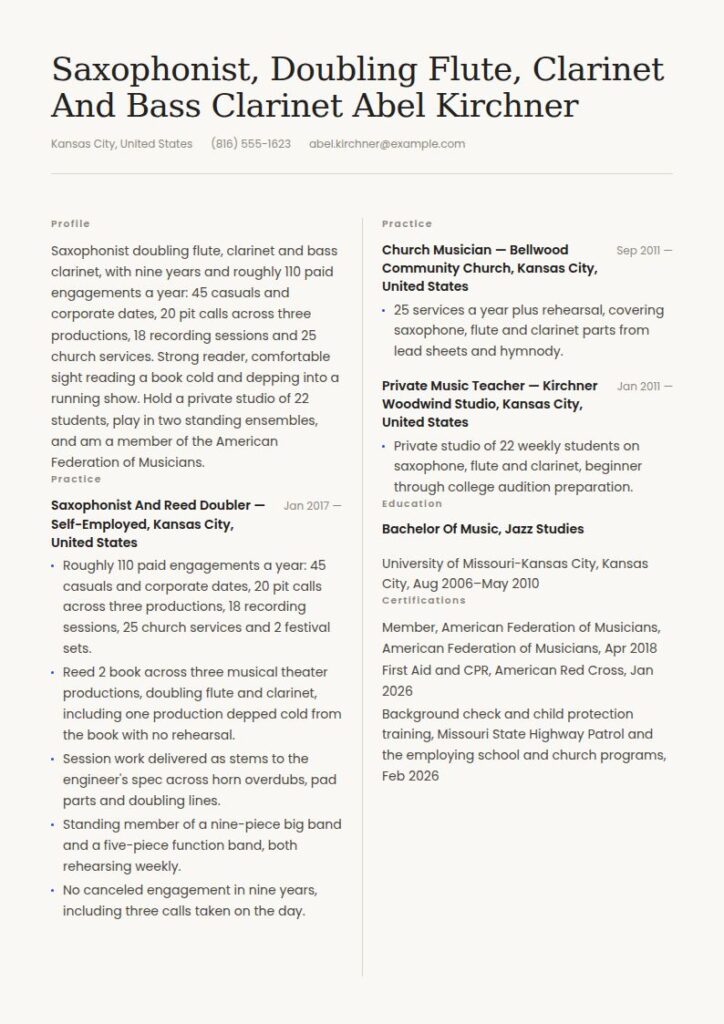
Saxophonist doubling flute, clarinet and bass clarinet, with nine years and roughly 110 paid engagements a year: 45 casuals and corporate dates, 20 pit calls across three productions, 18 recording sessions and 25 church services. Strong reader, comfortable sight reading a book cold and depping into a running show. Hold a private studio of 22 students, play in two standing ensembles, and am a member of the American Federation of Musicians.
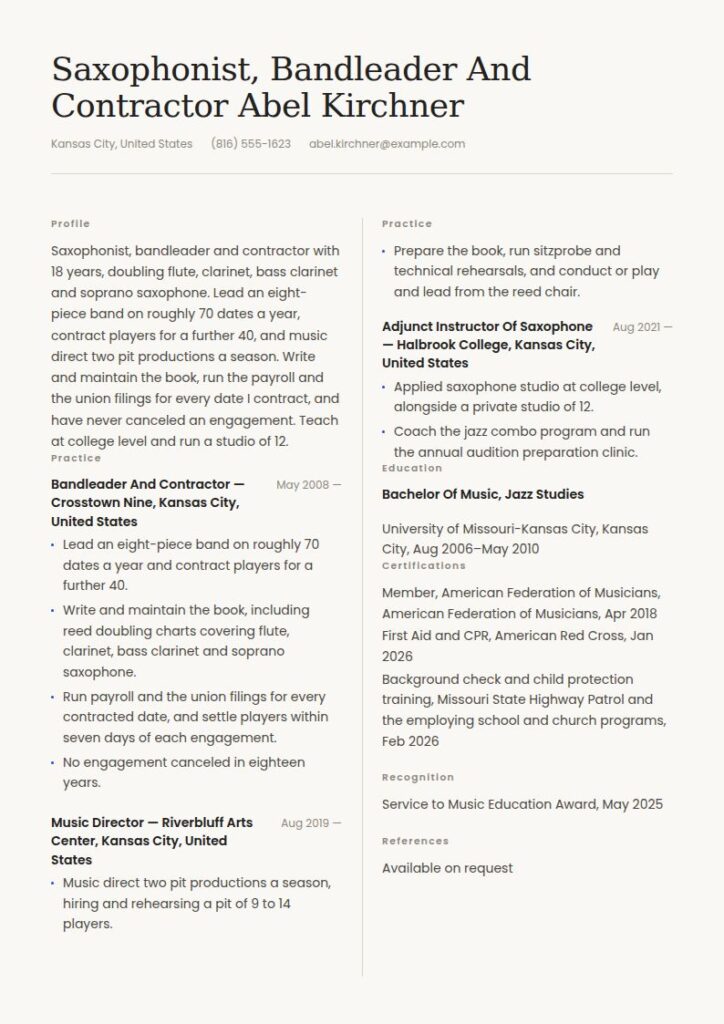
Saxophonist, bandleader and contractor with 18 years, doubling flute, clarinet, bass clarinet and soprano saxophone. Lead an eight-piece band on roughly 70 dates a year, contract players for a further 40, and music direct two pit productions a season. Write and maintain the book, run the payroll and the union filings for every date I contract, and have never canceled an engagement. Teach at college level and run a studio of 12.
Right vs wrong: the same musician summary, twice
| ✅ Right | ❌ Wrong |
|---|---|
| Saxophonist doubling flute, clarinet and bass clarinet. | Multi-instrumentalist with a versatile and unique sound. |
| Roughly 110 paid engagements a year across casuals, pit, sessions and church services. | Extensive experience performing live and in the studio. |
| Strong reader, comfortable sight reading a book cold and depping into a running show. | Able to play in any style and adapt to any situation. |
| Member of the American Federation of Musicians. | Professional, reliable and passionate about music. |
Every line on the right, for example, is a booking fact. Every line on the left is what the other nine submissions in the inbox also said.
Outline your experience
Group by kind of work. Give the ensemble or client type, your chair, the volume and the period, then the detail that proves it.
| Instead of | Use |
|---|---|
| Performed at many events and venues | Roughly 45 casuals and corporate dates a year, 4 to 6 piece bands, own backline and transport |
| Played in musical theater productions | 20 pit calls across three productions, reed 2 book, doubling flute and clarinet, one show depped cold |
| Did session work in a studio | 18 recording sessions a year: horn overdubs, pad and doubling parts, delivered as stems to the engineer's spec |
| Regular church musician | 25 services a year as a church musician, plus rehearsal, working from lead sheets and hymnody |
| Teach music lessons | Private studio of 22 weekly students, ages and levels across beginner through college audition preparation |
Saxophonist, doubling flute, clarinet and bass clarinet, Kansas City, MO, 2017 to present
Roughly 110 paid engagements a year: 45 casuals and corporate dates, 20 pit calls across three productions, 18 recording sessions, 25 services as a church musician and 2 festival sets.
Reed 2 book across three musical theater productions, doubling flute and clarinet, including one production depped cold from the book with no rehearsal.
Recording work delivered as stems to the engineer's spec, with 18 sessions a year across horn overdubs, pad parts and doubling lines.
Standing member of a nine-piece big band and a five-piece function band, both rehearsing weekly.
No canceled engagement in nine years, including three calls taken on the day.
Instruments, doubles and reading: what a contractor needs before they call you
However, this is the block the rest of the page exists to support, and it is the one most musicians write as a list of hobbies.
A contractor is matching you against a book. That book has specific parts in it, some of them requiring an instrument change mid-number, and therefore whoever they call has to cover all of it or they have to hire two people. Write the block so that a reader can make that comparison without a phone call.
Instruments, in order of what you would be hired for. Principal first, then the doubles, and mark the ones you would take a paid call on today as distinct from the ones you own and are still building. A double is a professional claim: it means you can play that instrument, in tune, in public, on a date.
Reading, described in the field's own terms. "Good sight reader" is unmeasurable. Say what you can do: read down a book at the first rehearsal, sight read at a session, read transposed parts at pitch, read chord charts and comp, read from lead sheets, read a score. Name the ones that are true and leave out the rest, because a page and a half of music will test this.
Gear, when it is part of the hire. Own backline, own amplification, a doubling case that fits in a pit, and anything you can supply that the production would otherwise rent.
INSTRUMENTS Principal: Tenor and alto saxophone Doubles, gig ready: Flute, clarinet, bass clarinet, soprano saxophone Owned and developing, not offered for hire: Baritone saxophone
READING Read down a book at the first rehearsal. Sight read at a session. Read transposed parts at pitch. Read chord charts and comp. Read from lead sheets and hymnody. Comfortable with reed book doubling changes mid-number.
GEAR AND LOGISTICS Own transport. Own amplification for small rooms. Doubling case and pit-sized setup. Travel two hours without a fee adjustment. Calls taken on 24 hours' notice, and on the day where the book allows.
Where musician work and pay come from
Two facts about the occupation explain why this block matters more than a discography.
The first is where the work actually is. BLS reports that 48 percent of musicians and singers are self-employed and that religious, grantmaking, civic, professional and similar organizations employ 35 percent, at a median of $53.16 an hour, which is above the occupation median; performing arts, spectator sports and related industries employ 12 percent at $50.56, and educational services 3 percent at $30.88 (BLS Occupational Outlook Handbook, musicians and singers, page last modified 27 August 2026). In particular, church and civic work is the largest employing category in the occupation by a wide margin, and it is the one most musicians leave off the page entirely.
The second is that most of the rest is contracted rather than employed, which is what the union exists to organize. The American Federation of Musicians was founded in 1896 and says it represents 70,000 professional musicians in the United States and Canada, negotiating agreements, protecting ownership of recorded music and securing benefits including health care and pension (American Federation of Musicians, about the AFM, retrieved 17 September 2026). If you are a member, write it and name your local by number. Also, it tells a contractor which dates they can hire you on and how they will pay you.
Build a snapshot of your key skills
In practice, list ten to fourteen entries in three groups: playing, session and stage practice, and the business half of the job. Keep it short; the instruments block has already done the heavy work.
Playing: Reed doubling, Jazz and commercial styles, Classical and pit repertoire, Improvisation over changes, Section playing and blend, Solo and lead playing
Session and stage: Sight reading, Click and headphone tracking, Stem delivery to spec, In-ear and wedge monitoring, Depping into a running show, Rehearsal efficiency
Business: Booking and contracting, Payroll and union filing for contracted dates, Invoicing and 1099 record keeping, Instrument insurance and maintenance schedule, Studio teaching administration
After all, the business group separates a player who gets rehired from one who does not. Contractors remember who invoiced correctly.
List your education and certifications
Short. BLS gives the typical entry-level education for musicians and singers as no formal educational credential, with long-term on-the-job training (BLS Occupational Outlook Handbook, page last modified 27 August 2026), so a degree is useful rather than required. Instead, what matters is who you studied with and what you keep current.
Bachelor of Music, Jazz Studies, University of Missouri-Kansas City, 2016. Principal study saxophone, secondary study flute and clarinet.
Study: Six years of private saxophone study, three years of clarinet, ongoing classical flute lessons.
Union: Member, American Federation of Musicians, since 2018.
Certifications: First aid and CPR, American Red Cross, 2026. Background check and child protection training current for school and church work, 2026.
Also: Music copyright and licensing workshop, 2025.
The background check line belongs on the page if you teach, do school outreach or play church services, because it is a hiring prerequisite in those settings and stating it current saves a step.
A word on rights, because people ask musicians about them constantly and give them bad answers. For example, the Music Modernization Act has three parts: the Music Licensing Modernization Act, the Classics Protection and Access Act and the Allocation for Music Producers Act. Under the first, the US Copyright Office designated a mechanical licensing collective on 8 July 2019 to administer a blanket license replacing the song-by-song compulsory structure for digital music providers; the second brings sound recordings fixed before 15 February 1972 partially into the federal copyright system; the third lets producers, mixers and engineers receive royalties collected under the section 114 statutory license (US Copyright Office, Music Modernization Act, retrieved 17 September 2026). If you write, record or release, say on your resume where you hold your own publishing or your own masters. In short, it is a factual claim and it changes how a licensing supervisor reads you.
Choose the right layout and design
Single column, plain type at 10 to 12 point, no photographs, logos or album art. The listening link carries the sound. Name the file for yourself and the instrument: abel-kirchner-saxophone-resume.pdf, and keep the link in plain text as well as hyperlinked, because contracting emails get forwarded as plain text.
Put the instruments and doubles line where a job title would go. Separate doubles you would take a paid call on from instruments you are still building. Describe reading in the field's terms. Count engagements by type and by year. Name your union local by number. Say how far you travel and how much notice you need. Keep one working listening link.
Do not list an instrument you would not play in public tomorrow. Do not describe yourself as versatile, which is the word every submission uses. Do not hide church, teaching or corporate work; it is where most of the occupation's employment actually is. Do not put a full discography on the page. Do not send a link you have not opened this month.
Musician job market and outlook
A flat occupation with heavy self-employment, a very wide earnings spread and no published annual wage.
| Measure | Value |
|---|---|
| Musicians and singers jobs, 2025 | 170,400 |
| Projected employment, 2035 | 170,900 |
| Projected change, 2025-35 | 0 percent, +600 jobs |
| Projected annual openings | ~17,400 |
| Typical entry-level education | No formal educational credential |
| Typical on-the-job training | Long term |
| Median hourly wage, May 2025 | $47.80 |
| Annual median wage | Not published; work is intermittent |
Source: U.S. Bureau of Labor Statistics, Occupational Outlook Handbook, musicians and singers, 2025 to 2035 projections and May 2025 wage data, page last modified 27 August 2026.
The largest employer of musicians is not a venue
Religious, grantmaking, civic, professional and similar organizations employ 35 percent of musicians and singers, at a median of $53.16 an hour, which is higher than the occupation median of $47.80 for May 2025. Performing arts, spectator sports and related industries employ 12 percent at $50.56, and educational services 3 percent at $30.88 (BLS Occupational Outlook Handbook, musicians and singers, page last modified 27 August 2026).
Self-employed workers account for 48 percent of the occupation, the largest category of all, and the earnings spread is enormous: the lowest 10 percent earned less than $20.35 an hour and the highest more than $132.56 (same source).
Two conclusions follow, and they should change the page. First, the steadiest paid work in this occupation is in civic and religious settings and in teaching, and leaving it off a resume to look more like a touring musician is removing the part a hiring reader can actually verify. Second, with nearly half the occupation self-employed and about 17,400 openings a year against no growth, your page has to work as a proposal to a contractor rather than as an application to an employer.
What salary you can expect as a musician
BLS publishes no annual median wage for musicians and singers, and says so plainly: the work is intermittent, so an hourly figure cannot be multiplied into a year. Any page showing you an annual salary for musicians has done that multiplication anyway.
Instead, what BLS does publish is the hourly spread. The median hourly wage was $47.80 in May 2025, with the lowest 10 percent under $20.35 an hour and the highest 10 percent above $132.56 (BLS Occupational Outlook Handbook, page last modified 27 August 2026).
Even so, the number that decides your year is not the rate but how many paid hours you can assemble, and the resume's job is to show you can assemble a lot of them. Three lines do most of that work: the doubles, because a contractor hires a player who covers three books where they would otherwise hire two; the reading, because it turns a one-off call into a standing chair; and the mix, because a year built on casuals, pit work, sessions, church services and teaching is far less fragile than one built on gigs alone.
Key takeaways for a musician resume
- First, put instruments and doubles where the job title would go, because it is the first filter.
- Separate doubles you would take a paid call on today from instruments you still own and are building.
- Then describe reading in the field's own terms, and only claim what will survive a first rehearsal.
- Count engagements by type and by year, not by venue or by title.
- Finally, keep church, civic and teaching work on the page, because that is where the occupation's employment is.
- Name your union local by number if you are a member.
- Say how far you travel and how much notice you need, because contractors are filling a date.
Build your musician resume in 15 minutes with our AI resume builder.
Related creative and artistic resume examples
- Musical theater resume
- Actor resume
- Voice actor resume
- Choreographer resume
- Dance teacher resume
- Stage manager resume
- Costume designer resume
- Videographer resume
- Photographer resume
- Screenwriter resume
- Film producer resume
- Theater resume
Pair it with a matching musician cover letter.
Musician resume questions, answered
How long should a musician resume be?
One page for your first five years. Two once your gig and session record, your teaching and your ensembles each need their own block. A discography belongs on your listening page, not on the resume.
Should I list every instrument I play?
List every instrument you would take a paid call on tomorrow, and separate those from instruments you own and are still building. A double is a claim that you can play that instrument in tune, in public, on a date, and it is tested at the first rehearsal. Overclaiming one is the fastest way to lose a contractor.
How do I describe my sight reading?
In the field's terms rather than with an adjective. "Read down a book at the first rehearsal", "sight read at a session", "read transposed parts at pitch", "read chord charts and comp", "read from lead sheets". Claim the ones that are true. Reading is what converts a single call into a standing chair, so it is worth being exact about.
Should teaching go on a musician resume?
Yes, with the number of weekly students and the levels. Teaching is a substantial part of most working musicians' income, and for school, church or community posts it is directly relevant experience. If you teach children, keep a current background check on the page, because it is a prerequisite rather than a bonus.
Do I need to be in the union?
Not to work, but it decides which dates you can be hired on and how you are paid. The American Federation of Musicians was founded in 1896 and says it represents 70,000 professional musicians across the United States and Canada, negotiating agreements and securing benefits including health care and pension (American Federation of Musicians, retrieved 17 September 2026). Non-union work is large, and plenty of players hold both on one page.