Abel Kirchner Saxophonist, doubling flute, clarinet and bass clarinet Kansas City, 64111, United States [email protected] · (816) 555-1623
11 September 2026
Mr. Ignacio Sandoval Music Direction Riverbluff Arts Center Kansas City, United States
Reed chair, spring production at Riverbluff Arts Center
Dear Mr. Sandoval,
I am writing about the reed chair for your spring production at Riverbluff Arts Center. I play tenor and alto saxophone and double flute, clarinet and bass clarinet, all gig ready, and I read down a book at the first rehearsal rather than learning it over the run.
My year runs to roughly 110 paid engagements: 45 casuals and corporate dates, 20 pit calls across three productions, 18 recording sessions, 25 church services and a couple of festival sets. I have carried the reed 2 book on three productions, including one I depped cold from the book with no rehearsal when a player dropped out on the day. In nine years I have not canceled an engagement, and I have taken three calls on the day of the show. I own my transport and a pit-sized doubling setup, so I do not need anything from the production beyond a chair and a stand.
I saw from your season announcement that the spring title carries a bass clarinet double in the second act, which is the reason I am writing rather than waiting for the general call. I have played that double in a pit twice and own the instrument.
I am free for the whole rehearsal and performance period, can take a call on 24 hours' notice, and a short listening link is in my signature. Thank you for your time.
Sincerely, Abel Kirchner
Summary
A musician cover letter names the chair you can cover, the doubles you carry, how well you read, and the dates you are available. This guide gives you a full adaptable letter, what changes between a contractor, a church or school post and a session, and the openings that get a player called rather than filed.
Musician cover letter examples by experience level
A musician cover letter is a short letter that says which chair you can cover, which doubles you carry, how you read, and when you are free.
However, almost nobody writes it that way, which is why readers answer the ones that do. The person reading has a date, a book and a gap, and they are deciding in under a minute whether to put your number in their phone. For instance, a paragraph about your love of music does not help them; a line saying you double flute, clarinet and bass clarinet and can read the book down at the first rehearsal does.
Guide to a musician cover letter
In short, this guide and the corresponding musician cover letter example will cover:
- First, how to structure the letter, paragraph by paragraph
- Why instruments, doubles and reading come before anything else
- What counts as evidence when the work is a hundred short engagements
- Then, how the letter changes for a contractor, a church or school post, and a session
- The openings that get a player a call rather than a place in the file
How to write a musician cover letter
| Paragraph | Its job | Length |
|---|---|---|
| Opening | The post or the date, your instruments and doubles, your reading | 2 to 3 sentences |
| Evidence | Volume by type, and one thing that proves reliability | 4 to 5 sentences |
| Fit | Something specific about their book, ensemble or season | 2 to 3 sentences |
| Close | Availability, notice, listening link, thank you | 2 sentences |
Open with the doubles, because they are the hire
A contractor covering a reed book does not want a saxophonist. They want whoever covers reed 2, which today means flute, clarinet and possibly bass clarinet inside the same number.
So the first sentence names them: "Tenor and alto saxophone, doubling flute, clarinet and bass clarinet, all gig ready." Then the reading, in the field's own terms: "I read down a book at the first rehearsal and sight read at sessions."
Only claim doubles you would play in public tomorrow. It is tested at the first rehearsal, in front of the people you most want to be rehired by, and an overclaimed double is the fastest way to lose a market that is smaller than it looks.
A musician cover letter example you can adapt
Dear Mr. Sandoval,
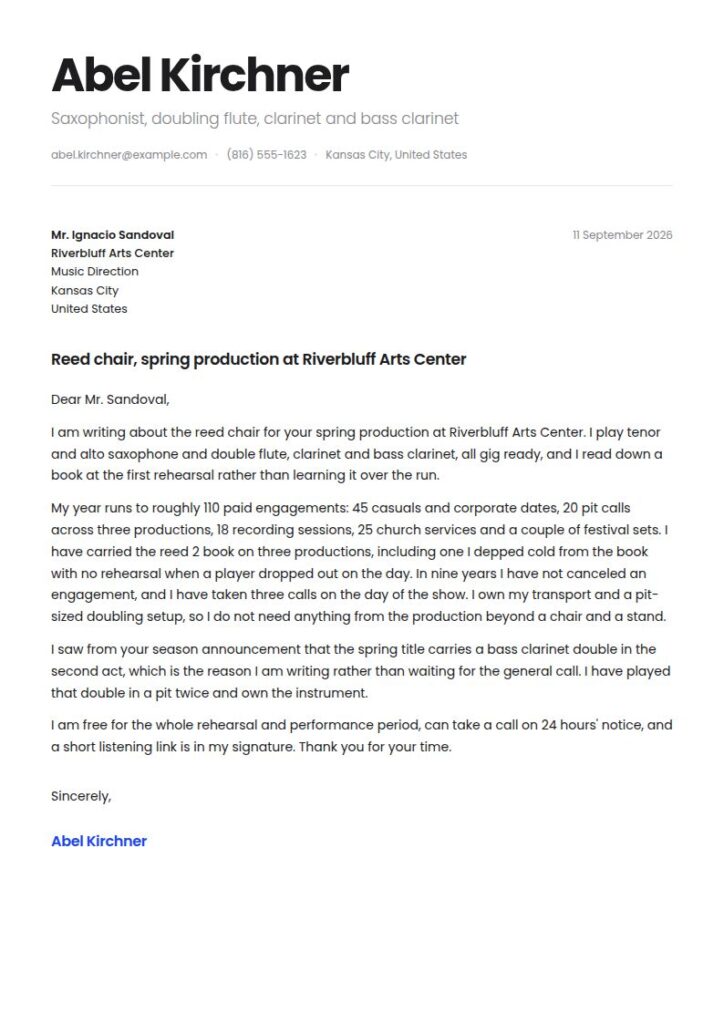
I am writing about the reed chair for your spring production at Riverbluff Arts Center. I play tenor and alto saxophone and double flute, clarinet and bass clarinet, all gig ready, and I read down a book at the first rehearsal rather than learning it over the run.
My year runs to roughly 110 paid engagements: 45 casuals and corporate dates, 20 pit calls across three productions, 18 recording sessions, 25 church services and a couple of festival sets. I have carried the reed 2 book on three productions, including one I depped cold from the book with no rehearsal when a player dropped out on the day. In nine years I have not canceled an engagement, and I have taken three calls on the day of the show. I own my transport and a pit-sized doubling setup, so I do not need anything from the production beyond a chair and a stand.
I saw from your season announcement that the spring title carries a bass clarinet double in the second act, which is the reason I am writing rather than waiting for the general call. I have played that double in a pit twice and own the instrument.
I am free for the whole rehearsal and performance period, can take a call on 24 hours' notice, and a short listening link is in my signature. Thank you for your time.
Sincerely, Abel Kirchner
Openings that work
| Instead of | Use |
|---|---|
| I am a passionate and versatile musician | Tenor and alto saxophone, doubling flute, clarinet and bass clarinet, all gig ready |
| I have performed at a wide variety of venues | Roughly 110 paid engagements a year across casuals, pit, sessions and church services |
| I am a quick learner and a great sight reader | I read down a book at the first rehearsal rather than learning it over the run |
| I would love the opportunity to work with you | Your spring title carries a bass clarinet double in the second act, and I own the instrument |
What counts as evidence when the work is a hundred short jobs
Because a player's career is not a list of employers, the letter has to carry the shape of the year instead.
| Kind of evidence | What it looks like in a sentence |
|---|---|
| Volume by type | 45 casuals, 20 pit calls, 18 sessions, 25 church services a year |
| Doubles | Flute, clarinet and bass clarinet, all played in a pit and gig ready |
| Reading | Read down a book at the first rehearsal; sight read at sessions |
| Reliability | No canceled engagement in nine years; three calls taken on the day |
| Depping | Covered a reed 2 book cold, with no rehearsal, and was asked back |
| Logistics | Own transport, pit-sized doubling setup, two-hour travel radius |
Depping is the strongest single line available to a player, because it is the only one that proves reading, preparation and temperament at once.
Writing to a contractor, a school or church, or a session
For a contractor or fixer, lead with doubles, reading and availability, and keep the whole letter under 250 words. For a church, school or community post, lead with the service or teaching volume, name your current background check, and say which parts of the repertoire you already know. For a session, lead with click and headphone tracking, turnaround and delivery format. In every version, give the dates you are free.
Do not claim a double you would not play in public tomorrow. Do not describe yourself as versatile, which every letter in the pile says. Do not send a discography instead of a paragraph. Do not leave out church, teaching or corporate work in order to sound more like a touring player. Do not send a listening link you have not opened this month.
Nearly half the occupation is self-employed, and the biggest employer is not a venue
Musicians and singers had a median hourly wage of $47.80 in May 2025, with the lowest 10 percent under $20.35 an hour and the highest above $132.56. BLS publishes no annual median for the occupation, because the work is intermittent (BLS Occupational Outlook Handbook, musicians and singers, page last modified 27 August 2026).
Self-employed workers make up 48 percent of the occupation. The largest employing industry is religious, grantmaking, civic, professional and similar organizations at 35 percent, paying a median of $53.16 an hour, above the occupation median; performing arts, spectator sports and related industries employ 12 percent at $50.56, and educational services 3 percent at $30.88 (same source).
Employment is projected at 0 percent change between 2025 and 2035, from 170,400 to 170,900 jobs, with about 17,400 openings a year (same cycle). So most of the work is contracted rather than advertised, which is exactly why a letter written to a contractor, naming a date and a double, outperforms an application sent into a general inbox.
Length, format and sending it
Short. In practice, that means four paragraphs, 200 to 300 words, in the body of the email. Contractors read on a phone between calls; as a result, an attachment is one step too many for a first contact.
Put the listening link in your signature as plain text, and attach the one page resume rather than pasting it. Name the file for yourself and the instrument: abel-kirchner-saxophone-resume.pdf.
Use the same numbers as your resume so the two agree. Our musician resume examples page is written with the figures used here, and if the post is a school, university or municipal ensemble job, run the resume through the free ATS checker first, because those applications are parsed before a person opens them.
Key takeaways
- First, open with your instruments and doubles; they are the hire.
- Then say how you read, in the field's own terms, and claim only what survives a first rehearsal.
- Also, give volume by type of work and by year, not a list of venues.
- In addition, put one reliability fact in the letter, ideally a dep taken cold.
- Also, name something specific from their book, season or service list.
- Finally, give the dates you are free and the notice you can take a call on.
- Above all, keep it under 300 words with one plain-text listening link.
Write your musician cover letter in 10 minutes with our AI cover letter builder.
Musician cover letter questions, answered
How long should a musician cover letter be?
Four paragraphs, 200 to 300 words, in the body of the email. Contractors are reading between calls, and a long letter from a player reads as someone who has not worked much.
Do contractors actually read cover letters?
They read the first two lines, which is why those lines have to be the instruments, the doubles and the reading. If those match the book, the rest gets read. If they do not, nothing else in the letter would have helped.
What do I write with very few paid engagements?
Count honestly and describe precisely. Services played, rehearsals, student productions, community ensembles, unpaid sessions with the instrumentation and the delivery format. Then the doubles you would genuinely play tomorrow and how you read. A player with 20 real engagements and an accurate doubles line is more hirable than one with a vague claim to versatility.
Should I mention teaching in a performance application?
Yes, briefly, with the number of weekly students. It shows a stable working week and it is directly relevant to any school, community or outreach part of the post. Keep a current background check on the page if you teach children or play church services, because it is a prerequisite in those settings.
Should I mention union membership?
Yes, if you hold it, with your local's number. The American Federation of Musicians was founded in 1896 and says it represents 70,000 professional musicians in the United States and Canada, negotiating agreements and securing benefits including health care and pension (American Federation of Musicians, retrieved 17 September 2026). It tells a contractor which dates you can be hired on and how you will be paid, which is a practical fact rather than a credential.