Theater Production and Company Staff Eleni Petrakis
Production Office Assistant
[email protected] | (502) 555-1601 | Louisville, United States
Profile
Theater production and company staff with three seasons across summer stock and a small professional house, covering 14 productions from first rehearsal to strike. Handled housing, travel and per diem for visiting companies of up to 22 people, kept the contract and rider file for every guest artist, and ran the daily call distribution. Trained in first aid and in fall protection and rigging awareness.
Work Experience
09/2016 - 06/2018, Production Office Assistant, Two Rivers Repertory (Small Professional Theatre contract, 180 seats), Cincinnati, United States
- Supported a four-production season plus a touring education program on a year-round staff of 9.
- Ran the daily call distribution and kept the contract and rider file for every guest artist engaged in the season.
- Booked travel and reconciled per diem for visiting directors and designers, 23 engagements across two seasons.
- Maintained the production calendar in the shared system and flagged conflicts between build, rehearsal and technical weeks.
06/2015 - 08/2018, Seasonal Company Staff, Fox Hollow Playhouse (summer stock, 10-week season), Traverse City, United States
- Three summer seasons on a 10-week repertory schedule, 14 productions in total from first rehearsal to strike.
- Handled on-site housing, travel and per diem for a resident company of up to 22 people.
- Ran arrival week for every incoming artist, including housing walkthroughs, keys and the local orientation pack.
Education
08/2011 - 05/2015, Bachelor of Arts, Theater Studies, University of Louisville, Louisville, United States
Concentration in arts administration. Four seasons on the student production staff.
Skills
Artist housing and travel management, 75
Per diem and petty cash reconciliation, 70
Production calendar maintenance, 65
Guest artist contract and rider filing, 70
Daily call distribution, 80
First aid and CPR, 85
Languages
English, native
Greek, native
Spanish, intermediate
Certificates
02/2018, First Aid, CPR and AED, American Red Cross
Renewed on the standard two-year cycle.
06/2017, Fall Protection and Rigging Awareness, Fox Hollow Playhouse safety program
Summary
A theater resume is a one to two page document that names the kind of company you worked for, the contract or code the work ran under, and the size of the season you were part of. This guide gives you three adaptable versions, a map of the company types and contracts that make up the American theater, and current Bureau of Labor Statistics figures for the occupations it is measured in.
Theater resume examples by experience level
A theater resume is a one to two page document that answers three questions before it answers anything else: what kind of company you worked for, what contract or code the work ran under, and how big the season was.
In short, this page is for everyone in the building. Performers have their own document and their own rules, and so do the design and production roles. What almost nobody writes down is the thing every theater employer reads first, whatever the job: whether you have worked at their scale, under their kind of agreement, on a calendar that looks like theirs. Therefore, a resume that lists shows without saying where people saw them cannot answer it.
Resume guide for a theater resume
In particular, this guide and the corresponding theater resume example will cover:
- How to write a theater resume that works for any role in a company
- The company types that make up the American theater, and how each hires
- Three adaptable summaries: seasonal, company staff and department head
- How the contract landscape and the season calendar decide when you apply
- What the published figures say about pay in theater occupations
How to write a theater resume
Six sections: contact header, summary, the company and season block, experience, skills, then education and training. Use one page for your first five years, then two once you have run a department or a building.
In practice, the order follows the reader. People who are also doing another job that week do the theater hiring, usually in the weeks around a season announcement or before a contract starts, and they are scanning for scale and for fit with their calendar.
| Section | What it is answering | Where it goes |
|---|---|---|
| Company and season block | Have you worked at our scale, under our kind of agreement? | Directly under the summary |
| Experience | What did you own, for how many productions, with what budget or crew? | Reverse chronological, with numbers |
| Skills | Can you do the parts of the job nobody advertises? | Grouped, short |
| Education and training | Where were you trained, and what have you kept current? | At the foot, with safety certifications |
Write the company type beside every credit, not just the name
An unfamiliar theater name tells a reader nothing. The company type tells them budget band, staff size, rehearsal length, how many productions run at once, and whether anyone on the payroll is under a union agreement.
Write it as a short tag after the company: "Marlowe Stage Company (LORT D, 299 seats, six-production season)" or "Fox Hollow Playhouse (summer stock, 10 weeks, three shows in repertory)". Six words of context turn a name into a credential.
The same rule applies to the contract. "Equity Small Professional Theatre contract" and "non-union community production" describe very different weeks, and a reader who cannot tell which you had will assume the smaller.
Put the finished file through the ATS resume checker before it goes anywhere. Larger companies, university theaters and municipal arts organizations post through the same applicant systems as any other employer, and those parse before a person reads.
Choosing the best resume format for a theater resume
Reverse chronological, single column, with a production credit list promoted above the employment history if credits are the point of your job.
Theater careers consist of overlapping engagements, and therefore the format has to survive that. Group a run of seasonal contracts under one heading with a date range and the company, then list the productions beneath it. For example, nine separate ten-week entries read as instability; the same nine under "Seasonal Production Staff, Fox Hollow Playhouse, 2019 to 2023" reads as a company that kept asking you back, which is the strongest thing a theater resume can say. Functional formats fail because this field hires on continuity and on the calendar, and a format that hides dates hides both.
Include your contact information
| ✅ Right | ❌ Wrong |
|---|---|
| Eleni Petrakis | Eleni Petrakis |
| Company Manager: LORT and SPT houses | Theater lover with a passion for the performing arts |
| Louisville, KY. Available to relocate for a season | 2214 Beargrass Avenue, Apt 3, Louisville, KY 40206 |
| (502) 555-1601, [email protected] | (502) 555-1601, [email protected] |
Put relocation and availability in the header. Theater work moves people between cities for a season at a time, and a hiring manager filling a contract that starts in nine weeks reads availability before experience. Also, if you hold a union membership that matters to the post, put it on the first two lines; if you do not, leave the line off instead of writing "willing to join".
Make use of a summary
Keep it to four lines: the part of the industry you work in, years, the scale you have worked at, and finally one number that shows the size of what you have carried.
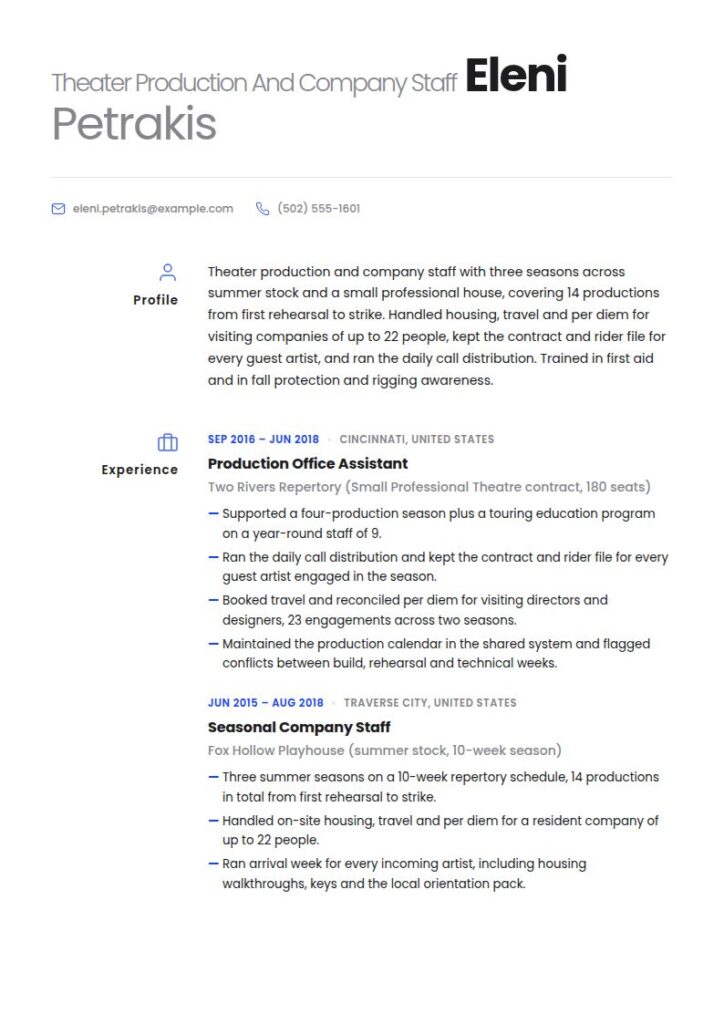
Theater production and company staff with three seasons across summer stock and a small professional house, covering 14 productions from first rehearsal to strike. Handled housing, travel and per diem for visiting companies of up to 22 people, kept the contract and rider file for every guest artist, and ran the daily call distribution. Trained in first aid and in fall protection and rigging awareness.
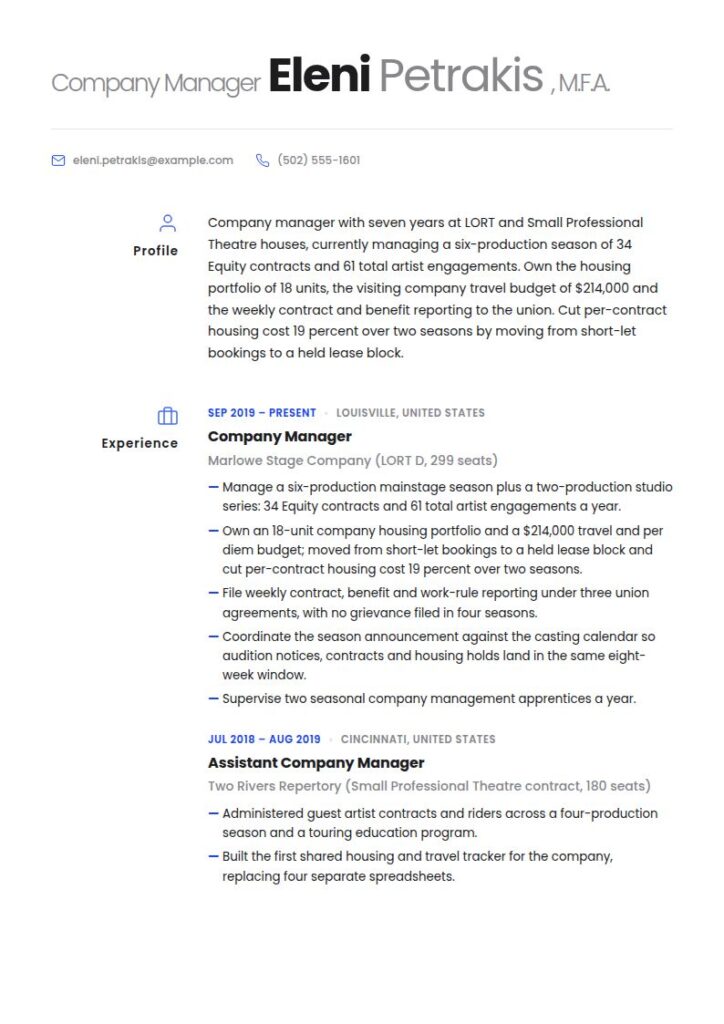
Company manager with seven years at LORT and Small Professional Theatre houses, currently managing a six-production season of 34 Equity contracts and 61 total artist engagements. Own the housing portfolio of 18 units, the visiting company travel budget of $214,000 and the weekly contract and benefit reporting to the union. Cut per-contract housing cost 19 percent over two seasons by moving from short-let bookings to a held lease block.
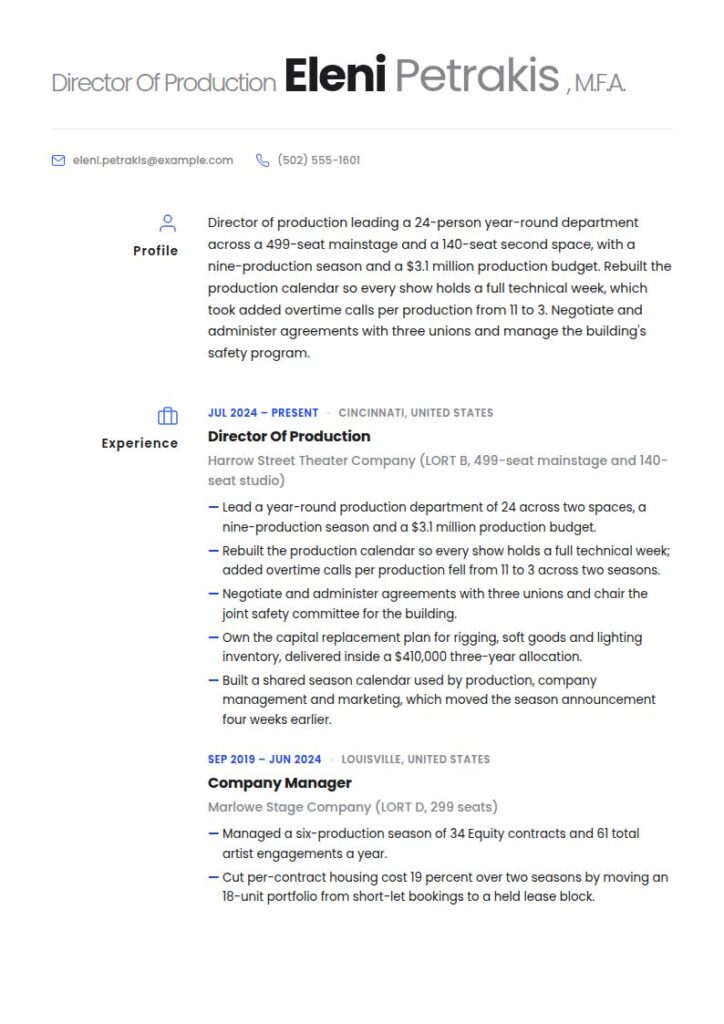
Director of production leading a 24-person year-round department across a 499-seat mainstage and a 140-seat second space, with a nine-production season and a $3.1 million production budget. Rebuilt the production calendar so every show holds a full technical week, which took added overtime calls per production from 11 to 3. Negotiate and administer agreements with three unions and manage the building's safety program.
Right vs wrong: the same theater summary, twice
| ✅ Right | ❌ Wrong |
|---|---|
| Company manager with seven years at LORT and Small Professional Theatre houses. | Experienced theater professional with a love of live performance. |
| Currently managing a six-production season of 34 Equity contracts and 61 total artist engagements. | Has worked on many productions in a variety of roles. |
| Own the housing portfolio of 18 units and a visiting company travel budget of $214,000. | Skilled at multitasking in a fast-paced creative environment. |
| Cut per-contract housing cost 19 percent over two seasons. | Committed to supporting artists and audiences alike. |
For example, a reader can check every line on the right against a season brochure and a budget. Nothing on the left says whether you have run a season the size of theirs.
Outline your experience
Then give the company, company type, city, your title, and dates. Then three to five bullets, each carrying a production count, a head count, a budget or a calendar fact.
| Instead of | Use |
|---|---|
| Worked on many theater productions | Covered 14 productions across three seasons, from first rehearsal through strike |
| Helped manage the company | Administered 34 Equity contracts and 61 total artist engagements across a six-production season |
| Handled travel and accommodation for actors | Ran an 18-unit housing portfolio and a $214,000 travel and per diem budget for visiting companies |
| Worked with the unions | Filed weekly contract, benefit and work-rule reporting under agreements with three unions, with no grievance filed in four seasons |
Company Manager, Marlowe Stage Company (LORT D, 299 seats), Louisville, KY, September 2021 to Present
Manage a six-production mainstage season plus a two-production studio series: 34 Equity contracts and 61 total artist engagements a year.
Own the company housing portfolio of 18 units and a $214,000 travel and per diem budget; moved from short-let bookings to a held lease block and cut per-contract housing cost 19 percent over two seasons.
File weekly contract, benefit and work-rule reporting under three union agreements, and act as the first point of contact for visiting artists on every arrival week.
Coordinate the season announcement against the casting calendar so audition notices, contracts and housing holds land in the same eight-week window, and supervise two seasonal apprentices a year.
Company type, contract and season size: how a theater reads scale
This is the block that decides whether a reader takes your credits at full value, and almost nobody includes it.
However, the American theater is not one employer type. It is at least six, hiring on different calendars, at different budget scales, with different agreements in force. That is why naming yours lets a reader place you.
| Company type | What it usually looks like | How it hires |
|---|---|---|
| Resident and regional | Year-round staff, a subscription season, a mainstage plus a smaller space | Staff posts annually, artists per production |
| Touring | A production that moves, with a road crew and local labor at each stop | For the length of the tour, booked far ahead |
| Off-Broadway and independent commercial | Open-ended runs, small permanent staff, capitalization raised per show | Per production, largely through networks |
| Summer stock and festival | Eight to fourteen week seasons, several shows in repertory | Annual seasonal hiring, concentrated in winter |
| Community | Volunteer or stipended performers, a small paid staff | Rolling; the paid roles are administrative |
| Academic and educational | A producing arm inside a school or university | The academic calendar, plus guest artist contracts |
LORT categories and the contract landscape
The League of Resident Theatres is the reference point for scale in the resident sector. It has 82 member theaters in 30 states and the District of Columbia, administers collective bargaining agreements with Actors' Equity Association, the Stage Directors and Choreographers Society and United Scenic Artists, and states that its members collectively issue more Equity contracts to actors than Broadway and commercial tours combined (League of Resident Theatres, retrieved 17 September 2026). Rule 13 of the LORT-Equity Agreement grades LORT houses in categories from A+ down to D, so the category beside a company name gives a reader the budget band in two characters.
The contract landscape is broader than most resumes suggest. Equity represents more than 51,000 professional actors and stage managers and promulgates over 40 national and local contracts (Actors' Equity Association, about Equity, accessed 17 September 2026), and its published list names 28 agreements, among them Production, LORT, Off Broadway, Small Professional Theatre, Chicago Area Theater, Theatre for Young Audiences, Outdoor Drama and the Letters of Agreement (Actors' Equity Association, contracts and codes, accessed 17 September 2026). If you worked under one, name it: it is the most compressed way to say what the work was.
Companies and scale
Marlowe Stage Company, Louisville KY. LORT D, 299-seat mainstage plus a 120-seat studio. Six-production season, 34 Equity contracts, year-round staff of 26.
Two Rivers Repertory, Cincinnati OH. Small Professional Theatre contract, 180 seats. Four-production season plus a touring education program, staff of 9.
Fox Hollow Playhouse, Traverse City MI. Summer stock, 10-week season, three productions in repertory, resident company of 31 housed on site.
Agreements worked under: LORT, Small Professional Theatre, Letters of Agreement, Guest Artist. Also non-union community and academic productions, labeled as such.
When theater companies hire each season
Then the calendar, because it is the other half of how this industry hires. A casting notice is a public document with the terms in it: Equity requires a producer's notice to state the agreement type and the current weekly salary, the audition dates and times, the rehearsal and performance dates, and a cast breakdown (Actors' Equity Association, casting call guidance, accessed 17 September 2026). Read those notices even when you are not auditioning, because they say which houses are staffing, at what scale and on what dates, months before an administrative or production post is advertised. Summer companies hire in winter, resident theaters advertise staff posts around the season announcement and again before the fall, and touring work is booked furthest ahead of anything in the field. In short, a resume finished in August for a summer company is a resume that missed.
Build a snapshot of your key skills
In practice, list ten to fourteen entries in three groups: the craft, the administration, and the safety and compliance work that every theater job touches.
Company and production administration: Contract administration under union agreements, Weekly benefit and work-rule reporting, Artist housing and travel management, Per diem and petty cash reconciliation, Visa and work authorization coordination for guest artists
Season and calendar: Production calendar building, Technical week scheduling, Casting calendar coordination, Strike and changeover planning
Safety and systems: First aid and CPR, Fall protection and rigging awareness, Emergency and evacuation procedure, Incident reporting, Ticketing and patron database reporting, Payroll and paymaster reporting, Budget tracking to line
Also keep the safety group on the page whatever your role. It reads as professional rather than enthusiastic, and it is the group most theater applicants leave off.
List your education and certifications
Training and certifications first when they are current, then degrees. A theater employer checks what is in date before what is impressive.
Certifications: First aid, CPR and AED, American Red Cross, renewed 2026. Fall protection and rigging awareness, completed 2025. Food handler certification for company events, 2024.
Master of Fine Arts, Theater Management, 2019
Bachelor of Arts, Theater Studies, 2015
In fact, there is no license to work in theater and no single credential that decides a hire. A hiring manager is checking whether your training matches the department and whether the safety and first aid certifications are current, because in most buildings they have to be.
Choose the right layout and design
Above all, use a single column, plain type at 11 or 12 point, clear headings, and no photograph, production stills or borders. A performer's headshot resume, on the other hand, is a different object with different rules; this is the document that goes into an applicant system and gets printed for a search committee.
Tag every company with its type, size and season length. Name the contract or code the work ran under. Group repeat seasonal engagements under one heading with a date range. Put relocation and availability in the header. Count productions, contracts, crew and budget.
Do not list a theater name with no context; a reader outside your city cannot place it. Do not describe community work as professional work, because the field is small and the call gets made. Do not send a headshot resume into an applicant system. Do not fill a page with show titles and no scale.
Theater job market and outlook
However, the Bureau of Labor Statistics publishes no Occupational Outlook Handbook profile called theater. The Handbook covers broad occupations rather than industries, so a theater career is measured inside two or three at once.
| Measure | Actors | Producers and directors |
|---|---|---|
| Employment, 2025 | 67,500 | 181,000 |
| Projected employment, 2035 | 67,500 | 188,300 |
| Change, 2025 to 2035 | 0 percent, 0 jobs | 4 percent, +7,300 jobs |
| Projected annual openings | ~6,300 | ~12,100 |
| Typical entry-level education | Some college, no degree | Bachelor's degree |
| Median wage, May 2025 | $29.05 an hour, no annual median published | $90,360 a year, $43.44 an hour |
Source: U.S. Bureau of Labor Statistics, Occupational Outlook Handbook, actors and producers and directors, 2025 to 2035 projections and May 2025 wage data, both pages last modified 27 August 2026.
Even so, within those occupations the theater industries are identifiable. Theater companies and dinner theaters employ 10 percent of actors at a median of $25.53 an hour, and performing arts, spectator sports and related industries employ 9 percent of producers and directors at a median of $74,240 a year, the lowest of the four industry medians published for that occupation (BLS Occupational Outlook Handbook, May 2025, pages last modified 27 August 2026).
The staff, not the stage, is where the sector changed
Theatre Communications Group's Theatre Facts 2023, released on 3 March 2025, surveys a universe of over 2,000 U.S. professional not-for-profit theaters and tracks 137 Trend Theaters reporting every year from 2019 to 2023. Those theaters contributed over $3.6 billion to the U.S. economy and attracted more than 27 million attendees.
The employment finding is the one that should change how you write a resume. Average total staff employed fell 47 percent, from 319 in 2019 to 175 in 2023, while payroll still averaged 51 percent of total expenses, and 61 percent of Trend Theaters reported a negative change in unrestricted net assets (same report).
Half the staff, the same share of the budget. That is a sector where jobs got broader rather than more numerous, and where the person who can cover two functions gets the post. Write the second thing you can do, with a number attached, rather than saving it for the interview.
Self-employment is the largest single category in both occupations after the industries: 23 percent of actors and 20 percent of producers and directors work for themselves (same source).
What salary you can expect in theater
As a result, there is no single theater wage, and quoting one would mean inventing it. Instead, BLS publishes the pay in the occupations it counts theater work in, and the industry figure inside each.
Actors had a median hourly wage of $29.05 in May 2025, with no annual median published because the work is intermittent, and theater companies and dinner theaters paid $25.53 an hour. Producers and directors, the bracket covering artistic and production leadership, had a median annual wage of $90,360 and $43.44 an hour, with the lowest 10 percent under $45,780 and the highest over $198,540, and performing arts, spectator sports and related industries paid $74,240 (BLS Occupational Outlook Handbook, pages last modified 27 August 2026).
The theater industry pays below the occupation median in both cases, so the argument your resume makes is not that theater pays well; it is that you are worth the top of a band that is already narrow. What moves money inside it is scale and breadth: the size of house you have worked in, the number of productions you have carried at once, the budget or contract count you have owned, and the second department you can cover when the staff is half what it was.
Key takeaways for a theater resume
- First, tag every company with its type, seat count and season length, because the name alone is not a credential.
- Then name the contract or code the work ran under, and label non-union and academic work as such.
- Group repeat seasonal engagements under one heading, because a company asking you back is the strongest claim you have.
- Also count productions, contracts, crew and budget, and put a number in every bullet.
- Put relocation and availability in the header, because this industry hires against a calendar.
- Similarly, keep first aid and safety certifications current and on the page whatever your role.
- Finally, write the second function you can cover, since the sector's staffs are half what they were.
Build your theater resume in 15 minutes with our AI resume builder.
Related creative and artistic resume examples
- Actor resume
- Musical theater resume
- Stage manager resume
- Costume designer resume
- Choreographer resume
- Dance teacher resume
- Voice actor resume
- Musician resume
- Film producer resume
- Screenwriter resume
- Cinematographer resume
- Photographer resume
Pair it with a matching theater cover letter.
Theater resume questions, answered
How long should a theater resume be?
One page for your first five years of seasonal and contract work. Two once you have run a department, a building or a season. Performers are the exception: a casting resume is always one page, trimmed to 8 by 10 inches and attached to a headshot, and it follows its own rules entirely.
Do I need to name the contract I worked under?
Yes, wherever there was one. Equity promulgates over 40 national and local contracts and its published list names 28 agreements from Production and LORT down to Small Professional Theatre and the Letters of Agreement (Actors' Equity Association, accessed 17 September 2026). The contract is the most compressed description of the work that exists, and leaving it off means a reader assumes the smallest one.
How do I write community or unpaid theater on a resume?
Honestly and in full. Give the company, the production, your role and what you actually did, and label it community, academic or volunteer. The work counts, and the field is small enough that describing it as professional will be found out. What makes it read well is scale: productions, audience size, the crew you led.
When should I apply for theater jobs?
Against the season calendar rather than whenever you are ready. Summer companies hire during the winter. Resident theaters advertise staff posts around the season announcement and again before the first rehearsal of the fall. Touring work is booked furthest ahead of anything in the field. Reading public casting notices is a good early signal, because Equity requires them to state the agreement type, the weekly salary and the rehearsal and performance dates.
Is theater a shrinking field?
The occupations are flat rather than shrinking. Actors are projected at 0 percent change between 2025 and 2035 with about 6,300 openings a year, and producers and directors at 4 percent with about 12,100 (BLS Occupational Outlook Handbook, 2025 to 2035 projections published 27 August 2026). Staffing is what changed: average total staff at the theaters TCG tracks fell 47 percent between 2019 and 2023, from 319 to 175 (Theatre Communications Group, Theatre Facts 2023, released 3 March 2025).