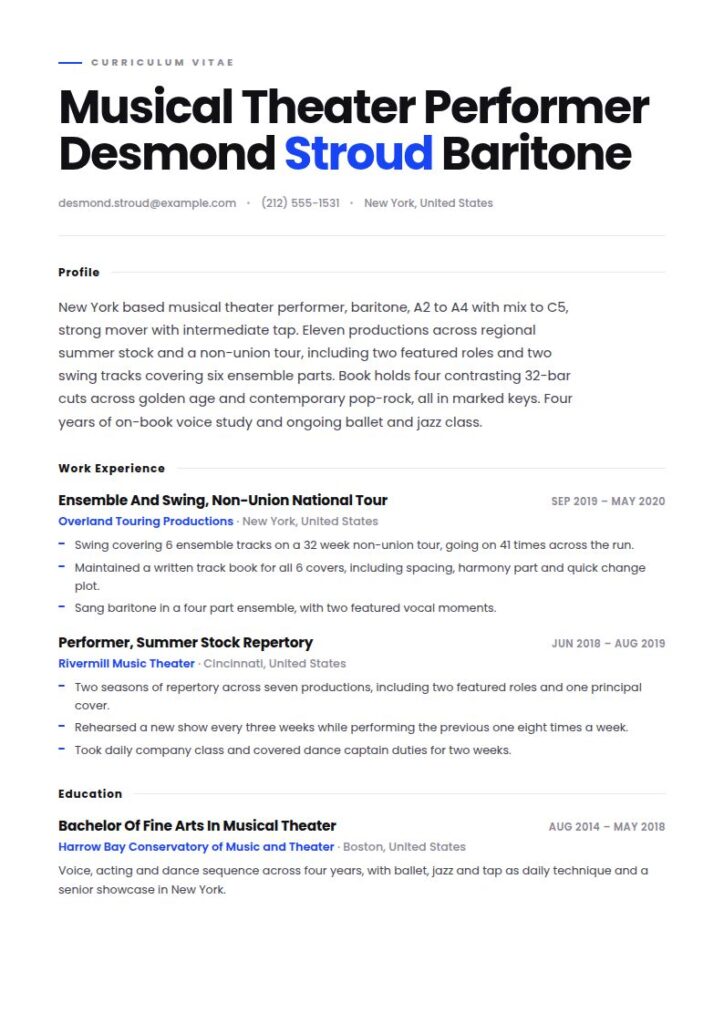
Musical Theater Performer Desmond Stroud Baritone
Ensemble and Swing, Non-Union National Tour
[email protected] | (212) 555-1531 | New York, United States
Profile
New York based musical theater performer, baritone, A2 to A4 with mix to C5, strong mover with intermediate tap. Eleven productions across regional summer stock and a non-union tour, including two featured roles and two swing tracks covering six ensemble parts. Book holds four contrasting 32-bar cuts across golden age and contemporary pop-rock, all in marked keys. Four years of on-book voice study and ongoing ballet and jazz class.
Work Experience
09/2019 - 05/2020, Ensemble and Swing, Non-Union National Tour, Overland Touring Productions, New York, United States
- Swing covering 6 ensemble tracks on a 32 week non-union tour, going on 41 times across the run.
- Maintained a written track book for all 6 covers, including spacing, harmony part and quick change plot.
- Sang baritone in a four part ensemble, with two featured vocal moments.
06/2018 - 08/2019, Performer, Summer Stock Repertory, Rivermill Music Theater, Cincinnati, United States
- Two seasons of repertory across seven productions, including two featured roles and one principal cover.
- Rehearsed a new show every three weeks while performing the previous one eight times a week.
- Took daily company class and covered dance captain duties for two weeks.
Education
08/2014 - 05/2018, Bachelor of Fine Arts, Musical Theater, Harrow Bay Conservatory of Music and Theater, Boston, United States
Voice, acting and dance sequence across four years, with ballet, jazz and tap as daily technique and a senior showcase in New York.
Skills
Baritone, A2 to A4, mix to C5, 85
Sight-reading and close harmony, 75
Jazz and musical theater dance, 75
Tap, intermediate, 65
Swing track maintenance, 80
Audition book preparation and cutting, 75
Guitar, rhythm, playable on stage, 60
Languages
English, native
French, intermediate
Certificates
01/2026, CPR and First Aid, American Red Cross
Summary
A musical theater resume is a performer's one page document listing credits as production, role, house and director, with an honest vocal range and type, your dance level, and your Equity status on the first line. This guide gives you three adaptable versions, what belongs in your audition book, and current Bureau of Labor Statistics figures for the occupations this work is measured in.
Musical Theater resume examples by experience level
In short, a musical theater resume is a performer's one page document listing each credit as production, role, house and director, with your voice type and range, your dance level and your Equity status where a reader will find them in the first two seconds.
It is a triple threat document, and that is not a slogan. Three people read it: casting checks the credits and the houses, the music director checks the range and your book, and the choreographer checks whether the word you used for your dancing survives the dance call. In fact, any one of them can end the audition.
Physically, in fact, the object is the same as any performer resume: one page, cut to 8 by 10 inches and attached to the headshot. What differs is everything on it, because a play resume never has to answer the range question or the dance question and yours does.
Resume guide for a musical theater resume
In particular, this guide and the corresponding musical theater resume example will cover:
- How to build a musical theater resume that survives three different readers
- Credits as production, role, house and director, and why the house column matters
- Three adaptable profiles: non-union, Equity working performer and principal
- The audition book, the honest range line, and the dance call label
- What the published figures say about pay across the three occupations this work sits in
How to write a musical theater resume
Use six blocks: name and Equity status, contact and representation, vitals and voice, credits, training, and finally special skills. One page, always.
Voice comes higher than it does on a play resume, because the music director is reading for it before anything else. Also put the voice line in the header block with your height instead of burying it at the bottom with your skills.
| Block | Which reader it is for | Where it goes |
|---|---|---|
| Name and Equity status | Casting, and the production's payroll | Top line |
| Voice type and range | The music director | Header block, with vitals |
| Dance level | The choreographer | Header block, one word plus a qualifier |
| Credits by tier | Casting | The body, grouped by level of work |
| Training | All three, as lineage | Below credits, with named teachers and coaches |
Write the range in notes, and write the one you can hold on a two-show day
"Baritone with a strong belt" tells a music director nothing they can cast from. "Baritone, A2 to A4, mix to C5" tells them whether you can sing the part.
Write the range as the bottom note you can sing in a room and the top note you can hold eight times a week, not the top note you have ever reached. Musical theater contracts run two shows on a Saturday and a Wednesday, and a top note that exists only when you are fresh is a top note the production will find out about in week three.
If your belt and your legit top differ, write both: "Baritone. Legit to F4, mix to C5." That single line has more casting information in it than a paragraph of description, and it is checkable in sixteen bars.
If you also apply for teaching artist work, cruise and theme park contracts, or arts administration, keep a separate parseable version and run it through the ATS resume checker. You do not build the casting version for a parser.
Choosing the best resume format for a musical theater resume
Four columns, grouped by tier of work rather than by date, and never a paragraph.
| Column | What goes in it |
|---|---|
| Production | The show title |
| Role | The character name, or Ensemble, Swing, u/s followed by the role |
| House | The theater or producing company, and the contract level if it helps |
| Director | The director, or director and choreographer where both are relevant |
The house column does more work than most performers realize. After all, musical theater is organized by contract and house scale, and a reader who knows the field sees "regional house" or "non-union tour" and knows the company size, the rehearsal period and the caliber of the room. Two ensemble tracks at different houses are not the same credit, and the house is how you say so.
Group credits into tiers by weight: national tour or first class, regional, Off-Broadway or equivalent, then stock and summer work. Understudy and swing tracks are listed openly with "u/s" or "Swing" in the role column, because they are respected credits here and hiding one reads as inexperience.
Include your contact information
| ✅ Right | ❌ Wrong |
|---|---|
| Desmond Stroud | Desmond Stroud |
| AEA | Triple threat performer with a passion for storytelling |
| Baritone, A2 to A4, mix to C5 | Great singer, wide range |
| Strong mover, tap intermediate. Height 6'0" | Dancer. Height 6'0", weight 175 lb, age 29 |
| (212) 555-1531, [email protected] | 318 W 47th St, Apt 4B, New York, NY 10036 |
Similarly, leave off home address, weight and age. Meanwhile, you hand this page out in volume at open calls, and people leave it on tables.
In practice, write the Equity line as it stands and nothing more. Actors' Equity Association represents more than 51,000 professional actors and stage managers across more than 40 national and local contracts (Actors' Equity Association, about Equity, accessed 17 September 2026). If you are a member, write AEA. However, if you are not, write nothing, or write "non-union" if the call asked. The Equity Membership Candidate program that people still reference on resumes was phased out when Open Access came in, and Equity now states that former candidates can join whenever they are ready, with any fees already paid applied to the initiation fee (Actors' Equity Association, EMC page, accessed 17 September 2026). For example, writing "EMC" on a resume in 2026 dates the document by three years.
Make use of a summary
The casting version carries no summary, because the credits and the voice line are the summary. But people will ask you for a profile constantly, on casting platforms, in submissions to regional houses, in teaching artist applications and in the program bio. Write it once, in three versions.
New York based musical theater performer, baritone, A2 to A4 with mix to C5, strong mover with intermediate tap. Eleven productions across regional summer stock and a non-union tour, including two featured roles and two swing tracks covering six ensemble parts. Book holds four contrasting 32-bar cuts across golden age and contemporary pop-rock, all in marked keys. Four years of on-book voice study and ongoing ballet and jazz class.
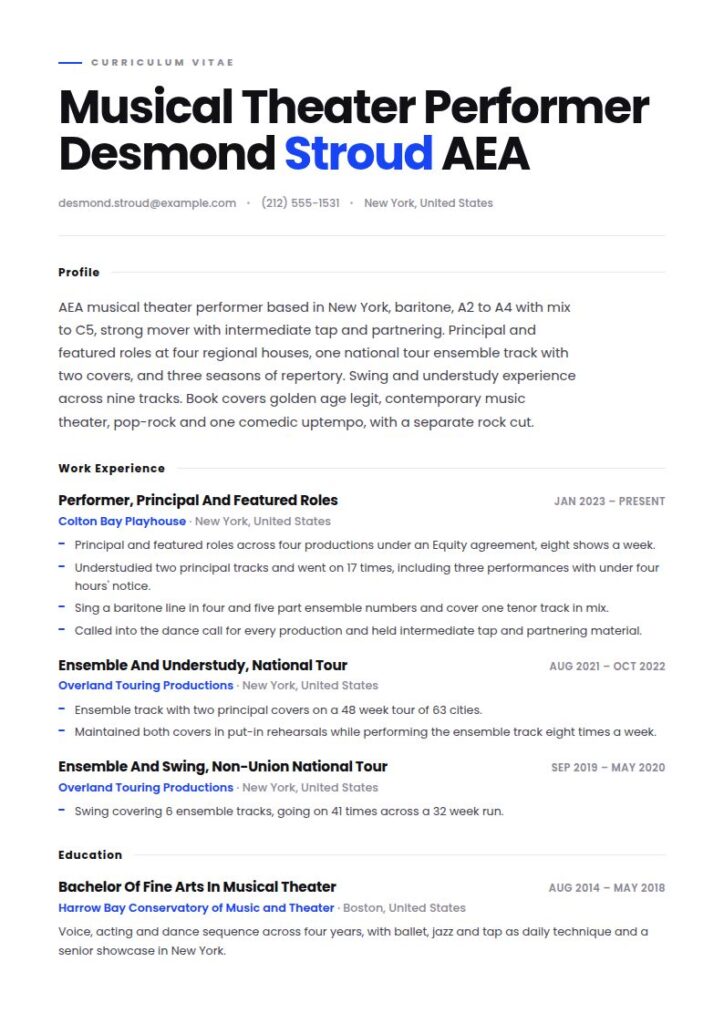
AEA musical theater performer based in New York, baritone, A2 to A4 with mix to C5, strong mover with intermediate tap and partnering. Principal and featured roles at four regional houses, one national tour ensemble track with two covers, and three seasons of repertory. Swing and understudy experience across nine tracks. Book covers golden age legit, contemporary music theater, pop-rock and one comedic uptempo, with a separate rock cut.
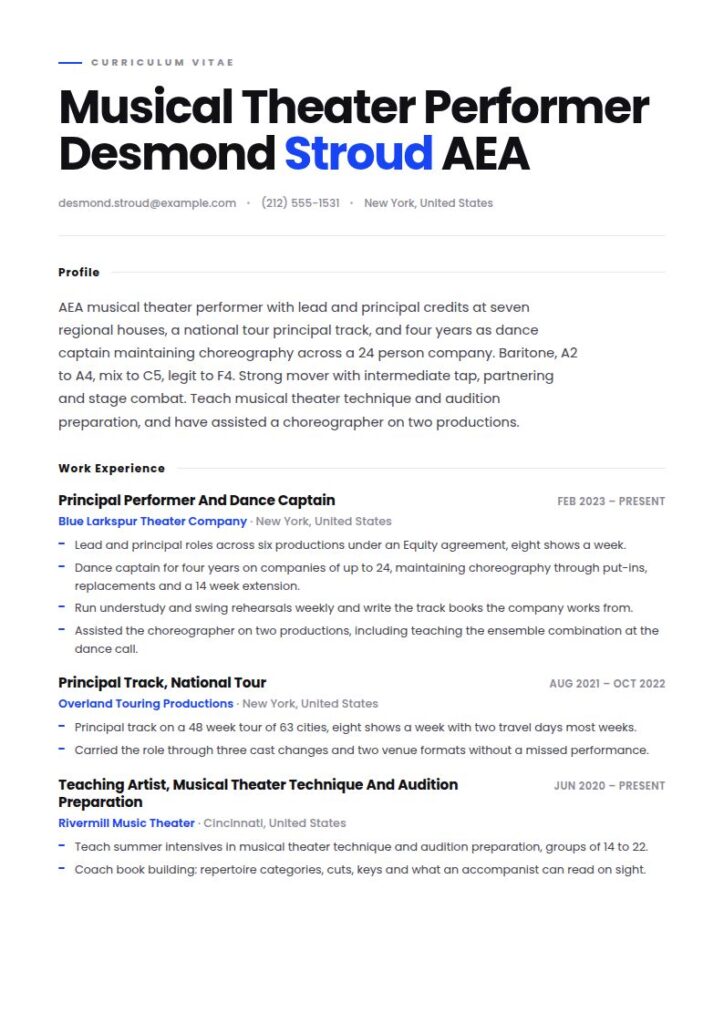
AEA musical theater performer with lead and principal credits at seven regional houses, a national tour principal track, and four years as dance captain maintaining choreography across a 24 person company. Baritone, A2 to A4, mix to C5, legit to F4. Strong mover with intermediate tap, partnering and stage combat. Teach musical theater technique and audition preparation, and have assisted a choreographer on two productions.
Right vs wrong: the same musical theater profile, twice
| ✅ Right | ❌ Wrong |
|---|---|
| Baritone, A2 to A4, mix to C5, legit to F4. | Powerful voice with an incredible range. |
| Strong mover with intermediate tap and partnering. | Excellent dancer in all styles. |
| Principal and featured roles at four regional houses, one national tour ensemble track with two covers. | Extensive experience in musicals of all kinds. |
| Swing and understudy experience across nine tracks. | Reliable, hardworking and always off book early. |
Each line on the right, for instance, can be verified in the room in under a minute. In contrast, nothing on the left can be tested, which is why readers ignore it.
Outline your credits
Use four columns, no dates, no bullets, and then group them in tiers.
| Instead of | Use |
|---|---|
| Lead role in a summer musical, 2023 | The Copper Lantern, Nate Wilkes, Rivermill Music Theater |
| Chorus member in several productions | Paper Crown, Ensemble and u/s Halloran, Colton Bay Playhouse |
| Was a swing and covered many parts | Halfway to Denver, Swing covering 6 tracks, national tour |
| Performed in college musicals | (move to a training block once you have professional credits) |
| Understudied the lead but never went on | Ensemble and u/s Nate Wilkes, Blue Larkspur Theater Company |
NATIONAL TOUR Halfway to Denver, Swing covering 6 tracks, Overland Touring Productions Halfway to Denver, Ensemble and u/s Deacon Reed, Overland Touring Productions
REGIONAL The Copper Lantern, Nate Wilkes, Rivermill Music Theater Paper Crown, Ensemble and u/s Halloran, Colton Bay Playhouse The Ninety-Nine, Featured, Blue Larkspur Theater Company The Copper Lantern, Ensemble and Dance Captain, Colton Bay Playhouse
SUMMER STOCK AND REPERTORY Three seasons of repertory, principal and ensemble tracks across nine productions
TRAINING PRODUCTIONS Removed; replaced by professional credits
The last line matters. University and conservatory productions come off as soon as professional credits can fill the space. Instead, keep them on your casting platform, and keep the roles in your pocket for "what have you played?", which is a different question from what is on the page.
Your book, your range and your dance call, on one page
In practice, three things decide a musical theater audition, and only one of them is a credit. In fact, this section is the difference between this document and any other performer resume.
The book. Your audition book is a three-ring binder of sheet music, taped back to back or single sided so it does not slam shut, in your keys, with the cut marked clearly and the tempo written at the top. A pianist you have never met has to play it correctly on sight, at your tempo, with your cut, while the panel watches you.
BOOK CONTENTS, FOUR CATEGORIES, TWO CUTS EACH
Golden age legit: one ballad, one uptempo. Written in the key, marked 16 and 32 bar cuts. Contemporary music theater: one ballad, one uptempo, both with a clean 16 bar option. Pop-rock: one belt or mix, one gentler contemporary, with a rock cut marked separately. Comedic uptempo: one, and it should be genuinely funny rather than merely fast.
EVERY CUT CARRIES Tempo marking at the top. Bar count written on the first page. Starting pitch bracketed. Page turns taped so the accompanist never lifts a hand. A named key change if you sing it transposed.
The resume does not list your book, but it should say what is in it in one line under the voice information, because casting reads that line as evidence you have prepared rather than assembled.
The range. Written in notes, honestly, as described above. Separating your legit top from your mix or belt is the single most useful line you can add.
The musical theater dance call label
The dance call. The vocabulary is small and everyone in the field uses it the same way, which is what makes an inflated label so visible. "Moves well" means you can be given staging and will look comfortable. "Strong mover" means you can hold a jazz combination in an ensemble. "Dancer" means you can be called into the dance call and taught a full combination at tempo. Then the qualifiers: tap with a level, partnering, ballet, acro, any style you would put your body in front of a choreographer for.
Pick the word you can survive. After all, casting tests the label within four minutes, and being the person who wrote "dancer" and cannot hold the combination is worse than not being called.
Equity Chorus Call procedures to know
Two procedural facts sit behind all three. Equity Chorus Calls, the open calls that exist specifically for ensemble and chorus casting, run in New York City, Chicago and Los Angeles, with online sign-up opening at 9:00 am one week before the audition and closing at 2:00 pm the business day prior. First, the monitor tells members what casting has asked for, which may be an up-tempo, a ballad or sixteen bars, and for dance auditions the monitor may call members in groups to learn a combination, and casting may see them in groups. Then, once typing is announced, no non-Equity performers may be seen at that call (Actors' Equity Association, ECC procedures, revised 2 August 2023). As a result, your book has to be ready for "sixteen bars, uptempo" with no warning, and your dance label has to be true in a group of twelve.
Build a snapshot of your special skills
One or two lines at the bottom, and in musical theater it is where a production finds the solution to a casting problem: the ensemble member who can also play the on-stage instrument, tumble, or cover a role in another voice part.
Special skills: Tap (intermediate), partnering, stage combat (unarmed, certified 2025), guitar (rhythm, can play on stage), piano (basic, can read a vocal line), sight-reading, close harmony, standard and Southern American dialects, roller skates, valid driver's license, conversational French.
Above all, everything here has to be performable on request, without practice. An on-stage instrument is the highest value entry, because a production that can cast one person instead of two will, and it is the skill most performers under-report.
List your training and education
Training is the credential. BLS gives the typical entry-level education for actors as some college with no degree plus long-term on-the-job training, and for musicians and singers as no formal educational credential with long-term on-the-job training (BLS Occupational Outlook Handbook, actors and musicians and singers, pages last modified 27 August 2026). A degree helps; however, it does not decide anything.
TRAINING
Voice: four years of on-book study with a named teacher. Ongoing coaching on repertoire and book maintenance.
Acting: two years of scene study, one year of Shakespeare text.
Dance: ballet four years, jazz six years, tap three years, partnering two years, all with named teachers and studios. Ongoing class twice a week.
Stage combat: unarmed, certified 2025.
Bachelor of Fine Arts, Musical Theater, 2018.
List ongoing class, especially dance. In a field where the dance call is a gate, therefore, a performer who is in class this year reads differently from one whose training stopped at graduation.
Choose the right layout and design
One typeface, 10 to 12 point, name largest at the top, four columns aligned with tab stops rather than typed spaces, one page trimmed to 8×10. Also, no photograph on the resume, no borders, no color blocks.
Put voice type and range in notes in the header block. Give one honest dance word plus qualifiers. List credits as production, role, house and director, grouped in tiers. Show swing and understudy tracks openly with the number of tracks covered. Say what is in your book in one line. Keep ongoing dance class on the page. Update the file the day a contract ends.
Do not write a top note you cannot hold eight times a week. Do not write "dancer" if you are a strong mover. Do not put your address, age or weight on the page. Do not write EMC, which has not existed since 2023. Do not keep university productions once professional credits can replace them. Do not send the 8×10 casting version into an applicant tracking system.
Musical theater job market and outlook
However, the Bureau of Labor Statistics publishes no Occupational Outlook Handbook profile for musical theater performer. The Handbook covers broad occupations rather than job titles, so BLS measures a triple threat career across three of them at once.
| Bracketing occupation | Employment, 2025 | Projected 2035 | Change, 2025 to 2035 | Annual openings | Median hourly wage, May 2025 |
|---|---|---|---|---|---|
| Actors | 67,500 | 67,500 | 0 percent, 0 jobs | ~6,300 | $29.05 |
| Musicians and singers | 170,400 | 170,900 | 0 percent, +600 | ~17,400 | $47.80 |
| Dancers | 13,800 | 14,100 | part of a 2 percent rise across dancers and choreographers | ~2,200 for dancers and choreographers combined | $24.80 |
Source: U.S. Bureau of Labor Statistics, Occupational Outlook Handbook, actors, musicians and singers, and dancers and choreographers, 2025 to 2035 projections and May 2025 wage data, all pages last modified 27 August 2026.
Three flat occupations, and no annual wage in any of them
None of the three occupations a musical theater career is measured in publishes an annual median wage, because the work is intermittent and BLS reports it hourly. Actors had a median of $29.05 an hour in May 2025, musicians and singers $47.80, and dancers $24.80 (BLS Occupational Outlook Handbook, May 2025 wage data published 27 August 2026).
All three are flat. Actors are projected at 0 percent change through 2035, musicians and singers at 0 percent, and dancers and choreographers together at 2 percent, with roughly 6,300, 17,400 and 2,200 openings a year respectively (same cycle).
The spreads are wide in every direction. For actors the lowest 10 percent earned under $16.50 an hour and the highest over $143.68; for musicians and singers under $20.35 and over $132.56; for dancers under $14.88 and over $52.30 (same source). Self-employment is high: 48 percent of musicians and singers and 41 percent of dancers work for themselves.
What that means for the page is that you are not competing for a salary band, you are competing to be the person who fills three needs in one contract. That is exactly why the range line, the dance label and the on-stage instrument in your special skills are not decoration.
What you can expect to earn in musical theater
As a result, there is no published median for musical theater performer, and quoting one would mean inventing it. Instead, BLS publishes the hourly spread in the three surrounding occupations, and none of them can honestly be multiplied into a year.
Actors had a median hourly wage of $29.05 in May 2025, with theater companies and dinner theaters, which employ 10 percent of actors, paying a median of $25.53 an hour, and self-employed workers making up 23 percent of the occupation (BLS Occupational Outlook Handbook, actors, May 2025). For example, musicians and singers had a median of $47.80 an hour, with performing arts and spectator sports at $50.56 and educational services at $30.88, and 48 percent self-employed. Similarly, dancers had a median of $24.80 an hour, with educational services at $27.00 and performing arts industries at $25.18 (same Handbook cycle).
What moves your earnings is the mix: contract level and length, whether you are on a principal, understudy or swing track, how many weeks a year you work, whether teaching, cruise or theme park contracts fill the gaps, and whether a second skill lets a production cast one body instead of two.
Key takeaways for a musical theater resume
- First, one page, cut to 8×10, attached to the headshot; the casting version is never a business resume.
- Then voice type and range in notes, in the header block, honest to a two-show day.
- Next, one dance word you can survive, plus qualifiers with levels.
- Credits as production, role, house and director, grouped by tier rather than by date.
- Also, swing and understudy tracks go on the page, with the number of tracks covered.
- In addition, say in one line what is in your book, and keep the book in marked keys with clean cuts.
- Finally, write your Equity status exactly as it stands, and never write EMC, which ended in 2023.
Build your musical theater resume in 15 minutes with our AI resume builder.
Related creative and artistic resume examples
- Actor resume
- Dance teacher resume
- Choreographer resume
- Musician resume
- Stage manager resume
- Voice actor resume
- Costume designer resume
- Film producer resume
- Screenwriter resume
- Photographer resume
- Videographer resume
- Theater resume
Pair it with a matching musical theater cover letter.
Musical theater resume questions, answered
How long should a musical theater resume be?
One page, cut to 8 by 10 inches and attached to the headshot. With more credits than fit, drop the weakest tier rather than adding a page. An edited page shows you know which of your credits are the strong ones.
How do I write my vocal range on a musical theater resume?
In notes, with the bottom and the top you can hold repeatedly: "Baritone, A2 to A4, mix to C5." Separate your legit top from your belt or mix if they differ. A music director will test it in sixteen bars, so an inflated top costs you the room rather than winning it.
Should I write "dancer" or "moves well"?
Write the one that survives the dance call. "Moves well" means you take staging comfortably, "strong mover" means you can hold a jazz combination in an ensemble, and "dancer" means you can be taught a full combination at tempo in a group. Add levels for tap, partnering and ballet separately.
Do I put understudy and swing credits on the page?
Yes, openly, with "u/s" or "Swing" in the role column and the number of tracks covered for a swing. In musical theater these are respected credits, and a swing who covered six tracks is demonstrating exactly the reliability a production is hiring for.
Can I still write EMC on my musical theater resume?
No. The Equity Membership Candidate program was phased out when Actors' Equity introduced Open Access, and Equity states that former candidates can join whenever they are ready, with fees already paid applied to the initiation fee (Actors' Equity Association, EMC page, accessed 17 September 2026). Write AEA if you are a member, and write nothing or "non-union" if you are not.