Assistant Costume Designer Marguerite Okonjo
Assistant Costume Designer
[email protected] | (612) 555-2324 | Minneapolis, United States
Profile
Assistant costume designer with three years in regional theater, supporting main stage seasons of six to eight productions. Break scripts down by character, scene and page, maintain the costume plot and the change list, and run fittings with the designer across casts of 12 to 30. Cut and stitch to pattern, alter from stock, and ran the dressing room paperwork for 9 quick changes on the most recent musical.
Work Experience
08/2024 - Present, Assistant Costume Designer, Mill City Repertory, Minneapolis, United States
- Break down scripts by character, scene and page for a main stage season of six to eight productions, casts of 12 to 40.
- Maintain the costume plot and the change list, including 22 changes on the most recent musical of which 9 were quick changes under 90 seconds.
- Schedule and run fittings with the designer, three rounds a principal and two for chorus.
- Track rental returns and damage inspection for a costume house hire of 27 looks, released with no damage charge.
06/2023 - 08/2024, Stitcher and First Hand, Mill City Repertory, Minneapolis, United States
- Cut and stitched to pattern in a shop of a cutter, two stitchers and a crafts artisan.
- Built period underpinnings including four corseted bodices, and handled alterations from stock.
Education
08/2021 - 05/2025, Bachelor of Fine Arts, Costume Design, University of Minnesota, Twin Cities, Minneapolis, United States
Designed two studio productions and assisted on three main stage shows. Coursework in pattern drafting, draping, period underpinnings and rendering.
Skills
Script breakdown and costume plot, 75
Change list and quick change planning, 70
Flat pattern drafting and draping, 75
Corsetry and period underpinnings, 70
Fitting support and alterations, 80
Rental tracking and damage inspection, 70
Rendering in gouache and digital, 65
Languages
English, native
Certificates
08/2025, Safety First! online course, IATSE Training Trust Fund
Entertainment industry safety training.
Summary
A costume designer resume is a one to two page document showing you can break a script down by character, scene and shooting day, turn that into a costume plot and a build, rent and buy split inside a given budget, and get it onto bodies on time. This guide gives you three adaptable versions, the United Scenic Artists route, and current Bureau of Labor Statistics figures.
Costume Designer resume examples by experience level
A costume designer resume is a one to two page document showing that you can read a script, break it into every costume the production needs, and get those costumes onto bodies on the day, inside a number somebody else chose.
That is a production job, not a fashion job. A fashion designer develops a line for sale, with a tech pack, a factory and a season. A costume designer serves a story: one script, a fixed cast, a schedule, and a budget set before anyone read the script. The two roles share a sewing vocabulary and little else, and a resume that blurs them reads as someone who has not worked on a production.
The Bureau of Labor Statistics publishes no separate costume designer profile; the published occupation covering the work is fashion designers (BLS Occupational Outlook Handbook, fashion designers, page last modified 27 August 2026). Every wage figure below is labeled with the occupation it belongs to.
Resume guide for a costume designer resume
This guide and the corresponding costume designer resume example will cover:
- How to write a costume designer resume, section by section
- The breakdown: characters, changes, doubles and the costume plot
- Three adaptable summaries: assistant, designer and lead designer
- Build versus rent versus buy, and how to write a budget you held
- The United Scenic Artists route, with its real costs
How to write a costume designer resume
Six sections: contact header with a portfolio link, summary, production credits, a breakdown and build record, skills and shop capability, then training and union status. One page under five years, two once you are designing full seasons. The order answers a production manager's questions in sequence: what have you designed, at what scale, did it come in on budget, and can you run a shop and a crew.
| Section | What it is answering | Where it goes |
|---|---|---|
| Production credits | What have they designed, for whom, at what scale? | Grouped by medium, strongest first |
| Breakdown and build record | Costume count, changes, build split, budget held | Under the summary |
| Skills and shop capability | What can they cut, build, alter or age? | Grouped |
| Training and union | Category membership, safety training, who taught them | Foot of the page |
Count the costumes, not the productions
"Designed 14 productions" tells a production manager almost nothing. A two-hander and a 40-person musical are both one production, and they are different jobs.
Count what sizes the work: characters, total looks, changes, and how many are quick changes. "38 characters, 61 looks, 22 changes of which 9 were quick changes under 90 seconds" describes a show anybody in the business can picture.
Then add the two numbers that decide whether you are hired again: the budget you were given and whether you came in on it. "Built to a $46,000 costume budget and closed at $44,100" says something no adjective can.
Run the file through the ATS resume checker before you submit to a theater company, a university or a studio; those applications are usually parsed before a person opens them.
Choosing the best resume format for a costume designer resume
Credits grouped by medium, then a breakdown and build record, then everything else. Theater, opera, dance, film, television and commercials are separate hiring pools with different vocabularies, and a reader wants their own medium at the top.
Within a medium, order by scale and house rather than by date. A recent two-hander does not outrank a 40-person main stage production from three years ago, because a production manager is measuring the size of the room you have worked in.
Keep the portfolio separate: renderings, swatched boards, fitting photographs and a costume plot live in a linked book.
Include your contact information
| ✅ Right | ❌ Wrong |
|---|---|
| Marguerite Okonjo | Marguerite Okonjo |
| Costume Designer: theater, opera, independent film | Creative costume artist passionate about storytelling through clothes |
| United Scenic Artists Local USA 829, Costume Design | Union member |
| (612) 555-2324, [email protected], Minneapolis, MN | (612) 555-2324, [email protected] |
Name the media you actually take work in. A repertory season, an opera, a music video and an episodic show are different crafts that share a shop.
If you hold United Scenic Artists membership, put the local and category on the page. It is checkable in one call and it changes which contracts you can be hired under.
Make use of a summary
Four lines: media and scale, the breakdown numbers, the build split, one budget fact.
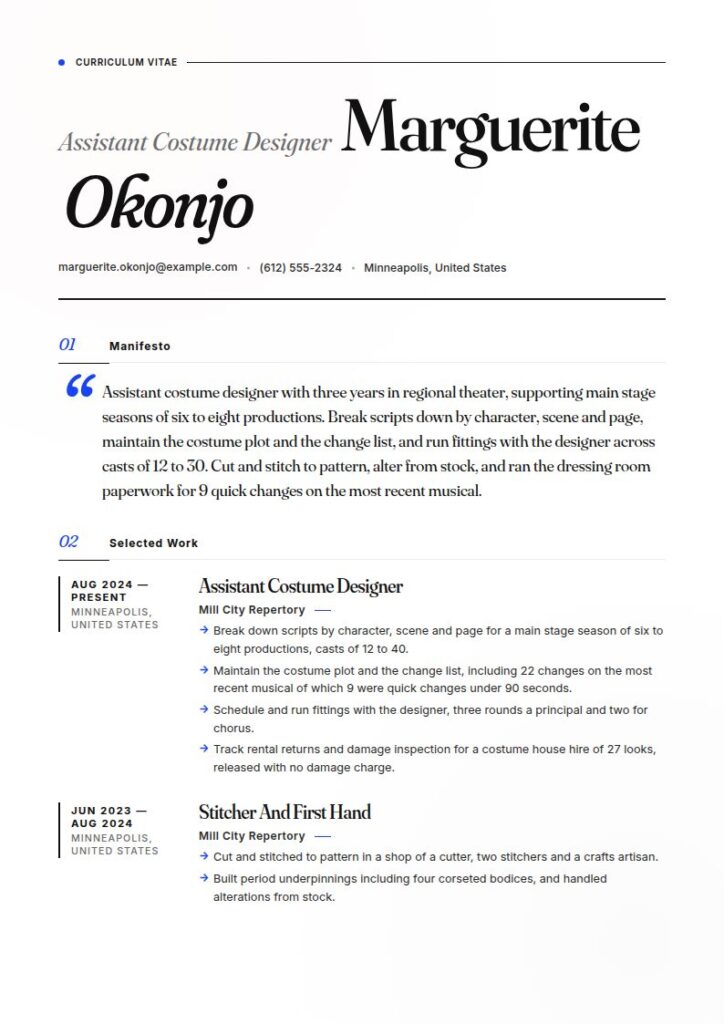
Assistant costume designer with three years in regional theater, supporting main stage seasons of six to eight productions. Break scripts down by character, scene and page, maintain the costume plot and the change list, and run fittings with the designer across casts of 12 to 30. Cut and stitch to pattern, alter from stock, and ran the dressing room paperwork for 9 quick changes on the most recent musical.
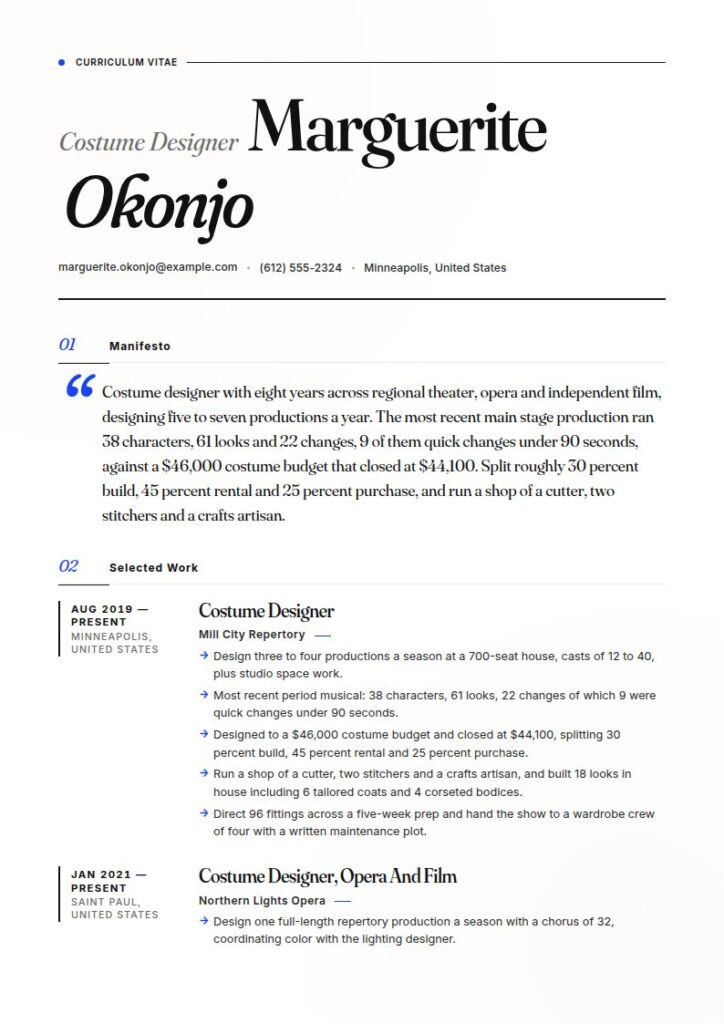
Costume designer with eight years across regional theater, opera and independent film, designing five to seven productions a year. The most recent main stage production ran 38 characters, 61 looks and 22 changes, 9 of them quick changes under 90 seconds, against a $46,000 costume budget that closed at $44,100. Split roughly 30 percent build, 45 percent rental and 25 percent purchase, and run a shop of a cutter, two stitchers and a crafts artisan.
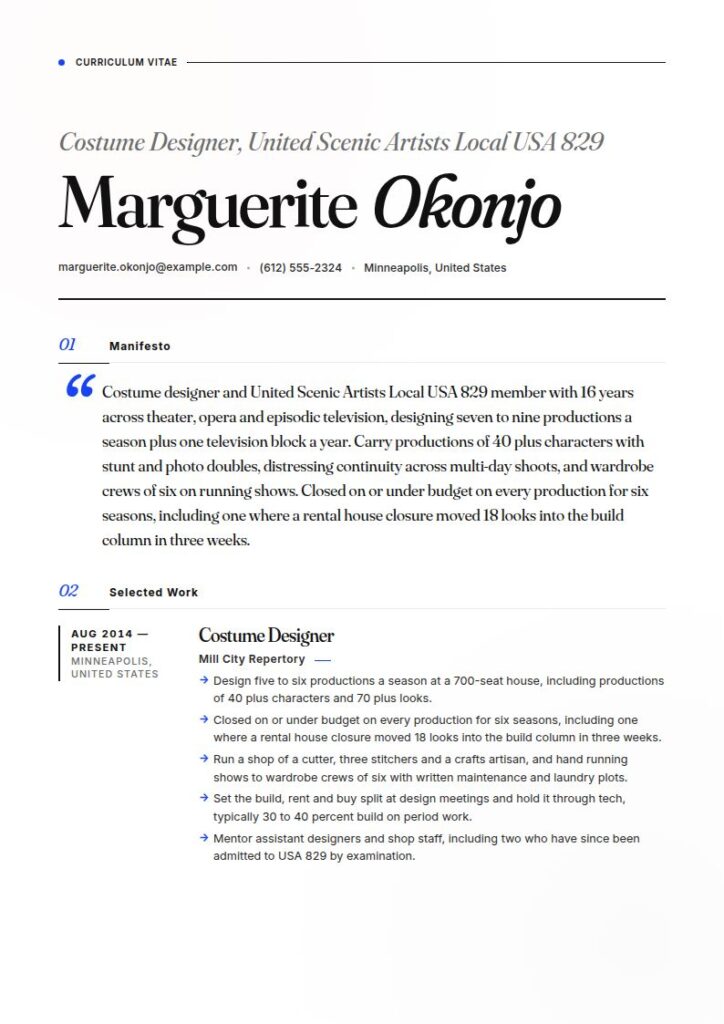
Costume designer and United Scenic Artists Local USA 829 member with 16 years across theater, opera and episodic television, designing seven to nine productions a season plus one television block a year. Carry productions of 40 plus characters with stunt and photo doubles, distressing continuity across multi-day shoots, and wardrobe crews of six on running shows. Closed on or under budget on every production for six seasons, including one where a rental house closure moved 18 looks into the build column in three weeks.
Right vs wrong: the same costume designer summary, twice
| ✅ Right | ❌ Wrong |
|---|---|
| 38 characters, 61 looks, 22 changes, 9 of them quick changes under 90 seconds. | Designed costumes for a large-cast musical. |
| $46,000 costume budget, closed at $44,100. | Worked within tight budget constraints. |
| 30 percent build, 45 percent rental, 25 percent purchase. | Sourced costumes from a variety of places. |
| Shop of a cutter, two stitchers and a crafts artisan. | Collaborated with the costume team. |
The right column lets a production manager staff and budget the next show. The left describes anyone who has been near a costume shop.
Outline your production credits
Production, role, company or production house, director and year. No bullets. Group by medium, order by scale within each group: the reader is measuring level, not recency.
| Instead of | Use |
|---|---|
| Designed costumes for several theater productions | Main stage: 6 productions a season, 700-seat house, casts of 12 to 40 |
| Worked on a period drama | Period build, 1890s, 22 principal looks with corsetry, 14 hired from a costume house |
| Handled costume changes during performances | 22 changes including 9 quick changes under 90 seconds, wardrobe crew of four |
| Managed the costume budget | Designed to a $46,000 budget; closed at $44,100 across build, rental and purchase |
THEATER Main Stage Season, Costume Designer, Mill City Repertory, 6 productions a year Period musical, 38 characters, 61 looks, Costume Designer, Mill City Repertory Two-hander, contemporary, Costume Designer, Mill City Repertory studio space
OPERA Full-length repertory production, Costume Designer, Northern Lights Opera, chorus of 32
DANCE Contemporary program of three works, Saint Anthony Falls Dance
FILM AND TELEVISION Independent feature, period, Costume Designer, Brightleaf Pictures Episodic block, four episodes, Costume Designer, Brightleaf Pictures
Break down the script, then build the show
This separates a costume designer from someone who makes clothes, and almost nobody writes it down.
A costume designer's first deliverable is not a rendering. It is a breakdown: a reading of the script producing every costume the production needs, attached to the character who wears it, the scene it appears in, and the day it has to exist.
| Breakdown element | What you are counting | Why it decides the job |
|---|---|---|
| Characters and looks | Named characters, chorus, ensemble, and how many looks each carries | Sizes the whole build |
| Changes | Every change, and which are quick changes with a time | Decides crew size and dressing room layout |
| Doubles | Stunt and photo doubles, duplicates for blood, water or damage | Multiplies one look into three or four |
Out of it comes the costume plot: one document with every character down one axis and every scene down the other, each look in its cell. Once it exists, everybody in the building works from it.
Then the split. Every look resolves into one of three columns, and the ratio is a design decision with a budget attached.
| Column | When it is the right answer | What it costs you |
|---|---|---|
| Build | Period silhouette, fit-critical, duplicates needed, or nothing exists | Shop hours, cutter time, fabric, longest lead |
| Rent | Large chorus, single-use period, uniform looks | Hire fee, deposit, damage liability, return date |
| Buy | Contemporary looks, pieces that read as ordinary clothing | Fast, but sizing and returns eat the saving |
Breakdown and build record, most recent main stage production
Scale: period musical, 38 characters including a chorus of 16, 61 total looks.
Changes: 22 changes, 9 of them quick changes under 90 seconds, handled by a wardrobe crew of four with two pre-set stations in the wings.
Split: 30 percent build, 45 percent rental, 25 percent purchase. Built 18 looks in house, including 6 tailored coats and 4 corseted bodices.
Budget: given $46,000, closed at $44,100, rental return released with no damage charge.
Fittings: three rounds a principal, two for chorus, 96 fittings across a five-week prep.
Continuity: aging and distressing on 11 looks across three states, duplicates built for two.
Six lines, every one a number a production manager can plan against. None of it describes an aesthetic; your renderings do that better.
The union route: United Scenic Artists Local USA 829
For designers working in theater, opera, dance, film and television, the relevant union is United Scenic Artists Local USA 829, an IATSE local. Costume Designer is one of its listed membership categories, alongside scenic, lighting, sound and projection design, scenic art and the coordinator categories (United Scenic Artists Local USA 829, Categories and Crafts, accessed 17 September 2026).
The main route in is an examination. USA 829 runs exams for scenic, costume, lighting and sound design across its regions. An applicant pays a non-refundable application fee of $75 per category plus an exam fee of $125, so a standard exam costs $200, and the process runs from application to an interview and then the exam or portfolio review (United Scenic Artists Local USA 829, Exams, accessed 17 September 2026).
Membership itself costs more. In the Central Region the portfolio review carries a non-refundable fee of $200, and the union states that the initiation fee for all designers, scenic artists, art department coordinators and computer artists is $3,500, with a $2,000 rebate for anyone admitted through the exam process, making the actual initiation fee $1,500. Successful applicants also complete an IATSE Training Trust Fund Safety First! online course as part of the final application, and are recommended for membership by the Exam Committee at the general membership meeting after their interview (United Scenic Artists Local USA 829, Central Region exams, accessed 17 September 2026).
The designer and the crew belong to different locals
A costume designer is USA 829. The people who run the show once it opens usually are not.
In New York, Theatrical Wardrobe Union Local 764, IATSE represents wardrobe workers and technicians, set costumers and tailors, child actor guardians, crafts artisans, dressers and stitchers, covering film and television within a 50-mile radius of Columbus Circle and all of Long Island, and live theater and events in New York City, all of Long Island and parts of Westchester County (Theatrical Wardrobe Union Local 764, IATSE, accessed 17 September 2026).
That division matters on your resume. If you have worked as a dresser, a stitcher or a set costumer, write it as crew experience with the craft named, not as design credit. Production managers read the distinction instantly, and claiming design on crew work is the fastest way to lose a reference.
Build a snapshot of your key skills
Twelve to fourteen entries in four groups: what you design, what you make by hand, what you run, and the paperwork.
Design: Period research and silhouette, Character-driven design, Rendering in gouache and digital, Swatching and sourcing, Color coordination with the lighting designer
Making: Flat pattern drafting and draping, Tailoring, Corsetry and period underpinnings, Millinery, Dyeing, Aging and distressing
Running the show: Fitting direction, Wardrobe crew supervision, Quick change choreography, Maintenance plots, Rental returns and damage inspection
Paperwork: Script breakdown, Costume plot, Change list, Budget tracking across build, rent and buy, Continuity records, Fitting schedules
List your education and training
Short, at the foot. Costume design is not licensed, so a degree, a shop apprenticeship and years of credits all count as routes. BLS gives the typical entry-level education for fashion designers, the published occupation covering this work, as a bachelor's degree (BLS Occupational Outlook Handbook, fashion designers, page last modified 27 August 2026).
Bachelor of Fine Arts, Costume Design, University of Minnesota, Twin Cities, Minneapolis, MN, 2010.
United Scenic Artists Local USA 829, Costume Design category, admitted by examination, 2016.
Safety First! online course, IATSE Training Trust Fund, 2016, refreshed 2024.
Tailoring and coat making, two-year shop apprenticeship under a resident cutter, Mill City Repertory.
Millinery and period headwear, summer intensive, 2018.
Name the shop and the cutter you trained under. Costume shops are a small, connected world, and a resident cutter's name carries more weight with a production manager than a school's does.
Choose the right layout and design
Single column, plain type at 11 or 12 point, no photograph, no renderings embedded. The portfolio carries the images and the resume has to survive being parsed. Align credit columns with tab stops rather than typed spaces, because misaligned columns are the most visible amateur tell on a production resume. Name the file marguerite-okonjo-costume-designer-resume.pdf.
Count characters, looks, changes and quick changes on your largest productions. Give the budget you were handed and the number you closed at. State the build, rent and buy split as percentages. Name the shop you ran and its size. Put your USA 829 local and category on the page. Group credits by medium and order them by scale.
Do not list productions without scale attached. Do not claim design credit for crew work; write dresser, stitcher or set costumer by name. Do not embed renderings in a parsed file. Do not write "worked within budget" instead of the two numbers. Do not describe your aesthetic in the summary. Do not name a production under embargo.
Costume designer job market and outlook
BLS publishes no separate costume designer profile, so two published occupations bracket the work: fashion designers covers the craft, and producers and directors is the production-side reference for where a costume designer sits on a show's payroll.
| Measure | Fashion designers | Producers and directors |
|---|---|---|
| Employment, 2025 | 32,700 | 181,000 |
| Projected employment, 2035 | 32,800 | 188,300 |
| Projected change, 2025-35 | 0% (little or no change) | 4%, +7,300 jobs |
| Projected annual openings | ~2,500 | ~12,100 |
| Typical entry-level education | Bachelor's degree | Bachelor's degree |
| Median annual wage, May 2025 | $80,960 | $90,360 |
Source: U.S. Bureau of Labor Statistics, Occupational Outlook Handbook, fashion designers and producers and directors, pages last modified 27 August 2026, May 2025 wage data and 2025 to 2035 projections.
Where the production work sits, and what it pays
Among producers and directors, BLS puts self-employed workers at 20 percent, motion picture and video industries at 19 percent, media streaming distribution services, social networks and other content providers at 13 percent, performing arts, spectator sports and related industries at 9 percent, and television broadcasting at 7 percent (BLS Occupational Outlook Handbook, producers and directors, page last modified 27 August 2026).
The May 2025 industry medians were $105,300 in motion picture and video industries, $98,520 in media streaming and content providers, $74,240 in performing arts, spectator sports and related industries, and $65,230 in television broadcasting (same source).
Performing arts at $74,240 is the closest published industry to a theater costume designer's working life, and it sits $31,000 below the motion picture figure. That gap is the largest financial fact about this career, and it is why so many designers hold a theater season and a screen block in the same year.
What salary you can expect as a costume designer
There is no published median for costume designers, so be careful with any site that quotes one. The two published occupations that bracket the work are fashion designers at a median of $80,960 a year, or $38.92 an hour, and producers and directors at $90,360 a year, or $43.44 an hour, both May 2025 (BLS Occupational Outlook Handbook, pages last modified 27 August 2026).
Neither is a salary you are offered. Costume design is contracted per production, per week of prep and run, or per episodic block, so the annual figure depends on how many productions you carry and what kind they are.
Three things on a resume move it. Scale, because characters, looks and changes on your largest production are what a producer uses to decide whether you can carry theirs. Budget performance, the number you were given against the number you closed at, on more than one show, because a designer who lands the budget repeatedly can be planned around. Medium mix, because a theater season and a screen block pay very differently and a resume presenting both in separate groups can be hired for either.
Union membership sits behind all three, at a real cost: $200 for the standard exam, and an initiation fee of $3,500 reduced to $1,500 by the $2,000 rebate for admission through the exam process (United Scenic Artists Local USA 829, Central Region exams, accessed 17 September 2026).
Key takeaways for a costume designer resume
- Group credits by medium and order them by scale, not by date.
- Count characters, looks, changes and quick changes on your largest productions.
- Show the breakdown and the costume plot as work you produce, not background.
- Give the build, rent and buy split as percentages.
- Put two budget numbers on the page: given and closed.
- Name your USA 829 local and category, and write crew work as crew work.
- Keep the file parseable and leave the renderings in the portfolio.
Build your costume designer resume in 15 minutes with our AI resume builder.
Related creative and artistic resume examples
- Tailor resume
- Fashion designer resume
- Stage manager resume
- Actor resume
- Musical theater resume
- Choreographer resume
- Film producer resume
- Cinematographer resume
- Illustrator resume
- Visual artist resume
- Theater resume
- Dance teacher resume
Pair it with a matching costume designer cover letter.
Costume designer resume questions, answered
How long should a costume designer resume be?
One page under five years, two once you are designing full seasons and carrying screen work. The book of renderings and paperwork is separate and does not count.
Is a costume designer the same thing as a fashion designer?
No. A fashion designer develops a line for sale against a season, a factory and a margin. A costume designer serves one script with a fixed cast, a schedule and a budget set in advance. BLS folds the work into fashion designers (BLS Occupational Outlook Handbook, page last modified 27 August 2026), which is a data convention rather than a description of the job.
Do I need to join United Scenic Artists to work as a costume designer?
Not to start, and plenty of regional, academic and independent work is non-union. Membership matters when you want the agreements covering larger houses and screen productions. The route is an examination, at $75 to apply per category and $125 for the exam, with an initiation fee of $3,500 reduced to $1,500 by the rebate for admission through the exam process (United Scenic Artists Local USA 829, accessed 17 September 2026).
What do I put on a costume designer resume with no design credits?
Crew work, with the craft named: dresser, stitcher, first hand, cutter, set costumer, wardrobe supervisor. Then any design at any scale, including student and community work, with characters and looks counted. Then what you can make by hand, because a designer who can draft, tailor and do corsetry is useful in a shop from week one.
How do I show work on a production I cannot name?
Give the shape instead of the title: medium, house size, cast size, look count, change count and the budget split. "Period musical, 700-seat house, 38 characters, 61 looks, 22 changes, closed under a $46,000 budget" tells a production manager everything and names nothing.
Should I put renderings on my resume?
No. Keep one plain-text portfolio URL in the header and hyperlink it. Renderings, boards, fitting photographs and a costume plot belong in the book at a size where they can be read, and an embedded image is compressed to nothing by a parser.