Marguerite Okonjo Costume Designer, United Scenic Artists Local USA 829 Minneapolis, 55401, United States [email protected] · (612) 555-2324
17 September 2026
Ms. Ingrid Halvorsen Production Harbor Street Playhouse Duluth, United States
Application for Resident Costume Designer, Harbor Street Playhouse
Dear Ms. Halvorsen,
I am applying for the resident costume designer post at Harbor Street Playhouse. I am a United Scenic Artists Local USA 829 member designing seven to nine productions a season across theater and opera, plus one episodic television block a year, and my largest main stage production ran 38 characters and 61 looks at a 700-seat house.
On that production I broke the script down by character, scene and page, built a costume plot the whole building worked from, and carried 22 changes of which 9 were quick changes under 90 seconds with a wardrobe crew of four. The split came out at 30 percent build, 45 percent rental and 25 percent purchase, which let me put the shop hours into the six tailored coats and four corseted bodices that had to fit. The budget was $46,000 and I closed at $44,100, with the rental return released with no damage charge. I have closed on or under budget on every production for six seasons.
I saw that Harbor Street is programming two period pieces and a new work next season, and that the shop runs with a resident cutter and two stitchers. That is the shape I have worked in for a decade, and I would want to own the breakdown, the plot and the budget split from the first design meeting rather than receive them at build. I am also comfortable rebuilding a plan mid-prep: one season a rental house closure moved 18 looks into the build column with three weeks left, and we opened on schedule.
I hold USA 829 membership in the Costume Design category and current IATSE Training Trust Fund safety training. My portfolio, including the costume plot from that production, is at margueriteokonjo.example.com. I am available from the start of the prep period. Thank you for your time.
Sincerely, Marguerite Okonjo
Summary
A costume designer cover letter tells a production manager what scale you can carry, what budget you closed at, and what shop and crew you can run. This guide gives you a full adaptable letter, the openings that work, what changes between a theater season, a film block and an academic post, and how to write evidence for a production you cannot name.
Costume Designer cover letter examples by experience level
A costume designer cover letter is a one-page letter telling a production manager what size of show you can carry, what you closed the last budget at, and what you can run in the shop and in the wings.
The portfolio makes the case for your eye. The letter makes the case that hiring you is not a risk, which is the question a production manager is actually holding. A season is a fixed calendar and a fixed number, and the last designer who missed both is still on their mind.
Guide to a costume designer cover letter
This guide and the corresponding costume designer cover letter example will cover:
- How to structure the letter, paragraph by paragraph
- Why the scale of your largest production belongs in the first paragraph
- What counts as evidence when you cannot name the production
- What changes between a theater season, a film block and an academic post
How to write a costume designer cover letter
| Paragraph | Its job | Length |
|---|---|---|
| Opening | The post, your media, and the scale you carry | 2 to 3 sentences |
| Evidence | One production, counted, with a budget given and closed | 4 sentences |
| Fit | Something specific about their season, and what you would run | 3 sentences |
| Close | Union status, shop capability, availability | 2 sentences |
Count the show in your first paragraph
Production managers think in numbers before taste. Characters, looks, changes, crew and budget are the five that decide whether a designer fits a slot.
So open with them: "My largest main stage production ran 38 characters, 61 looks and 22 changes, 9 of them quick changes under 90 seconds, against a $46,000 budget that closed at $44,100."
One sentence, and the reader knows you have worked at their scale, that you count your own work, and that you remember the closing number. Almost nobody writes that sentence, which is why it works.
A costume designer cover letter example you can adapt
Dear Ms. Halvorsen,
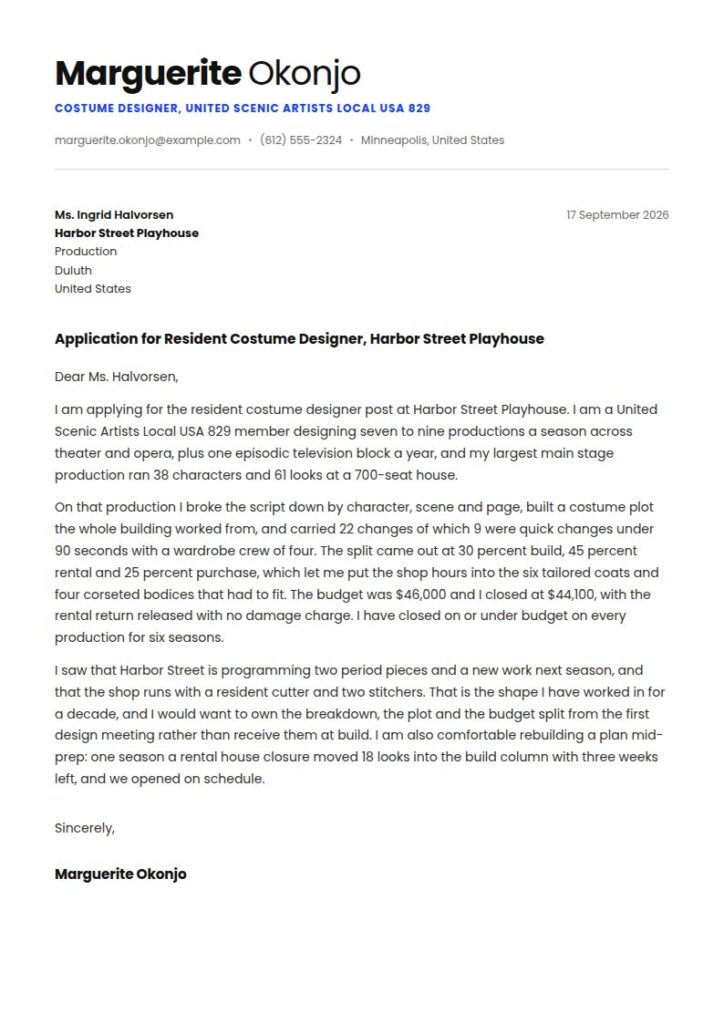
I am applying for the resident costume designer post at Harbor Street Playhouse. I am a United Scenic Artists Local USA 829 member designing seven to nine productions a season across theater and opera, plus one episodic television block a year, and my largest main stage production ran 38 characters and 61 looks at a 700-seat house.
On that production I broke the script down by character, scene and page, built a costume plot the whole building worked from, and carried 22 changes of which 9 were quick changes under 90 seconds with a wardrobe crew of four. The split came out at 30 percent build, 45 percent rental and 25 percent purchase, which let me put the shop hours into the six tailored coats and four corseted bodices that had to fit. The budget was $46,000 and I closed at $44,100, with the rental return released with no damage charge. I have closed on or under budget on every production for six seasons.
I saw that Harbor Street is programming two period pieces and a new work next season, and that the shop runs with a resident cutter and two stitchers. That is the shape I have worked in for a decade, and I would want to own the breakdown, the plot and the budget split from the first design meeting rather than receive them at build. I am also comfortable rebuilding a plan mid-prep: one season a rental house closure moved 18 looks into the build column with three weeks left, and we opened on schedule.
I hold USA 829 membership in the Costume Design category and current IATSE Training Trust Fund safety training. My portfolio, including the costume plot from that production, is at margueriteokonjo.example.com. I am available from the start of the prep period. Thank you for your time.
Sincerely, Marguerite Okonjo
Openings that work
| Instead of | Use |
|---|---|
| I am passionate about telling stories through costume | My largest main stage production ran 38 characters and 61 looks at a 700-seat house |
| I am writing to express my interest in the costume designer position | I am applying for the resident costume designer post at Harbor Street Playhouse |
| I would love to bring my creativity to your season | I saw you are programming two period pieces and a new work next season |
Each sentence on the right is checkable in an interview. Each on the left has been read four hundred times by the person holding your letter.
What counts as evidence when you cannot name the production
Embargo, a studio agreement or plain discretion will often stop you naming a title. That removes the name and leaves everything a production manager was going to ask about anyway.
| Kind of evidence | What it looks like in a sentence |
|---|---|
| Scale | 38 characters, 61 looks, 700-seat house, chorus of 16 |
| Changes and crew | 22 changes, 9 quick changes under 90 seconds, wardrobe crew of four |
| Budget | Given $46,000, closed at $44,100, rental return with no damage charge |
| Split | 30 percent build, 45 percent rental, 25 percent purchase |
| Recovery | A rental house closure moved 18 looks into the build column in three weeks; opened on schedule |
The last row is worth more than any credit. Every production goes wrong somewhere, and a designer who can describe a recovery is describing the part of the job that is hard.
Theater season, film block or academic post: what changes
For a theater season, lead with scale and budget and say what you would own from the first design meeting. For a film or episodic block, lead with breakdown by shooting day, doubles and multiples, and continuity across aging states. For an academic post, write an ordinary business letter and name your teaching and shop supervision alongside the credits. Mention one real production in their announced season.
Do not describe your aesthetic; the portfolio does it better. Do not claim design credit for crew work, since production managers read the difference instantly. Do not say "worked within budget" when you could give two numbers. Do not send a letter with no mention of their season. Do not send the whole book as an attachment.
Two published occupations, and a $31,000 gap between mediums
BLS publishes no separate costume designer profile. The two published occupations that bracket the work are fashion designers, with a median annual wage of $80,960 in May 2025, and producers and directors at $90,360 (BLS Occupational Outlook Handbook, pages last modified 27 August 2026).
The industry medians for producers and directors show where the money sits: $105,300 in motion picture and video industries against $74,240 in performing arts, spectator sports and related industries, both May 2025 (same source).
That gap is why so many designers write two versions of this letter. The theater version sells season capacity and budget discipline; the screen version sells breakdown by shooting day, doubles and continuity. Same craft, different application.
Length, format and sending it
Four paragraphs on one page, 250 to 400 words, as a PDF named for yourself and the company.
Address a person. Production managers, artistic directors and shop managers are listed on nearly every company's own site, and a named reader answers at a higher rate than a committee.
Link the portfolio rather than attaching it, and put one page of paperwork in it: a costume plot or a breakdown page from a real production. Designers almost never show their paperwork, and for a production manager it is the most persuasive page in the book. Keep the figures identical to your resume. Our costume designer resume example is written with the numbers used here.
Key takeaways
- Open with the scale of your largest production: characters, looks and changes.
- Give the budget you were handed and the number you closed at.
- State the build, rent and buy split as percentages.
- Name the shop and the crew size you can run.
- Describe one recovery, because that is the part of the job that is hard.
- Mention one real production in their announced season.
- Link the portfolio and put a costume plot page in it.
Write your costume designer cover letter in 10 minutes with our AI cover letter builder.
Costume designer cover letter questions, answered
How long should a costume designer cover letter be?
Four paragraphs on one page, 250 to 400 words. It is read next to a portfolio link, and its job is to be the fast, factual half of the pair.
Is the letter still needed when the portfolio is strong?
Yes. A book answers whether the reader likes your work. The letter answers whether you can carry their scale on their calendar inside their number, which is what a production manager is deciding.
Should I put my union status in the letter?
If you hold it, yes, with the local and the category: United Scenic Artists Local USA 829, Costume Design. It changes which agreements you can be hired under and it is checkable in one call. If you are not a member, say nothing about it rather than describing yourself as union eligible.
What do I write with no design credits yet?
Write your crew work with the craft named, then any design at any scale with characters and looks counted, including student and community productions. Then say what you can make: drafting, draping, tailoring, corsetry, millinery, dyeing, distressing. A designer who is useful in the shop from week one is a strong early hire.
How do I write to a company I do not know?
Read their announced season, their staff page and any production photography first. Name one real production and one real fact about their shop, such as whether they carry a resident cutter. One accurate sentence about what they are doing next year beats a paragraph of admiration, and it cannot be reused in the next letter.