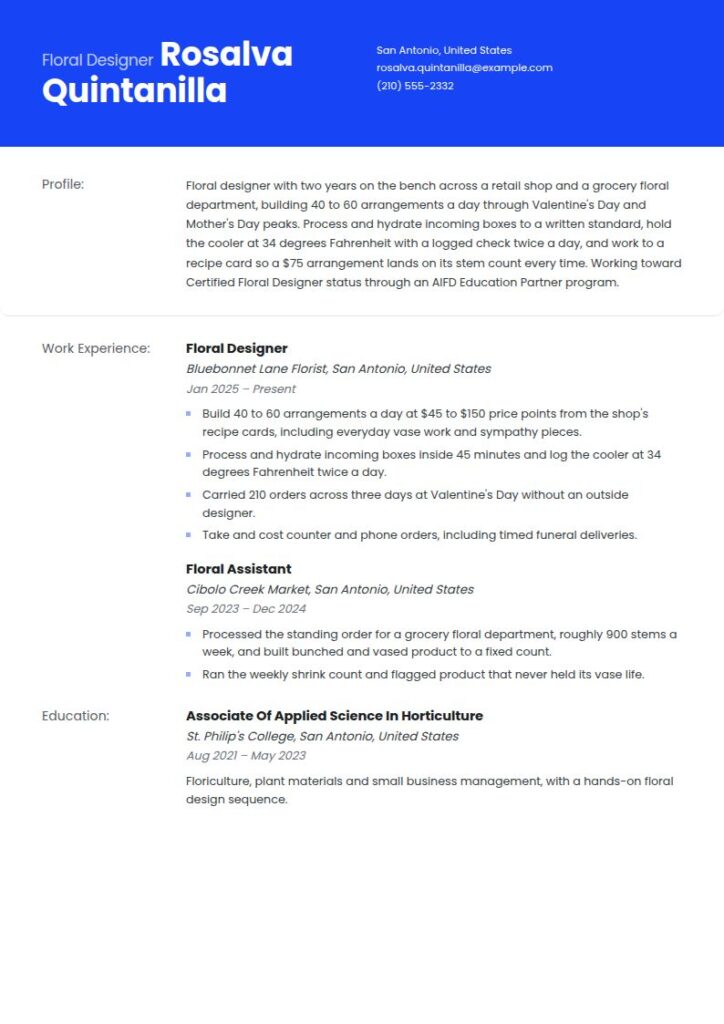
Floral Designer Rosalva Quintanilla
Floral Designer
[email protected] | (210) 555-2332 | San Antonio, United States
Profile
Floral designer with two years on the bench across a retail shop and a grocery floral department, building 40 to 60 arrangements a day through Valentine's Day and Mother's Day peaks. Process and hydrate incoming boxes to a written standard, hold the cooler at 34 degrees Fahrenheit with a logged check twice a day, and work to a recipe card so a $75 arrangement lands on its stem count every time. Working toward Certified Floral Designer status through an AIFD Education Partner program.
Work Experience
01/2025 - Present, Floral Designer, Bluebonnet Lane Florist, San Antonio, United States
- Build 40 to 60 arrangements a day at $45 to $150 price points from the shop's recipe cards, including everyday vase work and sympathy pieces.
- Process and hydrate incoming boxes inside 45 minutes and log the cooler at 34 degrees Fahrenheit twice a day.
- Carried 210 orders across three days at Valentine's Day without an outside designer.
- Take and cost counter and phone orders, including timed funeral deliveries.
09/2023 - 12/2024, Floral Assistant, Cibolo Creek Market, San Antonio, United States
- Processed the standing order for a grocery floral department, roughly 900 stems a week, and built bunched and vased product to a fixed count.
- Ran the weekly shrink count and flagged product that never held its vase life.
Education
08/2021 - 05/2023, Associate of Applied Science, Horticulture, St. Philip's College, San Antonio, United States
Floriculture, plant materials and small business management, with a hands-on floral design sequence.
Skills
Everyday vase and container work, 80
Sympathy and casket work, 65
Flower processing and hydration, 85
Cold chain and cooler logging, 85
Recipe card build, 80
Wiring and taping, 65
Counter and phone order taking, 75
Languages
English, native
Spanish, native
Certificates
05/2024, Floral design program, AIFD Education Partner, American Institute of Floral Designers Education Partner
Coursework completed; working toward Certified Floral Designer status.
Summary
A floral designer resume is a one to two page document that shows you can hit a recipe and a margin on a product that loses value every day. This guide gives you three adaptable versions, the recipe and cost of goods block almost nobody writes, the AIFD credentials a shop owner can check, and current Bureau of Labor Statistics pay and outlook.
Floral Designer resume examples by experience level
In short, a floral designer resume is a one to two page document that shows you can hit a recipe and a margin, not that you have an eye for flowers.
After all, everyone on the shortlist has an eye for flowers. The person reading your file has a wholesale invoice on the desk, a cooler of product worth less tomorrow than today, and a van that has to reach a funeral home before the family does. Instead, what they buy is repeatability: the same arrangement, at the same price, with the same cost inside it, on the fourteenth of February as on a quiet Tuesday.
Resume guide for a floral designer resume
In particular, this guide and the corresponding floral designer resume example will cover:
- How to write a floral designer resume, section by section
- How to state a recipe, a stem count and a cost of goods percentage
- Three adaptable summaries: bench designer, lead designer and studio owner
- What the AIFD credentials are worth and what they require
- What the job market looks like and what you can expect to earn
How to write a floral designer resume
Six sections: contact header, summary, recipe and margin block, design experience, skills and mechanics, then education and certifications. Use one page for your first five years, then two once you run a bench or carry events. Therefore, the order follows the owner's questions: what can you build unsupervised, at what price, how fast, and at what cost.
| Section | What it is answering | Where it goes |
|---|---|---|
| Recipe and margin | Can this person hit a price point with a known cost inside it? | Directly under the summary |
| Design experience | What volume, at what price points, through which peaks? | Reverse chronological, with counts |
| Education and certifications | Anything an owner or customer can verify? | Short, at the foot, credential dated |
Put a price point and a stem count in the first four lines
A shop owner wants to know what you can build alone, at what price, and how fast. Write it as a specification: "build 40 to 60 arrangements a day at $45 to $150 price points, to a recipe card, holding fresh cost of goods at 32 percent of retail".
Then add the peak: "carried 210 orders across three days at Valentine's Day without bringing in an outside designer" gets read twice, because holiday peaks are when a shop makes its year.
Run the finished file through the ATS resume checker first: grocery chains and larger floral groups parse applications before a person opens them, and a two-column template with a flower motif behind the text is where that breaks.
Choosing the best resume format for a floral designer resume
Go reverse chronological; in addition, promote the recipe and margin block above experience. Unlike most creative occupations, this one has employers to apply to: BLS puts 55 percent of floral designers in florists and 19 percent in grocery and specialty food retailers, against 14 percent self-employed (BLS Occupational Outlook Handbook, floral designers, page last modified 27 August 2026). Dates and employers matter here, so a functional format reads as a timeline worth hiding.
Include your contact information
| ✅ Right | ❌ Wrong |
|---|---|
| Rosalva Quintanilla | Rosalva Quintanilla |
| Floral Designer: everyday, sympathy, wedding and event | Creative floral artist with a love of flowers |
| Certified Floral Designer, American Institute of Floral Designers | AIFD certified |
| (210) 555-2332, [email protected] | (210) 555-2332, [email protected] |
Also name the categories you take work in, because everyday counter, sympathy, weddings and corporate installations run at four different speeds. Similarly, write the credential in full, because "AIFD certified" is not a thing: the American Institute of Floral Designers issues Certified Floral Designer status and, separately, accredited membership.
Make use of a summary
Keep it to four lines: what you build, at what volume and price point, the margin discipline you hold, and, above all, one number or credential that de-risks hiring you.
Floral designer with two years on the bench across a retail shop and a grocery floral department, building 40 to 60 arrangements a day through Valentine's Day and Mother's Day peaks. Process and hydrate incoming boxes to a written standard, hold the cooler at 34 degrees Fahrenheit with a logged check twice a day, and work to a recipe card so a $75 arrangement lands on its stem count every time. Working toward Certified Floral Designer status through an AIFD Education Partner program.
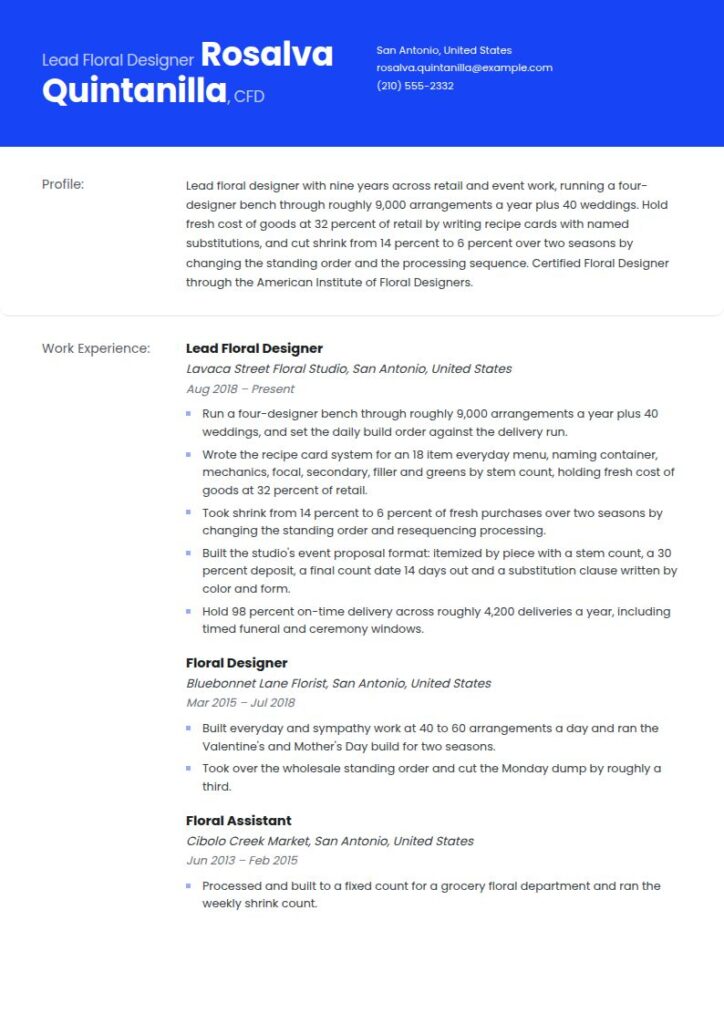
Lead floral designer with nine years across retail and event work, running a four-designer bench through roughly 9,000 arrangements a year plus 40 weddings. Hold fresh cost of goods at 32 percent of retail by writing recipe cards with named substitutions, and cut shrink from 14 percent to 6 percent over two seasons by changing the standing order and the processing sequence. Certified Floral Designer through the American Institute of Floral Designers.
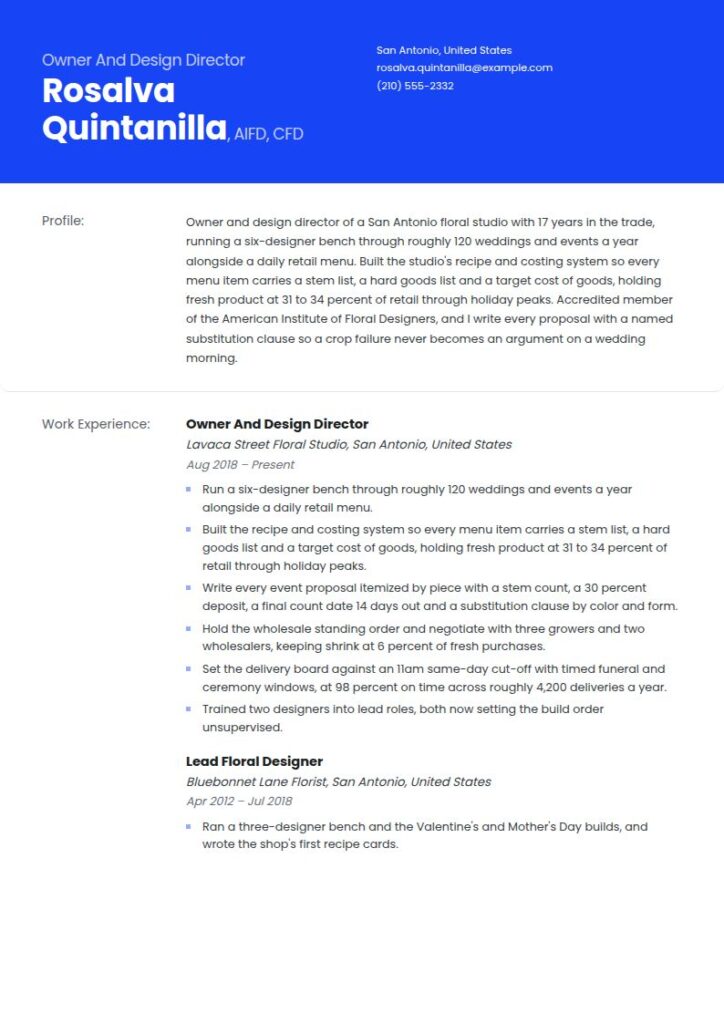
Owner and design director of a San Antonio floral studio with 17 years in the trade, running a six-designer bench through roughly 120 weddings and events a year alongside a daily retail menu. Built the studio's recipe and costing system so every menu item carries a stem list, a hard goods list and a target cost of goods, holding fresh product at 31 to 34 percent of retail through holiday peaks. Accredited member of the American Institute of Floral Designers, and I write every proposal with a named substitution clause so a crop failure never becomes an argument on a wedding morning.
Right vs wrong: the same floral designer summary, twice
| ✅ Right | ❌ Wrong |
|---|---|
| Build 40 to 60 arrangements a day at $45 to $150 price points, to a recipe card. | Creative designer with a natural eye for color and form. |
| Hold fresh cost of goods at 32 percent of retail across the everyday menu. | Experienced in working with a wide variety of flowers. |
| Carried 210 orders across three days at Valentine's Day with no outside help. | Able to work well under pressure during busy periods. |
The right column, for example, can be checked against an invoice. The left column, on the other hand, is what every other applicant wrote.
Outline your floral design experience
Shop, role, city and dates, then the remit in one line, then three to five bullets, each with a volume or a number that moved.
| Instead of | Use |
|---|---|
| Created beautiful floral arrangements for customers | Built 40 to 60 arrangements a day at $45 to $150 price points from recipe cards |
| Helped with weddings and events | Designed and installed 40 weddings a year, 12 to 300 guests, including four full-venue installs |
| Worked during busy holidays | Carried 210 orders across three days at Valentine's Day, all inside the quoted window |
Lead Floral Designer, Lavaca Street Floral Studio, San Antonio, TX, August 2018 to Present. Everyday retail menu, sympathy work, weddings and corporate installations.
Run a four-designer bench through roughly 9,000 arrangements a year plus 40 weddings, and set the daily build order against the delivery run.
Wrote the recipe card system for an 18 item menu, naming container, mechanics, focal, secondary, filler and greens by stem count, holding fresh cost of goods at 32 percent of retail.
Took shrink from 14 percent to 6 percent of fresh purchases over two seasons by changing the standing order and resequencing processing, and built the studio's event proposal format: itemized by piece with a stem count, a named substitution clause and a final count date 14 days out.
Write the recipe and the cost of goods
However, this is the block almost nobody includes, and it is the one that turns a folder of photographs into a hire.
In practice, a floral designer is paid to put a stated retail price on the counter with a known cost inside it, over and over, on a product that loses value from the day it arrives. In fact, six things sit inside that sentence, and all six belong on the page.
The recipe. A recipe card names the container, the mechanics, the focal flower, the secondary, the filler and the greens, each with a count against it, plus sundries and design minutes. Say how many menu items you have written: an owner reading "18 item menu, each with a recipe card and a target cost" knows the bench produces the same $75 vase whoever builds it.
The cost of goods. Writing in Florists' Review on 15 January 2024, Nita Robertson, AIFD, CFD, sets out the arithmetic most shops run on: fresh product marked up 3.5 times wholesale, hard goods 2.5 times, and a design labor charge of 25 percent, which turns $20 of fresh flowers and $10 of hard goods into a $118.75 retail price. The same article quotes the accountant Paul Goodman, CPA, that total cost of goods sold for fresh arrangements in a typical flower shop "should be no more than 30 percent to 35 percent of the retail price" (Florists' Review, 15 January 2024). That is the number an owner checks on the last day of the month.
Shrink. Shrink is what you bought and did not sell, and it is the fastest number a new designer can move. State it as a percentage of fresh purchases, say how you measured it, and say what you changed: the standing order, the processing sequence, or a menu item retired because its focal never lasted the week.
Processing, cold chain and delivery windows
Processing and the cold chain. The Oklahoma Cooperative Extension Service fact sheet on the care and handling of cut flowers tells you to hold storage at 32 to 35 degrees Fahrenheit, notes that flowers held at 41 degrees may deteriorate as much as four times faster than those held at 32, and says uptake "is enhanced by acidic (pH 3 to 4) and warm" water at about 110 degrees Fahrenheit after an inch is cut from the stem end under water (Oklahoma Cooperative Extension Service, fact sheet HLA-6426, Dole and Schnelle, retrieved 17 September 2026). Put the clock on the page: minutes from the box hitting the floor to the stems being in solution, and whether the cooler is logged.
Delivery windows. Floral delivery is a deadline problem, not a courier problem: a casket spray has to reach the funeral home before the family does, a hospital delivery ahead of a discharge, and a wedding install inside a venue access window that is often 90 minutes long. State your same-day cut-off, your delivery volume and your on-time rate.
Wedding proposals and substitution clauses
The wedding proposal and its substitution clause. Event work carries the margin and the worst losses, and a proposal reading "bridal bouquet, $400" is an argument waiting to happen. Itemize by piece with a stem count, state the deposit and the final count date, name the delivery, install and breakdown windows, and say who returns the rentals. Then write the substitution clause by color and form rather than by variety: "garden roses in blush, substituted by color and form if the crop fails, never by reducing stem count." That sentence is the difference between a phone call and a refund.
Everyday menu: 18 items from $45 to $150, each with a recipe card naming container, mechanics, focal, secondary, filler and greens by stem count.
Cost of goods: fresh held at 32 percent of retail, hard goods at 26 percent, measured monthly against the wholesale invoice.
Shrink: 6 percent of fresh purchases, down from 14 percent, counted in, sold and dumped every Monday.
Cold chain: boxes cut, hydrated and in the cooler inside 45 minutes; cooler held at 34 degrees Fahrenheit and logged twice a day.
Delivery: 11am same-day cut-off, timed funeral and ceremony windows, 98 percent on time across roughly 4,200 deliveries a year.
Events: itemized proposals with a stem count per piece, a substitution clause by color and form, a 30 percent deposit and a final count date 14 days out.
Six lines, six questions an owner has been burned on before.
Build a snapshot of your key skills
In practice, list ten to fourteen entries in three groups: what you build, the mechanics you own, and the commercial systems the shop runs on.
Design: Everyday vase and container work, Sympathy and casket work, Bridal bouquets, Ceremony and reception installation
Mechanics and product: Foam-free mechanics, Armature and chicken wire, Wiring and taping, Processing and hydration, Cold chain and cooler logging, Product knowledge across roses, hydrangea and seasonal locals
Commercial: Recipe card writing and costing, Cost of goods tracking, Shrink measurement, Standing order and wholesale buying, Event proposals and substitution clauses
List your education and certifications
Finally, keep it short, at the foot, and weighted toward what an owner can verify. Floral design is not licensed, and BLS gives the typical entry-level education as a high school diploma or equivalent with moderate-term on-the-job training (BLS Occupational Outlook Handbook, floral designers, 27 August 2026), so a checkable credential carries unusual weight.
Accredited Member, American Institute of Floral Designers, 2021. Continuing education current.
Certified Floral Designer, American Institute of Floral Designers, 2016.
Associate of Applied Science, Horticulture, St. Philip's College, San Antonio, TX, 2011. Floral design program, AIFD Education Partner, 2015.
Other: Texas driver license, class C, clean record.
Specifically, the American Institute of Floral Designers runs the two credentials a shop owner can look up, but they are not the same thing.
First, Certified Floral Designer is the entry credential. One route is coursework at an AIFD Education Partner, a state association or a student chapter, then an online test on The AIFD Guide to Floral Design passed at 80 percent or better, for a $179 exam fee. Also, Certified Floral Designers pay annual dues of $234, or $184 at the early rate, and earn 25 continuing education units every three years (American Institute of Floral Designers, retrieved 17 September 2026).
Accredited membership, on the other hand, is the harder one, and you earn it in a room with a knife in your hand. Candidates sit the Professional Floral Design Evaluation, described by AIFD as "a four (4) hour hands-on design evaluation consisting of five (5) designs", scored on line, color, balance, proportion, dominance, contrast, rhythm, unity, mechanics and creativity. An automatic invitation then requires "a cumulative score of 20.0 (4.0 average) with no individual design scoring below 3.75". Similarly, accredited members earn 30 continuing education units every five years, five in service and leadership (American Institute of Floral Designers, retrieved 17 September 2026).
Write each credential with its year and whether your continuing education is current. A lapsed credential written as if it were live can cost you the job.
Choose the right layout and design
Above all, use a single column, plain type at 11 or 12 point, no photograph of yourself and no flower images behind the text. This is the one document where making it a design object works against you, because the pictures belong in a gallery and the resume has to survive being parsed and printed in black and white.
State your daily build volume and the price points you build to. Give a cost of goods percentage and say how it was measured. Name the holiday peaks you carried and the order count. Say what your cooler is held at. Write the AIFD credential in full with its year.
Do not write "creative" or "artistic" as a skill; every applicant wrote it. Do not say "worked with flowers" when the variety list and the mechanics prove you can work unsupervised. Do not put images behind the text. Do not list a lapsed credential without saying it lapsed. Do not claim event experience without a piece count and an install window.
Floral designer job market and outlook
Overall, it is a shrinking occupation inside a large industry: the U.S. Department of Agriculture put the total value of floriculture crop sales at $6.71 billion in 2024, while cut flowers came to $414.0 million, across 11,262 producers (USDA National Agricultural Statistics Service, Floriculture Crops 2024 Summary, released February 2026).
| Measure | Value |
|---|---|
| Floral designers employed, 2025 | 45,200 |
| Projected employment, 2035 | 42,700 |
| Projected change, 2025-35 | -6% (decline), -2,500 jobs |
| Projected annual openings | ~5,200 |
| Typical entry-level education | High school diploma or equivalent |
| Median annual wage, May 2025 | $37,360 |
Source: U.S. Bureau of Labor Statistics, Occupational Outlook Handbook, floral designers, page last modified 27 August 2026, May 2025 wage data and 2025 to 2035 projections.
A declining occupation with 5,200 openings a year is a replacement market
BLS projects floral designer employment falling from 45,200 in 2025 to 42,700 in 2035, a change of -6 percent and -2,500 jobs, while still projecting about 5,200 openings a year on average over the decade (BLS Occupational Outlook Handbook, floral designers, page last modified 27 August 2026). Both are true at once because almost every opening is a replacement: shops refill a bench when someone leaves the trade, and very few add a seat.
That changes what your resume has to do. In a growing occupation you argue that you would be a good addition. In a replacement market you are measured against the person who just left, and the owner's question is how fast the bench gets back to full output. So write for continuity: build volume, price points, the peaks you carried, and the margin discipline that keeps the numbers steady while you learn the shop.
Next, here is where the jobs sit, and what those settings pay:
| Setting | Share of employment | Median annual wage (May 2025) |
|---|---|---|
| Florists | 55% | $36,870 |
| Grocery and specialty food retailers | 19% | $38,760 |
| Self-employed workers | 14% | Not published |
| Wholesale trade | 4% | $40,530 |
| Lawn and garden equipment and supplies retailers | 1% | $37,650 |
Source: U.S. Bureau of Labor Statistics, Occupational Outlook Handbook, floral designers, May 2025.
About 10 percent separates the highest of those rows from the lowest, so employer type is not the lever here. What you are responsible for is.
What salary you can expect as a floral designer
In fact, the median annual wage for floral designers was $37,360 a year, or $17.96 an hour, as of May 2025. The lowest 10 percent earned less than $28,600 and the highest 10 percent more than $51,000 (BLS Occupational Outlook Handbook, floral designers, page last modified 27 August 2026).
Meanwhile, the tenth to ninetieth percentile spread is about $22,400, and the four published industry medians sit inside a $3,700 band. Therefore, a resume cannot argue across a gap that small on design ability. What moves money is scope.
Buying. A designer who writes the standing order and negotiates with wholesalers is doing a different job. Say if you hold it, and what shrink did while you did.
Events. Weddings and installations carry the margin and the risk. Piece counts, install windows, crew size and the substitution clause are the evidence that you can be trusted with a $12,000 booking, not a $75 vase.
The AIFD credentials. They are the only part of this resume a stranger can verify in thirty seconds.
Key takeaways for a floral designer resume
- First, lead with the recipe and the margin: build volume, price points, cost of goods.
- Then give a shrink number, say how you measured it and what you changed.
- Also put the cold chain on the page: processing time and the cooler temperature.
- Next, state delivery cut-off, timed windows and on-time rate instead of "delivered flowers".
- In addition, itemize event work by piece count, install window and substitution clause.
- Write the AIFD credential in full with its year and whether education is current.
- Finally, keep the file single column, and leave the photographs in the gallery.
Build your floral designer resume in 15 minutes with our AI resume builder.
Related creative and artistic resume examples
- Wedding photographer resume
- Jewelry designer resume
- Fashion designer resume
- Visual artist resume
- Artist resume
- Illustrator resume
- Photographer resume
- Costume designer resume
- Tailor resume
- Landscape designer resume
- Tattoo artist resume
- Stage manager resume
Pair it with a matching floral designer cover letter.
Floral designer resume questions, answered
How long should a floral designer resume be?
One page for your first five years on the bench. Two once you run a bench, hold the buying, or carry an event book worth itemizing.
Do I need an AIFD credential to get hired as a floral designer?
No. Floral design is not licensed, and BLS gives the typical entry-level education as a high school diploma or equivalent with moderate-term on-the-job training (BLS Occupational Outlook Handbook, floral designers, page last modified 27 August 2026). But because little else on the page is verifiable by a stranger, Certified Floral Designer status and accredited membership in the American Institute of Floral Designers do unusual work here.
What do I put on a floral designer resume with no shop experience?
Anything with a count in it: grocery floral work, a farm stand, a farmers market table, wedding freelancing, or a course with a hands-on component. Write what you built, how many, at what price, and what you did with the product before you built it. Processing and hydration is half the job, so a candidate who describes the cold chain accurately reads as trained.
Should I put photographs on my floral designer resume?
No. Link one plain-text portfolio URL in the header. Images embedded in a resume are compressed by parsers and print badly in black and white. Keep the gallery current.
Does grocery floral department work count as real experience?
Yes. Nineteen percent of floral designers work in grocery and specialty food retailers, and that setting has a higher published median than florists do, at $38,760 against $36,870 (BLS Occupational Outlook Handbook, floral designers, May 2025). Grocery teaches volume, standing orders, shrink and speed, which is what a florist wants to know you can handle.