Licensed Tattoo Artist Ondine Leclerc
Tattoo Artist, 50/50 split
[email protected] | (503) 555-1563 | Portland, United States
Profile
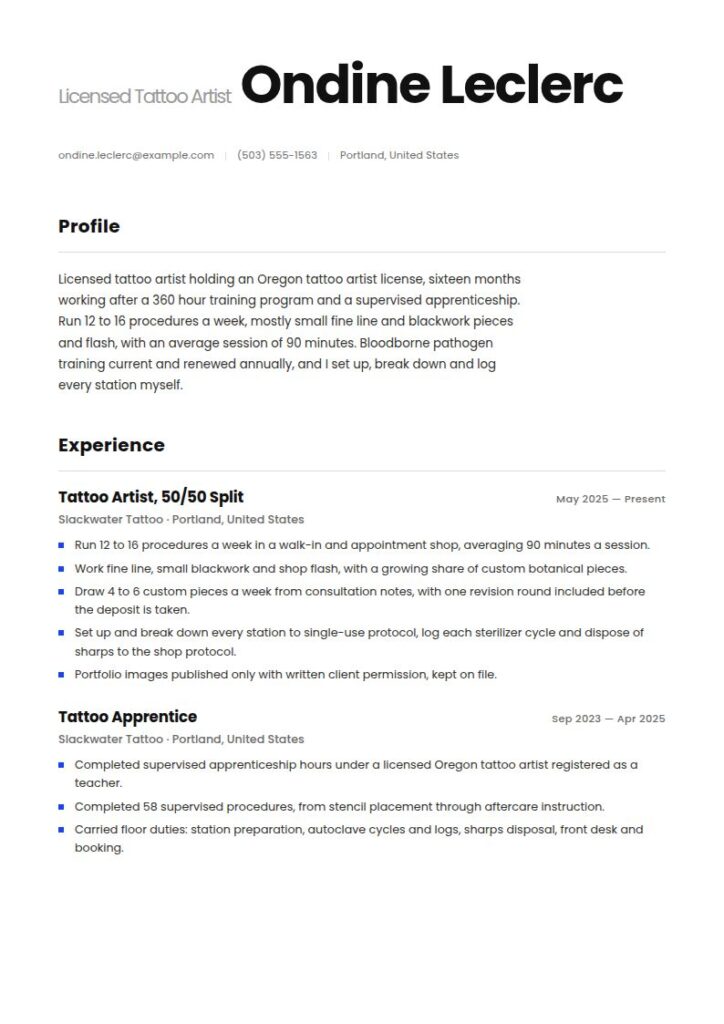
Licensed tattoo artist holding an Oregon tattoo artist license, sixteen months working after a 360 hour training program and a supervised apprenticeship. Run 12 to 16 procedures a week, mostly small fine line and blackwork pieces and flash, with an average session of 90 minutes. Bloodborne pathogen training current and renewed annually, and I set up, break down and log every station myself.
Work Experience
05/2025 - Present, Tattoo Artist, 50/50 split, Slackwater Tattoo, Portland, United States
- Run 12 to 16 procedures a week in a walk-in and appointment shop, averaging 90 minutes a session.
- Work fine line, small blackwork and shop flash, with a growing share of custom botanical pieces.
- Draw 4 to 6 custom pieces a week from consultation notes, with one revision round included before the deposit is taken.
- Set up and break down every station to single-use protocol, log each sterilizer cycle and dispose of sharps to the shop protocol.
- Portfolio images published only with written client permission, kept on file.
09/2023 - 04/2025, Tattoo Apprentice, Slackwater Tattoo, Portland, United States
- Completed supervised apprenticeship hours under a licensed Oregon tattoo artist registered as a teacher.
- Completed 58 supervised procedures, from stencil placement through aftercare instruction.
- Carried floor duties: station preparation, autoclave cycles and logs, sharps disposal, front desk and booking.
Education
01/2023 - 08/2023, Tattooing Program, 360 hours, Tattooing, 210 theory and 150 practical, Cascade Body Art Institute, Portland, United States
Oregon tattoo artist license #OR-TA-20714 issued May 2025 after the written examination.
Skills
Fine line, 80
Blackwork and solid fill, 70
Flash sheet development, 75
Stencil design and placement, 80
Single-use setup and breakdown, 90
Sterilizer operation and cycle logging, 90
Consultation and written consent process, 75
Languages
English, native
French, intermediate
Certificates
05/2025, Tattoo Artist License, Oregon Health Authority, Health Licensing Office, OR-TA-20714
Issued after 360 hours of training, 50 supervised procedures and the written examination.
04/2026, Bloodborne Pathogens, Cascade Body Art Institute
Renewed annually, compliant with 29 CFR 1910.1030.
02/2026, First Aid and CPR, American Red Cross
Summary
A tattoo artist resume is a one page document that points at a portfolio, names the state or county license and shop permit you hold, and states your bloodborne pathogen training and single-use practice. This guide gives you three adaptable versions, the privacy rule that protects your clients, and what published wage data can and cannot tell you about this job.
Tattoo Artist resume examples by experience level
A tattoo artist resume is a one page document whose real job is to get someone to open your portfolio, and whose second job is to prove you may legally work.
The art decides whether a studio wants you. The license, the permit and the bloodborne pathogen certificate decide whether they can have you. A file showing one without the other fails in a different way each time.
Resume guide for a tattoo artist resume
This guide and the corresponding tattoo artist resume example will cover:
- How to write a tattoo artist resume, section by section
- What the portfolio must show, and what must never appear in it
- Three adaptable summaries: apprentice-trained, resident artist and studio owner
- Licensing, permits and the bloodborne pathogen rule that sits under all of it
- Why no single published occupation matches this job, and what to use instead
How to write a tattoo artist resume
Five blocks: contact header with the portfolio link, summary, license and health credentials, studio history with styles and volume, and training including the apprenticeship. One page, because the portfolio is the long document. Put the link in the header, not at the end; a studio manager who has to hunt for it will not hunt.
| Section | What it is answering | Where it goes |
|---|---|---|
| Portfolio link | Is the work good enough to put on my wall? | Header, once, as a plain URL |
| License and permit | May this person legally tattoo in my county on Friday? | Directly under the summary |
| Bloodborne pathogen training | Is the certificate current, and who issued it? | With the license, with its date |
| Styles and volume | Which of my walk-ins and bookings can I hand them? | Inside each studio entry |
Run the finished file through the ATS resume checker before you send it. Larger studio groups and convention organizers increasingly collect applications through a form that parses the file first.
Choosing the best resume format
Reverse chronological, one page. The exception is a first application out of an apprenticeship, where the apprenticeship is the spine of the page and deserves the space a job would get.
Do not build a visual resume. It is tempting here and it is a mistake: the portfolio already carries the visual argument, and a designed two column page is what breaks in a parser and prints badly when a studio pins it to a board.
Include your contact information
| ✅ Right | ❌ Wrong |
|---|---|
| Ondine Leclerc | Ondine Leclerc |
| Licensed Tattoo Artist, Oregon #OR-TA-20714 | Ink slinger and creative soul |
| Fine line, blackwork, illustrative color, botanical, cover-up work | Custom tattoos, all styles welcome |
| (503) 555-1563, [email protected], Portland, OR | (503) 555-1563, [email protected] |
"All styles" reads as no styles. Name four or five and let the portfolio prove them. A studio is looking for work that fits the wall and fills a gap on it.
Make use of a summary
Four lines: license and state, years tattooing, the styles that make up most of your week, and one volume number with a period attached.
Licensed tattoo artist holding an Oregon tattoo artist license, sixteen months working after a 360 hour training program and a supervised apprenticeship. Run 12 to 16 procedures a week, mostly small fine line and blackwork pieces and flash, with an average session of 90 minutes. Bloodborne pathogen training current and renewed annually, and I set up, break down and log every station myself.
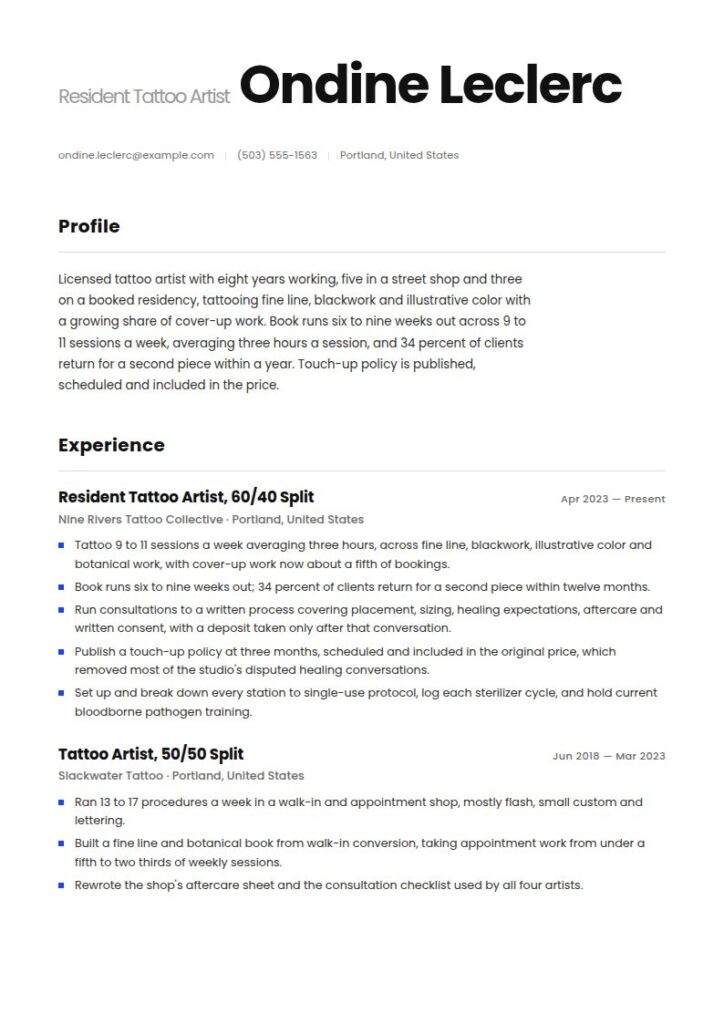
Licensed tattoo artist with eight years working, five in a street shop and three on a booked residency, tattooing fine line, blackwork and illustrative color with a growing share of cover-up work. Book runs six to nine weeks out across 9 to 11 sessions a week, averaging three hours a session, and 34 percent of clients return for a second piece within a year. Touch-up policy is published, scheduled and included in the price.
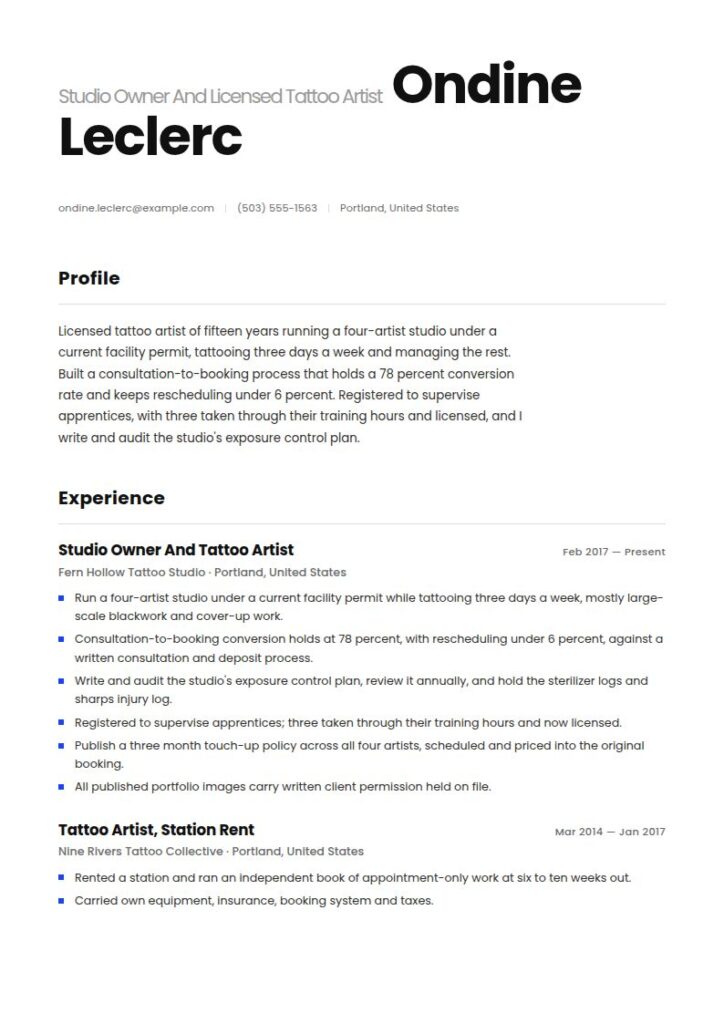
Licensed tattoo artist of fifteen years running a four-artist studio under a current facility permit, tattooing three days a week and managing the rest. Built a consultation-to-booking process that holds a 78 percent conversion rate and keeps rescheduling under 6 percent. Registered to supervise apprentices, with three taken through their training hours and licensed, and I write and audit the studio's exposure control plan.
Right vs wrong: the same tattoo artist summary, twice
| ✅ Right | ❌ Wrong |
|---|---|
| Eight years working, five in a street shop and three on a booked residency. | Experienced artist with a passion for the craft and the culture. |
| Fine line, blackwork and illustrative color, with a growing share of cover-up work. | Versatile artist comfortable with any style a client wants. |
| Book runs six to nine weeks out across 9 to 11 sessions a week. | Busy artist with a long waiting list. |
The right column tells a studio owner what to put on the schedule. The left tells them nothing they cannot assume about every applicant.
Outline your experience
Studio, city, arrangement, dates. Then three to five bullets, each naming a style, a process or a volume and carrying a number. Say whether you were employed, on a percentage split or renting a station in the entry itself; it changes what the numbers mean and it is the first thing you will be asked.
| Instead of | Use |
|---|---|
| Tattooed clients in a busy studio | Ran 9 to 11 sessions a week averaging three hours, across fine line, blackwork and illustrative color |
| Created custom designs | Drew 6 to 8 custom pieces a week from consultation notes, with one revision round built into the price |
| Maintained a clean workspace | Set up and broke down every station single-use, logged the autoclave cycle, and disposed of sharps to the shop protocol |
| Good with clients | Ran consultations to a written process: placement, sizing, healing expectations, aftercare and consent, before a deposit was taken |
| Built a following | Book runs six to nine weeks out; 34 percent of clients return for a second piece within a year |
Resident Tattoo Artist, 60/40 split, Nine Rivers Tattoo Collective, Portland, OR, April 2023 to Present
Tattoo 9 to 11 sessions a week averaging three hours, across fine line, blackwork, illustrative color and botanical work, with cover-up work now about a fifth of bookings.
Book runs six to nine weeks out; 34 percent of clients return for a second piece within twelve months.
Run consultations to a written process covering placement, sizing, healing expectations, aftercare and written consent, with a deposit taken only after that conversation.
Publish a touch-up policy at three months, scheduled and included in the original price, which removed most of the studio's disputed healing conversations.
Set up and break down every station to single-use protocol, log each sterilizer cycle, and hold current bloodborne pathogen training.
The portfolio and the permit, in that order
Two things get an artist hired and neither is a bullet point: a portfolio that shows what you can actually do, sequenced deliberately, and proof that a health authority has cleared you to do it. The resume is the short document carrying you between them.
What the portfolio has to show
Twenty to thirty pieces, not two hundred. Lead with the style you want to be booked for rather than the one you are best at: a portfolio is a booking argument, not a retrospective. Show healed work as well as fresh, because fresh work flatters everyone and healed work is what an owner is really assessing. Add a few process images: the drawing, the stencil placement, the finished piece. Keep it on one link, because a studio manager will open one URL and not chase a second.
What must never appear in it, and why to say so
Never post or describe a client in a way that identifies them. A tattoo sits on someone's body, and the photograph proving your line work also carries a person's skin, other tattoos, sometimes a face.
Get written permission before you publish anything, keep it on file, and describe your work by style, volume and process rather than by the person wearing it. A short line on the page, "portfolio images published with written client permission," is unusual enough to be noticed and tells an owner you will not create a problem for them. The same rule holds in the bullets: write "large-scale cover-up over existing work across a full forearm, four sessions," never the person or their story.
The permit layer, which is public health rather than art
Tattoo regulation in the United States is health regulation, administered by states and counties rather than by any art or design body, and it varies sharply.
Oregon licenses individual artists through the Health Licensing Office's Board of Electrologists and Body Art Practitioners. An applicant must be at least 18, complete 360 hours of training split as 210 theory and 150 practical under a licensed Oregon tattoo artist registered as a teacher at a one to one ratio, complete a minimum of 50 procedures, and pass a written examination of 100 multiple choice questions in 100 minutes at a 75 percent pass mark, with current bloodborne pathogen training compliant with 29 CFR 1910.1030 (Oregon Health Authority, retrieved 17 September 2026).
New York runs a different model. Public Health Law Article 4-A requires operators to hold a permit to operate and all tattoo and piercing artists to hold an individual permit, with local regulations applying until state regulations take effect. Practitioners wash their hands before tattooing and use single-use gloves, use single-use sterile needles and tubes and single-use inks, and cover the tattooed skin with a bandage and provide aftercare information. Tattooing a person under 18 violates Section 260.21 of the New York State Penal Law (New York State Department of Health, retrieved 17 September 2026).
Write yours the same way: the issuing authority, the license or permit number, the expiry, and whether the studio permit is yours or the building's. If you are writing for a move, say you will verify the receiving jurisdiction's rules rather than assume they match.
The apprenticeship is a credential, so write it as one
Most artists still enter through an apprenticeship and most resumes waste it in half a line. Write it as a job: the studio, the dates, the hours, the supervised procedures, what you were trusted to do alone and when, and your floor duties. In Oregon that structure is the licensing route itself, at 360 hours and 50 procedures under a registered teacher, so writing it out is not padding.
No published occupation is called tattoo artist
The Bureau of Labor Statistics Occupational Outlook Handbook publishes no profile for tattoo artists. The Arts and Design occupational group page lists art directors, craft and fine artists, fashion designers, floral designers, graphic designers, industrial designers, interior designers, special effects artists and animators, and set and exhibit designers, and nothing for tattooing (BLS Occupational Outlook Handbook, page last modified 27 August 2026).
The nearest published occupation is craft and fine artists, with a median of $55,290 a year or $26.58 an hour in May 2025, 53,400 jobs in 2025, a projected change of -1 percent and about 4,300 openings a year, and 58 percent of workers self-employed (same source).
That means nobody can quote you a national tattoo artist wage honestly. What can be said is where the surrounding occupations sit, which is what this page does in the market and salary sections below.
Build a snapshot of your key skills
Twelve to fourteen entries in three groups: application, design, and the health and business side. The third is the one studios read hardest and artists write worst.
Application: Fine line, Blackwork and solid fill, Illustrative color, Botanical and floral, Geometric and ornamental, Cover-up work, Whip shading, Single-needle work
Design and consultation: Custom drawing from consultation notes, Stencil design and placement, Sizing and flow to the body, Flash sheet development, Digital drawing on tablet, Written consultation and consent process
Health and business: Single-use setup and breakdown, Sterilizer operation and cycle logging, Sharps handling and disposal, Exposure control plan, Deposit and rescheduling policy, Booking system administration, Aftercare and touch-up policy
Sterilization and single-use practice, written the way an inspector reads it
This is the section most artists skip and most studio owners want. Write the practice as a procedure rather than as an adjective.
The federal anchor is the OSHA bloodborne pathogens standard at 29 CFR 1910.1030, which applies wherever there is occupational exposure, defined as reasonably anticipated skin, eye, mucous membrane or parenteral contact with blood or other potentially infectious materials. Under it the exposure control plan is reviewed and updated at least annually and whenever necessary to reflect new or modified tasks; hepatitis B vaccination is made available within 10 working days of initial assignment at no cost to the employee; training happens at initial assignment and at least annually thereafter; sharps containers are closable, puncture resistant, leakproof on sides and bottom, and labeled or color-coded; contaminated sharps are not bent, recapped or removed except as the standard allows; and a sharps injury log is established and maintained (29 CFR 1910.1030, retrieved 17 September 2026).
If you are self-employed there is no employer to write that plan for you, which is exactly why "maintain a written exposure control plan, reviewed annually" separates a resume. State and county rules sit on top of the federal standard and are stricter in places, so name yours.
List your education and certifications
License first with its authority and number, then bloodborne pathogen training with its date, then the program and apprenticeship, then anything in your own name.
Tattoo Artist License, Oregon Health Authority, Health Licensing Office, #OR-TA-20714, current
Bloodborne Pathogens certification, renewed annually, most recent 2026
Tattooing program, 360 hours (210 theory, 150 practical), Cascade Body Art Institute, Portland, OR, 2018
Apprenticeship, Slackwater Tattoo, Portland, OR, 2017 to 2018, 62 supervised procedures under a registered teacher
First aid and CPR, current. Continuing education: color theory for skin tones, 2025. Cover-up and re-work intensive, 2024.
Choose the right layout and design
Single column, plain type at 11 or 12 point, one portfolio link in the header, no images in the file, PDF unless a studio asks otherwise.
The instinct to design the resume is strong here and worth resisting. The visual argument is already made, at length, in the portfolio. This file only has to be legible in eight seconds on a phone in a studio with poor light.
Put the portfolio link in the header as a plain URL. Name the license, its authority and its number, and the expiry. Give the bloodborne pathogen certificate with its date. Name four or five styles rather than claiming all of them. Write the apprenticeship as a job, with hours and supervised procedures. Write your sterile setup as a procedure. State that portfolio images are published with written client permission.
Do not identify a client, name one, or describe a piece in a way that would identify the person wearing it. Do not use images inside the resume file. Do not claim a style your portfolio does not show. Do not quote another state's licensing rules as if they were national, because tattoo regulation is local. Do not describe healing, infection or aftercare as medical advice; write your policy and point clients to a clinician.
Tattoo artist job market and outlook
There is no published Bureau of Labor Statistics profile for tattoo artists, so this section brackets the role between the nearest published occupations rather than quoting a number that does not exist.
| Bracketing occupation | Employment, 2025 | Projected change, 2025-35 | Annual openings | Median annual wage, May 2025 |
|---|---|---|---|---|
| Craft and fine artists | 53,400 | -1 percent, -300 jobs | About 4,300 | $55,290 |
| Barbers, hairstylists and cosmetologists | 670,800 | 7 percent, 48,400 jobs | About 80,300 | $35,880 |
Source: U.S. Bureau of Labor Statistics, Occupational Outlook Handbook, May 2025 wage data and 2025 to 2035 projections, pages last modified 27 August 2026.
Those two are the honest neighbors. Craft and fine artists is the closest match for the work and shares its self-employment pattern, at 58 percent self-employed. The personal care and service group is where a tattoo studio sits as a business, with a group median of $36,410 a year against $50,980 for all occupations and about 714,700 openings a year. Graphic designers, at a median of $62,960, is where the drawing half of the job gets priced in a different market (all same source).
One figure inside the craft and fine artists profile is worth reading closely. Artists employed in personal care services had a median of $38,790 a year, against $49,100 in independent artists, writers and performers and $55,290 for the occupation overall (same source). The setting moves the number more than the skill does.
What salary you can expect as a tattoo artist
No national median exists for this job title, and quoting one would mean inventing it.
What the published data supports is a range and a shape. Craft and fine artists had a median of $55,290 a year in May 2025, the lowest 10 percent under $31,490 and the highest 10 percent over $131,810 (BLS Occupational Outlook Handbook, page last modified 27 August 2026). That spread, a factor of more than four, is the shape of self-employed creative income, and tattooing behaves the same way.
Three things move you inside it. The arrangement comes first: employed, on a percentage split, or renting a station and keeping everything above the rent. The book comes second, meaning how far out it runs and whether clients come back. The style you are known for comes third, because hourly and day rates cluster by what a studio can advertise rather than by years worked. Write those three onto the resume and a reader can place you; leave them off and they price you against the nearest published median, which is not your job.
Put the healed work in the portfolio
Fresh work photographs beautifully and proves very little. Line weight, saturation and how a piece settles into the skin only become visible once it has healed, and a studio owner reviewing portfolios knows that better than anyone.
Include healed images at three months or more for at least a third of the pieces you show, and say so in the caption. Very few applicants do, and the ones who do read as experienced immediately.
The same logic applies to the touch-up policy. Publishing one, and saying on the resume that it is scheduled and priced in, tells a studio you understand the part of the job that happens after the client leaves.
Key takeaways for a tattoo artist resume
- Put one portfolio link in the header, as a plain URL.
- Name the license or permit, its issuing authority, its number and its expiry.
- Give the bloodborne pathogen certificate with its date, and renew it annually.
- Name four or five styles rather than claiming all of them.
- Write the apprenticeship as a job, with hours and supervised procedures.
- Describe work by style, volume and process, never by the client.
- Write the sterile setup as a procedure, not as an adjective.
Build your tattoo artist resume in 15 minutes with our AI resume builder.
Related creative and artistic resume examples
- Illustrator resume
- Visual artist resume
- Artist resume
- Jewelry designer resume
- Barber resume
- Floral designer resume
- Photographer resume
- Fashion designer resume
- Costume designer resume
- Tailor resume
- Musician resume
- Choreographer resume
Pair it with a matching tattoo artist cover letter.
Tattoo artist resume questions, answered
How long should a tattoo artist resume be?
One page. The portfolio is the long document and the resume only has to get it opened, prove you may legally work, and show that you understand sterile practice.
Do I need a license to tattoo in the United States?
Requirements are set by states and counties, not nationally, and they differ sharply. Oregon requires 360 hours of training, 50 supervised procedures and a written examination (Oregon Health Authority, retrieved 17 September 2026). New York requires an individual artist permit alongside an operator permit under Public Health Law Article 4-A (New York State Department of Health, retrieved 17 September 2026). Check with the authority in the county you intend to work in.
What should I say about a client's tattoo on my resume?
Describe the work, never the person. "Large-scale cover-up over existing work across a full forearm, four sessions" is useful and safe. Anything naming a client, describing them, or letting a reader recognize them has no place on a resume or in a public portfolio. Get written permission before publishing any image and keep it on file.
How do I write a tattoo artist resume with no professional experience?
Write the apprenticeship as a job: the studio, the dates, the hours completed, the supervised procedures, what you were cleared to do alone and when, and the floor duties you carried. Then the license and the bloodborne pathogen certificate, then the styles your portfolio actually shows.
How much do tattoo artists earn?
There is no published national figure for the title, because the Occupational Outlook Handbook has no tattoo artist profile (page last modified 27 August 2026). The nearest published occupation, craft and fine artists, had a median of $55,290 a year in May 2025 with the lowest 10 percent under $31,490 and the highest 10 percent over $131,810 (same source). Your own number depends far more on the arrangement, the book and the style you are booked for than on any national median.
Should I include flash sheets in my portfolio?
Yes, in a separate labeled section. Flash shows range, speed and a consistent hand, and it is what a street shop books from on a Saturday. Keep custom work and flash apart so a studio sees both arguments without separating them itself.