Junior Videographer Nikhil Bhatt
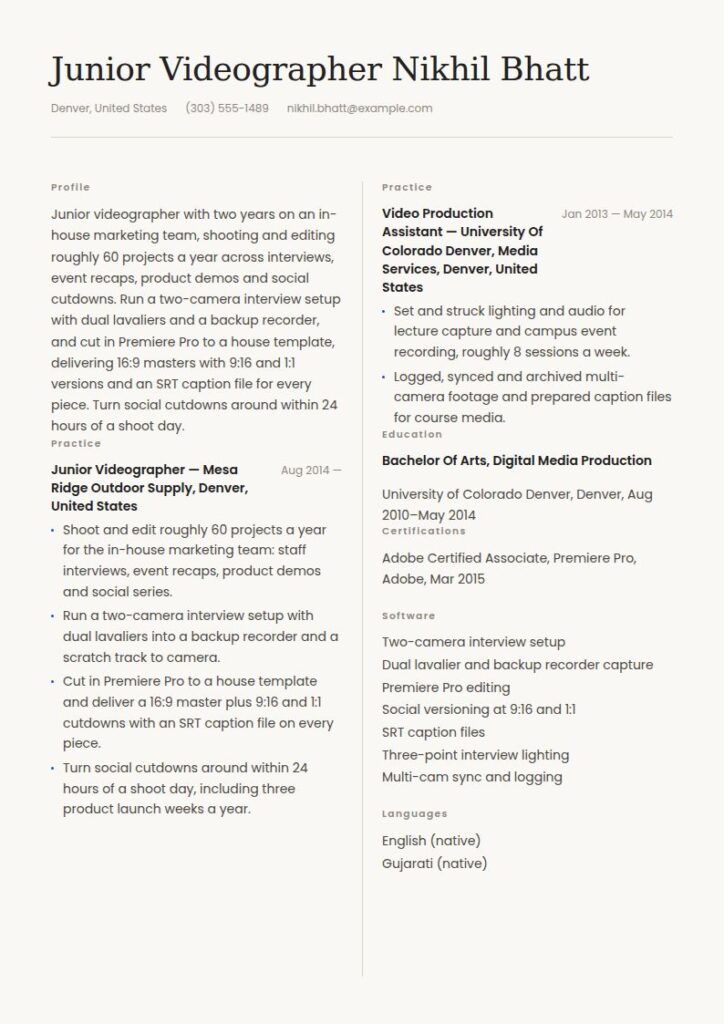
Junior Videographer
[email protected] | (303) 555-1489 | Denver, United States
Profile
Junior videographer with two years on an in-house marketing team, shooting and editing roughly 60 projects a year across interviews, event recaps, product demos and social cutdowns. Run a two-camera interview setup with dual lavaliers and a backup recorder, and cut in Premiere Pro to a house template, delivering 16:9 masters with 9:16 and 1:1 versions and an SRT caption file for every piece. Turn social cutdowns around within 24 hours of a shoot day.
Work Experience
08/2014 - Present, Junior Videographer, Mesa Ridge Outdoor Supply, Denver, United States
- Shoot and edit roughly 60 projects a year for the in-house marketing team: staff interviews, event recaps, product demos and social series.
- Run a two-camera interview setup with dual lavaliers into a backup recorder and a scratch track to camera.
- Cut in Premiere Pro to a house template and deliver a 16:9 master plus 9:16 and 1:1 cutdowns with an SRT caption file on every piece.
- Turn social cutdowns around within 24 hours of a shoot day, including three product launch weeks a year.
01/2013 - 05/2014, Video Production Assistant, University of Colorado Denver, Media Services, Denver, United States
- Set and struck lighting and audio for lecture capture and campus event recording, roughly 8 sessions a week.
- Logged, synced and archived multi-camera footage and prepared caption files for course media.
Education
08/2010 - 05/2014, Bachelor of Arts, Digital Media Production, University of Colorado Denver, Denver, United States
Coursework in cinematography, location sound, editing and media accessibility.
Skills
Two-camera interview setup, 80
Dual lavalier and backup recorder capture, 75
Premiere Pro editing, 80
Social versioning at 9:16 and 1:1, 85
SRT caption files, 80
Three-point interview lighting, 70
Multi-cam sync and logging, 75
Languages
English, native
Gujarati, native
Certificates
03/2015, Adobe Certified Associate, Premiere Pro, Adobe
Editing and workflow certification taken during the first year in the role.
Summary
A videographer resume is a one to two page document showing that you own every step of the chain: scripting, camera, location sound, edit, color, captions and delivery to spec. This guide gives you three adaptable versions, the kit and deliverable blocks that get you booked, and current Bureau of Labor Statistics pay and outlook for the published occupations the work sits between.
Videographer resume examples by experience level
In short, a videographer resume is a one to two page document showing that one person, or two, can carry a project from a phone call to a file that plays correctly on the client's channel.
That is the actual job description, and it is what makes this resume different from a camera resume. For example, a cinematographer runs one department inside a large crew. By contrast, a videographer runs the whole chain: the scoping call, the shot list, the camera, the lights, the microphones, the edit, the color, the graphics, the captions and the export settings. As a result, hiring you is a decision to not hire four people, and the resume has to make that decision look safe.
Resume guide for a videographer resume
In addition, this guide and the corresponding videographer resume example will cover:
- First, how to write a videographer resume, section by section
- Next, how to show that you own shoot, sound, edit and delivery
- In addition, three adaptable summaries: assistant, staff videographer and owner-operator
- Similarly, why deliverable specs and captions belong on the page
- Finally, what the job market looks like and what you can expect to earn
How to write a videographer resume
Six sections: contact header with a reel link, summary, the chain you own, project experience, kit and software, then education and certifications. As a rule, one page for your first few years, two once you are running your own client list and owning the schedule.
In practice, the order answers a marketing manager's questions in the order they arrive. First of all, can you do all of it. What have you made. On whose equipment. How fast.
| Section | What it is answering | Where it goes |
|---|---|---|
| The chain you own | For instance, which parts of this do I not have to hire separately? | Directly under the summary |
| Project experience | Finally, what have you made, for whom, at what volume? | Reverse chronological, with project counts |
| Kit and software | Do you arrive with everything, including sound? | Grouped, with audio listed separately |
| Turnaround and specs | When do I get it, and will it play where I need it? | Short, with the deliverable set named |
List the audio kit separately from the camera kit
The single most common failure on a one-person corporate shoot is sound, and every client who has been burned once knows it. A perfectly exposed interview with room noise, a rustling lavalier or a dead battery is unusable, and unlike a soft frame it cannot be fixed later.
So give sound its own line rather than folding it into a gear list. Two lavaliers with a backup recorder, a shotgun on a boom, a scratch track to camera, and headphones monitored on every take is four facts that a marketing manager who has sat through a bad edit will read twice.
Then say how you handle it on a two-camera interview: which mic is the primary, where the backup records, and how you sync. That is the paragraph that separates a videographer from somebody with a nice camera.
Run the finished file through the ATS resume checker before you send it. However, corporate, agency and in-house video posts are collected through parsing systems, and motion-graphic resume templates are exactly what those systems fail on.
Choosing the best resume format for a videographer resume
In general, reverse chronological, with a capability block promoted above employment history. Thirty-five percent of film and video editors and 35 percent of camera operators are self-employed (BLS Occupational Outlook Handbook, film and video editors and camera operators, page last modified 27 August 2026), and most videographers sit in that group with a long client list and a short employer list.
A functional format is tempting here because the work genuinely is a set of skills, and it still fails. The reader is testing whether you have delivered repeatedly under deadline, and that is a question about dates and counts. Keep the reel separate and give it one short URL, because the reel is watched first and the resume is opened to find out how it was made and how long it took.
Include your contact information
| ✅ Right | ❌ Wrong |
|---|---|
| Nikhil Bhatt | Nikhil Bhatt |
| Videographer: shoot, location sound, edit, delivery to spec | Creative video professional and visual storyteller |
| Reel: nikhilbhatt.example.com | Reel available on request |
| Owner-operated kit including two-camera interview and audio package | Professional equipment available |
| (303) 555-1489, [email protected], Denver, CO | (303) 555-1489, [email protected] |
Therefore, say "shoot, sound, edit" in the title line. Half the people hiring a videographer have previously hired someone who only shot, then discovered they needed an editor, and the phrase answers the question that made them cautious.
Make use of a summary
Overall, four lines: what you produce, at what volume, which parts of the chain you own, and the turnaround you hold.
Junior videographer with two years on an in-house marketing team, shooting and editing roughly 60 projects a year across interviews, event recaps, product demos and social cutdowns. Run a two-camera interview setup with dual lavaliers and a backup recorder, and cut in Premiere Pro to a house template, delivering 16:9 masters with 9:16 and 1:1 versions and an SRT caption file for every piece. Turn social cutdowns around within 24 hours of a shoot day.
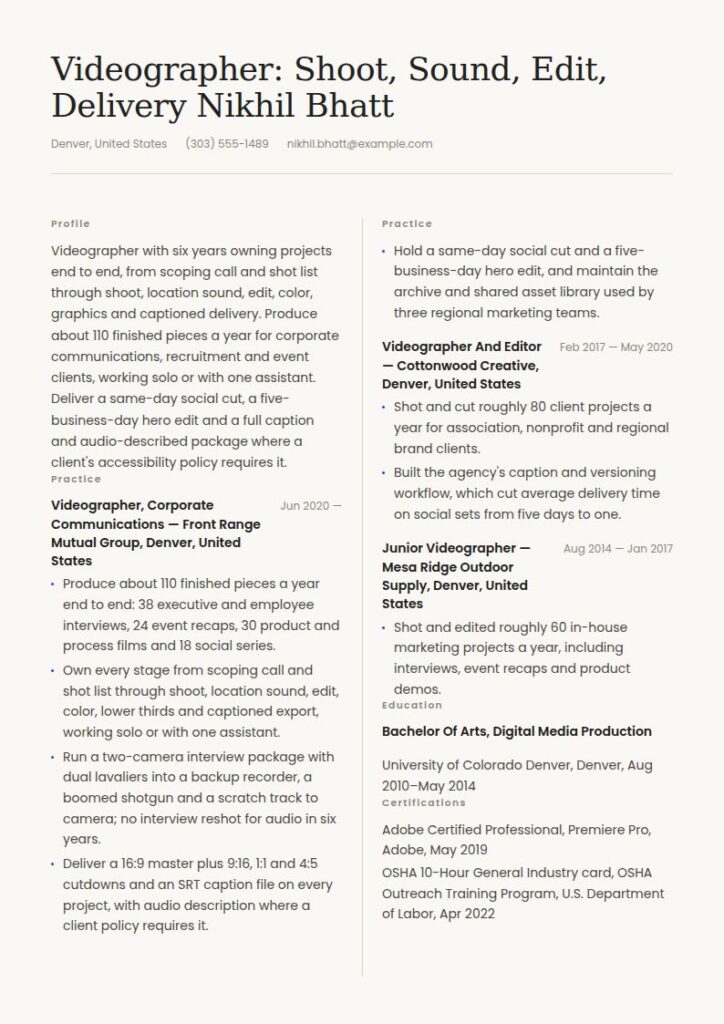
Videographer with six years owning projects end to end, from scoping call and shot list through shoot, location sound, edit, color, graphics and captioned delivery. Produce about 110 finished pieces a year for corporate communications, recruitment and event clients, working solo or with one assistant. Deliver a same-day social cut, a five-business-day hero edit and a full caption and audio-described package where a client's accessibility policy requires it.
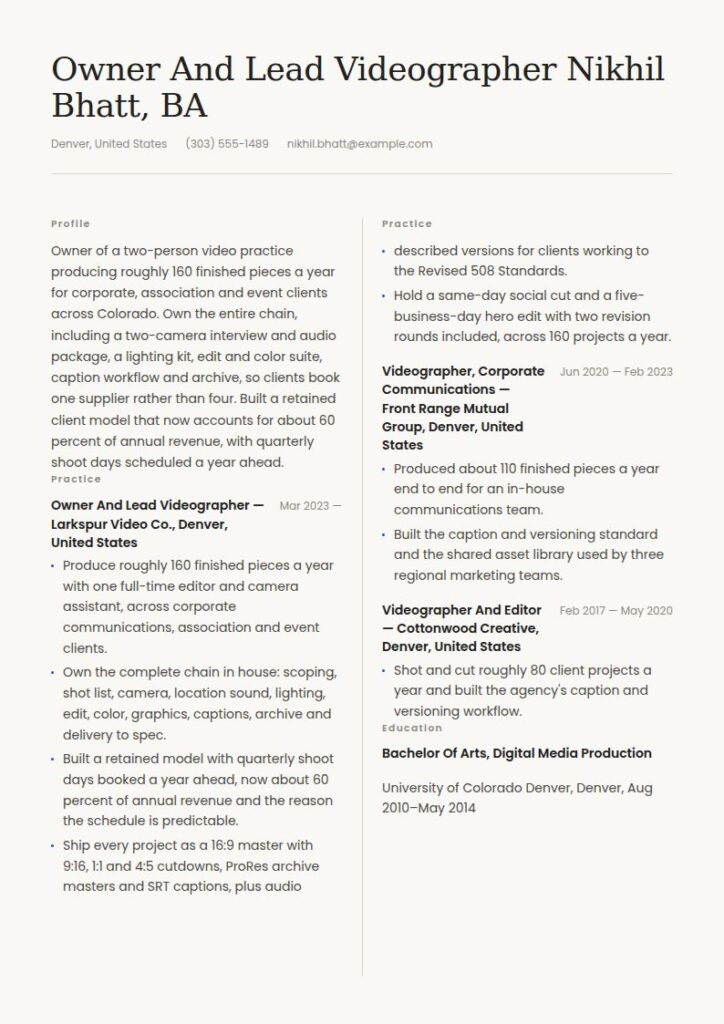
Owner of a two-person video practice producing roughly 160 finished pieces a year for corporate, association and event clients across Colorado. Own the entire chain, including a two-camera interview and audio package, a lighting kit, edit and color suite, caption workflow and archive, so clients book one supplier rather than four. Built a retained client model that now accounts for about 60 percent of annual revenue, with quarterly shoot days scheduled a year ahead.
Right vs wrong: the same videographer summary, twice
| ✅ Right | ❌ Wrong |
|---|---|
| Own the chain from scoping call through shoot, location sound, edit, color, graphics and captioned delivery. | Skilled in all aspects of video production from start to finish. |
| About 110 finished pieces a year for corporate communications, recruitment and event clients. | Extensive experience producing high-quality video content. |
| Same-day social cut, five-business-day hero edit, caption file on every delivery. | Fast turnaround and attention to detail. |
Above all, the right column is a supplier a manager can plan a quarter around. On the other hand, the left column is every other file in the folder.
Outline your production experience
To begin with, employer or client type, your role, dates, and the remit in one line. Then three to five bullets, each with a volume, a turnaround or a finished deliverable set.
| Instead of | Use |
|---|---|
| Filmed and edited videos for the company | Shot and cut 110 finished pieces a year: 38 interviews, 24 event recaps, 30 product and process films, 18 social series |
| Responsible for the full production process | Owned scoping, shot list, shoot, location sound, edit, color, graphics and captioned export on every project |
| Recorded audio on location | Ran dual lavaliers into a backup recorder with a boomed shotgun and a scratch track to camera on every interview |
| Edited videos for social media | Delivered every piece as a 16:9 master with 9:16, 1:1 and 4:5 cutdowns and an SRT caption file |
| Worked to tight deadlines | Held a same-day social cut and a five-business-day hero edit across 110 projects, with two exceptions agreed in advance |
Videographer, Corporate Communications, Front Range Mutual Group, Denver, CO, June 2020 to Present
Produce about 110 finished pieces a year end to end, covering 38 executive and employee interviews, 24 event recaps, 30 product and process films and 18 social series.
Own every stage: scoping call, shot list, shoot, location sound, edit, color, lower thirds and captioned export, working solo or with one assistant.
Run a two-camera interview package with dual lavaliers into a backup recorder, a boomed shotgun and a scratch track to camera; no interview reshot for audio in six years.
Deliver a 16:9 master plus 9:16, 1:1 and 4:5 cutdowns and an SRT caption file on every project, with audio description added where a client's accessibility policy requires it.
Hold a same-day social cut and a five-business-day hero edit, and maintain the archive and the shared asset library used by three regional marketing teams.
Own the whole chain: shoot, sound, edit, deliver
However, this is the block that makes the case for hiring one person, and it is the block almost every videographer leaves out in favor of a gear list.
After all, a gear list says what you own. In contrast, a chain block says what a client does not have to arrange. Therefore, write it as stages, with the thing that could go wrong at each one already handled.
Pre-production: scoping call, treatment or outline, shot list, location scout, release collection, call sheet.
Camera: two-camera interview or single-camera documentary coverage, gimbal and slider movement, log capture to a shared color pipeline.
Location sound: dual lavaliers into a backup recorder, boomed shotgun on a stand, scratch track to camera, headphones on every take, spare batteries and a wind kit.
Lighting: three-point interview kit with a soft key, negative fill and practical-led setups for offices, plants and event spaces.
Post: edit in Premiere Pro, color in Resolve, lower thirds and animated titles, music licensed for the stated use, mix to a consistent loudness across the series.
Delivery: 16:9 master plus 9:16, 1:1 and 4:5 cutdowns; H.264 for web and ProRes masters archived; SRT caption files on every piece; audio description where required.
Turnaround: same-day social cut, five business days for a hero edit, two revision rounds included.
Sound, delivery specs and captions
In particular, three things in that block do the persuading.
Sound, listed as its own stage. After all, it is the failure everyone has experienced and the one nobody writes down.
Delivery, written as specs rather than as "final files". For example, a marketing manager whose vertical cutdown came back letterboxed will read aspect ratios with real interest.
Captions, treated as part of the deliverable. In fact, this is where a lot of corporate and public sector work is now decided, and most videographers have no answer. Federal agencies, and the suppliers who make content for them, work to the Revised 508 Standards, which incorporate the WCAG success criteria: captions are required for all prerecorded audio in synchronized media under 1.2.2 and for live audio under 1.2.4, audio description or a media alternative is required for prerecorded synchronized media under 1.2.3, audio description under 1.2.5, and a product displaying video with synchronized audio must offer user controls for closed captions and audio descriptions at the same menu level as volume or program selection under requirement 503.4 (Section508.gov, Video and Other Synchronized Media, page updated May 2026).
Of course, you are not being asked to be a compliance officer. Instead, you are being asked whether a caption file comes with the delivery, and whether you can produce an audio-described version if the client's policy needs one. As a result, a videographer who can say yes, and say which standard the client is probably working to, is the one who gets the university, agency and association work.
Build a snapshot of your key skills
In short, twelve to sixteen entries in four groups: production, sound, post, and delivery. Keep sound as its own group rather than a single line inside production, because that grouping is itself an argument.
Production: Two-camera interview setup, Single-camera documentary coverage, Event and conference coverage, Product and process filming, Gimbal and slider movement, Three-point and practical-led lighting
Sound: Dual lavalier capture, Boomed shotgun, Backup field recorder, Scratch track and sync, Room treatment for office interviews, Loudness consistency across a series
Post: Premiere Pro editing, DaVinci Resolve color, After Effects lower thirds and titles, Audio cleanup and mixing, Music licensing for stated use, Multi-cam sync
Delivery: 16:9, 9:16, 1:1 and 4:5 versioning, H.264 web exports and ProRes masters, SRT caption files, Audio described versions, Archive and asset library management
List your education and certifications
Short, at the foot. For reference, the typical entry-level education for the published occupation is a bachelor's degree in a field related to film or broadcasting, and employers may train new hires on the specific editing software they use (BLS Occupational Outlook Handbook, film and video editors and camera operators, page last modified 27 August 2026). However, there is no license for this work, so the useful entries are the ones that reduce a client's friction.
Bachelor of Arts, Digital Media Production, University of Colorado Denver, Denver, CO, 2014.
Adobe Certified Professional, Premiere Pro, 2019.
OSHA 10-Hour General Industry card, OSHA Outreach Training Program, U.S. Department of Labor, 2022. Required by several manufacturing and utility clients before filming on operating sites.
Insurance: general liability with scheduled equipment coverage; certificates issued on request.
In particular, the safety card is worth a line on its own. For instance, corporate video takes you onto plant floors, construction sites, hospital corridors and utility yards, and a supplier who already holds site safety training is one fewer approval for the client's facilities team to chase.
Choose the right layout and design
Overall, single column, plain type at 11 or 12 point, no frames, no thumbnails, no QR code sitting where a phone number should be. Video people design these documents more than anyone and it works against them: the file is parsed, printed and forwarded, and the motion work belongs on the reel.
In addition, keep the reel URL in plain text as well as hyperlinked, and name the file plainly: nikhil-bhatt-videographer-resume.pdf.
Write the chain as stages, with sound as its own stage. Give project counts by type and by year. State turnaround for social cuts and hero edits separately. List the deliverable set, including aspect ratios and caption files. Say what kit you own and arrive with. Name the safety or site training a client would otherwise have to arrange.
Do not write "full-service video production" without listing the stages. Do not bury audio inside a camera list. Do not claim a role on a large crew project that you did not hold. Do not use a design-led two-column template for a parsed application. Do not promise unlimited revisions; name the number included.
Videographer job market and outlook
Meanwhile, the Bureau of Labor Statistics publishes no Occupational Outlook Handbook profile for videographer. The Handbook covers broad occupations rather than job titles, and this one is unusual in that it spans two published occupations at once: camera operators, television, video and film, and film and video editors. Doing both is the job.
| Measure | Film and video editors and camera operators |
|---|---|
| Employment, 2025 | 72,000 |
| Projected change, 2025-35 | 3% growth, 1,900 jobs |
| Projected annual openings | ~5,600 |
| Typical entry-level education | Bachelor's degree |
| Median annual wage, May 2025 | $75,100 |
Source: U.S. Bureau of Labor Statistics, Occupational Outlook Handbook, film and video editors and camera operators, page last modified 27 August 2026, May 2025 wage data and 2025 to 2035 projections.
You are doing two published occupations at once
BLS publishes the two halves of this job separately. Film and video editors had a median annual wage of $75,420 in May 2025, with the lowest 10 percent under $40,280 and the highest 10 percent over $148,550. Camera operators in television, video and film had a median of $74,990, with the lowest 10 percent under $38,520 and the highest over $135,180 (BLS Occupational Outlook Handbook, page last modified 27 August 2026).
The medians are within $430 of each other, and the top decile for editors is about $13,000 higher. Editing is where the ceiling sits, which is worth knowing if you are deciding which half of your practice to deepen.
Industry matters more than either. For editors, the motion picture and video industries paid a median of $79,570, publishing, broadcasting and content providers $78,300, religious, grantmaking and civic organizations $72,590, and professional, scientific and technical services $63,250 (BLS Occupational Outlook Handbook, May 2025).
Thirty-five percent of editors are self-employed, with 31 percent in motion picture and video industries, 11 percent in publishing, broadcasting and content providers, 8 percent in professional, scientific and technical services and 3 percent in religious, grantmaking and civic organizations (BLS Occupational Outlook Handbook, page last modified 27 August 2026). More than a third of this occupation is invoicing rather than applying, which is why the resume has to read as a capability statement as well as a history.
Instead, across the combined occupation, employment is projected to grow 3 percent between 2025 and 2035, adding about 1,900 jobs, with roughly 5,600 openings a year over the decade (BLS Occupational Outlook Handbook, 2025 to 2035 projections). That is a modest, stable market where most openings replace people leaving, and where the in-house corporate video role, largely invisible in the occupational titles, is a significant share of the steady work.
What salary you can expect as a videographer
Consequently, there is no published median for the title. The combined film and video editors and camera operators occupation had a median annual wage of $75,100, or $36.10 an hour, as of May 2025, with editors at $75,420 and camera operators at $74,990 (BLS Occupational Outlook Handbook, page last modified 27 August 2026).
Those are employed-worker medians, and more than a third of the occupation is self-employed, so for many videographers the relevant number is a day rate, a project fee and how many finished pieces a year the practice can carry. Even so, four things on the page move it.
The chain. First, every stage you own is a supplier the client does not pay separately, and pricing the project rather than the shoot day is what captures that value.
Volume and cadence. Second, retained work at a stated cadence, such as quarterly shoot days booked a year ahead, is worth more than the same number of one-off projects because it removes the selling.
The deliverable set. Third, naming the versions included, and the number of revision rounds, turns everything else into a quoted addition rather than a free evening.
Accessibility capability. Similarly, captioned and audio-described delivery is a requirement for a large class of public sector, education and association clients, and it is a genuine filter on who can bid.
Key takeaways for a videographer resume
- Above all, say in the title line that you shoot, record sound and edit.
- Next, write the chain as stages, not as a gear list.
- Likewise, give location sound its own stage; it is the failure clients fear most.
- Meanwhile, put project counts by type and by year in the experience bullets.
- Specifically, name the deliverable set: aspect ratios, codecs, caption files, revision rounds.
- State turnaround for social cuts and hero edits separately.
- Therefore, keep the file single column and leave the motion work on the reel.
Build your videographer resume in 15 minutes with our AI resume builder.
Related creative and artistic resume examples
- Cinematographer resume
- Photographer resume
- Wedding photographer resume
- Film producer resume
- Screenwriter resume
- Voice actor resume
- Actor resume
- Musician resume
- Visual artist resume
- Illustrator resume
- Stage manager resume
- Choreographer resume
As a final step, pair it with a matching videographer cover letter.
Videographer resume questions, answered
How long should a videographer resume be?
One page for your first few years. Two once you own a client list, a kit and a schedule, because the chain block, the deliverable set and the project counts are the point by then. The reel is separate and does not count toward the page limit.
Should my videographer resume list every camera I own?
List the package, not the inventory. Bodies, the lens range, the audio kit, the lighting kit and the support. A client is asking whether you arrive complete, not whether you can name twelve items, and a long list crowds out the stages of the chain, which is what actually differentiates you.
What is the difference between a videographer and a cinematographer resume?
Scope. A cinematographer heads the camera department on a crew and is read for credits, format and department size; the [cinematographer resume example](/resume/cinematographer/) is written that way. A videographer owns the whole chain and is read for capability, turnaround and delivery. Writing one resume as the other is the most common mistake in this field.
Do I need to know about captions and accessibility?
If you want public sector, education or association work, yes. Federal agencies work to the Revised 508 Standards, which require captions for prerecorded audio in synchronized media and audio description or a media alternative for prerecorded synchronized media, and require user controls for captions and audio descriptions at the same menu level as volume (Section508.gov, page updated May 2026). Saying a caption file ships with every delivery is often enough to be shortlisted.
What do I put on a videographer resume with no clients yet?
Work you have finished, described as projects with a scope: what it was for, how long it ran, what you shot it on, how you recorded the sound, how long the edit took and what you delivered. Volunteer and student work counts if it is written that way. Then your kit and your turnaround, because a client with a deadline and no equipment is hiring both of those before they hire a style.