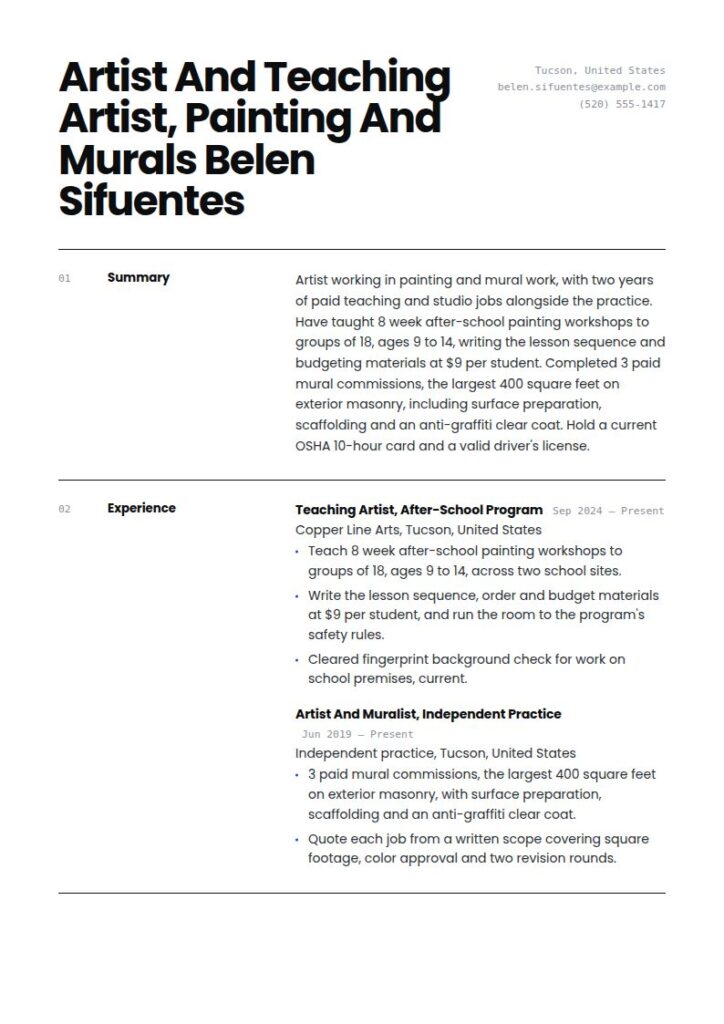
Artist and teaching artist, painting and murals Belen Sifuentes
Teaching Artist, After-School Program
[email protected] | (520) 555-1417 | Tucson, United States
Profile
Artist working in painting and mural work, with two years of paid teaching and studio jobs alongside the practice. Have taught 8 week after-school painting workshops to groups of 18, ages 9 to 14, writing the lesson sequence and budgeting materials at $9 per student. Completed 3 paid mural commissions, the largest 400 square feet on exterior masonry, including surface preparation, scaffolding and an anti-graffiti clear coat. Hold a current OSHA 10-hour card and a valid driver's license.
Work Experience
09/2024 - Present, Teaching Artist, After-School Program, Copper Line Arts, Tucson, United States
- Teach 8 week after-school painting workshops to groups of 18, ages 9 to 14, across two school sites.
- Write the lesson sequence, order and budget materials at $9 per student, and run the room to the program's safety rules.
- Cleared fingerprint background check for work on school premises, current.
06/2019 - Present, Artist and Muralist, Independent Practice, Independent practice, Tucson, United States
- 3 paid mural commissions, the largest 400 square feet on exterior masonry, with surface preparation, scaffolding and an anti-graffiti clear coat.
- Quote each job from a written scope covering square footage, color approval and two revision rounds.
02/2022 - 08/2024, Framing and Print Production Assistant, Ridgeline Frame and Print, Tucson, United States
- Roughly 60 custom frames a month to a 5 day turnaround, including mat cutting, glazing and archival mounting.
- Handled customer orders, quoting and collection scheduling at a three person counter.
Education
08/2013 - 05/2017, Bachelor of Fine Arts, Painting, University of Arizona, Tucson, United States
Concentration in painting, with coursework in printmaking and art education methods.
Skills
Acrylic and latex mural painting, 85
Surface preparation and priming, 80
Lesson sequencing for youth groups, 75
Materials budgeting, 70
Mat cutting and archival mounting, 85
Scaffolding and ladder safety, 75
Languages
English, native
Spanish, native
Certificates
03/2024, OSHA 10-hour Construction Safety, OSHA Outreach Training Program
Required for exterior mural work involving ladders, scaffolding and lifts.
08/2024, Fingerprint Background Check Clearance, Arizona Department of Public Safety
Current clearance for work in school-based programs.
Summary
Most working artists earn from several places at once: commissions, teaching, a part-time arts job, grants and often work outside the arts. This guide shows how to keep one base record and aim a single page at whichever income stream is hiring, what to demote and what to cut, and current Bureau of Labor Statistics pay and outlook for the occupations involved.
Artist resume examples by experience level
In short, an artist resume is a one or two page document aimed at exactly one of the several things you do for money.
That is the whole problem with this word. For example, "artist" covers a painter who teaches four days a week, a muralist who quotes commissions like a contractor, a printmaker with a part-time job at a frame shop, and someone whose practice is one stream among several. In practice, each of those people is applying for something different, and a resume that tries to describe all of it at once describes none of it.
So this page is about which artist you are on the page today, what happens to the rest of your record, and how to keep one base file so the next version takes twenty minutes instead of a weekend.
Resume guide for an artist resume
In particular, this guide and the corresponding artist resume example will cover:
- First, how to write an artist resume, section by section
- Then how to aim one page at a single income stream without hiding the others
- Also, three adaptable summaries: early practice, working artist and artist with an arts job
- What to do when the opportunity wants a qualifications packet rather than a resume
- Finally, what the job market looks like and what you can expect to earn
How to write an artist resume
In addition, use six blocks: contact header with a site, a summary written for the target, experience, a compact practice block, skills, and education. One page until you are carrying two substantial streams at once, then two.
The order changes with the target. For a teaching post, for instance, teaching goes above the practice. In contrast, the paid work goes first for a gallery or production job, and the practice sits in a five line block. For a commission, however, the practice leads and the jobs support it.
| Section | What it is answering | Where it goes |
|---|---|---|
| Summary | Which of your several jobs is this application about? | Top, rewritten for every target |
| Experience | What have you been paid to do, at what scale, for whom? | Reverse chronological, numbers in every bullet |
| Practice block | Is the practice real and current, without taking over the page? | Four or five lines, labeled selected |
| Skills | Fabrication, materials, tools, and the safety cards | Grouped, short, target-relevant |
Keep one base file and cut targeted versions from it
Write everything once into a base file you never send: every commission with its budget, site and install method; every class with contact hours, group size and age range; every exhibition with venue, city and date; every grant with its amount and reporting deadline; every job with dates and duties, including jobs outside the arts.
A targeted resume is then a deletion exercise rather than a writing exercise. Choose the stream that is hiring, promote its evidence into the top half, compress the others into one line each, and cut anything that supports neither.
That takes an afternoon once and twenty minutes per application afterward. Rewriting from memory each time is how numbers drift between versions and how a resume ends up disagreeing with an application form.
Run the finished version through the ATS resume checker before you send it. School districts, universities, municipalities and arts nonprofits all run applicant systems, and a resume built in a design tool is the usual reason a strong candidate never appears in the results.
Choosing the best resume format for an artist resume
Overall, go reverse chronological, single column, one or two pages. It is the only format that survives an irregular career honestly: a functional resume reads as an attempt to hide the sequence, and irregular sequences are so normal here that hiding one is the only thing that looks suspicious.
Keep concurrent work concurrent. If you taught on Tuesdays while working three days at a frame shop and delivering two commissions, list all three with overlapping dates. A tidy sequence that leaves out two of the three reads as a shorter career than you have had.
Include your contact information
| ✅ Right | ❌ Wrong |
|---|---|
| Belen Sifuentes | Belen Sifuentes |
| Artist and teaching artist, painting and murals | Creative soul, maker of things |
| belensifuentes.com | Portfolio on request |
| (520) 555-1417, [email protected], Tucson, AZ | (520) 555-1417, [email protected] |
Above all, the second line is the aiming device. That is why it changes with the target: "Artist and teaching artist" for a school program, "Muralist and public art fabricator" for a commission, "Gallery assistant and artist" for an arts job. The rest of the header, however, never changes.
Make use of a summary
Similarly, keep it to four lines, rewritten for every target: what you make, what you are paid to do with it, the scale, and one number.
Artist working in painting and mural work, with two years of paid teaching and studio jobs alongside the practice. Have taught 8 week after-school painting workshops to groups of 18, ages 9 to 14, writing the lesson sequence and budgeting materials at $9 per student. Completed 3 paid mural commissions, the largest 400 square feet on exterior masonry, including surface preparation, scaffolding and an anti-graffiti clear coat. Hold a current OSHA 10-hour card and a valid driver's license.
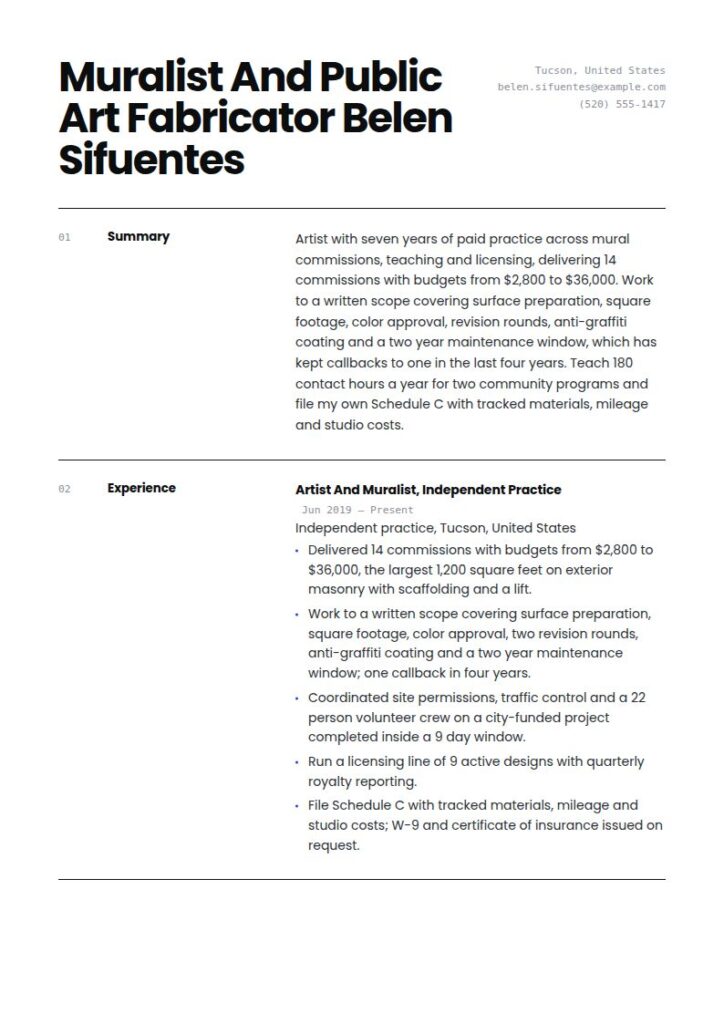
Artist with seven years of paid practice across mural commissions, teaching and licensing, delivering 14 commissions with budgets from $2,800 to $36,000. Work to a written scope covering surface preparation, square footage, color approval, revision rounds, anti-graffiti coating and a two year maintenance window, which has kept callbacks to one in the last four years. Teach 180 contact hours a year for two community programs and file my own Schedule C with tracked materials, mileage and studio costs.
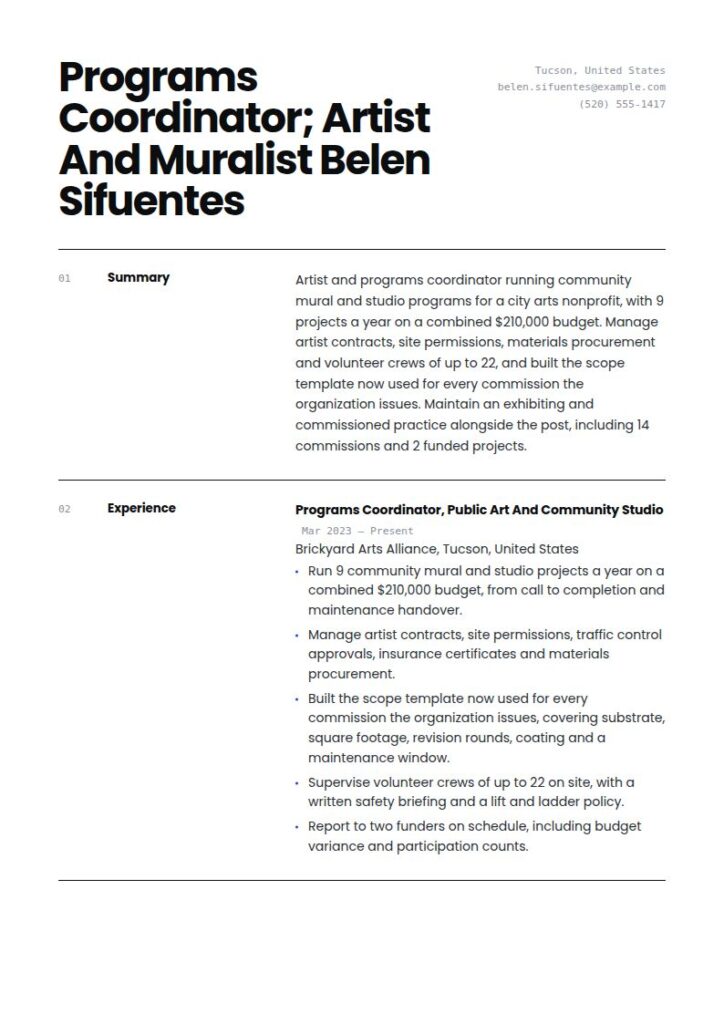
Artist and programs coordinator running community mural and studio programs for a city arts nonprofit, with 9 projects a year on a combined $210,000 budget. Manage artist contracts, site permissions, materials procurement and volunteer crews of up to 22, and built the scope template now used for every commission the organization issues. Maintain an exhibiting and commissioned practice alongside the post, including 14 commissions and 2 funded projects.
Right vs wrong: the same artist summary, twice
| ✅ Right | ❌ Wrong |
|---|---|
| Delivered 14 commissions with budgets from $2,800 to $36,000. | Creates vibrant work that brings communities together. |
| Teach 180 contact hours a year for two community programs. | Enjoys sharing creativity with people of all ages. |
| A written scope has kept callbacks to one in four years. | Reliable, hardworking and easy to collaborate with. |
The right column, for instance, is a supplier and an employee. The left column, on the other hand, is a feeling, and every other applicant has submitted the same one.
Outline your artist experience
Next, give the client or employer, city, dates, and one line on what the work was. Then three to five bullets, each with a number: square footage, budget, contact hours, group size, crew, callbacks.
| Instead of | Use |
|---|---|
| Painted murals for local businesses | Delivered 14 mural commissions, $2,800 to $36,000, the largest 1,200 square feet on exterior masonry |
| Taught art to children | Taught 8 week after-school workshops to groups of 18, ages 9 to 14, 180 contact hours a year |
| Sold work at markets and online | Ran a licensing and print line with 9 active designs and quarterly royalty reporting |
| Worked with the city on a project | Coordinated site permissions, traffic control and a 22 person volunteer crew for a city-funded mural |
| Managed my own art business | File Schedule C with tracked materials, mileage and studio costs, and issue written scopes and invoices for every job |
Artist and Muralist, Independent Practice, Tucson, AZ, June 2019 to Present
Commissioned mural and painting work for businesses, municipalities and community organizations.
Delivered 14 commissions with budgets from $2,800 to $36,000, the largest 1,200 square feet on exterior masonry with scaffolding and a lift.
Work to a written scope covering surface preparation, square footage, color approval, two revision rounds, anti-graffiti coating and a two year maintenance window; one callback in four years.
Coordinated site permissions, traffic control and a 22 person volunteer crew on a city-funded project completed inside a 9 day window.
Run a licensing line of 9 active designs with quarterly royalty reporting, and file Schedule C with tracked materials, mileage and studio costs.
Aim the page at one income stream and demote the rest
In fact, this is the decision that makes an artist resume work, and the one nobody tells you to make. After all, a working artist usually has three or four income streams running at once, and on a resume they cannot all lead. Instead, one is the applicant; the others are supporting evidence or they are cut.
| If the opening is | Lead with | Demote to one line | Cut |
|---|---|---|---|
| Teaching artist, school or community program | Contact hours, group sizes, ages, lesson sequences, safety and background check | Commissions, as proof you are a practicing artist | Licensing revenue, market sales |
| Arts nonprofit or gallery staff | Budgets, contracts, procurement, crews, events, reporting | Teaching, as proof you can run public programs | Individual sales history |
| Public art or commission panel | Built work: square footage, substrates, engineering, permits, maintenance | Teaching and arts jobs, as institutional literacy | Unbuilt personal work |
| A day job outside the arts | Reliability, tools, safety cards, customer work, scheduling | The practice, in one factual line | Exhibition lists, statements |
| Grant or fellowship | This is not a resume application; follow the call's own format |
Two of those rows need explaining, because they are where artists most often get it wrong.
Commission panels and the day job
The commission panel does not want a resume. Public art and larger commissions are usually procured through a request for qualifications, and what they ask for is a packet: a letter of interest, an annotated image list with dimensions, materials, date, budget and location, references from previous commissioning bodies, and only sometimes a CV. Read the call and build what it names, in the order it names it.
The day job outside the arts is not a confession. A hiring manager at a print shop or a facilities department is not scandalized by a practice; they want to know whether you will be there on Tuesday. Give the practice one factual line, keep the tools and safety cards prominent, and do not explain yourself. "Artist and muralist, independent practice, 2019 to present: commissioned exterior work, scaffolding and lift certified" is an asset in a job that involves ladders.
Your own records decide whether this is a business
An artist with several income streams is running a small business whether or not it feels like one, and the paperwork shows up on a resume as competence.
The IRS says taxpayers should weigh whether they carry on the activity in a businesslike manner and maintain complete and accurate books and records, whether they depend on income from the activity, whether the time and effort put into it shows an intent to make a profit, and whether losses are beyond their control or normal for the startup phase of that type of business, among other factors, when deciding whether an activity is a business or a hobby (Internal Revenue Service, Fact Sheet FS-2022-38, October 2022).
That list is not only a tax question. Complete books, written scopes, invoices, tracked materials and mileage, and a filed return are exactly what a commissioning body, a school district vendor process and a nonprofit finance officer are checking for before they can pay you at all. Get your own tax advice, and then put the evidence on the page: "written scope and invoice for every commission", "Schedule C filed with tracked materials and mileage", "W-9 and certificate of insurance on file".
Build a snapshot of your key skills
In practice, list ten to fourteen entries in three groups, and change which group leads with the target: making, delivering, and the business and safety credentials.
Making: Acrylic and latex mural painting, Exterior masonry and concrete substrates, Surface preparation and priming, Color matching and mixing, Projection and grid layout, Screen printing
Delivering on site: Scaffolding and lift work, Site survey and measurement, Traffic control coordination, Volunteer crew supervision, Anti-graffiti coating and maintenance schedules, Weather and cure planning
Business and safety: Written scopes and change orders, Estimating by square foot, Invoicing and Schedule C records, W-9 and certificate of insurance, OSHA 10-hour card, Background check cleared for school programs
List your education and certifications
Degree if you have one, then teaching and safety credentials, then anything a client or a district checks. There is no license to be an artist, and BLS notes that most fine artists pursue postsecondary education to improve their skills and job prospects, while a formal educational credential is typically not needed to be a craft artist (BLS Occupational Outlook Handbook, craft and fine artists, page last modified 27 August 2026).
Bachelor of Fine Arts, Painting, University of Arizona, Tucson, AZ, 2017
OSHA 10-hour Construction Safety card, 2024. Aerial and scissor lift operator training, 2024. First aid and CPR, American Red Cross, 2025.
Cleared fingerprint background check for work in school programs, current. Commercial general liability insurance in force, certificates issued on request.
Business records: written scope and invoice for every commission; Schedule C filed with tracked materials, mileage and studio costs.
Those last two lines are worth more than most certificates here. Indeed, a district cannot put you in front of students without the background check, and a municipality cannot issue a purchase order without the insurance certificate and the W-9.
Choose the right layout and design
Single column, 11 or 12 point, one typeface, no images, no color fields, no hand lettering. Save the design energy for the site and the image packet. Name the file for yourself and the target: belen-sifuentes-teaching-artist-resume.pdf, and keep a separate belen-sifuentes-muralist-resume.pdf rather than sending one file to both.
Decide which income stream is applying before you write the summary. Keep one base file and cut targeted versions from it. Show concurrent work as concurrent. Give a number in every bullet: square feet, budget, contact hours, group size, crew. Put the background check, the insurance and the safety cards where a coordinator can see them. Keep the practice on the page even when applying outside the arts.
Do not send one resume to a school, a gallery and a hardware store. Do not send a resume when the call asks for a qualifications packet. Do not list an exhibition record on an application for a job that has nothing to do with exhibitions. Do not apologize for a day job or leave it off. Do not use a designed template for an applicant system.
Artist job market and outlook
However, BLS publishes no Occupational Outlook Handbook profile under the plain title artist, and no single profile matches a career assembled from several streams. Instead, the closest is craft and fine artists. Artists whose income is mostly teaching sit under teachers, those working in galleries and museums under archivists, curators and museum workers, and those doing digital or motion work under special effects artists and animators or graphic designers.
| Measure | Craft and fine artists |
|---|---|
| Employment, 2025 | 53,400 |
| Projected employment, 2035 | 53,000 |
| Projected change, 2025 to 2035 | -1 percent, -300 jobs |
| Projected annual openings | ~4,300 |
| Self-employed workers | 58 percent |
| Median annual wage, May 2025 | $55,290 |
Source: U.S. Bureau of Labor Statistics, Occupational Outlook Handbook, craft and fine artists, page last modified 27 August 2026, May 2025 wage data and 2025 to 2035 projections.
Four adjacent occupations, four very different medians
In May 2025 the median annual wage was $55,290 for craft and fine artists, $62,960 for graphic designers, $102,030 for special effects artists and animators and $114,850 for art directors, while art, drama and music teachers at postsecondary level had a median of $78,620 (BLS Occupational Outlook Handbook, arts and design occupations and postsecondary teachers, pages last modified 27 August 2026).
Inside the craft and fine artists profile itself the split is wide: craft artists at $46,080, fine artists including painters, sculptors and illustrators at $55,490, and artists and related workers, all other at $71,240 (BLS, May 2025). BLS projects overall employment in arts and design occupations to grow more slowly than the average for all occupations, with about 76,400 openings a year over the decade, mostly replacements (BLS Occupational Outlook Handbook, arts and design occupations, page last modified 27 August 2026).
The practical reading is that the word on your resume is worth money. The same person can be a fine artist, a designer, a teaching artist or an animator depending on which of their streams the page is built around, and those four labels sit in very different pay bands. Aim deliberately rather than by habit.
The minority who hold a job rather than work for themselves sit here:
| Industry | Share of employment | Median annual wage, May 2025 |
|---|---|---|
| Self-employed workers | 58% | Not published |
| Independent artists, writers and performers | 7% | $49,100 |
| Federal government, excluding postal service | 6% | $115,150 |
| Personal care services | 4% | $38,790 |
| Motion picture and sound recording industries | 2% | $132,950 |
Source: U.S. Bureau of Labor Statistics, Occupational Outlook Handbook, craft and fine artists, May 2025.
What salary you can expect as an artist
Craft and fine artists had a median annual wage of $55,290 in May 2025, with the lowest 10 percent under $31,490 and the highest 10 percent above $131,810 (BLS Occupational Outlook Handbook, craft and fine artists, page last modified 27 August 2026).
Also read that against the 58 percent self-employment share, and the median is clearly describing a minority. In other words, for most artists the annual figure is a stack, and each part is priced by a different logic: commissions by square foot or project, teaching by contact hour, an arts job by salary band, licensing by royalty rate, a day job by the hour.
The resume moves two of them. The salaried part, because a job at a nonprofit, a district, a museum or a studio is awarded on documented capability and nothing else. And the commission part, because a written scope with square footage, substrate, revision rounds, coating and a maintenance window lets a client compare you against a contractor rather than against a hobby, which is the single change most likely to raise a quote.
Sales is the stream a resume cannot move, because it is priced by an audience built elsewhere. Worth knowing, because artists routinely spend on the resume the effort that belongs on the audience.
Key takeaways for an artist resume
- Decide which income stream is applying before you write a word.
- First, keep one base file with every number in it and then cut targeted versions from it.
- Then demote the other streams to one line each, and cut what supports neither.
- Also show concurrent work as concurrent, because overlap reads as a working life.
- Specifically, put a number in every bullet: square feet, budget, contact hours, group size, crew.
- Finally, make the background check, the insurance and the safety cards easy to find.
- If the call asks for a qualifications packet, build that instead of a resume.
Build your artist resume in 15 minutes with our AI resume builder.
Related creative and artistic resume examples
- Illustrator resume
- Visual artist resume
- Tattoo artist resume
- Jewelry designer resume
- Floral designer resume
- Photographer resume
- Musician resume
- Dance teacher resume
- Actor resume
- Screenwriter resume
- Fashion designer resume
- Theater resume
Pair it with a matching artist cover letter.
Artist resume questions, answered
How long should an artist resume be?
One page while a single income stream is doing most of the work, two once you are carrying teaching and commissions or a salaried arts job at the same time. Length should come from concurrent work, not from listing every piece you have made.
Should I put my exhibitions on an artist resume?
Only where they are evidence for the target. For a gallery or teaching post, a four line selected block with counts is right. For a job outside the arts, cut the list entirely and keep one line saying the practice exists. For an exhibition or residency application, the document you need is an artist CV, not a resume.
What do I do about a day job outside the arts?
List it with dates and duties, and do not explain it. Gaps read worse than unrelated work, and the transferable parts are usually real: scheduling, customers, tools, inventory, safety. If the day job taught you something the arts job needs, put it in a bullet rather than an apology.
How do I price and present commissions on a resume?
By scale and scope rather than by rate. Give the budget range, the largest project, the square footage or dimensions, the substrate, and what your written scope covers. That tells a commissioning body you can be procured, which is a different and more useful claim than saying your work is affordable.
Is being an artist a realistic career?
It is a realistic income, usually assembled from several sources. BLS reports craft and fine artists with a median annual wage of $55,290 in May 2025, 58 percent self-employed, employment projected to decline 1 percent from 2025 to 2035, and about 4,300 openings a year, nearly all replacements (BLS Occupational Outlook Handbook, page last modified 27 August 2026). The adjacent occupations pay differently, from $46,080 for craft artists to $102,030 for special effects artists and animators (BLS, May 2025), which is why aiming the page matters more here than in almost any other field.
What should I put on an artist resume with no formal experience?
Everything you have done that had a client, a deadline or a group of people in it, written plainly. A commissioned sign, a school workshop you assisted, a market stall with its own accounts, a set painted for a community production. Give the size, the number of people, the budget and the date. That is experience, and it is what a first teaching or assistant job is hired on.