Assistant Designer, Womenswear Delphine Auclair
Assistant Designer, Womenswear
[email protected] | (212) 555-2320 | New York, United States
Profile
Assistant designer with two years in contemporary womenswear, supporting a 60 to 80 style seasonal line across four drops a year. Write and maintain tech packs in Centric PLM, log fit comments across three sample rounds, and keep the bill of materials and lab dips current against the development calendar. Trained on Gerber AccuMark and CLO 3D, and I chase fabric approvals so the factory receives a clean package on the date it was promised.
Work Experience
07/2024 - Present, Assistant Designer, Womenswear, Verdigris Studio, New York, United States
- Write and maintain tech packs in Centric PLM for a 60 to 80 style seasonal line across four drops, including flat sketches with callouts, bill of materials and points of measure.
- Log fit comments across three sample rounds a style and issue corrected packages to three cut-and-sew factories within one business day of each fit session.
- Track lab dips, strike-offs and trim approvals against the development calendar, flagging any gate at risk two weeks before it closes.
- Built the trim card library that cut duplicate trim orders across the knitwear group by consolidating 41 items to 23.
06/2023 - 06/2024, Design Intern, Womenswear, Marchmont Apparel Group, New York, United States
- Prepared flat sketches in Adobe Illustrator and first-pass bills of materials for a private label womenswear program.
- Sat in weekly fit sessions and transcribed comments into the technical designer's format.
- Maintained the fabric and trim library, logging 300 plus swatches with supplier, content and minimum.
Education
08/2020 - 05/2024, Bachelor of Fine Arts, Fashion Design, Fashion Institute of Technology, New York, United States
Senior collection of 12 styles, patterned and graded across sizes 00 to 12, with full tech packs and a costed line sheet.
Skills
Tech pack authoring, 70
Bill of materials and trim management, 75
Centric PLM, 70
Gerber AccuMark, 60
CLO 3D, 65
Adobe Illustrator and Photoshop, 85
Fit comment logging, 70
Lab dip and strike-off tracking, 70
Languages
English, native
French, native
Certificates
09/2024, AccuMark Pattern Design and Grading, Gerber Technology
Vendor training certificate covering pattern creation, grading and marker making.
03/2024, CLO 3D Garment Simulation, CLO Virtual Fashion
Certificate of completion, garment simulation and virtual fit.
Summary
A fashion designer resume is a one to two page document showing you can move a garment from sketch to shippable product: a tech pack a factory can build from, a cost sheet that hits a margin, a development calendar you hold, and labels that clear federal rules. This guide gives you three adaptable versions and current Bureau of Labor Statistics pay and outlook.
Fashion Designer resume examples by experience level
In short, a fashion designer resume is a one to two page document that shows you can take a garment from sketch to a costed, compliant, shippable product at a quantity a factory will agree to run.
Almost every fashion designer resume describes taste instead: trends researched, mood boards built, collections inspired by something. However, a design director hiring for a commercial label reads for something narrower. Can this person write a tech pack a factory in another time zone can build from, cost a style to a target margin, hold a calendar when the fabric is late, and get the labels right so the brand can legally sell the line.
Resume guide for a fashion designer resume
To start, this guide and the corresponding fashion designer resume example will cover:
- First, how to write a fashion designer resume, section by section
- Then, what belongs in a tech pack, and why it is the section that wins you the job
- Also, three adaptable summaries: assistant designer, designer and design director
- Next, the development calendar, minimums and lead times, written as evidence
- Finally, what the job market looks like and what you can expect to earn
How to write a fashion designer resume
Six sections: contact header with a portfolio link, summary, a development record, experience, skills and software, then education and certifications. In general, one page under five years, two once you own a category and a calendar. In particular, the order follows a design director's questions in sequence: what have you produced, at what volume, did it ship when you said it would, and can somebody else build from your paperwork.
| Section | What it is answering | Where it goes |
|---|---|---|
| Development record | How many styles, how many drops, did they land on the calendar date? | Directly under the summary |
| Experience | Which categories, which price tier, which factories? | Reverse chronological, with style counts |
| Skills and software | Can this person work in our PLM and hand off to our technical designer? | Grouped, with the systems named |
| Education and certifications | Pattern, grading and compliance training | Short, at the foot |
Count your styles and name your drop calendar
The most useful number on a fashion designer resume is the style count per season, because it sizes the job instantly. "Designed womenswear collections" could mean nine styles for a capsule or two hundred for a private label program, and those are different careers.
Write it as volume plus cadence plus outcome: "45 to 55 styles a season across four drops, both of the last two seasons shipped complete on the calendar date." Then add full-price sell-through if you have access to it. Design is judged on the same report as buying, and a designer who quotes sell-through has read one.
Run the finished file through the ATS resume checker before you submit. Brands and wholesalers collect design applications through parsing systems, and those systems break on the two-column layout designers reach for first.
Choosing the best resume format for a fashion designer resume
As a rule, reverse chronological, with a development record promoted above experience. The inversion matters because BLS puts 36 percent of fashion designers in self-employment, the largest single share of the occupation (BLS Occupational Outlook Handbook, fashion designers, page last modified 27 August 2026). For example, a designer with a decade of freelance technical work has a thin employer list and a thick production history, and a format that leads with employers describes the wrong career.
Also keep the resume and the portfolio separate, connected by one plain-text URL in the header.
Include your contact information
| ✅ Right | ❌ Wrong |
|---|---|
| Delphine Auclair | Delphine Auclair |
| Womenswear designer: knitwear, wovens, contemporary tier | Creative fashion designer passionate about beautiful clothes |
| Portfolio and line sheets: delphineauclair.example.com | Portfolio available upon request |
| Centric PLM, Gerber AccuMark, CLO 3D, Adobe Illustrator | Proficient in industry software |
| (212) 555-2320, [email protected], New York, NY | (212) 555-2320, [email protected] |
Above all, name the category and the price tier. After all, womenswear, menswear, kids, intimates, activewear, denim and outerwear are separate hiring pools.
Make use of a summary
For the summary, four lines: category and tier, style volume and drop cadence, what you own in development, and one number proving the calendar held.
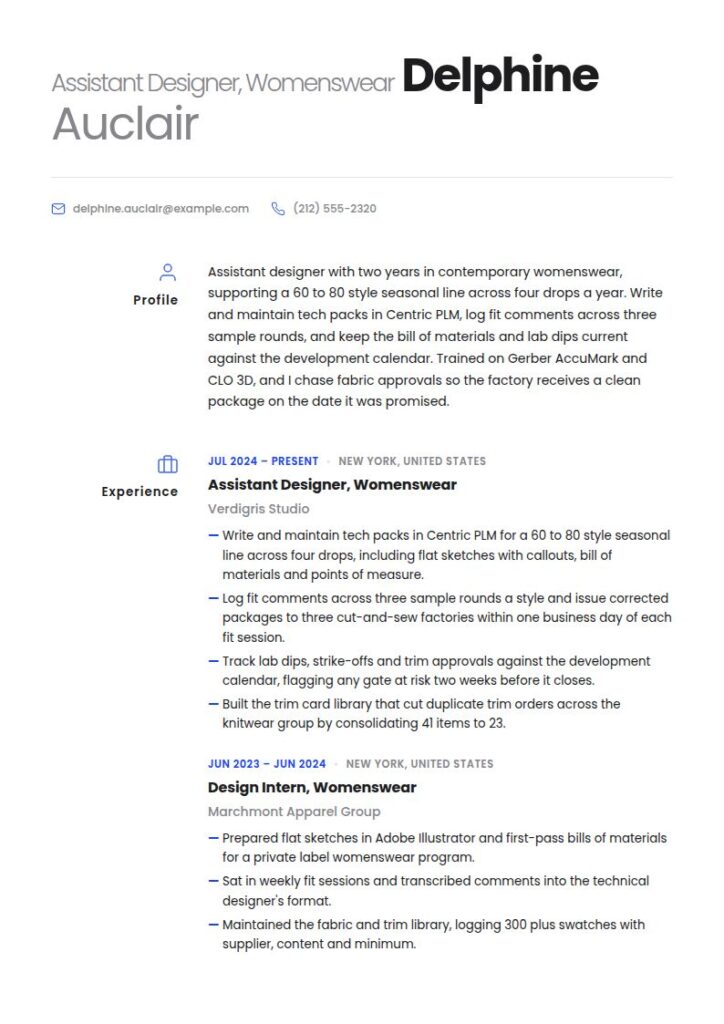
Assistant designer with two years in contemporary womenswear, supporting a 60 to 80 style seasonal line across four drops a year. Write and maintain tech packs in Centric PLM, log fit comments across three sample rounds, and keep the bill of materials and lab dips current against the development calendar. Trained on Gerber AccuMark and CLO 3D, and I chase fabric approvals so the factory receives a clean package on the date it was promised.
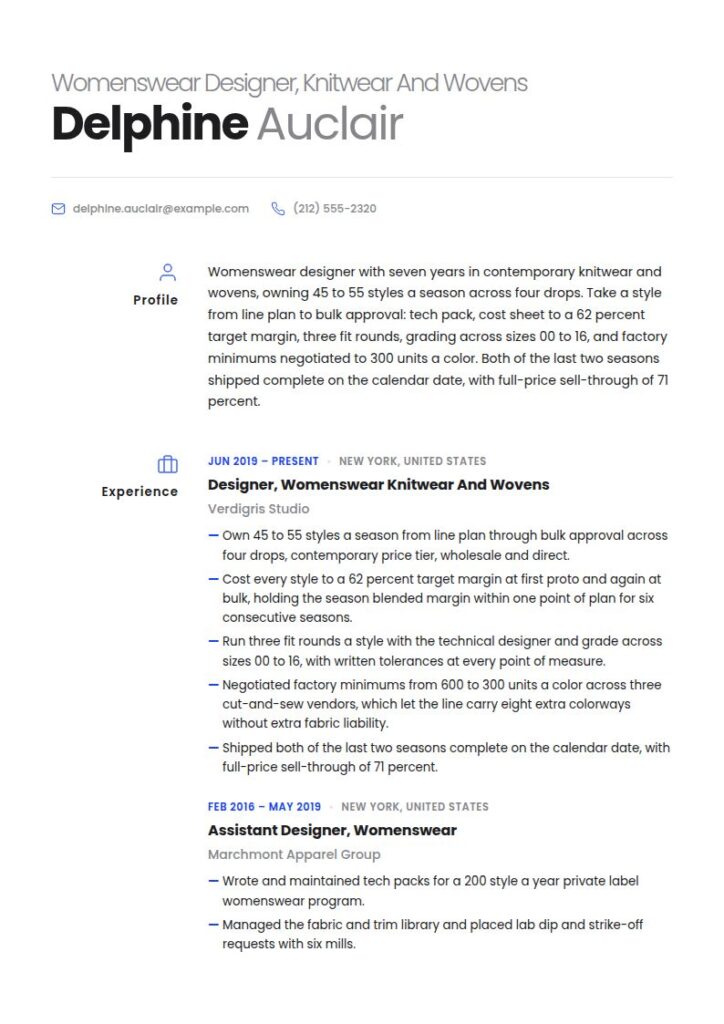
Womenswear designer with seven years in contemporary knitwear and wovens, owning 45 to 55 styles a season across four drops. Take a style from line plan to bulk approval: tech pack, cost sheet to a 62 percent target margin, three fit rounds, grading across sizes 00 to 16, and factory minimums negotiated to 300 units a color. Both of the last two seasons shipped complete on the calendar date, with full-price sell-through of 71 percent.
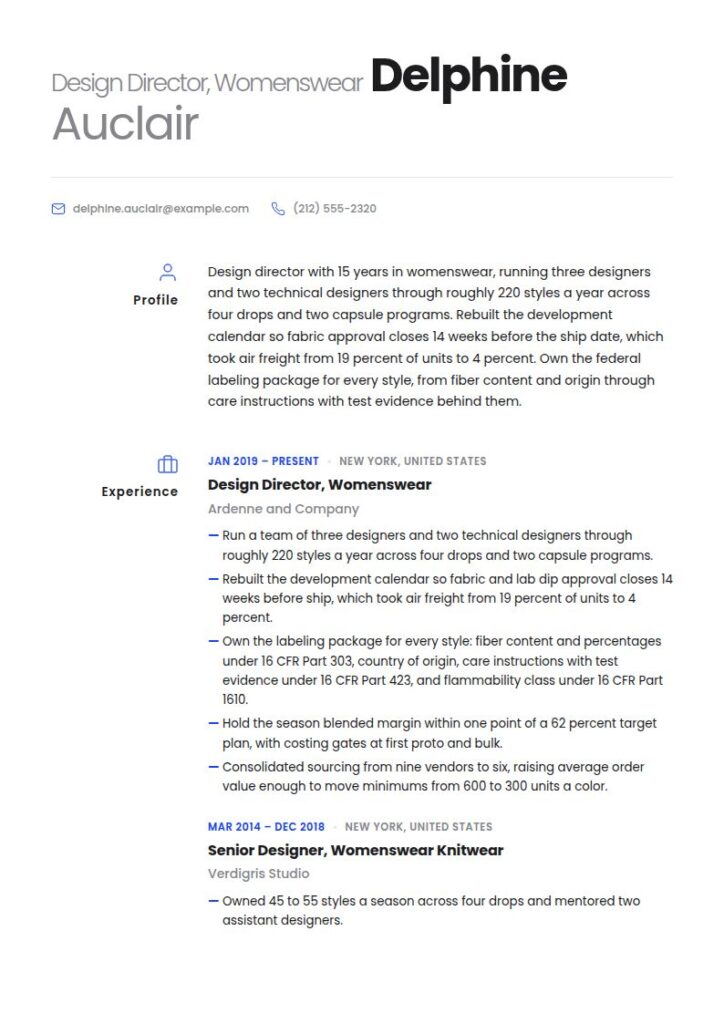
Design director with 15 years in womenswear, running three designers and two technical designers through roughly 220 styles a year across four drops and two capsule programs. Rebuilt the development calendar so fabric approval closes 14 weeks before the ship date, which took air freight from 19 percent of units to 4 percent. Own the federal labeling package for every style, from fiber content and origin through care instructions with test evidence behind them.
Right vs wrong: the same fashion designer summary, twice
| ✅ Right | ❌ Wrong |
|---|---|
| Womenswear designer owning 45 to 55 styles a season across four drops. | Creative designer with a strong eye for silhouette and detail. |
| Cost sheet to a 62 percent target margin, three fit rounds, graded 00 to 16. | Experienced in all stages of design from concept to production. |
| Both of the last two seasons shipped complete on the calendar date. | Known for delivering collections on time and to a high standard. |
| Factory minimums negotiated to 300 units a color. | Strong relationships with overseas vendors. |
In other words, a manager can put the right column into a hiring plan: it says what you would own on Monday and what the business gets for it. The left describes a temperament.
Outline your fashion design experience
Brand or client, title, category and tier in one line, then dates. Then three to five bullets, each carrying a style count, a margin, a calendar date or a sell-through figure.
| Instead of | Use |
|---|---|
| Designed seasonal collections for a womenswear brand | Owned 45 to 55 styles a season across four drops in contemporary knitwear and wovens |
| Created tech packs for production | Wrote tech packs in Centric PLM for 200 styles a year, with graded points of measure and a full bill of materials |
| Worked with overseas factories | Ran development with four mills and three cut-and-sew factories, negotiating minimums to 300 units a color |
| Managed the design calendar | Moved fabric approval to 14 weeks before ship, cutting air freight from 19 percent of units to 4 percent |
Designer, Womenswear Knitwear and Wovens, Verdigris Studio, New York, NY, June 2019 to Present. Contemporary tier, four drops a year, wholesale and direct.
Own 45 to 55 styles a season from line plan through bulk approval, including tech pack, cost sheet, fit and grading.
Cost every style to a 62 percent target margin at first proto and again at bulk, holding the season blended margin within one point of plan for six consecutive seasons.
Run three fit rounds a style with the technical designer and grade across sizes 00 to 16, with written tolerances at every point of measure.
Negotiated factory minimums from 600 to 300 units a color, which let the line carry eight extra colorways without extra fabric liability.
Shipped both of the last two seasons complete on the calendar date, with full-price sell-through of 71 percent.
Write the tech pack, not the mood board
In fact, this is the section almost nobody includes, and it separates a designer a brand can hire from a design student people admire.
However, no factory produces a garment from a sketch. Instead, it produces it from a tech pack: a document precise enough that a factory you have never visited can cut, sew, finish, label and pack the style without asking a question. If your resume does not show you write them, a director assumes somebody else did.
| Page | What it holds | What goes wrong without it |
|---|---|---|
| Flat sketch with callouts | Front, back, details, every seam and closure named | The factory guesses at a construction you did not draw |
| Bill of materials | Fabric, trim, thread, labels and packaging with supplier and placement | Trim arrives late because nobody ordered it |
| Points of measure and grade rule | Every measurement, the tolerance, how it grows across the run | Fit drifts at the ends of the size range |
| Label and care placement | Fiber content, origin, care label, exact position | The line cannot ship |
Similarly, the development calendar is the other half of the same skill. It runs backward from the date goods must be in the warehouse, so every gate is a date somebody else is waiting on.
Development record, most recent season
Volume and cadence: 52 styles, four drops, contemporary womenswear, knitwear and wovens.
Calendar: line plan locked 40 weeks out; first proto 32 weeks; fit sample 26 weeks; fabric and lab dip approval 14 weeks; pre-production sample 10 weeks; top-of-production approval 4 weeks; in warehouse on date.
Costing: costed at first proto and again at bulk to a 62 percent target margin, season blended margin within one point of plan.
Fit: three fit rounds a style, graded 00 to 16, written tolerance at every point of measure, fit comments logged in Centric PLM.
Sourcing: four mills and three cut-and-sew factories across Portugal, Turkey and Vietnam. Minimums 300 units a color, fabric minimums 500 meters, 90 to 120 day lead times.
Result: shipped complete on the calendar date, air freight 4 percent of units, full-price sell-through 71 percent.
Minimums are the constraint that shapes design at every tier. A factory minimum of 600 units a color decides how many colorways a style can carry, which decides how the line is built. A designer who has negotiated one down, or designed a group around a shared base cloth to clear one, should say so.
What the label has to say before the line ships
Compliance is unglamorous and non-negotiable, which, as a result, makes it useful to be visibly good at.
Fiber content, identity and origin. Under the Textile Fiber Products Identification Act rules at 16 CFR Part 303, a textile label must disclose generic fiber names and percentages by weight in descending order, the identity of the manufacturer or dealer, and the country where the product was processed or manufactured. Fibers under 5 percent are disclosed as "other fiber" rather than named, wool excepted, and all of it must be "clearly legible, conspicuous and readily accessible to the consumer" (Federal Trade Commission, Threading Your Way Through the Labeling Requirements Under the Textile and Wool Acts, published 2 July 2014, page last modified 10 April 2026).
A US business may use a Registered Identification Number in place of a company name; the FTC issues one RN per company, to US businesses only, at no charge (FTC, Registered Identification Number frequently asked questions, page last modified 30 April 2026).
Care labels and flammability testing rules
Care instructions, and the evidence behind them. The Care Labeling Rule at 16 CFR Part 423 requires a label covering washing method, bleaching, drying, ironing and any warning a consumer would otherwise get wrong, plus a reasonable basis: "reliable evidence to support the care instructions". Labels must be "attached permanently and securely" and stay "legible during the useful life of the product" (Federal Trade Commission, Clothes Captioning: Complying with the Care Labeling Rule, published 2 May 2014, last reviewed 7 January 2015).
Flammability. The Standard for the Flammability of Clothing Textiles, 16 CFR Part 1610, sorts clothing textiles into three classes. Class 3 fabrics "exhibit rapid and intense burning and are dangerously flammable", and "you are not permitted to use Class 3 textiles in clothing for the U.S. market". Plain surface fabrics of 2.6 ounces per square yard or heavier are exempt from testing, as are fabrics made entirely of acrylic, modacrylic, nylon, olefin, polyester or wool (CPSC, Summary Information for Clothing Textiles, 16 CFR Part 1610, March 2023).
Therefore, put one line on the resume naming the three. Yet very few applicants do, and any brand that has taken a chargeback reads it immediately.
Build a snapshot of your key skills
For skills, list twelve to fourteen entries in four groups: what you design, how you develop it, the systems, and the commercial side.
Design: Womenswear knitwear and wovens, Silhouette and proportion development, Colorways and print placement, Line plan and range building
Development: Tech pack authoring, Bill of materials, Points of measure and grading, Fit session direction, Lab dip approval, Top-of-production sign-off
Systems: Centric PLM, Gerber AccuMark, CLO 3D, Adobe Illustrator and Photoshop, NuORDER line sheets
Commercial and compliance: Cost sheet and target margin, Factory and fabric minimums, Lead time and calendar management, Fiber content and care labeling, Flammability class and vendor guaranties
List your education and certifications
Keep education short, at the foot, and weighted toward what a technical reader can check. The typical entry-level education is a bachelor's degree, with no work experience and no on-the-job training listed as typical (BLS Occupational Outlook Handbook, fashion designers, page last modified 27 August 2026); consequently, the degree does real gatekeeping. Software certificates earn their space too, because a brand running Centric PLM is choosing between a designer it can hand a login to on day one and one it must train for six weeks.
Bachelor of Fine Arts, Fashion Design, Fashion Institute of Technology, New York, NY, 2011.
AccuMark Pattern Design and Grading, Gerber Technology training certificate, 2015.
CLO 3D Garment Simulation, certificate of completion, 2021.
Registered Identification Number issued by the Federal Trade Commission for an owned label, 2019.
Languages: English native, French native, Portuguese conversational for mill and factory work.
Choose the right layout and design
Single column, plain type at 11 or 12 point, no photograph, no flats embedded in the file. Fashion designers are the profession most tempted to make the resume a design object and least able to afford it: the parser reads text, and a text box holding your best work reads as an empty page. Name the file delphine-auclair-womenswear-designer-resume.pdf.
Give style counts per season and the drop cadence. Say whether the season shipped on the calendar date. Name the PLM, the pattern system and the 3D tool. State the target margin you cost to. Name your minimums and lead times. Put the labeling rules you own on the page by citation.
Do not describe collections by inspiration; the portfolio does it better. Do not write "concept to production" without saying which gates you held. Do not embed flats in a parsed file. Do not name a client under embargo. Do not claim a sell-through figure you cannot source.
Fashion designer job market and outlook
Overall, a small occupation, flat on projection, a third self-employed, with a wide pay spread by industry.
| Measure | Value |
|---|---|
| Fashion designer jobs, 2025 | 32,700 |
| Projected employment, 2035 | 32,800 |
| Projected change, 2025-35 | 0% (little or no change), 0 jobs |
| Projected annual openings | ~2,500 |
| Typical entry-level education | Bachelor's degree |
| Median annual wage, May 2025 | $80,960 |
Source: U.S. Bureau of Labor Statistics, Occupational Outlook Handbook, fashion designers, page last modified 27 August 2026, May 2025 wage data and 2025 to 2035 projections.
The same job title, paid two and a half times differently
BLS puts self-employed workers at 36 percent of fashion designers, retail trade at 20 percent, apparel, piece goods and notions merchant wholesalers at 16 percent, management of companies and enterprises at 11 percent, and apparel manufacturing at 7 percent (BLS Occupational Outlook Handbook, fashion designers, page last modified 27 August 2026).
The May 2025 industry medians spread further than the title suggests: management of companies and enterprises $105,350, merchant wholesalers $91,020, apparel manufacturing $79,040, and retail trade $43,020 (same source).
A designer in a corporate head office and one in retail trade are separated by roughly $62,000 a year while doing recognizably the same work. With about 2,500 openings a year against flat employment, nobody moves by waiting for growth. The move is lateral, toward the wholesale end, which is why production evidence matters more on your resume than aesthetic evidence.
Here, then, is where the work sits, and what each setting pays:
| Industry | Share of employment | Median annual wage (May 2025) |
|---|---|---|
| Self-employed workers | 36% | Not published |
| Retail trade | 20% | $43,020 |
| Apparel, piece goods and notions merchant wholesalers | 16% | $91,020 |
| Management of companies and enterprises | 11% | $105,350 |
| Apparel manufacturing | 7% | $79,040 |
Source: U.S. Bureau of Labor Statistics, Occupational Outlook Handbook, fashion designers, May 2025.
What salary you can expect as a fashion designer
For instance, the median annual wage for fashion designers was $80,960 a year, or $38.92 an hour, as of May 2025. The lowest 10 percent earned less than $39,490 and the highest 10 percent more than $146,870 (BLS Occupational Outlook Handbook, fashion designers, page last modified 27 August 2026). That is nearly four to one across one occupation, and the industry table above explains most of it: where you sit matters more than how long you have been designing.
Three things move the number inside a band. Ownership of the calendar, because a designer handed dates and one who sets them hold different liabilities. Costing to a margin, because holding a season within a point of plan reads as commercial rather than decorative. Compliance ownership, because fiber content, care evidence, origin and flammability class decide whether a line ships.
By contrast, no band sets the pay of self-employed designers, the largest single group at 36 percent. Clients pay them per style or per development package, and one more lever applies: whether the engagement includes production follow-through or ends at the tech pack.
Key takeaways for a fashion designer resume
- In practice, lead with volume and cadence: styles per season, drops per year, category and price tier.
- Then show that you write tech packs, and name what they contain.
- In addition, put the development calendar on the page with its gates and the weeks they close.
- Cost to a target margin and say whether you held it.
- Likewise, name factory and fabric minimums and the lead times you work with.
- Claim the labeling package by citation, because almost nobody does.
- Finally, keep the file single column and parseable, and leave the flats in the portfolio.
Build your fashion designer resume in 15 minutes with our AI resume builder.
Related creative and artistic resume examples
- Tailor resume
- Fashion buyer resume
- Costume designer resume
- Jewelry designer resume
- Illustrator resume
- Visual artist resume
- Modeling resume
- Photographer resume
- Artist resume
- Floral designer resume
- Landscape designer resume
- Wedding photographer resume
Pair it with a matching fashion designer cover letter.
Fashion designer resume questions, answered
How long should a fashion designer resume be?
One page under five years, two once you own a category, a calendar and a team. The portfolio is a separate document and does not count toward the page limit.
Do I need a portfolio as well as a resume?
Yes, and they do different jobs. The portfolio shows flats, line sheets and finished garments; the resume states volume, cadence, margin, minimums and dates. A director looks at the first to decide whether they like your eye and the second to decide whether you can run a season.
What do I put on a fashion designer resume with no industry experience?
Write your technical work as work. A senior collection is a development project: how many styles, how many fit rounds, what you patterned and graded yourself, which fabrics you sourced and what they cost. Then software by name, and any internship, sample room or freelance tech pack work with volume attached. Technical evidence beats a mood board at every tier.
Should I put sell-through or margin figures on my resume?
Yes, if you can source them from a real report and no agreement stops you. They are the numbers the business is judged on, and a designer who quotes them is read as someone who has sat in the review. Never estimate one; a figure you cannot defend in an interview is worse than no figure.
Does a fashion design degree matter?
BLS gives a bachelor's degree as the typical entry-level education, with no work experience and no on-the-job training listed as typical (BLS Occupational Outlook Handbook, page last modified 27 August 2026), which is unusual among creative occupations. It is not absolute, since a technical portfolio and real production credits move people without one, but if you hold the degree put the school and year on the page.
How do I show work for a brand that will not let me name it?
Describe it by category, tier and scale instead: "contemporary womenswear label, four drops a year, 45 to 55 styles a season, wholesale and direct". Volume, cadence, margin discipline and calendar performance are yours to state, and they are what the reader is assessing anyway.