Delphine Auclair Womenswear Designer, Knitwear and Wovens New York, 10018, United States [email protected] · (212) 555-2320
17 September 2026
Ms. Harriet Boyle Design Lindenhall Apparel New York, United States
Application for Womenswear Designer, Lindenhall Apparel
Dear Ms. Boyle,
I am applying for the Womenswear Designer post at Lindenhall Apparel. I own 45 to 55 styles a season across four drops at Verdigris Studio, contemporary tier, knitwear and wovens, taking each style from line plan through tech pack, costing, fit and bulk approval. Your posting says the role owns the knitwear group end to end, which is the part of a line I have run for seven years.
What I would most want to bring to Lindenhall is calendar discipline. At Verdigris I moved fabric and lab dip approval to 14 weeks before ship rather than eight, which sounds administrative and was not: air freight fell from 19 percent of units to 4 percent, and both of the last two seasons shipped complete on the date we promised wholesale. Over the same period I costed every style to a 62 percent target margin at proto and again at bulk, holding the season blended margin within one point of plan for six consecutive seasons.
I noticed Lindenhall has moved a third of the knitwear program to a single Portuguese mill and added a January capsule. Consolidating vendors is how I took minimums from 600 to 300 units a color at Verdigris, which let the line carry eight more colorways on the same fabric liability. I would expect to own the knitwear line plan, the tech packs and the fit calendar, and to sit in costing with merchandising rather than receive the targets.
I work in Centric PLM, Gerber AccuMark and CLO 3D, and I own the labeling package for my styles, from fiber content and origin through care instructions with test evidence. I could start within four weeks of an offer. Thank you for reading.
Sincerely, Delphine Auclair
Summary
A fashion designer cover letter names the part of the line you would own, the development calendar you can hold, and one costed number from a season you shipped. This guide gives you a full adaptable letter, the openings that work, what changes between a brand, a wholesaler and freelance work, and how to write evidence when the collection is still under embargo.
Fashion Designer cover letter examples by experience level
A fashion designer cover letter is a one-page letter telling a design director which part of the line you would own, what you can hold on the development calendar, and what happened commercially the last time you owned one.
It is not the place to describe your aesthetic. The portfolio does that better and faster. The letter answers the question a portfolio cannot: whether the person who made those clothes can run a season.
Guide to a fashion designer cover letter
This guide and the corresponding fashion designer cover letter example will cover:
- How to structure the letter, paragraph by paragraph
- Why the style count and the drop cadence belong in the first paragraph
- What evidence looks like when the collection is still under embargo
- What changes between a brand, a wholesaler and freelance technical work
How to write a fashion designer cover letter
| Paragraph | Its job | Length |
|---|---|---|
| Opening | The post, the category and tier, the volume you carry | 2 to 3 sentences |
| Evidence | One season, one costed number, one calendar outcome | 4 to 5 sentences |
| Fit | Something specific about their line, and what you would own | 3 sentences |
| Close | Systems, availability, thanks | 2 sentences |
Put the volume and the cadence in your first sentence
A design director reading applications is trying to size you before your second paragraph. The sentence that does it is volume plus cadence plus category: "45 to 55 styles a season across four drops, contemporary womenswear, knitwear and wovens."
That line tells them whether you are the right scale for the job, the first screen and the one most letters never clear. A designer used to a nine-style capsule and one used to a 220-style year are both good designers, and neither steps straight into the other's calendar.
Then name the systems in the closing line. A brand running Centric PLM is choosing between someone it can hand a login to on Monday and someone it must train for six weeks.
A fashion designer cover letter example you can adapt
Dear Ms. Boyle,
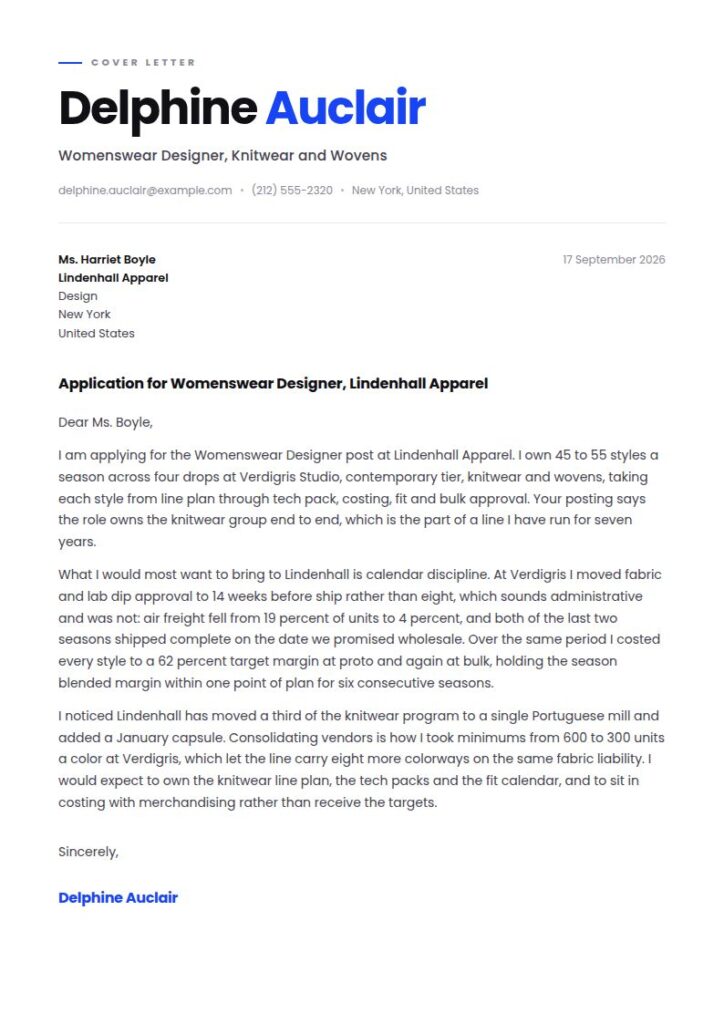
I am applying for the Womenswear Designer post at Lindenhall Apparel. I own 45 to 55 styles a season across four drops at Verdigris Studio, contemporary tier, knitwear and wovens, taking each style from line plan through tech pack, costing, fit and bulk approval. Your posting says the role owns the knitwear group end to end, which is the part of a line I have run for seven years.
What I would most want to bring to Lindenhall is calendar discipline. At Verdigris I moved fabric and lab dip approval to 14 weeks before ship rather than eight, which sounds administrative and was not: air freight fell from 19 percent of units to 4 percent, and both of the last two seasons shipped complete on the date we promised wholesale. Over the same period I costed every style to a 62 percent target margin at proto and again at bulk, holding the season blended margin within one point of plan for six consecutive seasons.
I noticed Lindenhall has moved a third of the knitwear program to a single Portuguese mill and added a January capsule. Consolidating vendors is how I took minimums from 600 to 300 units a color at Verdigris, which let the line carry eight more colorways on the same fabric liability. I would expect to own the knitwear line plan, the tech packs and the fit calendar, and to sit in costing with merchandising rather than receive the targets.
I work in Centric PLM, Gerber AccuMark and CLO 3D, and I own the labeling package for my styles, from fiber content and origin through care instructions with test evidence. I could start within four weeks of an offer. Thank you for reading.
Sincerely, Delphine Auclair
Openings that work
| Instead of | Use |
|---|---|
| I am passionate about fashion and have always loved designing clothes | I own 45 to 55 styles a season across four drops, contemporary womenswear, knitwear and wovens |
| I am writing to express my interest in the designer position | I am applying for the Womenswear Designer post, and the knitwear group is the part of a line I have run for seven years |
| I would love the opportunity to bring my creativity to your team | I noticed Lindenhall has consolidated a third of knitwear to one Portuguese mill and added a January capsule |
Every sentence on the right is checkable. Every one on the left could have been written by someone who has never seen a cost sheet.
What counts as evidence when the work is under embargo
Most designers cannot name the brand, show the season or quote the report. That removes the logo and leaves what matters.
| Kind of evidence | What it looks like in a sentence |
|---|---|
| Volume and cadence | Owned 45 to 55 styles a season across four drops, contemporary tier |
| Calendar | Moved fabric approval from 8 to 14 weeks before ship; air freight fell from 19 percent of units to 4 percent |
| Costing | Costed to a 62 percent target margin at proto and bulk, blended margin within one point of plan |
| Commercial | Full-price sell-through of 71 percent across the season |
None of that names a brand and all of it is specific. A described engagement with numbers is more persuasive than a logo the reader cannot verify.
Brand, wholesaler or freelance: what changes
For a brand, lead with the category and the calendar, and say which gates you would own. For a wholesaler or private label program, lead with volume and cost discipline, because the job is throughput at a price. For freelance technical design, say exactly what a package includes and where it ends: tech pack only, tech pack plus fit, or development through top-of-production. Name one real thing about their line.
Do not open with a design philosophy. Do not send the same letter to a mass-market program and a contemporary label; they want opposite instincts about cost. Do not attach a full portfolio PDF to a first email. Do not claim a margin or sell-through figure you cannot source. Do not call yourself passionate about fashion.
A flat occupation where the money is in which industry you sit in
Employment of fashion designers was 32,700 in 2025 and is projected at 32,800 in 2035, a change of 0 percent, with about 2,500 openings a year over the decade (BLS Occupational Outlook Handbook, fashion designers, 2025 to 2035 projections published 27 August 2026).
The pay spread by industry is wider than the title suggests. May 2025 medians run from $43,020 in retail trade to $79,040 in apparel manufacturing, $91,020 among apparel, piece goods and notions merchant wholesalers, and $105,350 in management of companies and enterprises, against an occupation median of $80,960 (same source).
Two things follow. There is no growth to ride, so almost every opening is a replacement and you are compared with a specific person who left. And the move that pays is lateral, toward wholesale and corporate, where the reader assesses production competence rather than taste.
Length, format and sending it
One page, four paragraphs, 250 to 400 words, sent as a PDF named for yourself and the post.
Address a person. Design leadership is usually findable on a brand's own site or in trade coverage, and "Dear Hiring Manager" on an otherwise specific letter reads as one of twelve sent that morning.
Send a portfolio link rather than an attachment, with its first pages in the category the job is hiring for. Use the same figures as your resume so the two agree. Our fashion designer resume example is written with the numbers used here.
Key takeaways
- Open with volume, cadence and category, so the reader can size you in one line.
- Give one calendar outcome and one costed number, both with a time frame.
- Name the gates you would own, not "concept to production".
- Say one checkable thing about their line, taken from their own pages.
- Name the PLM and pattern system, because onboarding cost is a real factor.
- Describe embargoed work by category, tier and scale instead of by brand.
- Address a named person and link the portfolio rather than attaching it.
Write your fashion designer cover letter in 10 minutes with our AI cover letter builder.
Fashion designer cover letter questions, answered
How long should a fashion designer cover letter be?
One page, four paragraphs, 250 to 400 words. Directors read these alongside a portfolio link, and the letter is the fast, factual half of that pair.
Do I need a cover letter if I am sending a portfolio?
Yes, and they answer different questions. The portfolio shows whether the reader likes your eye; the letter shows whether you can run a season. Sending only the first leaves the second question unanswered, and it decides most commercial hires.
What do I write with no industry experience yet?
Write your technical work as work. A senior collection is a development project with a style count, fit rounds, patterns you drafted, grading you did and fabrics you sourced at a cost. Add internship or sample room work with volume attached, and name the software. A new designer who can write a tech pack is useful on day one.
Should I put numbers in a creative cover letter?
Yes. Margin, sell-through, style counts, minimums and calendar dates are what the business is judged on, and quoting them separates a designer from a design student. Only use figures you can source and defend.
How do I write to a brand I do not know well?
Spend twenty minutes on their own material: the shop pages, the care labels visible in product photography, any press about sourcing, and the posting itself. One accurate sentence about what they are actually doing, such as a mill consolidation or a new capsule, beats a paragraph of admiration, and it cannot be reused in the next letter.