Wedding Second Shooter Aubrey Sandoval
Second Shooter, Weddings
[email protected] | (615) 555-1471 | Nashville, United States
Profile
Second shooter with two years on wedding days, covering 44 weddings alongside lead photographers at guest counts from 60 to 320. Work the getting-ready room, the reception detail coverage and the second angle on the ceremony, shooting to a written shot list and delivering culled, backed-up cards to the lead before leaving the venue. Own two dual-slot bodies, a 35mm and 85mm prime pair and two off-camera flashes, and carry my own general liability coverage.
Work Experience
01/2015 - 03/2017, Second Shooter, Weddings, Freelance, engaged by lead wedding photographers, Nashville, United States
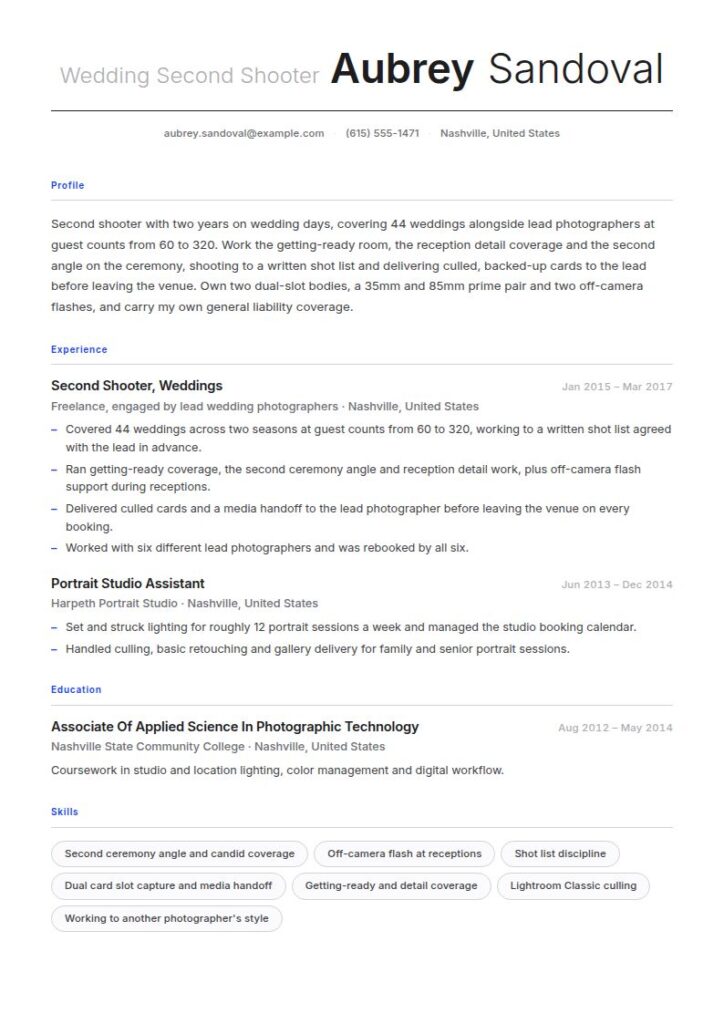
- Covered 44 weddings across two seasons at guest counts from 60 to 320, working to a written shot list agreed with the lead in advance.
- Ran getting-ready coverage, the second ceremony angle and reception detail work, plus off-camera flash support during receptions.
- Delivered culled cards and a media handoff to the lead photographer before leaving the venue on every booking.
- Worked with six different lead photographers and was rebooked by all six.
06/2013 - 12/2014, Portrait Studio Assistant, Harpeth Portrait Studio, Nashville, United States
- Set and struck lighting for roughly 12 portrait sessions a week and managed the studio booking calendar.
- Handled culling, basic retouching and gallery delivery for family and senior portrait sessions.
Education
08/2012 - 05/2014, Associate of Applied Science, Photographic Technology, Nashville State Community College, Nashville, United States
Coursework in studio and location lighting, color management and digital workflow.
Skills
Second ceremony angle and candid coverage, 80
Off-camera flash at receptions, 75
Shot list discipline, 85
Dual card slot capture and media handoff, 85
Getting-ready and detail coverage, 80
Lightroom Classic culling, 70
Working to another photographer's style, 75
Languages
English, native
Certificates
02/2015, General liability coverage, own policy, Licensed insurance agent, Tennessee
Carried independently so venue certificates can be issued without relying on the lead photographer's policy.
Summary
A wedding photographer resume is a one to two page document about running a small business on dates that cannot move: weddings booked a year, package and pricing structure, what the contract covers, how capture is made redundant, and what gets delivered and when. This guide gives you three adaptable versions and current Bureau of Labor Statistics pay and outlook.
Wedding Photographer resume examples by experience level
In short, a wedding photographer resume is a one to two page document about running a business on dates that cannot move.
In contrast, every other photography job has a reshoot in it somewhere. This one does not. A studio owner hiring a lead, or a couple comparing three quotes, is reading for whether you have a system that survives a failed card, a sick photographer, a ceremony that starts 40 minutes late and a venue that will not admit an uninsured supplier. The file that answers that in writing beats the one with nicer pictures, because the pictures are on your site already.
Resume guide for a wedding photographer resume
In particular, this guide and the corresponding wedding photographer resume example will cover:
- How to write a wedding photographer resume, section by section
- Why volume, packages and turnaround belong above the portfolio
- Three adaptable summaries: second shooter, lead photographer and studio owner
- How to write redundancy, contract terms and insurance without giving advice
- What the market looks like and what you can expect to earn
How to write a wedding photographer resume
Six sections: contact header with a portfolio link, summary, the business you run, wedding experience, skills and kit, then education, certifications and insurance. Use one page as a second shooter, then two once you carry your own bookings, contract and coverage.
In practice, the order is a hiring order instead of a creative one: volume and reliability first, images second, taste third. That feels wrong to most photographers, which is why so few files in this field get read past the header.
| Section | What it is answering | Where it goes |
|---|---|---|
| The business you run | How many weddings, what package, what turnaround? | Directly under the summary |
| Wedding experience | What have you covered, at what size and in what role? | Reverse chronological, with wedding counts |
| Skills and kit | Can you work a dark reception on your own equipment? | Grouped, with dual-card bodies named |
| Certifications and insurance | Will a venue and a studio owner let you work? | Short, at the foot, with coverage type named |
Put the number of weddings on the page, by year and by role
"Experienced wedding photographer" is unreadable. Volume is the whole story, because in this work experience is measured in days that cannot be repeated.
Write it three ways: how many weddings you have photographed in total, how many you shot last year, and how they split between lead and second shooter. "184 weddings since 2016, 31 last year, 26 as lead and 5 as second" is a career in one line.
Then add the shape of the day: typical coverage hours, guest counts, and whether you handle multi-day or multi-event celebrations. A studio hiring a lead for 300-guest Saturdays is checking whether you have already worked that size.
Run the finished file through the ATS resume checker before you send it. Studio and hospitality-group postings are collected through parsing systems, and the designer templates photographers reach for are what those systems break on.
Choosing the best resume format for a wedding photographer resume
Go reverse chronological; in addition, promote a business block above the experience list. Two thirds of photographers are self-employed (BLS Occupational Outlook Handbook, photographers, page last modified 27 August 2026), so most people here have very few employers and a great many bookings, and a plain employment history describes almost none of the work.
Skills-based formats fail here because the reader is testing continuity. Weddings are seasonal, and someone who shot 30 a year for six years and someone who shot 12 once are not comparable, however similar their skill lists look.
Include your contact information
| ✅ Right | ❌ Wrong |
|---|---|
| Aubrey Sandoval | Aubrey Sandoval |
| Wedding photographer: 184 weddings since 2015, 31 last season | Passionate about capturing your special day |
| Portfolio: aubreysandoval.example.com | Portfolio available upon request |
| $2,000,000 general liability, certificate issued in one business day | Fully insured |
| (615) 555-1471, [email protected], Nashville, TN | (615) 555-1471, [email protected] |
Also, the insurance line belongs in the header instead of buried at the foot. Many venues will not admit a supplier who cannot produce a certificate, and leading with it answers a gate question before anyone has to ask.
Make use of a summary
Keep it to four lines: volume, the role you work in, what the deliverable and the turnaround are, and finally the thing that makes you safe to book.
Second shooter with two years on wedding days, covering 44 weddings alongside lead photographers at guest counts from 60 to 320. Work the getting-ready room, the reception detail coverage and the second angle on the ceremony, shooting to a written shot list and delivering culled, backed-up cards to the lead before leaving the venue. Own two dual-slot bodies, a 35mm and 85mm prime pair and two off-camera flashes, and carry my own general liability coverage.
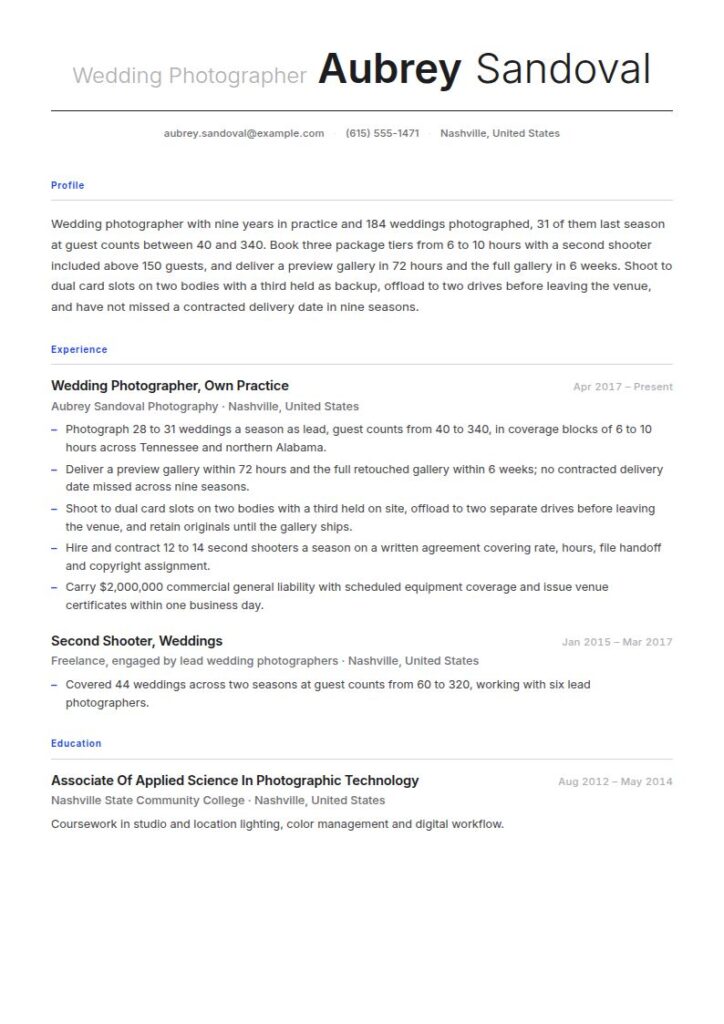
Wedding photographer with nine years in practice and 184 weddings photographed, 31 of them last season at guest counts between 40 and 340. Book three package tiers from 6 to 10 hours with a second shooter included above 150 guests, and deliver a preview gallery in 72 hours and the full gallery in 6 weeks. Shoot to dual card slots on two bodies with a third held as backup, offload to two drives before leaving the venue, and have not missed a contracted delivery date in nine seasons.
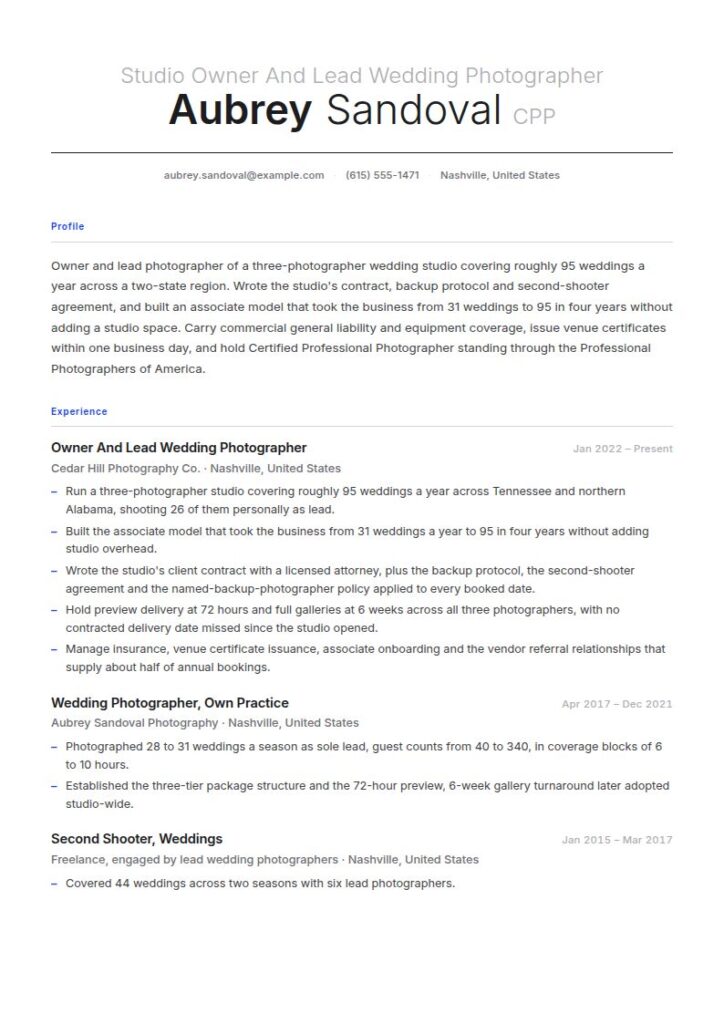
Owner and lead photographer of a three-photographer wedding studio covering roughly 95 weddings a year across a two-state region. Wrote the studio's contract, backup protocol and second-shooter agreement, and built an associate model that took the business from 31 weddings to 95 in four years without adding a studio space. Carry commercial general liability and equipment coverage, issue venue certificates within one business day, and hold Certified Professional Photographer standing through the Professional Photographers of America.
Right vs wrong: the same wedding photographer summary, twice
| ✅ Right | ❌ Wrong |
|---|---|
| 184 weddings photographed, 31 of them last season at guest counts between 40 and 340. | Years of experience capturing beautiful weddings. |
| Preview gallery in 72 hours, full gallery in 6 weeks, no missed delivery date in nine seasons. | Fast turnaround and stunning edits. |
| Dual card slots on two bodies with a third held, offloaded to two drives before leaving the venue. | Professional equipment and backup systems. |
The right column, for example, is a business somebody can buy from or hire into. The left column, on the other hand, is a feeling, and every competing file has the same one.
Outline your wedding experience
Then give your role, the studio or your own practice, dates, and the remit in one line. Then three to five bullets carrying counts, turnarounds or a business result.
| Instead of | Use |
|---|---|
| Photographed many weddings | Photographed 31 weddings last season as lead, at guest counts from 40 to 340 |
| Delivered images to happy clients | Delivered preview galleries in 72 hours and full galleries in 6 weeks, no contracted date missed in nine seasons |
| Worked with a second shooter | Hired, briefed and contracted 14 second shooters across the season, with copyright assignment written into each agreement |
| Used professional backup practices | Shot to dual card slots on two bodies, offloaded to two drives before leaving the venue, and held cards until the gallery shipped |
| Managed bookings and payments | Ran three package tiers with a retainer, a payment schedule and a written postponement clause across 31 contracts |
Wedding Photographer, own practice, Nashville, TN, April 2017 to Present. Full-service wedding coverage across Tennessee and northern Alabama.
Photograph 28 to 31 weddings a season as lead, guest counts from 40 to 340, in coverage blocks of 6 to 10 hours with a second shooter included above 150 guests.
Deliver a preview gallery within 72 hours and the full retouched gallery within 6 weeks; no contracted delivery date missed across nine seasons.
Shoot to dual card slots on two bodies with a third body held in the car, offload to two separate drives before leaving the venue, and retain original cards until the gallery ships.
Hire and contract 12 to 14 second shooters a season on a written agreement covering rate, hours, file handoff and copyright assignment.
Carry $2,000,000 commercial general liability with scheduled equipment coverage and issue venue certificates within one business day.
The date cannot move: redundancy, the contract and the certificate
However, this is the section that separates a wedding photographer from a photographer who sometimes shoots weddings, and almost nobody writes it down.
In fact, everything else in photography has a second attempt available. A wedding, however, has one ceremony, at one time, with people who will not reassemble. The professional apparatus here is operational rather than aesthetic, and it has three parts worth stating on a resume.
Capture redundancy
Two dual-slot bodies in use with a third body and a spare flash held on site. Every frame written to two cards simultaneously.
Media handling: cards offloaded to two separate drives before leaving the venue, originals retained until the full gallery has shipped, working files held for 12 months after delivery.
Coverage continuity: named backup photographer agreed in writing for every booked date, with contact details held by the couple.
Contract and terms
Written agreement on every booking covering the date and coverage hours, the retainer and payment schedule, delivery windows, postponement and cancellation, image usage and the limit of liability. Terms reviewed by a licensed attorney in the state where the business operates.
Insurance
$2,000,000 commercial general liability with scheduled equipment coverage. Certificate of insurance naming a venue as additional insured issued within one business day.
Redundancy is the part that is purely yours to control. Dual card slots, a third body, a written backup photographer and an offload before you sleep are four sentences, and they answer the question a studio owner or a couple is too polite to ask directly.
Contracts and the FTC Cooling-Off Rule
The contract is a legal document, and a resume should point at it rather than explain it. Say what your agreement covers, and say it was drafted or reviewed by a licensed attorney in your state. Consumer contract rules vary by state and by how the sale was made, so legal conclusions do not belong on a resume.
One federal rule is worth knowing about, because wedding bookings are often signed at a client's kitchen table. Specifically, the Federal Trade Commission's Cooling-Off Rule gives a buyer three days to cancel certain sales made somewhere other than the seller's permanent place of business, with the deadline at midnight of the third business day. It covers sales at a buyer's home, workplace or a temporary location such as a hotel room or convention center, does not apply below $25 at the buyer's home or $130 at a temporary location, and requires the seller to hand over a dated contract or receipt plus two copies of a cancellation form (Federal Trade Commission, page last modified 9 December 2025). Whether it reaches a given booking is a question for a lawyer, but a photographer who has heard of it is ahead of most.
Insurance is a gate, so name the coverage rather than the word. "Fully insured" means nothing to a venue coordinator. The Small Business Administration describes general liability as protection against financial loss from bodily injury, property damage, medical expenses, libel, slander, lawsuit defense and judgments, alongside commercial property coverage and a business owner's policy that bundles common coverages, and notes that some states require additional insurance and that you should work with a licensed agent (U.S. Small Business Administration, page last updated 28 August 2026). Say which you carry, at what limit, and how fast a certificate goes out.
Build a snapshot of your key skills
In practice, list twelve to sixteen entries in four groups: the wedding day, post-production, the business, and the kit. A studio reads the business group hardest, because shooting is the part they assume you can do.
Wedding day: Timeline building with planners and coordinators, Family formal list management, Ceremony coverage in low light and restricted positions, Off-camera flash at receptions, First look and portrait direction, Second shooter briefing
Post-production: Culling and preview selection, Lightroom Classic catalog and preset consistency, Skin and dress tone correction, Album design and revision rounds, Gallery delivery and archiving
Business: Package and pricing structure, Contracts and payment schedules, Booking calendar and date holds, Associate photographer management, Venue certificate issuance, Vendor referral relationships
Kit: Two dual-slot full-frame bodies plus a held third, 24-70mm and 70-200mm zooms, 35mm and 85mm primes, four off-camera flashes with triggers, two field drives
List your education, certifications and insurance
Finally, keep it short, at the foot, and weighted toward what a venue or a studio can verify. The typical entry-level education is a high school diploma or equivalent with moderate-term on-the-job training (BLS Occupational Outlook Handbook, photographers, page last modified 27 August 2026), so a degree is optional and checkable items carry the weight.
Certified Professional Photographer, Professional Photographers of America, 2020, renewed 2023.
Associate of Applied Science, Photographic Technology, Nashville State Community College, Nashville, TN, 2014.
Insurance: commercial general liability $2,000,000 per occurrence with scheduled equipment coverage; venue certificates issued within one business day.
Business: sole proprietorship registered in Tennessee, 2017. Contracts drafted with a licensed attorney and reviewed annually.
Memberships: Professional Photographers of America since 2018.
If you run your own bookings you are running a business. The Internal Revenue Service states that you generally must file if your net earnings from self-employment were $400 or more, that sole proprietors report business income or loss on Schedule C and compute Social Security and Medicare tax on Schedule SE, and that self-employed people usually make quarterly estimated payments on Form 1040-ES because no employer withholds for them (Internal Revenue Service, page last reviewed 28 June 2026). None of that goes on the page, but it is the difference between a second shooter and a business owner, and the resume should sound like whichever you are.
Choose the right layout and design
Single column, plain type at 11 or 12 point, no images, no script fonts, no self-portrait. This is the market where photographers are most tempted to design the resume like a brand asset, and the market where the reader is most likely to be a venue manager or a planner comparing suppliers on a phone. Keep the portfolio URL in plain text as well as hyperlinked, and name the file plainly: aubrey-sandoval-wedding-photographer-resume.pdf.
Give wedding counts by year and by role, and guest count ranges. State coverage hours and package structure. Write preview and full gallery turnaround as dates you have met. Name your capture redundancy in one line. Say what insurance you carry, at what limit, and how fast a certificate goes out. Point at your attorney for contract terms rather than explaining them.
Do not name a couple, a family or a venue, and do not describe an identifiable event. Do not write "fully insured" without the coverage type and limit. Do not promise unlimited coverage hours, unlimited edits or unlimited revisions. Do not submit a design-led template that a studio applicant system will mangle. Do not put legal conclusions about a contract on a resume.
Wedding photographer job market and outlook
However, the Bureau of Labor Statistics publishes no Occupational Outlook Handbook profile for wedding photographer. The Handbook covers broad occupations rather than job titles, and this work sits inside the published photographers profile, which also contains portrait, commercial, scientific and news photography.
| Measure | Photographers (published profile) |
|---|---|
| Employment, 2025 | 145,000 |
| Projected employment, 2035 | 144,000 |
| Projected change, 2025-35 | -1% (decline), -1,000 jobs |
| Projected annual openings | ~10,700 |
| Typical entry-level education | High school diploma or equivalent |
| Median annual wage, May 2025 | $44,660 |
Source: U.S. Bureau of Labor Statistics, Occupational Outlook Handbook, photographers, page last modified 27 August 2026, May 2025 wage data and 2025 to 2035 projections.
Two million dates a year, and almost no employers
The demand side of this market is a count of ceremonies. There were 2,041,926 marriages in the United States in 2023, a rate of 6.1 per 1,000 population (CDC National Center for Health Statistics, page last reviewed 17 March 2025).
The Knot's 2026 Real Weddings Study, which surveyed 10,474 US couples married in 2025, put the overall average wedding cost at $34,200 and average spending on a wedding photographer at $3,000 (The Knot, 2026 Real Weddings Study).
The supply side looks nothing like a job market: BLS puts self-employed workers at 67 percent of photographers, with photographic services at 17 percent of employment (BLS Occupational Outlook Handbook, photographers, page last modified 27 August 2026).
So for most people reading this the resume is not going to an employer. It is read by a studio owner deciding whether to send you out under their name, or by a couple deciding whether to give you a date they cannot get back. Volume, turnaround, redundancy and insurance are what both readers want.
Next, here is where the employed third of the occupation sits, and what those settings pay by the hour:
| Industry | Share of employment | Median hourly wage (May 2025) |
|---|---|---|
| Self-employed workers | 67% | Not published |
| Photographic services | 17% | $18.84 |
| Publishing, broadcasting and content providers | 4% | $30.04 |
| Arts, entertainment and recreation | 3% | $18.47 |
| Retail trade | 2% | $18.82 |
Source: U.S. Bureau of Labor Statistics, Occupational Outlook Handbook, photographers, May 2025.
What salary you can expect as a wedding photographer
In other words, there is no published wage for the title. Across the photographers occupation as a whole, the median was $44,660 a year, or $21.47 an hour, as of May 2025, with the lowest 10 percent under $14.82 an hour and the highest 10 percent over $44.14 an hour (BLS Occupational Outlook Handbook, page last modified 27 August 2026). BLS publishing the tails as hourly figures rather than annual ones is itself a signal: the hours are seasonal and uneven, and an annual number would describe a year very few people work.
For a wedding photographer the arithmetic is different anyway: weddings booked, times average package value, minus the cost of doing business, which includes second shooter fees, insurance, gear replacement, software, hosting, travel and self-employment tax. Even so, four things on the page move that number.
Package structure. Tiers with defined coverage hours turn an open-ended day into a priced one, and make a longer day an upgrade rather than a favor.
The second shooter line. A second shooter included above a stated guest count is priced coverage rather than unpaid risk, and it is what lets you take 300-guest bookings at all.
Turnaround as a commitment. A stated preview and gallery window with a record of meeting it is the strongest referral argument you have with planners and venues.
Associate capacity. Moving from shooting every date yourself to running associates changes the ceiling, because the business stops being limited to the Saturdays one person can work.
Key takeaways for a wedding photographer resume
- Lead with weddings photographed: total, last year, and the split between lead and second.
- First, give coverage hours, guest count ranges and package structure.
- Then state preview and full gallery turnaround as commitments you have met.
- Write your capture redundancy: dual slots, a held body, two drives before leaving.
- Also name the insurance type and limit and how fast you can issue a certificate.
- Finally, point at your attorney for contract terms instead of arguing law on a resume.
- Keep the file single column, and keep the pictures on your site.
Build your wedding photographer resume in 15 minutes with our AI resume builder.
Related creative and artistic resume examples
- Photographer resume
- Videographer resume
- Cinematographer resume
- Floral designer resume
- Fashion designer resume
- Jewelry designer resume
- Illustrator resume
- Visual artist resume
- Musician resume
- Artist resume
- Barber resume
- Modeling resume
Pair it with a matching wedding photographer cover letter.
Wedding photographer resume questions, answered
How long should a wedding photographer resume be?
One page as a second shooter. Two once you carry your own bookings, your own contract and your own insurance, because by then the business block, the season counts and the terms are the point. The gallery is separate and does not count toward the page limit.
How many weddings should I list?
None individually. List counts, not events: total weddings photographed, weddings last season, the split between lead and second shooter, and guest count ranges. Naming couples or venues is a privacy problem and it takes space from the numbers that actually persuade.
What do I put on a wedding photographer resume with no weddings yet?
Second shooting, written as work: how many days, alongside how many leads, what you were responsible for, and what you handed over before leaving the venue. Then your kit with the dual card slots named, your own liability coverage if you carry it, and any portrait or event volume. A studio hiring a second shooter is checking whether you are safe on a day that cannot be repeated.
Do I need insurance to photograph weddings?
Many venues require a certificate of insurance before they will admit a supplier, so in practice it is a gate on the work. What coverage you need is a question for a licensed agent; the Small Business Administration describes the common types, including general liability, commercial property and a business owner's policy, and notes that some states require additional insurance (U.S. Small Business Administration, page last updated 28 August 2026).
Should I put my prices on my resume?
No. Put structure on the resume and prices on your site or your quote. "Three tiers from 6 to 10 hours, second shooter included above 150 guests" tells a studio owner how you work without anchoring a negotiation, and a couple comparing suppliers will find the number where they expect it.
How do I show reliability when every photographer claims it?
With dates and counts: seasons worked, weddings per season, contracted delivery dates met, and the redundancy you run written as a procedure rather than a promise. "Two dual-slot bodies, offloaded to two drives before leaving the venue" is checkable in a conversation. "Reliable and professional" is not.