Bench Jeweler and Junior Designer Cedric Amponsah
Bench Jeweler and Junior Designer
[email protected] | (828) 555-1575 | Asheville, United States
Profile
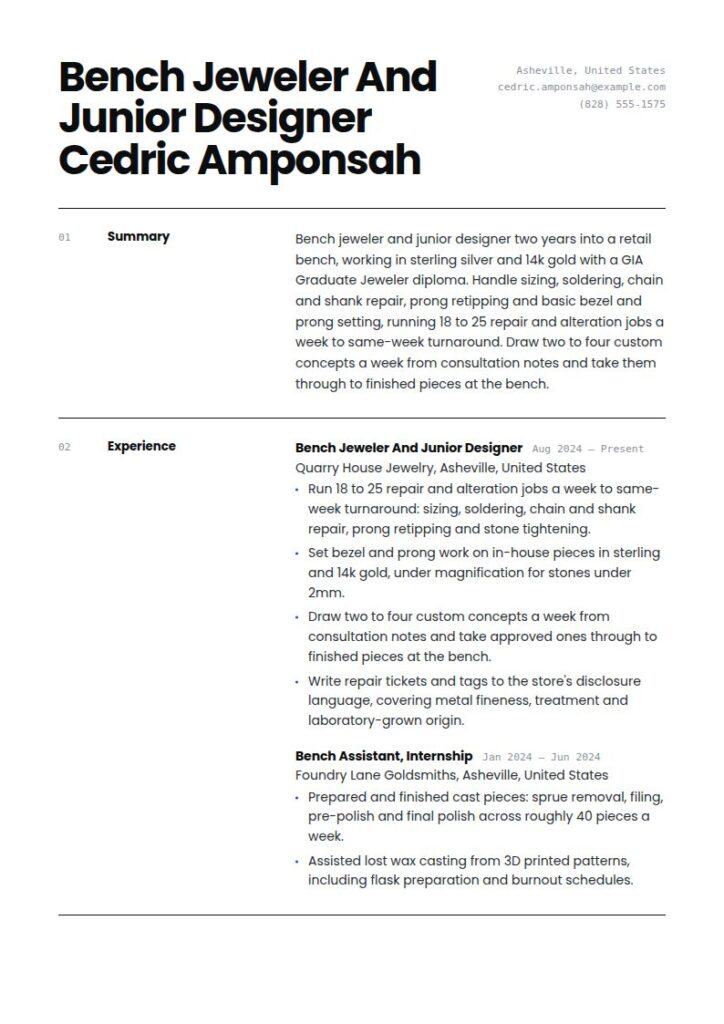
Bench jeweler and junior designer two years into a retail bench, working in sterling silver and 14k gold with a GIA Graduate Jeweler diploma. Handle sizing, soldering, chain and shank repair, prong retipping and basic bezel and prong setting, running 18 to 25 repair and alteration jobs a week to same-week turnaround. Draw two to four custom concepts a week from consultation notes and take them through to finished pieces at the bench.
Work Experience
08/2024 - Present, Bench Jeweler and Junior Designer, Quarry House Jewelry, Asheville, United States
- Run 18 to 25 repair and alteration jobs a week to same-week turnaround: sizing, soldering, chain and shank repair, prong retipping and stone tightening.
- Set bezel and prong work on in-house pieces in sterling and 14k gold, under magnification for stones under 2mm.
- Draw two to four custom concepts a week from consultation notes and take approved ones through to finished pieces at the bench.
- Write repair tickets and tags to the store's disclosure language, covering metal fineness, treatment and laboratory-grown origin.
01/2024 - 06/2024, Bench Assistant, internship, Foundry Lane Goldsmiths, Asheville, United States
- Prepared and finished cast pieces: sprue removal, filing, pre-polish and final polish across roughly 40 pieces a week.
- Assisted lost wax casting from 3D printed patterns, including flask preparation and burnout schedules.
Education
08/2023 - 03/2024, Graduate Jeweler diploma, Jewelry fabrication and repair, Gemological Institute of America, Carlsbad, United States
Fabrication, stone setting, soldering, finishing and repair.
08/2019 - 05/2023, Bachelor of Fine Arts, Studio Art, metals and jewelry concentration, Appalachian State University, Boone, United States
Degree show collection of 9 styles in sterling and brass.
Skills
Fabrication and soldering, 80
Sizing, shank and chain repair, 85
Prong retipping and stone tightening, 80
Bezel and prong setting, 70
Finishing and polishing, 85
Hand drawing and rendering, 80
Metal fineness and quality marking, 75
Languages
English, native
Twi, native
Certificates
03/2024, Graduate Jeweler diploma, Gemological Institute of America
Fabrication, stone setting, soldering, finishing and repair.
Summary
A jewelry designer resume is a one to two page document stating which parts of a piece you design, which you fabricate at the bench, and what your materials actually are. This guide gives you three adaptable versions, the maker against designer split that decides most hires, the disclosure rules the trade works under, and current Bureau of Labor Statistics pay and outlook.
Jewelry Designer resume examples by experience level
In short, a jewelry designer resume is a one to two page document answering one question early: how much of the piece do you make yourself?
A studio hiring a designer who also sets stones is buying a different person from one hiring a designer who sends everything to a casting house. Both are legitimate careers, and a resume that leaves the reader guessing gets sorted into the wrong pile.
Resume guide for a jewelry designer resume
In particular, this guide and the corresponding jewelry designer resume example will cover:
- How to write a jewelry designer resume, section by section
- The maker against designer split, and how to state yours without hedging
- Three adaptable summaries: bench assistant, designer-maker and studio owner
- How to write materials accurately, under the rules the trade is held to
- What the job market looks like and what you can expect to earn
How to write a jewelry designer resume
Use six blocks: a contact header with one portfolio link, summary, bench and process skills, work history with the work split named, collections and production, and finally education with credentials. Use one page early on, then two once you have collections, wholesale accounts and a bench worth describing.
Bench skills go above design language. Design intent is hard to verify from a resume; however, a stone setting list is not.
| Section | What it is answering | Where it goes |
|---|---|---|
| Work split | What do they make, and what do they send out? | Summary, then repeated in every job entry |
| Bench and process | Which operations can I hand them tomorrow? | Its own block, grouped by process |
| Materials | Can they describe metal and stone accurately and legally? | Inside experience, in the specifics |
| Collections and runs | Do they think in pieces or in seasons? | Its own section with sizes and dates |
Run the finished file through the ATS resume checker before you send it. Retail groups, manufacturers and wholesalers all parse applications before a person opens them.
Choosing the best resume format
Also go reverse chronological: one page for your first five years, two once you have collections, wholesale accounts or a production line to describe.
In addition, keep the portfolio separate, on one link in the header. After all, an image-heavy resume file is the wrong place for a visual argument: it breaks in a parser, prints badly, and competes with the portfolio it should point at.
Include your contact information
| ✅ Right | ❌ Wrong |
|---|---|
| Cedric Amponsah | Cedric Amponsah |
| Designer and Bench Jeweler, GIA Graduate Gemologist | Creative jewelry artist with a passion for beauty |
| Fabrication, lost wax casting, stone setting, CAD to 3D print | Handmade jewelry, custom designs, unique pieces |
| (828) 555-1575, [email protected], Asheville, NC | (828) 555-1575, [email protected] |
Put the credential in the header if you hold one. For example, GIA awards a Graduate Gemologist diploma covering diamond grading, colored stone identification, gem identification, instrumentation, treatments and laboratory-grown gems, and a separate Graduate Jeweler diploma covering fabrication, stone setting, soldering, finishing and repair (GIA, retrieved 17 September 2026). In other words, those are different qualifications, and a trade reader knows exactly what each one means.
Make use of a summary
Keep it to four lines: what you design, what you make yourself, the materials, and also one number tied to production or sales.
Bench jeweler and junior designer two years into a retail bench, working in sterling silver and 14k gold with a GIA Graduate Jeweler diploma. Handle sizing, soldering, chain and shank repair, prong retipping and basic bezel and prong setting, running 18 to 25 repair and alteration jobs a week to same-week turnaround. Draw two to four custom concepts a week from consultation notes and take them through to finished pieces at the bench.
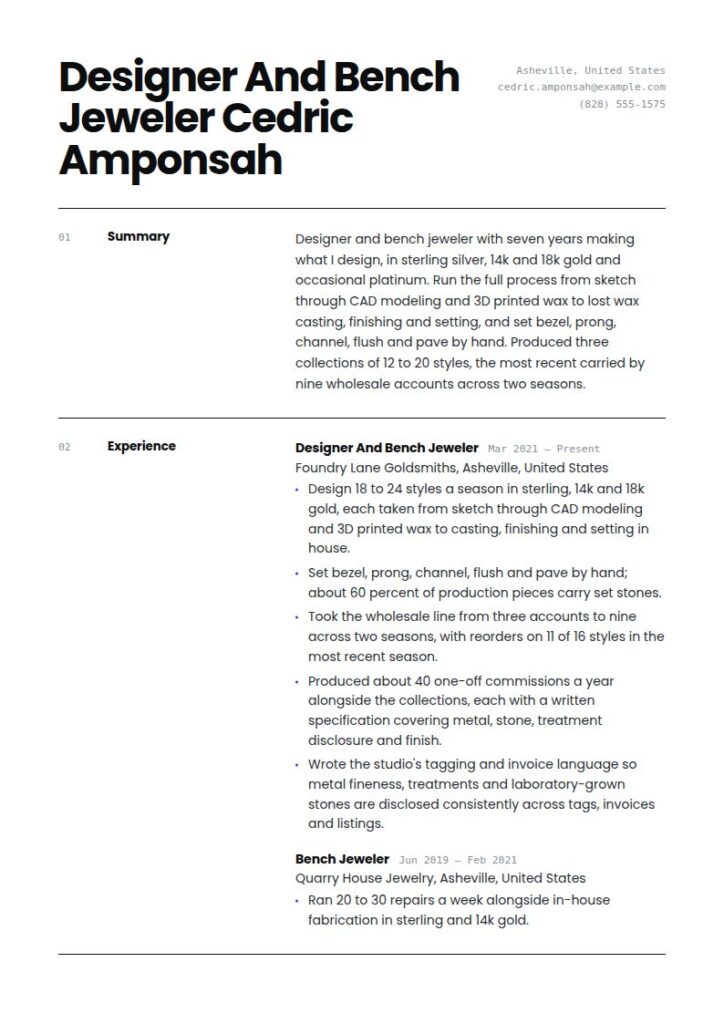
Designer and bench jeweler with seven years making what I design, in sterling silver, 14k and 18k gold and occasional platinum. Run the full process from sketch through CAD modeling and 3D printed wax to lost wax casting, finishing and setting, and set bezel, prong, channel, flush and pave by hand. Produced three collections of 12 to 20 styles, the most recent carried by nine wholesale accounts across two seasons.
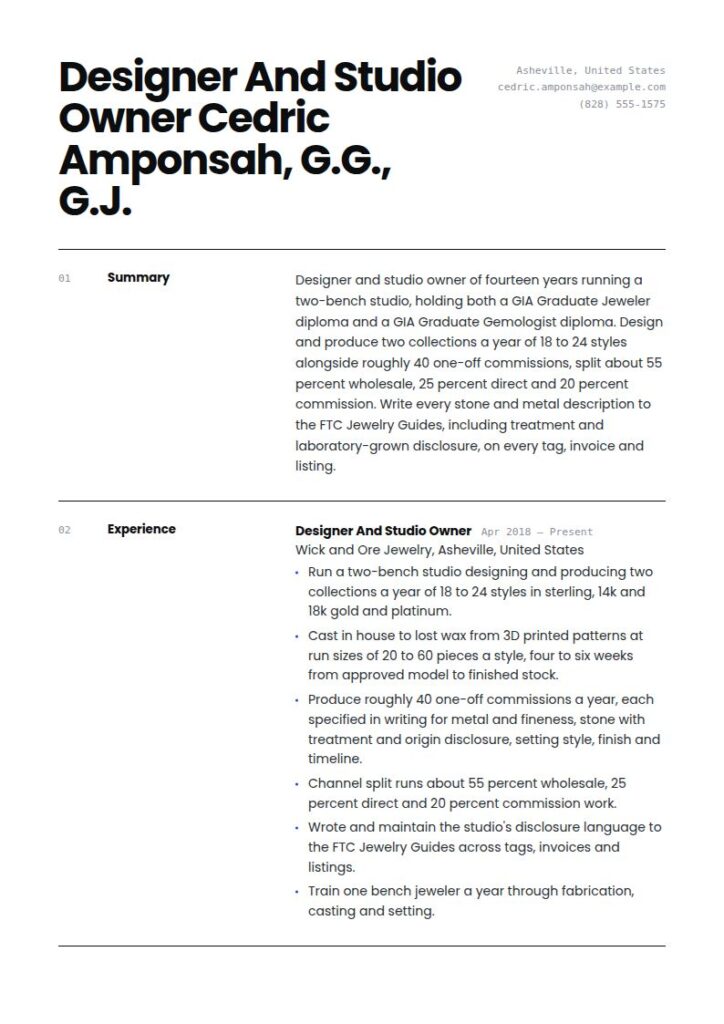
Designer and studio owner of fourteen years running a two-bench studio, holding both a GIA Graduate Jeweler diploma and a GIA Graduate Gemologist diploma. Design and produce two collections a year of 18 to 24 styles alongside roughly 40 one-off commissions, split about 55 percent wholesale, 25 percent direct and 20 percent commission. Write every stone and metal description to the FTC Jewelry Guides, including treatment and laboratory-grown disclosure, on every tag, invoice and listing.
Right vs wrong: the same jewelry designer summary, twice
| ✅ Right | ❌ Wrong |
|---|---|
| Designer and bench jeweler with seven years making what I design. | Creative jewelry designer with a passion for beautiful, meaningful pieces. |
| Sketch through CAD modeling and 3D printed wax to casting, finishing and setting. | Experienced with the full design and production process. |
| Three collections of 12 to 20 styles, the most recent carried by nine wholesale accounts. | Designed multiple successful collections for a range of clients. |
The right column, for example, can be checked against a portfolio in a minute. The left column, on the other hand, could be written by someone who has never touched a torch, which is why a reader discounts it.
Outline your experience
Next, give the studio, retailer or manufacturer, city, role, dates. Then three to five bullets, each naming a process, a material or a volume and carrying a number. In addition, name the work split inside the entry: "designed and fabricated in house" and "designed in house, cast and set by an outside shop" are both respectable sentences, and the difference between them is what the reader is trying to establish.
| Instead of | Use |
|---|---|
| Designed jewelry for a retail brand | Designed 18 styles a season in sterling and 14k, casting in house and setting by hand |
| Skilled in jewelry making techniques | Fabricate, cast to lost wax from 3D printed patterns, and set bezel, prong, channel, flush and pave |
| Worked with precious metals and gemstones | Work in sterling, 14k and 18k gold and occasional platinum, with stones sourced against written treatment disclosure |
| Helped grow the business | Took the wholesale line from three accounts to nine across two seasons, with reorders on 11 of 16 styles |
| Handled repairs | Ran 18 to 25 repairs a week, including sizing, retipping, shank replacement and stone tightening, to same-week turnaround |
Designer and Bench Jeweler, Foundry Lane Goldsmiths, Asheville, NC, March 2021 to Present
Design 18 to 24 styles a season in sterling, 14k and 18k gold, each taken from sketch through CAD modeling and 3D printed wax to casting, finishing and setting in house.
Set bezel, prong, channel, flush and pave by hand; about 60 percent of production pieces carry set stones.
Took the wholesale line from three accounts to nine across two seasons, with reorders on 11 of 16 styles in the most recent season.
Produced about 40 one-off commissions a year alongside the collections, each with a written specification covering metal, stone, treatment disclosure and finish.
Wrote the studio's tagging and invoice language so metal fineness, treatments and laboratory-grown stones are disclosed consistently across tags, invoices and listings.
Say who makes the piece, and say what it is made of
Two sentences carry a jewelry resume, and both are about honesty rather than talent. The first says how much of the object you personally make. The second says what the object actually is.
The maker against designer split
However, "jewelry designer" covers at least four jobs, and a hiring manager is working out which one you do.
| The job | What they actually do | What the resume must show |
|---|---|---|
| Bench jeweler | Fabricates, casts, sets and repairs, often to another's design | Operations by name, volume a week, turnaround, materials |
| Designer-maker | Designs and makes the same piece, usually at small scale | The full process chain, with parts sent out named |
| Production designer | Designs for a line others manufacture | CAD files, technical packs, tolerances, sampling rounds, cost targets |
| Design director | Sets range direction and margin, manages designers and vendors | Range sizes, margin, vendor management, seasons delivered |
The Bureau of Labor Statistics records the same spread inside one occupation: jewelers and precious stone and metal workers design, construct, adjust, repair, appraise and sell jewelry, with specializations including bench jewelers, gemologists and appraisers (BLS Occupational Outlook Handbook, page last modified 27 August 2026).
So state it flatly: "designed and fabricated in house," or "designed in house, cast by an outside shop, set in house," or "designed for offshore manufacture with technical packs and three sampling rounds." Nobody thinks less of any of these. What loses interviews is a page that lets a reader assume bench skills you do not have and then discover it at a trade test.
Write the bench as operations, not as adjectives
In fact, a bench list is the most checkable thing on a jewelry resume. Therefore, write the operations by name: fabrication and soldering, chain and shank work, lost wax casting, CAD modeling and 3D printed patterns, stone setting broken down by bezel, prong, channel, flush and pave, finishing and polishing, laser welding, engraving, and repair work by type.
GIA's Graduate Jeweler program is built on that list, covering fabrication of pieces and findings from base and precious metals, stone setting across multiple shapes and styles, soldering, finishing including texture, polish and electroplating, and repair using professional tools including laser welders (GIA, retrieved 17 September 2026). If you hold it, that is the vocabulary a reader expects.
Materials, and the rules the trade is held to
This separates a professional file from an enthusiastic one, because the way jewelry may be described is regulated. Specifically, the Federal Trade Commission's Guides for the Jewelry, Precious Metals, and Pewter Industries, at 16 CFR Part 23, make it unfair or deceptive to misrepresent any material aspect of a product (16 CFR 23.1). That is why the specifics are worth knowing by heart:
| What you are describing | What the guides require |
|---|---|
| Gold | The word "gold" unqualified is deceptive unless a correct karat fineness designation immediately precedes it (16 CFR 23.3(b)(2)) |
| Silver | "Sterling silver" means at least 925/1,000ths pure silver; "coin silver" at least 900/1,000ths (16 CFR 23.5) |
| Platinum | Unqualified "platinum" requires at least 950 parts per thousand; any platinum claim requires at least 500, with clear and conspicuous disclosure of full composition between 500 and 849 (16 CFR 23.6) |
| A partial quality mark | Where a mark applies to only part of a product, the part it applies to should be disclosed if the mark's location would misrepresent composition (16 CFR 23.10(a)(1)) |
| Treated stones | Treatments must be disclosed where they are not permanent, create special care requirements, or significantly affect the stone's value (16 CFR 23.24) |
| Laboratory-grown stones | An unqualified stone name is deceptive unless preceded by "laboratory-created," "laboratory-grown" or "imitation" to show it is not a mined gemstone (16 CFR 23.25(b)) |
Source: Federal Trade Commission, 16 CFR Part 23, retrieved 17 September 2026. Similarly, the National Stamping Act tolerances referenced in the silver guide allow four parts per thousand on articles without solder and ten on articles containing solder.
Showing jewelry disclosure rules on your resume
You do not put regulations on a resume. You put the evidence that you work to them: "wrote the studio's tagging and invoice language so metal fineness, treatments and laboratory-grown stones are disclosed consistently." An employer who has fielded a complaint about an undisclosed treatment reads that line twice.
A small occupation, shrinking, with a third self-employed
Jewelers and precious stone and metal workers held 32,800 jobs in 2025, projected to fall to 31,800 by 2035, a change of -3 percent and -1,100 jobs, with about 3,700 openings a year almost entirely from replacement (BLS Occupational Outlook Handbook, page last modified 27 August 2026).
Entry is a high school diploma or equivalent with long-term on-the-job training and no prior work experience required, and 32 percent of the occupation is self-employed (same source).
Read those together and the strategy is clear. Openings come from people leaving rather than from growth, so the bench list and the credential do more work than in a growing field, and a third of the people reading your file run their own studio rather than a human resources process.
Collections, production runs and one-off commissions
Give this its own short section, because it is how a reader works out your scale and speed. For collections, write the number of styles, the season, the materials and what happened commercially. Then, for production, write run sizes, the casting arrangement and the turnaround. For commissions, write the count a year and the specification process rather than the stories.
Collections: three of 12 to 20 styles, 2022 to 2026, in sterling, 14k and 18k gold. Most recent season carried by nine wholesale accounts, with reorders on 11 of 16 styles.
Production: run sizes of 20 to 60 pieces a style, cast in house to lost wax from 3D printed patterns, four to six week turnaround from approved model to finished stock.
Commissions: about 40 one-off pieces a year, each with a written specification covering metal and fineness, stone with treatment and origin disclosure, setting style, finish and timeline.
Channels: about 55 percent wholesale, 25 percent direct, 20 percent commission.
Build a snapshot of your key skills
In practice, list twelve to fourteen entries in three groups: bench operations, design and digital, and the trade side.
Bench: Fabrication and soldering, Lost wax casting, Stone setting (bezel, prong, channel, flush, pave), Chain and shank work, Prong retipping, Finishing and polishing, Laser welding, Hand engraving
Design and digital: Hand drawing and rendering, CAD modeling, 3D printed wax patterns, Technical packs and specifications, Collection and range planning
Trade and commercial: Metal fineness and quality marking, Treatment and laboratory-grown disclosure, Stone sourcing and written disclosure, Wholesale line sheets and terms, Costing and margin, Studio safety and casting ventilation
List your education and certifications
Trade credentials first, then the degree, then anything in your own name.
Graduate Gemologist diploma, Gemological Institute of America, 2020
Graduate Jeweler diploma, Gemological Institute of America, 2016
Bachelor of Fine Arts, Studio Art with a metals and jewelry concentration, Appalachian State University, Boone, NC, 2012
Continuing education: advanced pave and micro setting, 2025. CAD for production jewelry, 2024. Casting troubleshooting and porosity, 2023.
Gemological credentials are optional rather than licensed, and BLS says so, noting that certifications demonstrating expertise in areas such as gemology are optional (BLS Occupational Outlook Handbook, page last modified 27 August 2026). That is why one belongs in the header: it differentiates rather than merely qualifies.
Choose the right layout and design
Single column, plain type at 11 or 12 point, one portfolio link in the header, no images in the file, PDF unless asked otherwise. Group the bench operations so they scan: a studio owner reading between customers is looking for five words, casting, setting, CAD, repair, finishing.
Say in the summary how much of the piece you make yourself. List bench operations by name, including the setting styles you run. Write metal fineness accurately, by karat or parts per thousand. Disclose treatments and laboratory-grown stones in the guides' own language. Give collection sizes, run sizes and commission counts with dates. Put the GIA credential in the header if you hold one.
Do not write "worked with precious metals and gemstones" when the specifics are the point. Do not describe a stone in a way the FTC guides would not allow. Do not claim bench operations you cannot perform under a trade test. Do not name a client, a gallery or a retailer you have not agreed to name. Do not put images inside the resume file.
Jewelry designer job market and outlook
A small, slowly shrinking occupation where nearly all openings come from replacement rather than growth.
| Measure | Value |
|---|---|
| Jewelers and precious stone and metal workers, jobs in 2025 | 32,800 |
| Projected employment, 2035 | 31,800 |
| Projected change, 2025-35 | -3 percent, -1,100 jobs |
| Projected annual openings | About 3,700 |
| Typical entry-level education | High school diploma or equivalent |
| On-the-job training | Long-term on-the-job training |
| Median annual wage, May 2025 | $52,540, or $25.26 an hour |
Source: U.S. Bureau of Labor Statistics, Occupational Outlook Handbook, May 2025 wage data and 2025 to 2035 projections, page last modified 27 August 2026.
Next, here is where the work sits, and what each setting pays:
| Industry | Share of employment | Median annual wage, May 2025 |
|---|---|---|
| Jewelry, luggage and leather goods retailers | 35 percent | $53,990 |
| Self-employed | 32 percent | Not separately published |
| Jewelry and silverware manufacturing | 15 percent | $48,800 |
| Merchant wholesalers, durable goods | 6 percent | $58,320 |
| Personal and household goods repair | 4 percent | $46,390 |
Source: U.S. Bureau of Labor Statistics, Occupational Outlook Handbook, May 2025 wage data.
One more occupation matters if your work sits further toward art than trade. Craft and fine artists, which BLS describes as including jewelry artists alongside ceramic artists, fiber artists, furniture makers, glass artists and printmakers, had a median of $55,290 a year in May 2025 with 58 percent self-employed (same source). If you are aiming at galleries and shows rather than a retail bench, that is the market you compete in.
What salary you can expect as a jewelry designer
In fact, the median annual wage for jewelers and precious stone and metal workers was $52,540, or $25.26 an hour, as of May 2025. The lowest 10 percent earned less than $35,580 and the highest 10 percent more than $87,540 (BLS Occupational Outlook Handbook, page last modified 27 August 2026).
However, the industry spread is narrow: $58,320 at the top in durable goods wholesaling against $46,390 in personal and household goods repair, a gap of under $12,000 (same source). In other words, setting moves this number far less than it moves a photographer's, so what moves it is the range of operations you can actually run.
Instead, the real variable is the 32 percent who are self-employed, whose reported income is what remains after metal, stones, casting, tools, bench rent, insurance and self-employment tax. Consignment through a gallery, wholesale and direct sales produce three very different margins on the same piece, so a resume naming your channel split tells a reader which business you have been running.
Write the setting list, not the word setting
"Stone setting" on a resume means almost nothing, because it covers work ranging from a simple bezel to micro pave under a scope.
Write the styles you run: bezel, prong, channel, flush, pave, cluster, tension, and whether you set colored stones as well as diamonds. Add the smallest stone size you work comfortably and whether you set under magnification.
A bench manager reading that list knows in seconds which jobs they could hand you on your first morning, which is the entire purpose of a jewelry resume.
Key takeaways for a jewelry designer resume
- First, say in the first two lines how much of the piece you make yourself.
- List bench operations by name, with the setting styles you actually run.
- Then write metal fineness accurately and disclose treatments and laboratory-grown stones.
- Also give collection sizes, run sizes and commission counts, each with dates.
- Similarly, name your channel split: wholesale, direct, gallery, commission.
- Put a GIA credential in the header if you hold one; it is optional, so it differentiates.
- Finally, keep one portfolio link in the header and no images in the file.
Build your jewelry designer resume in 15 minutes with our AI resume builder.
Related creative and artistic resume examples
- Visual artist resume
- Artist resume
- Illustrator resume
- Fashion designer resume
- Tailor resume
- Costume designer resume
- Floral designer resume
- Tattoo artist resume
- Barber resume
- Photographer resume
- Fashion buyer resume
- Landscape designer resume
Pair it with a matching jewelry designer cover letter.
Jewelry designer resume questions, answered
How long should a jewelry designer resume be?
One page for your first five years. Two once you have collections, wholesale accounts or a bench broad enough that listing the operations needs the room.
Do I need a GIA credential to work as a jewelry designer?
No. BLS describes gemology certifications as optional, with entry typically at a high school diploma plus long-term on-the-job training (Occupational Outlook Handbook, page last modified 27 August 2026), which is precisely why holding one stands out. GIA's Graduate Gemologist diploma covers diamond and colored stone grading and identification; the separate Graduate Jeweler diploma covers fabrication, setting, soldering, finishing and repair (GIA, retrieved 17 September 2026).
Should I say that I send casting or setting out?
Yes, plainly. A studio is establishing what they would have to cover, and finding out at a trade test that you do not set is worse than reading it on the page.
How do I describe materials on a resume without getting it wrong?
Use the language the trade is legally held to. The FTC Jewelry Guides require a karat fineness designation immediately before the word gold, set sterling silver at 925/1,000ths and coin silver at 900/1,000ths, require at least 950 parts per thousand for unqualified platinum, and require treatments and laboratory-grown origin to be disclosed (16 CFR 23.3, 23.5, 23.6, 23.24 and 23.25, retrieved 17 September 2026). Writing "14k gold with laboratory-grown sapphires" rather than "gold and sapphire jewelry" signals that you work to them.
What do I put on a jewelry designer resume with no experience?
The bench operations you can genuinely perform, with the setting styles named, then the training that produced them, then the portfolio link. Then anything measurable from a school bench or an internship: repairs completed, pieces finished, models built, a degree show collection with its number of styles. Bench evidence beats a statement of intent every time.
How much do jewelry designers earn?
The median for jewelers and precious stone and metal workers was $52,540 a year, or $25.26 an hour, in May 2025, the lowest 10 percent under $35,580 and the highest 10 percent over $87,540 (BLS Occupational Outlook Handbook, page last modified 27 August 2026). With 32 percent self-employed, much of that is net of metal, stones, casting, tools, bench rent and self-employment tax.