Visual artist, sculpture and installation Lazaro Villescas
Preparator and Studio Assistant
[email protected] | (401) 555-1411 | Providence, United States
Profile
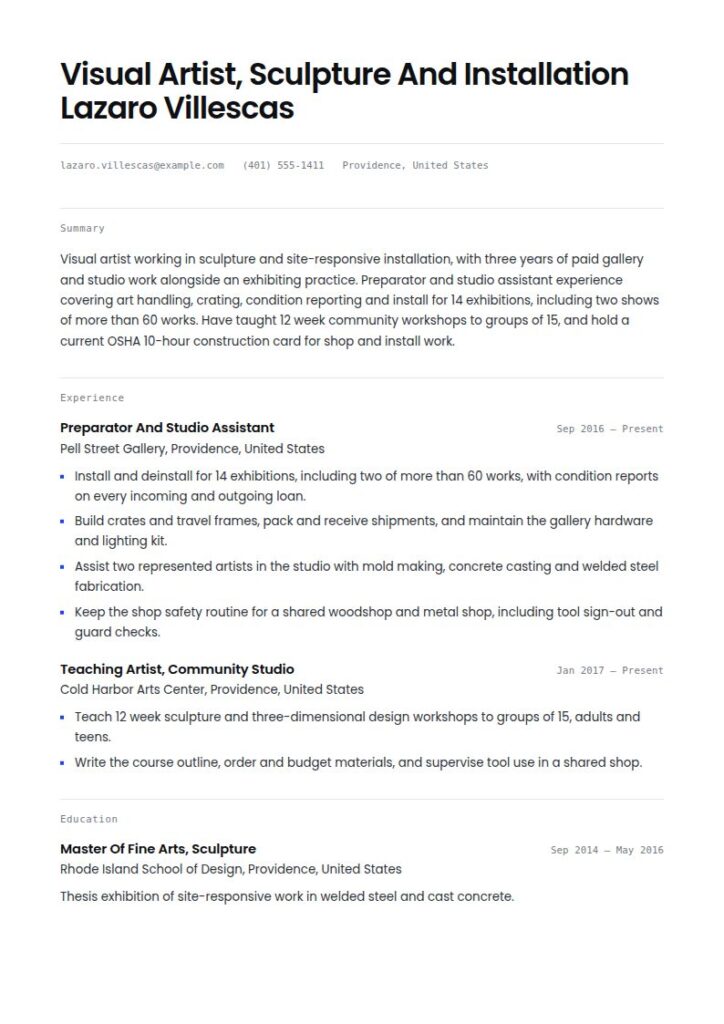
Visual artist working in sculpture and site-responsive installation, with three years of paid gallery and studio work alongside an exhibiting practice. Preparator and studio assistant experience covering art handling, crating, condition reporting and install for 14 exhibitions, including two shows of more than 60 works. Have taught 12 week community workshops to groups of 15, and hold a current OSHA 10-hour construction card for shop and install work.
Work Experience
09/2016 - Present, Preparator and Studio Assistant, Pell Street Gallery, Providence, United States
- Install and deinstall for 14 exhibitions, including two of more than 60 works, with condition reports on every incoming and outgoing loan.
- Build crates and travel frames, pack and receive shipments, and maintain the gallery hardware and lighting kit.
- Assist two represented artists in the studio with mold making, concrete casting and welded steel fabrication.
- Keep the shop safety routine for a shared woodshop and metal shop, including tool sign-out and guard checks.
01/2017 - Present, Teaching Artist, Community Studio, Cold Harbor Arts Center, Providence, United States
- Teach 12 week sculpture and three-dimensional design workshops to groups of 15, adults and teens.
- Write the course outline, order and budget materials, and supervise tool use in a shared shop.
Education
09/2014 - 05/2016, Master of Fine Arts, Sculpture, Rhode Island School of Design, Providence, United States
Thesis exhibition of site-responsive work in welded steel and cast concrete.
08/2008 - 05/2012, Bachelor of Fine Arts, Studio Art, University of New Mexico, Albuquerque, United States
Concentration in sculpture, with coursework in art history and woodshop practice.
Skills
Art handling and crating, 85
Condition reporting, 75
Install and gallery lighting, 80
Welded steel fabrication, 85
Mold making and concrete casting, 80
Shop safety supervision, 75
Languages
English, native
Spanish, native
Certificates
04/2023, OSHA 10-hour Construction Safety, OSHA Outreach Training Program
Required for shop and install work involving lifts, ladders and power tools.
02/2025, First Aid and CPR, American Red Cross
Summary
A visual artist works with two documents, not one. The artist CV is a conventional record of exhibitions, collections, residencies, grants and press, and it is not a resume. This guide shows which document each opportunity wants, how to convert the CV into a working resume for teaching, arts administration and studio posts, and current Bureau of Labor Statistics pay and outlook.
Visual Artist resume examples by experience level
In practice, a visual artist needs two documents, and sending the wrong one is the most common mistake in this field.
First, the artist CV is a conventional document with rules of its own: solo and group exhibitions, collections, residencies, grants, commissions, publications, education. In particular, it carries no summary, no bullet points, no skills section and no achievements written as outcomes. As a result, a gallery, a juror, a residency panel and a grant reader all expect it and would think a resume strange.
By contrast, a resume is what a university human resources system, an arts nonprofit, a museum registrar's office or a fabrication shop expects: a one or two page argument about what you can do for them, parsed by software before a person opens it. That is why an artist CV sent into that process reads as the wrong file. This page is about holding both, and converting between them without lying in either direction.
Resume guide for a visual artist resume
To start, this guide and the corresponding visual artist resume example will cover:
- When an artist CV is the right document and when a resume is
- First, what belongs on an artist CV, in the order the field expects
- Then, how to convert an exhibition record into resume evidence honestly
- Also, three adaptable summaries: emerging, mid-career and artist in an arts job
- Finally, what the job market looks like and what you can expect to earn
How to write a visual artist resume
In short, six blocks: contact header with a studio site, a summary, experience written as work, a selected exhibition and practice block, skills, and education. In general, one page for a first arts job, two once you are carrying teaching, installation and program work together. Keep the practice on the page: an artist who hides their studio work looks like a weaker candidate for the same job, because the practice is where the fabrication, budget and deadline experience came from.
| Section | What it is answering | Where it goes |
|---|---|---|
| Studio or portfolio link | Can I see the work, and does it match this place? | Header, under your name |
| Experience | What have you been paid to do, for whom, at what scale? | Reverse chronological, with numbers |
| Selected exhibitions and practice | Is this a serious practice, and is it current? | One compact block, clearly labeled selected |
| Education | MFA, BFA, and anything that licenses you to teach | Foot of the page |
Keep one master record, then cut two documents from it
Do not keep a CV and a resume as separate files that drift apart. Keep one master record holding everything: every exhibition with venue, city and dates, every residency with its duration, every grant with its amount and reporting date, every commission with its budget, fabrication method and site, every class with contact hours and group size, every install with crew size and hours.
The CV is a filter over that record, keeping exhibitions, collections, residencies, grants, press and education in the field's conventional order. The resume is a different filter over the same record, keeping paid work, scale, budget, people managed, safety and deadlines.
Neither document invents anything. They cut the same material two ways, which is why the master record has to hold the boring details: dates, dollar amounts, crew sizes and contact hours.
Run the resume version through the ATS resume checker before you send it. University and municipal arts postings almost always run through an applicant system, and an artist CV's dense two-column dates are exactly what those systems garble.
Choosing the best resume format for a visual artist resume
As a rule, reverse chronological, single column, one or two pages. Functional formats are tempting when paid work is irregular, and they read as concealment to a committee used to seeing irregular arts careers written honestly.
If the posting says curriculum vitae, send the CV. For a resume, send the resume. If it says "CV or resume", then ask who reads it first: a panel of artists and curators wants the CV, a human resources office wants the resume.
Include your contact information
| ✅ Right | ❌ Wrong |
|---|---|
| Lazaro Villescas | Lazaro Villescas |
| Visual artist, sculpture and installation; teaching artist | Emerging multidisciplinary creative |
| lazarovillescas.com | Instagram handle only |
| (401) 555-1411, [email protected], Providence, RI | (401) 555-1411, [email protected] |
The second line does the work. Naming the medium and the second role, therefore, tells a reader which of your two documents they are holding and which job you are applying for.
Make use of a summary
An artist CV has no summary; a resume, however, must have one. For the summary, four lines: what you make, what people have paid you to do with it, the scale you work at, and one number.
Visual artist working in sculpture and site-responsive installation, with three years of paid gallery and studio work alongside an exhibiting practice. Preparator and studio assistant experience covering art handling, crating, condition reporting and install for 14 exhibitions, including two shows of more than 60 works. Have taught 12 week community workshops to groups of 15, and hold a current OSHA 10-hour construction card for shop and install work.
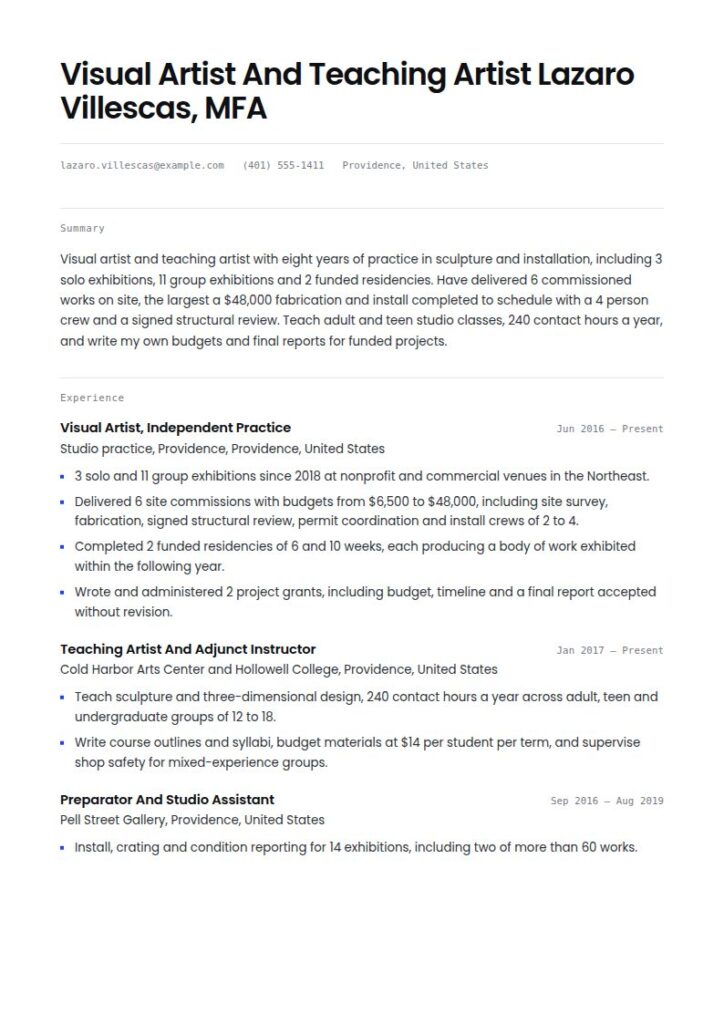
Visual artist and teaching artist with eight years of practice in sculpture and installation, including 3 solo exhibitions, 11 group exhibitions and 2 funded residencies. Have delivered 6 commissioned works on site, the largest a $48,000 fabrication and install completed to schedule with a 4 person crew and a signed structural review. Teach adult and teen studio classes, 240 contact hours a year, and write my own budgets and final reports for funded projects.
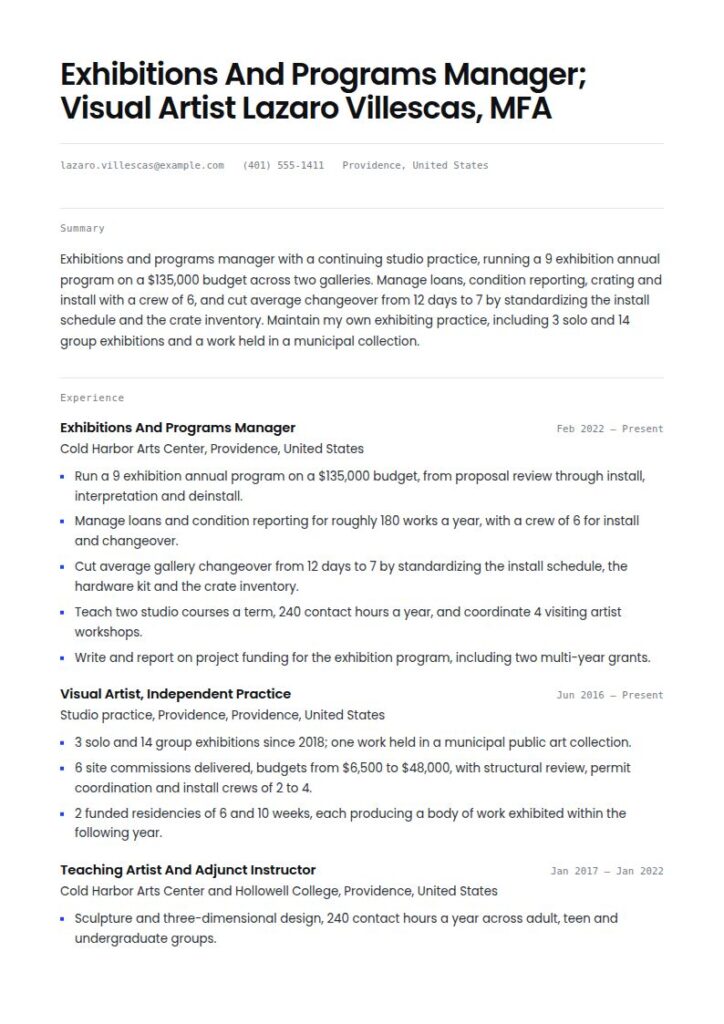
Exhibitions and programs manager with a continuing studio practice, running a 9 exhibition annual program on a $135,000 budget across two galleries. Manage loans, condition reporting, crating and install with a crew of 6, and cut average changeover from 12 days to 7 by standardizing the install schedule and the crate inventory. Maintain my own exhibiting practice, including 3 solo and 14 group exhibitions and a work held in a municipal collection.
Right vs wrong: the same visual artist summary, twice
| ✅ Right | ❌ Wrong |
|---|---|
| Delivered 6 commissioned works on site, the largest a $48,000 fabrication and install. | Creates thought-provoking work that challenges the viewer. |
| Teach adult and teen studio classes, 240 contact hours a year. | Passionate about sharing the transformative power of art. |
| Write my own budgets and final reports for funded projects. | Experienced in a wide range of media and contexts. |
For example, the right column is what an arts organization is hiring. Meanwhile, the left column is an artist statement in the wrong document, and a reader will take it as an inability to tell the two apart.
Outline your visual arts experience
Employer or client, city, dates, and one line on what the place actually does. Then three to five bullets carrying a number: works handled, crew size, budget, contact hours, changeover days.
| Instead of | Use |
|---|---|
| Assisted with exhibitions at a gallery | Handled install and deinstall for 14 exhibitions, including two of more than 60 works, with condition reports on every loan |
| Made sculptures for public spaces | Delivered a $48,000 site commission: fabrication, signed structural review, permit coordination and a 4 person install crew |
| Taught art classes in the community | Taught 12 week studio courses to groups of 15, 240 contact hours a year, with materials budgeted at $14 per student per term |
| Received grants for my work | Wrote and administered 2 project grants, including budget, timeline and final report accepted without revision |
Exhibitions and Programs Manager, Cold Harbor Arts Center, Providence, RI, February 2022 to Present
A two gallery nonprofit arts center with a 9 exhibition annual program and a community studio school.
Run the annual exhibition program on a $135,000 budget, from proposal review through install, interpretation and deinstall.
Manage loans and condition reporting for roughly 180 works a year, with a crew of 6 for install and changeover.
Cut average gallery changeover from 12 days to 7 by standardizing the install schedule, the hardware kit and the crate inventory.
Teach two studio courses a term, 240 contact hours a year, and coordinate 4 visiting artist workshops.
Maintain a studio practice alongside the post, with exhibitions scheduled outside the center.
The artist CV and the resume are two different documents
In fact, almost every problem a visual artist has with job applications comes from collapsing these two into one file. In fact, they follow different logic.
The artist CV is a record, in a fixed order. Name and contact, education, solo exhibitions, two-person exhibitions, group exhibitions, then whichever apply: public and private collections, commissions, residencies, grants and fellowships, awards, bibliography or press, lectures and visiting artist appearances, teaching, affiliations. Each line is year, title, venue, city. It explains nothing and sells nothing. Length is a function of career stage rather than a failing. Private collections are listed as "private collection" with the city, never by the owner's name.
The resume is an argument, in a flexible order. Summary, experience, a selected practice block, skills, education, everything explained in terms of what it produced, one or two pages, parsed by software, aimed at one job.
Turning an artist CV into a resume
Fortunately, the conversion is mechanical once you see what maps onto what.
| On the artist CV | Becomes, on the resume |
|---|---|
| Solo exhibition | A project delivered to a fixed date, with a work count, a venue footprint and an install method |
| Group exhibition | Coordination with a curator and other artists to a shared schedule and a shipping deadline |
| Residency | A self-directed project completed inside a fixed term, usually with a public outcome |
| Grant or fellowship | A budget written, a timeline committed to, and a final report filed |
| Commission | Client management, site survey, fabrication, engineering review, permits and install |
| Teaching or visiting artist | Curriculum written, contact hours delivered, group size, age range, safety supervision |
| Collection | A work fabricated to an archival standard and documented for a registrar |
Selected exhibitions: 3 solo and 14 group exhibitions since 2018 at nonprofit and commercial venues in the Northeast. Full exhibition record and images at lazarovillescas.com.
Commissions: 6 site works delivered, budgets from $6,500 to $48,000, including structural review, permit coordination and install crews of 2 to 4.
Residencies and funding: 2 funded residencies of 6 and 10 weeks; 2 project grants written and reported on in full.
Collections: one work in a municipal public art collection; additional works in private collections.
Fabrication: welded steel, cast concrete, CNC-cut plywood, rigging and anchor specification to a stamped drawing.
In other words, five lines doing the job of three CV pages. Note what it does not do: it names no private collectors, it does not inflate a group show into a solo one, and it says selected, the word that makes a short list honest rather than a short career.
Two of your rights in a work cannot be sold, only waived in writing
US law treats a narrow class of work differently. A "work of visual art" includes a painting, drawing, print or sculpture existing in a single copy or "in a limited edition of 200 copies or fewer that are signed and consecutively numbered by the author", while posters, motion pictures and works made for hire are excluded (17 U.S.C. 101, as published by the U.S. Copyright Office).
For work inside that definition the author holds rights of attribution and integrity: to claim authorship, to prevent use of their name on work they did not create, and to object to distortion or destruction that would harm their reputation. Those rights "may not be transferred, but those rights may be waived if the author expressly agrees to such waiver in a written instrument signed by the author" (17 U.S.C. 106A, as published by the U.S. Copyright Office).
Which is why a public art contract deserves reading before signing, and why "edition of 200 or fewer, signed and numbered" is not only a marketing decision. None of this is legal advice; get your own before you sign.
Build a snapshot of your key skills
For skills, list ten to fourteen entries in three groups: studio and fabrication, gallery and collections work, and the administration arts organizations hire for. Put a safety credential in if you hold one, because it decides who can go up on a scissor lift.
Studio and fabrication: Welded steel fabrication, Mold making and concrete casting, Woodshop and CNC cutting, Rigging and anchor specification, Digital fabrication drawings
Gallery and collections: Art handling and crating, Condition reporting, Loan and shipping coordination, Install and lighting, Changeover planning, Basic registrar practice
Program and administration: Budget writing and tracking, Grant applications and final reports, Studio class curriculum, Workshop facilitation, Safety supervision in a shared shop
List your education and certifications
MFA or BFA first, then teaching credentials, then the safety and trade cards that decide what you may operate. Craft and fine artists have no license, and BLS notes that most fine artists pursue postsecondary education to improve their skills and job prospects, while a formal educational credential is typically not needed to be a craft artist (BLS Occupational Outlook Handbook, craft and fine artists, page last modified 27 August 2026).
Master of Fine Arts, Sculpture, Rhode Island School of Design, Providence, RI, 2016
Bachelor of Fine Arts, Studio Art, University of New Mexico, Albuquerque, NM, 2012
OSHA 10-hour Construction Safety card, 2023. Aerial lift and scissor lift operator training, 2024. First aid and CPR, American Red Cross, 2025.
Teaching: adjunct instruction in sculpture and three-dimensional design since 2019; teaching artist in community studio programs since 2017.
Above all, an MFA matters most where it is a hiring requirement, which means college teaching. For instance, postsecondary teachers typically need a doctoral degree, though a master's may be enough at community colleges (BLS Occupational Outlook Handbook, postsecondary teachers, page last modified 27 August 2026), and in studio art the MFA is the terminal degree.
Choose the right layout and design
Single column, 11 or 12 point, one typeface, plain headings, no images, no color fields. This is the occupation whose applicants most often design the document and whose hiring committees are least impressed by it. Keep the images on the site and name the file for the role: lazaro-villescas-exhibitions-manager-resume.pdf.
Decide which document the posting wants before you write a word. Keep one master record and cut both documents from it. Label a short exhibition list "selected". Convert each CV line into what it produced: a budget, a date met, a crew, a group size. Name safety cards; they decide what you can be scheduled to do. Keep the studio practice visible on the resume.
Do not send a ten page CV to a human resources portal. Do not list a private collector by name. Do not describe a juried group show in language that implies a solo exhibition. Do not put your artist statement on the resume. Do not use a two-column artist CV layout for a parsed application, because the dates and venues merge into one unreadable string.
Visual artist job market and outlook
BLS publishes no Occupational Outlook Handbook profile under the title visual artist, so no single number describes this career. Of the published occupations, the closest is craft and fine artists. Similarly, artists working in galleries and collections sit under archivists, curators and museum workers; artists teaching at college level sit under postsecondary teachers. Most working visual artists have income from at least two of the three.
| Measure | Craft and fine artists | Archivists, curators and museum workers |
|---|---|---|
| Employment, 2025 | 53,400 | 38,500 |
| Projected employment, 2035 | 53,000 | 40,000 |
| Projected change, 2025 to 2035 | -1 percent, -300 jobs | 4 percent, about as fast as average |
| Projected annual openings | ~4,300 | ~4,300 |
| Self-employed workers | 58 percent | 8 percent |
| Median annual wage, May 2025 | $55,290 | $60,330 |
Source: U.S. Bureau of Labor Statistics, Occupational Outlook Handbook, craft and fine artists and archivists, curators, and museum workers, pages last modified 27 August 2026, May 2025 wage data and 2025 to 2035 projections.
The paid jobs near a studio practice are in museums and teaching
Craft and fine artists are 58 percent self-employed and the occupation is projected to decline 1 percent from 2025 to 2035, with about 4,300 openings a year, nearly all replacements (BLS Occupational Outlook Handbook, page last modified 27 August 2026).
The adjacent occupations behave differently. Archivists, curators and museum workers are projected to grow 4 percent to 40,000 jobs by 2035, with about 4,300 openings a year; curators had a median of $63,420 in May 2025, archivists $64,550, museum technicians and conservators $51,440, and 36 percent of the occupation works in museums, historical sites and similar institutions (BLS Occupational Outlook Handbook, page last modified 27 August 2026). Postsecondary teachers are projected to grow 7 percent to 2035 with about 103,300 openings a year, and art, drama and music teachers had a median of $78,620 in May 2025 against $85,330 for the group overall (BLS, page last modified 27 August 2026).
That is the shape of a visual arts career: a declining self-employed occupation next to two growing salaried ones that hire on documented skills. Which is why the resume exists alongside the CV rather than instead of it.
Next, here is where the employed minority of craft and fine artists sits:
| Industry | Share of employment | Median annual wage, May 2025 |
|---|---|---|
| Self-employed workers | 58% | Not published |
| Independent artists, writers and performers | 7% | $49,100 |
| Federal government, excluding postal service | 6% | $115,150 |
| Personal care services | 4% | $38,790 |
| Motion picture and sound recording industries | 2% | $132,950 |
Source: U.S. Bureau of Labor Statistics, Occupational Outlook Handbook, craft and fine artists, May 2025, also the latest published cycle.
What salary you can expect as a visual artist
Craft and fine artists had a median annual wage of $55,290 in May 2025, with the lowest 10 percent under $31,490 and the highest 10 percent above $131,810; fine artists including painters, sculptors and illustrators had a median of $55,490 and craft artists $46,080 (BLS Occupational Outlook Handbook, craft and fine artists, page last modified 27 August 2026).
Still, those figures describe wage and salary income, and 58 percent of the occupation is not in that count. For most working visual artists, however, the annual number comes from parts: sales and commissions, teaching, a salaried arts job, grants, and often work outside the arts. Therefore, the resume's job is to make the salaried parts legible.
Three moves change it. The adjacent salaried occupation: a museum post pays a curator a median of $63,420 and a museum technician $51,440 (BLS, May 2025), and those roles hire on art handling, registrar practice and program administration rather than on exhibition record. Teaching: art, drama and music teachers at postsecondary level had a median of $78,620 in May 2025 (BLS, May 2025), and the MFA, in turn, opens that door. Commission scale: a documented $48,000 site commission with an engineering review and a permit history is a different professional claim from a series of gallery sales, and, indeed, it is the claim public art panels exist to evaluate.
Key takeaways for a visual artist resume
- Decide first whether the opportunity wants an artist CV or a resume; send that one.
- Keep a single master record and cut both documents from it.
- On the CV, as a result, follow the conventional order and explain nothing.
- On the resume, by contrast, convert each exhibition, residency and grant into what it produced.
- Also keep a five line selected practice block on the resume, labeled selected.
- Name safety cards and shop skills, because they decide what a shop can schedule you to do.
- Keep your studio practice visible, because it is where the budget and deadline evidence came from.
Build your visual artist resume in 15 minutes with our AI resume builder.
Related creative and artistic resume examples
- Artist resume
- Illustrator resume
- Tattoo artist resume
- Photographer resume
- Jewelry designer resume
- Choreographer resume
- Musician resume
- Actor resume
- Dance teacher resume
- Film producer resume
- Costume designer resume
- Theater resume
Pair it with a matching visual artist cover letter.
Visual artist resume questions, answered
What is the difference between an artist CV and a resume?
The CV is a record and the resume is an argument. A CV lists exhibitions, collections, residencies, grants, press and education in a fixed order, with no summary and no explanation, and it grows with your career. A resume is one or two pages aimed at a specific job and read by software before a person. Galleries, jurors, residencies and grant panels expect the CV; employers expect the resume.
How long should a visual artist resume be?
One page for a first arts job, two once you are carrying teaching, installation and program work at once. The artist CV has no page limit, which is exactly why it cannot double as the resume.
How do I list exhibitions on a resume without it becoming a CV?
Use one block of no more than five lines, labeled selected, with counts rather than a list: "3 solo and 14 group exhibitions since 2018 at nonprofit and commercial venues in the Northeast", then a link to the full record. A hiring manager only needs to know the practice is real and current.
Should I include an artist statement?
Not on the resume. Send it where it is requested: exhibition proposals, residency applications and grants. A statement in a resume summary field is the clearest sign that an applicant has not understood which document they are sending.
Do I need an MFA to work as a visual artist?
Not to practice. It matters where it is a hiring requirement, most obviously in college teaching: postsecondary teachers typically need a doctoral degree, though a master's may be enough at community colleges, and in studio art the MFA is the terminal degree (BLS Occupational Outlook Handbook, postsecondary teachers, page last modified 27 August 2026). BLS also notes that most fine artists pursue postsecondary education to improve their skills and job prospects (BLS, craft and fine artists, 27 August 2026).
What if my paid work has nothing to do with art?
Put it on the resume anyway, briefly. Gaps read worse than unrelated employment, and arts organizations are staffed by people who have done the same thing. Keep the studio practice in its own block so the reader sees both, and let the summary say which one you are applying with.