Lazaro Villescas Exhibitions and programs manager; visual artist Providence, 02903, United States [email protected] · (401) 555-1411
17 September 2026
Mr. Emory Vance Director Bright Field Contemporary Providence, United States
Application for Exhibitions Coordinator, Bright Field Contemporary
Dear Mr. Vance,
I am applying for the Exhibitions Coordinator post at Bright Field Contemporary. I am a sculptor with a continuing exhibiting practice and eight years of paid gallery and teaching work, and the two parts of my background that match this post are install and budgets.
For the last four years I have run a nine exhibition annual program on a $135,000 budget across two galleries, managing loans and condition reporting for roughly 180 works a year with a crew of six. The change I am most pleased with is dull and useful: I standardized the install schedule, the hardware kit and the crate inventory, and average changeover fell from twelve days to seven, which gave the program two extra open weeks a year at no additional cost. My own commissions have run from $6,500 to $48,000, so I write fabrication and install budgets from the maker's side as well as the institution's.
Your spring season has three touring shows in it, which is a different loan and condition problem from a program built on local artists, and it is the part of the job I would want to take on first. I also teach, so I would be glad to carry the gallery talks and the school group visits rather than treating them as an add-on.
I hold a current OSHA 10-hour construction card and lift operator training, and I am available with four weeks' notice. Thank you for your time.
Sincerely, Lazaro Villescas
Summary
A visual artist cover letter is written for an employer, not for a curator. It translates a studio practice into the budgets, crews, deadlines and safety a gallery, museum, school or arts nonprofit is hiring for. This guide gives you a full adaptable letter, the difference between a letter of interest and a letter of inquiry, and what to leave for the artist statement.
Visual Artist cover letter examples by experience level
In short, a visual artist cover letter is a one page letter to an employer. In other words, it is not an artist statement, not a project proposal, and not the letter of interest that goes with an exhibition or residency application.
Those other documents are real and you will write all of them, but their readers are evaluating your work. A cover letter goes to someone deciding whether you can run a program, handle a collection, teach a class list or keep a shop safe. The practice is your evidence. It is not the subject.
Guide to a visual artist cover letter
To help, this guide and the corresponding visual artist cover letter example will cover:
- First, how to structure the letter, paragraph by paragraph
- How to use the practice as evidence rather than as the topic
- Next, the difference between a cover letter, a letter of interest and an artist statement
- Then, what changes for a teaching post, a gallery post and an arts nonprofit
- Finally, the openings that make a reader treat a studio practice as professional experience
How to write a visual artist cover letter
| Paragraph | Its job | Length |
|---|---|---|
| Opening | The post, what you do, and the two things about you that match it | 2 to 3 sentences |
| Evidence | One project with a budget, a crew, a date and an outcome | 4 to 5 sentences |
| Fit | Something specific about their program, and what you would take on | 3 to 4 sentences |
| Close | Credentials, availability, thank you | 2 sentences |
Translate the practice, do not narrate it
An exhibition is a project delivered to a fixed date. A residency is self-directed work completed inside a fixed term. A grant is a budget written and a report filed. A commission is a client, a site, an engineering review and an install crew.
Those translations are not spin; they are what actually happened, described in the vocabulary the reader uses to compare candidates. "I delivered a $48,000 site commission on schedule with a four person crew and a signed structural review" is understood immediately by a facilities manager, a program director and a dean. The version that fails says the work explores materiality and site, a sentence that belongs in the artist statement.
A visual artist cover letter example you can adapt
Dear Mr. Vance,
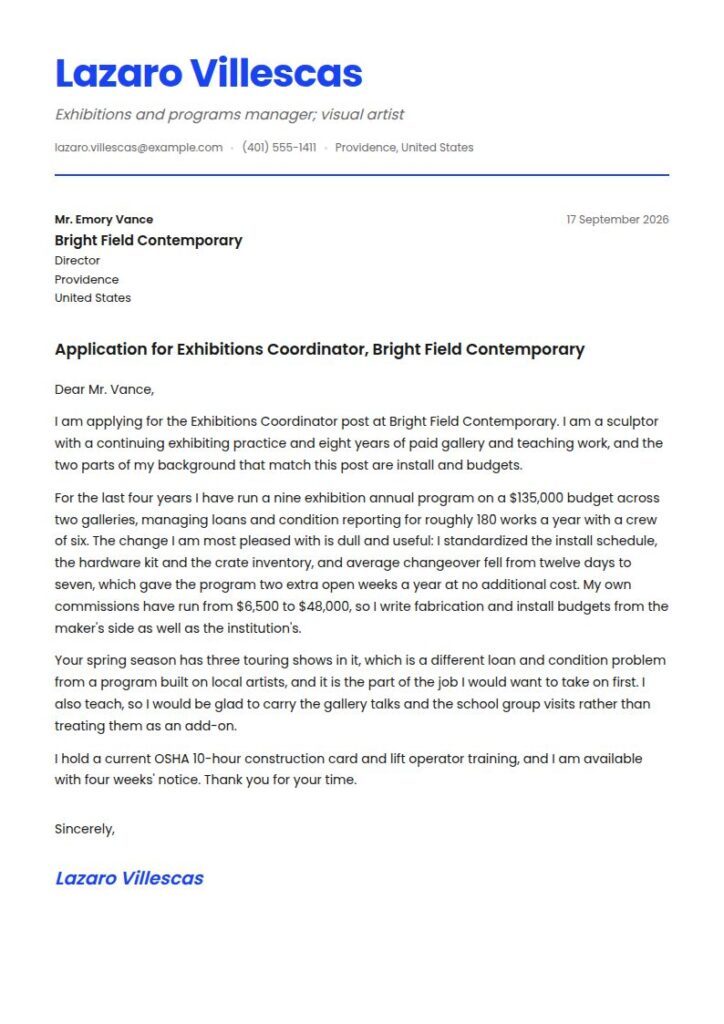
I am applying for the Exhibitions Coordinator post at Bright Field Contemporary. I am a sculptor with a continuing exhibiting practice and eight years of paid gallery and teaching work, and the two parts of my background that match this post are install and budgets.
For the last four years I have run a nine exhibition annual program on a $135,000 budget across two galleries, managing loans and condition reporting for roughly 180 works a year with a crew of six. The change I am most pleased with is dull and useful: I standardized the install schedule, the hardware kit and the crate inventory, and average changeover fell from twelve days to seven, which gave the program two extra open weeks a year at no additional cost. My own commissions have run from $6,500 to $48,000, so I write fabrication and install budgets from the maker's side as well as the institution's.
Your spring season has three touring shows in it, which is a different loan and condition problem from a program built on local artists, and it is the part of the job I would want to take on first. I also teach, so I would be glad to carry the gallery talks and the school group visits rather than treating them as an add-on.
I hold a current OSHA 10-hour construction card and lift operator training, and I am available with four weeks' notice. Thank you for your time.
Sincerely, Lazaro Villescas
Openings that work
| Instead of | Use |
|---|---|
| I am a passionate multidisciplinary artist seeking opportunities | I am applying for the Exhibitions Coordinator post; the two parts that match are install and budgets |
| My practice explores materiality, site and memory | I have run a nine exhibition annual program on a $135,000 budget across two galleries |
| I would welcome any chance to work in the arts | Average changeover fell from twelve days to seven after I standardized the install schedule |
| I have exhibited widely in the region | My own commissions have run from $6,500 to $48,000, so I write install budgets from both sides |
In practice, every wrong version asks the reader to be interested in you. By contrast, every right version tells them what you would take off their desk.
Cover letter, letter of interest, artist statement
People confuse these three constantly, and sending one in place of another is the most visible mistake an artist makes on paper.
| Document | Who reads it | What it argues |
|---|---|---|
| Cover letter | A hiring manager or search committee | That you can do this job, using the practice as evidence |
| Letter of interest | A curator, juror or residency panel | That this work belongs in this exhibition, space or program |
| Artist statement | Anyone looking at the work | What the work is doing, in the work's own terms |
For example, a cover letter opening with a statement paragraph reads as a candidate who does not know which room they are in. Similarly, a letter of interest written like a job application reads as one who does not take the work seriously. That is why you should keep all three separate and keep them short.
Name the post in the first line and the two things about you that match it. Give one project with a budget, a crew size, a date and an outcome. Name safety cards and the equipment you are cleared to use. Say one specific true thing about their program, taken from their own season or course list. Offer the second thing you can carry: gallery talks, school visits, shop supervision, a class.
Do not attach a ten page artist CV to an application that asked for a resume. Do not send an artist statement as the letter. Do not apologize for periods spent on your own work. Do not list exhibitions in the letter; the resume already carries a selected block. Do not send images unless the posting asks for them, and then follow its file specification exactly.
Teaching post, gallery post, arts nonprofit
The paid jobs near a practice are growing while the practice occupation is not
BLS publishes no Occupational Outlook Handbook profile under the title visual artist. The nearest published profile, craft and fine artists, reports a median annual wage of $55,290 in May 2025, 58 percent of the occupation self-employed, employment projected to decline 1 percent from 2025 to 2035, and about 4,300 openings a year, nearly all replacements (BLS Occupational Outlook Handbook, craft and fine artists, page last modified 27 August 2026).
The occupations that hire artists into salaried posts are moving the other way. Archivists, curators and museum workers are projected to grow 4 percent from 2025 to 2035, with a median of $60,330 in May 2025 and about 4,300 openings a year; postsecondary teachers are projected to grow 7 percent with about 103,300 openings a year, and art, drama and music teachers at that level had a median of $78,620 in May 2025 (BLS Occupational Outlook Handbook, pages last modified 27 August 2026).
Which is why this letter is worth writing carefully. The competitive jobs in a visual arts career are mostly institutional, and institutions hire on documented capability. Your practice is the strongest source of that documentation you have, provided you translate it.
A teaching post wants the class list, group sizes, contact hours and your shop safety record, and it usually wants a CV rather than a resume, so read the posting twice. Meanwhile, a gallery or museum post wants loans, condition reports, crating, install and changeover. An arts nonprofit, on the other hand, wants budgets, grant reporting and the ability to run an evening event without four staff. In each case, the middle paragraph changes; the shape does not.
Length, format and sending it
One page, four paragraphs, 250 to 400 words. PDF unless the portal specifies otherwise, named for yourself and the post: lazaro-villescas-exhibitions-coordinator-cover-letter.pdf.
Address a person. Also, almost every arts organization's site lists its program directors, chairs and gallery directors, and a named salutation on a letter that also names their spring season separates a considered application from a mailing.
Keep the figures identical to your resume. Our visual artist resume example uses the same numbers as the letter above.
Key takeaways
- To start, write to an employer, not to a curator, and keep the artist statement out of it.
- Then name the post and the two things about you that match it in the first three sentences.
- In addition, translate one project into a budget, a crew, a date and an outcome.
- Keep the exhibition list on the resume, not in the letter.
- Also, name your safety cards and the equipment you have clearance to operate.
- Say one specific true thing about their program from their own materials.
- Offer the second thing you can carry, because arts jobs are always two jobs.
Write your visual artist cover letter in 10 minutes with our AI cover letter builder.
Visual artist cover letter questions, answered
Should I send a cover letter with an artist CV?
Only if the opportunity asked for a job application. For exhibitions, residencies and grants the accompanying document is a letter of interest or a project proposal, arguing for the work rather than for your employability. Read the call; it almost always names the document it wants.
How do I write about my practice without sounding self-indulgent?
Give it a number and a date. "Two funded residencies of six and ten weeks, each producing a body of work shown the following year" is a professional record. "A deeply personal inquiry into place" is a statement sentence. Both can be true of one work, and only one belongs in a letter to a hiring manager.
What if there are gaps in my paid employment?
Fill them with what you were actually doing, in employer language: a residency, a commission, a funded project, a body of work made for a show with a date attached. Self-directed work with a deliverable and a deadline is not a gap, and saying so plainly beats leaving eighteen months unexplained.
Do I mention that I will keep making my own work?
Yes, briefly and without apology. Arts organizations expect it and many consider it an asset, and the alternative is discovering a conflict later. One clause is enough: that you maintain a practice and schedule exhibitions outside the institution you work for.
Is a cover letter still worth writing for arts jobs?
Yes, because the pool is large and the postings are few: craft and fine artists is projected to decline 1 percent from 2025 to 2035 with about 4,300 openings a year, while archivists, curators and museum workers is projected to grow 4 percent with about 4,300 openings a year (BLS Occupational Outlook Handbook, pages last modified 27 August 2026). Committees in small arts organizations read every letter, because it is where they find out whether you understand the job.