Elena Marchetti Actor, SAG-AFTRA and AEA Los Angeles, 90027, United States [email protected] · (323) 555-2276
17 September 2026
Ms. Priscila Reyes Theatrical Department Calder Talent Los Angeles, United States
Representation query, Elena Marchetti, SAG-AFTRA and AEA
Dear Ms. Reyes,
I am a SAG-AFTRA and AEA actor based in Los Angeles, currently without theatrical representation, and I am writing to ask whether you are taking meetings. Headshot, resume and a two-minute reel are attached.
Over the last two years I have played Guest Star and Co-Star roles across four network and streaming series, including two episodes of Harbor Division for Kingfisher Pictures, and a supporting role in the feature The Salt Line for the same company. On stage I have played seven principal roles at Belltower Theater Company, most recently Lady Macbeth, and I work under Equity contracts.
I am writing to you because your list is built around actors who work across theater and episodic television rather than one or the other, which is the career I have. I am fluent in Italian, certified in three stage combat disciplines, and hold standard and RP English dialects.
I am available for a meeting any weekday and can send additional material or record a reading on request. Thank you for your time.
Sincerely, Elena Marchetti
Summary
An actor cover letter is a short submission note for an agency query, a theater company introduction or a casting office follow-up. It gives union status, two recent credits, the reason you chose that office and a single clear ask. This guide gives you a full adaptable letter, the openings that work, and what changes between representation and a production submission.
Actor cover letter examples by experience level
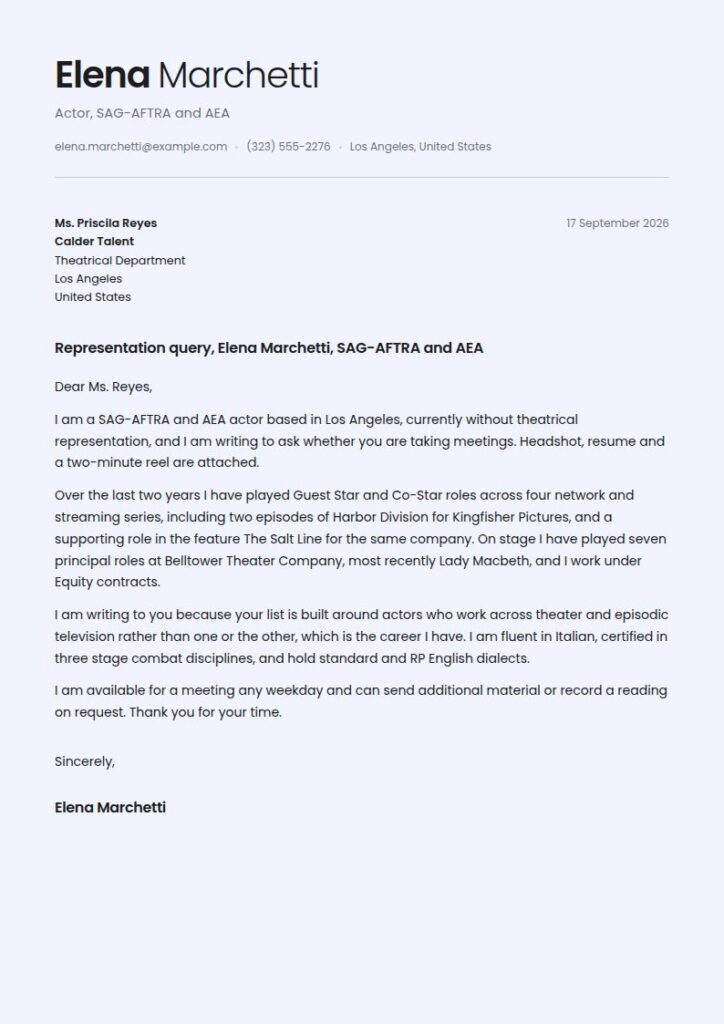
An actor cover letter is a short submission note that goes with a headshot and resume, and it exists for two situations: querying an agent or manager, and introducing yourself to a theater company or casting office.
However, it is not the letter other occupations write. In fact, nobody here wants four paragraphs about your journey. What they want is your union status, two credits they can place, one specific reason you wrote to them rather than the next name on a list, and a clear statement of what you are asking for.
Guide to an actor cover letter
To help, this guide and the corresponding actor cover letter example will cover:
- When you need an actor cover letter and when you do not
- First, how to structure the query, paragraph by paragraph
- Next, the two credits rule, and which two to pick
- Finally, what changes between an agency query and a theater submission
When an actor actually needs a cover letter
Most submissions do not take one. Similarly, a self-tape goes in with the file naming the breakdown asks for and nothing else, and a casting platform submission has a message box measured in characters.
| Situation | Letter needed? |
|---|---|
| Agency or management query | Yes, and it is the whole submission |
| Theater company general audition or season submission | Yes, short |
| Casting office introduction or postcard follow-up | Yes, very short |
| Self-tape for a specific role | No, unless the breakdown asks |
| Casting platform submission | No, use the note field |
| Teaching or theater administration work | Yes, a conventional letter |
How to write an actor cover letter
| Paragraph | Its job | Length |
|---|---|---|
| Opening | Who you are, union status, what you are asking for | 2 sentences |
| Credits | Two recent credits, with role type and company | 2 to 3 sentences |
| Why them | One accurate reason you chose this office | 2 sentences |
| Close | What is attached, availability, thank you | 2 sentences |
Two credits, chosen for level rather than recency
The instinct is to list everything you have done this year. The better move is to pick the two credits that sit highest on your resume and let the attached page carry the rest.
Pick for level and for fit with the reader. Writing to a theater company, lead with the principal stage role and the company that produced it. Writing to a commercial agent, lead with the national campaign. Writing to a theatrical agent, lead with the guest star.
Name the role type and the production company in the same sentence, because those two words tell an agent whether you are a client they can submit tomorrow: "Guest Star on Harbor Division for Kingfisher Pictures" is a complete fact in eight words.
An actor cover letter example you can adapt
Dear Ms. Reyes,
I am a SAG-AFTRA and AEA actor based in Los Angeles, currently without theatrical representation, and I am writing to ask whether you are taking meetings. Headshot, resume and a two-minute reel are attached.
Over the last two years I have played Guest Star and Co-Star roles across four network and streaming series, including two episodes of Harbor Division for Kingfisher Pictures, and a supporting role in the feature The Salt Line for the same company. On stage I have played seven principal roles at Belltower Theater Company, most recently Lady Macbeth, and I work under Equity contracts.
I am writing to you because your list is built around actors who work across theater and episodic television rather than one or the other, which is the career I have. I am fluent in Italian, certified in three stage combat disciplines, and hold standard and RP English dialects.
I am available for a meeting any weekday and can send additional material or record a reading on request. Thank you for your time.
Sincerely, Elena Marchetti
Openings that work
| Instead of | Use |
|---|---|
| I have been acting since I was a child | I am a SAG-AFTRA and AEA actor based in Los Angeles, currently without theatrical representation |
| I am writing to inquire about representation opportunities | I am writing to ask whether you are taking meetings |
| I have appeared in numerous film and theater projects | Guest Star on Harbor Division for Kingfisher Pictures, and Lady Macbeth at Belltower Theater Company |
| I would love the opportunity to work with your agency | Your list is built around actors who work across theater and episodic television |
The one sentence that makes a query worth reading
An agent receives these constantly, and almost all of them are interchangeable, because the actor could have addressed almost any of them to anyone. In the end, the sentence that separates yours says why this office.
It has to be true and checkable: their client list and the kind of work on it, a submission policy they have published, a niche the industry knows them for. One accurate sentence is enough, and a generic compliment is worse than nothing, because it proves the letter is a template.
Also, the same rule applies to a theater company. Read their last two seasons, and if they are doing work you are right for, say which play and why, in one sentence, without asking for a role.
Agency queries and production submissions
Say your union status in the first sentence. Ask for one specific thing: a meeting, a general audition, or to be kept on file. Name two credits with role type and company. Give one accurate reason for writing to this office. Say what is attached. Follow their submission instructions exactly, including whether they accept unsolicited material at all.
Do not describe your journey, your childhood or your love of the craft. Do not ask to be cast in a named role you were not invited to read for. Do not attach more than was asked for. Do not claim a union status or a credit you do not hold. Do not send the same letter to fifteen offices with the name changed; the industry is small enough that people compare notes.
A flat occupation, and most of it is not on screen
Employment of actors was 67,500 in 2025 and is projected to be 67,500 in 2035, a change of 0 percent, with about 6,300 openings a year (BLS Occupational Outlook Handbook, actors, 2025 to 2035 projections published 27 August 2026).
BLS publishes no annual median wage for actors, because the work is intermittent. The median hourly wage was $29.05 in May 2025, with the lowest 10 percent under $16.50 an hour and the highest 10 percent above $143.68 (same source, May 2025 wage data).
Where the work sits is the useful part for a query: self-employed workers account for 23 percent of actors, theater companies and dinner theaters for 10 percent, amusement parks and arcades for 7 percent and educational services for 4 percent (same source). A letter aimed only at film and television is aimed at a minority of the paid work.
Length, format and sending it
Under 250 words for a query. One screen, no attachments beyond what they asked for, and the body of the email is the letter; do not send it as a separate PDF unless a form requires that.
Name your files with your own name: elena-marchetti-headshot.jpg and elena-marchetti-resume.pdf. An assistant is saving these into a folder, and headshot_final_v3.jpg gets lost.
In addition, address a named person and check the spelling. After all, agency sites list their agents and theater companies list artistic staff, so "Dear Sir or Madam" reads as a mass mailing.
Keep the credits identical to the attached page. Our actor resume example uses the same credits.
Key takeaways
- To start, give union status in the first sentence, exactly as it stands.
- Ask for one specific thing: a meeting, a general audition, or to be kept on file.
- Then give two credits only, chosen for level and fit with the reader.
- Also, give role type and production company in the same sentence.
- Next, give one accurate, checkable reason you wrote to this office.
- In short, under 250 words, in the body of the email, files named with your own name.
Write your actor cover letter in 10 minutes with our AI cover letter builder.
Actor cover letter questions, answered
Do actors need a cover letter at all?
For agency and management queries, yes, and it is effectively the whole submission. For theater company general auditions and casting office introductions, a short note helps. For a self-tape against a breakdown, no: send exactly what was asked for, named the way they asked.
How long should an actor cover letter be?
Under 250 words for a query, and shorter for a casting office introduction. Length reads as inexperience here, not as effort. The resume and headshot do most of the work; the letter frames them and makes one clear ask.
What do I write if I have no credits yet?
Say what you are training in and with whom, name your strongest student, showcase or short film work, and ask for something proportionate: a general audition, or to be kept on file, rather than representation. Trained, honest and specific reads well at that stage. Inflated credits do not, and they are easy to check.
Should I mention that I am SAG-AFTRA eligible rather than a member?
Yes, in those words, and nothing more. Eligibility comes from covered employment, which is one day as a principal performer or recording artist, three days as a background actor, or a year in an affiliated performers' union with paid principal work (SAG-AFTRA, steps to join, accessed 17 September 2026). An agent reads "eligible" as a real and normal stage, and reads a vague claim as a warning.
How do I follow up if nobody replies?
Once, after four to six weeks, with two sentences and one new fact: a booking, a new reel, a role you are up for. Then stop, and write again only when something has changed. Offices keep the material they were sent, so a query with nothing to say is worth less than the same query six months later with a credit attached.