Soren Aalto Landscape Designer, CPLD Portland, 97214, United States [email protected] · (503) 555-2334
11 September 2026
Ms. Marisol Tvedt Design Foster Creek Design Build Portland, United States
Application for Landscape Designer, Foster Creek Design Build
Dear Ms. Tvedt,
I am applying for the Landscape Designer post at Foster Creek Design Build. I work on residential and small commercial sites around Portland, carrying 18 to 24 projects a year from site inventory to installation on budgets between $30,000 and $250,000. I am a landscape designer and not a licensed landscape architect: I prepare planting, layout, irrigation, lighting and hardscape concept, and grading, drainage, stormwater and structure go to a licensed professional before the drawing exists.
I have run my own practice since 2019, after six years in design-build as an assistant and then as the designer on the studio's residential book. The change I am proudest of is not a planting one. I wrote a scope of practice into every proposal, naming exactly which sheets we produce and which are prepared under the responsible charge of a licensed landscape architect or engineer, and it has held across 14 projects since 2019, including three with retaining walls over four feet where a registered Oregon engineer produced the stamped drawings and calculations. Separately, plant substitutions at install fell from about a fifth of the schedule to under 5 percent once I moved the nursery availability check to two weeks before order.
I noticed that you take residential work through permit in house rather than handing it to an outside consultant, which is how I have worked for seven years. I hold an Oregon Landscape Construction Professional license and the landscape contracting business license that goes with it, I am a Certified Professional Landscape Designer through APLD, and I am certified as an irrigation designer through a WaterSense labeled program. I produce full sets in Vectorworks Landmark: planting, layout, irrigation, lighting, schedules and specifications.
I am available inside four weeks, ahead of the spring install season. Thank you for your time.
Sincerely, Soren Aalto, CPLD
Summary
A landscape designer cover letter names the title you hold, the sheets you produce, the work you route to a licensed professional, and one measured result from a real site. This guide gives you a full adaptable letter, how it changes between a design-build firm and a private client, and the openings that get a file read to the end.
Landscape Designer cover letter examples by experience level
A landscape designer cover letter is a one-page letter that tells the reader what you may prepare before it tells them what your gardens look like.
That sounds like a strange opening for a creative role; even so, it is why the letter works. Landscape architecture is a licensed profession, landscape design mostly is not, and a principal reading applications is quietly sorting files into people who understand that boundary and people who do not.
Guide to a landscape designer cover letter
In short, this guide and the corresponding landscape designer cover letter example will cover:
- First, how to structure the letter, paragraph by paragraph
- Then, why the scope of practice belongs in the opening
- Also, what a measured result looks like on a landscape project
- In addition, how the letter changes between a design-build firm and a private client
- Finally, the openings that make a reader finish the file
How to write a landscape designer cover letter
| Paragraph | Its job | Length |
|---|---|---|
| Opening | The post, the title you hold, the sheets you produce, what you route out | 3 to 4 sentences |
| Evidence | One practice, one project volume, one number that moved, over a stated period | 4 to 5 sentences |
| Fit | Something specific about their work, plus licenses and software | 3 to 4 sentences |
| Close | Availability, thank you | 2 sentences |
Put the scope of practice in the first paragraph
Everyone applying can draw a nice plan. What separates the files is whether the reader can hand you work without checking what you are permitted to produce.
Write it plainly: "I am a landscape designer, not a licensed landscape architect. I prepare planting, layout, irrigation, lighting and hardscape concept, and grading, drainage, stormwater and structure go to a licensed professional before the drawing exists."
That answers the question a licensed principal was going to ask in the interview, and almost no other letter in the folder answers it at all.
A landscape designer cover letter example you can adapt
Dear Ms. Tvedt,
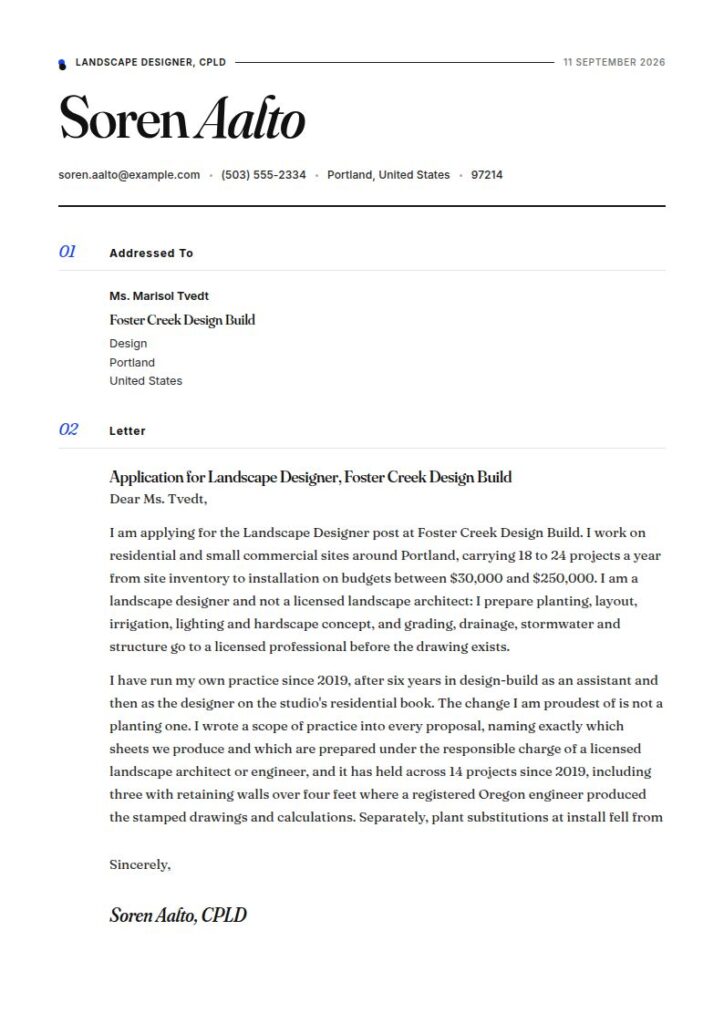
I am applying for the Landscape Designer post at Foster Creek Design Build. I work on residential and small commercial sites around Portland, carrying 18 to 24 projects a year from site inventory to installation on budgets between $30,000 and $250,000. I am a landscape designer and not a licensed landscape architect: I prepare planting, layout, irrigation, lighting and hardscape concept, and grading, drainage, stormwater and structure go to a licensed professional before the drawing exists.
I have run my own practice since 2019, after six years in design-build as an assistant and then as the designer on the studio's residential book. The change I am proudest of is not a planting one. I wrote a scope of practice into every proposal, naming exactly which sheets we produce and which are prepared under the responsible charge of a licensed landscape architect or engineer, and it has held across 14 projects since 2019, including three with retaining walls over four feet where a registered Oregon engineer produced the stamped drawings and calculations. Separately, plant substitutions at install fell from about a fifth of the schedule to under 5 percent once I moved the nursery availability check to two weeks before order.
I noticed that you take residential work through permit in house rather than handing it to an outside consultant, which is how I have worked for seven years. I hold an Oregon Landscape Construction Professional license and the landscape contracting business license that goes with it, I am a Certified Professional Landscape Designer through APLD, and I am certified as an irrigation designer through a WaterSense labeled program. I produce full sets in Vectorworks Landmark: planting, layout, irrigation, lighting, schedules and specifications.
I am available inside four weeks, ahead of the spring install season. Thank you for your time.
Sincerely, Soren Aalto, CPLD
Openings that work
| Instead of | Use |
|---|---|
| I have a lifelong passion for outdoor spaces and horticulture | I carry 18 to 24 residential projects a year on budgets between $30,000 and $250,000 |
| I am writing to express my interest in your landscape design position | I am applying for the Landscape Designer post, and I produce full permit-ready planting and irrigation sets |
| I have extensive experience in landscape architecture and design | I am a landscape designer, not a licensed landscape architect, and here is exactly what I prepare |
| I would love to bring my creativity to your talented team | You take residential work through permit in house, which is how I have worked for seven years |
The third row matters most, because "Extensive experience in landscape architecture" is the sentence that makes a licensed reader set a file aside, and applicants write it in good faith almost every time.
What to say about the licensure line
In practice, you do not need a paragraph of legal history. Instead, you need one sentence showing you know where the line is and one showing you work to it.
| What to state | What it sounds like |
|---|---|
| The title you hold | Landscape designer; not a licensed landscape architect |
| What you prepare | Planting, layout, irrigation, lighting, hardscape concept, schedules, specifications |
| What you route out | Grading, drainage, stormwater, retaining over four feet, structural elements |
| How you route it | Prepared under the responsible charge of a licensed landscape architect or engineer |
| Licenses you do hold | Contractor or trade license, with the number and current status |
Above all, never write that you have drawings stamped after the fact. A seal covers work prepared by or under a licensee's responsible charge; as a result, the licensed professional is involved before the drawing exists.
Design-build firm or private client
The two readers want different things, and the same letter does not serve both.
For a design-build firm, lead with production: projects a year, which sheets you produce, which software, and how you handle submittals and substitutions. For a private client, lead with scope and process: what you prepare, what goes to a licensed professional, the permit path, and what they receive at each stage. In both, name one real thing about their work.
Do not call yourself a landscape architect, or any variant, in a state where the title is protected. Do not attach a full portfolio PDF; link it. Do not promise a permit outcome you do not control. Do not quote a construction budget before a site visit. Do not send a letter with no project count and no license number in it.
Benchmark against $65,150, not the $79,870 headline
BLS publishes no separate landscape designer profile. For landscape architects, the published median annual wage was $79,870 as of May 2025, with 50 percent of the occupation in architectural, engineering and related services at $82,290 and 20 percent in landscaping services at $65,150 (BLS Occupational Outlook Handbook, landscape architects, page last modified 27 August 2026). It is also a small occupation: 23,500 employed in 2025 and about 1,700 openings a year.
Unlicensed designers mostly price against the landscaping services column, roughly $14,700 under the headline. That tells you what the letter is arguing for. You are not arguing that you are a landscape architect; you are arguing that you take a defined scope off the principal's desk and return it permit ready.
Length, format and sending it
One page, four paragraphs, 250 to 400 words. PDF unless the portal says otherwise, named for the post: soren-aalto-landscape-designer-cover-letter.pdf.
Address a person. Also, design-build firms usually name their principals on the site, and "Dear Hiring Manager" on a file that is otherwise precise reads like a letter sent to twelve firms.
Use the same figures as your resume so the two agree. Our landscape designer resume example is written with the numbers used here.
Key takeaways
- First, state the title you hold in the first paragraph, never a variant of the protected one.
- Then name the sheets you produce and the work you route to a licensed professional.
- In addition, give one project volume and one number that moved, with the period.
- Similarly, list the licenses you do hold, with numbers and current status.
- Also, name the software you produce full sets in.
- Then say one real thing about their work, taken from their own pages.
- Finally, address a named person and keep it to one page.
Write your landscape designer cover letter in 10 minutes with our AI cover letter builder.
Landscape designer cover letter questions, answered
Should I mention that I am not a licensed landscape architect?
Yes, in the first paragraph. It reads as precision rather than apology, and it removes the question a licensed reader would otherwise carry through the letter. Pair it with what you do prepare, so the sentence gives more than it takes away.
How long should a landscape designer cover letter be?
One page, four paragraphs, 250 to 400 words. The reader is deciding whether to open your portfolio, and a long letter delays that decision rather than improving it.
What if I am working toward licensure?
Say where you are: the accredited degree, the supervised hours logged under a named licensed professional, and which L.A.R.E. sections you have passed. CLARB states that all four sections must be passed for initial licensure (CLARB, retrieved 17 September 2026), so two of four is real progress. It is not a license yet, and the letter should not imply that it is.
Do I put fees or rates in the letter?
Not a number. Put the shape instead: the project sizes and budget ranges you work at, and what is included at each stage. That tells a principal which tier you work in without anchoring you below what they had in mind.
How do I write to a firm I do not know?
Spend ten minutes on their own pages first: whether they design and build or design only, whether they take permits in house, and the site types they publish. One accurate sentence about how they actually work beats a paragraph of admiration, and it is the part that cannot be pasted into the next letter.