

Summary
A high school resume should fit one page, use a single-column hybrid layout, and open with a line adult resumes never carry: your availability. Most teen jobs sit in hospitality and retail, where the schedule is the hardest thing to fill, and federal law caps 14- and 15-year-olds at 18 hours in a school week. In the weakest teen hiring market on record, the resume that wins proves you are low risk: reliable, available and already trusted by someone.
A high school resume has one job: convincing a busy manager that hiring you is a safe bet. Grades, clubs and babysitting matter as evidence for that claim. When babysitting is the strongest item on that list, our babysitter resume examples show how to write it up.
The market makes this harder than usual. Challenger, Gray & Christmas forecast roughly 790,000 teen summer jobs for 2026, which would be the lowest total since records began in 1948, down from 1,077,000 in 2024. Fortune reported one Cape Cod ice cream shop receiving hundreds of teen applications for 50 summer jobs.
So this guide leads with something adult resumes never need: a clear availability line. Then comes a copyable template, three short examples and how to hand the page in.
General information rather than legal advice — child labour rules differ by state, so check your state's rules before you apply.
What should a high school resume include?
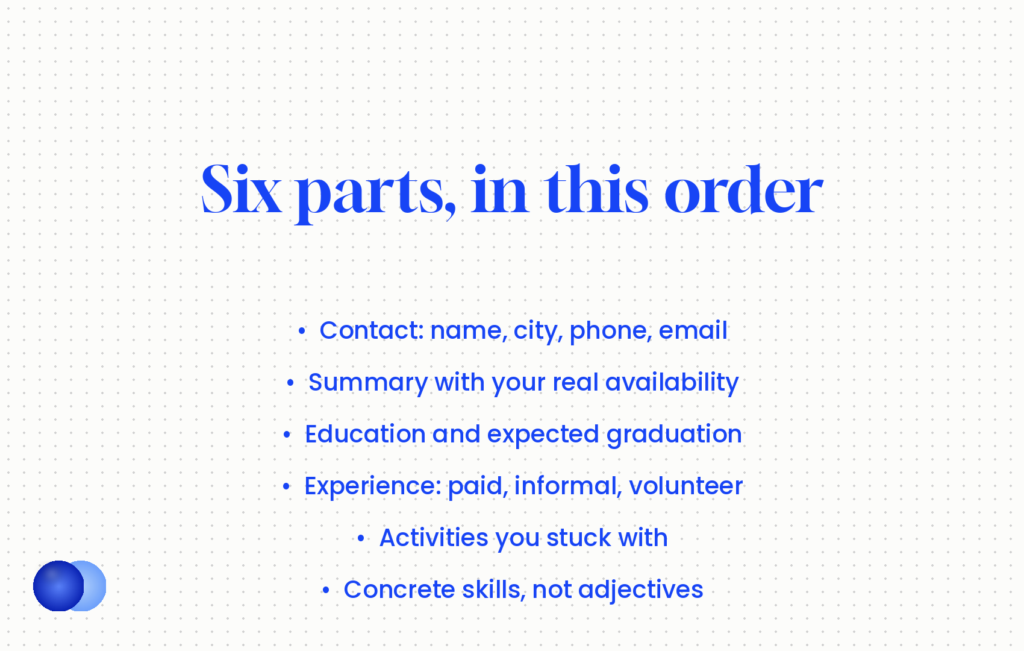
Six parts, in this order: contact details, a two-line summary with your availability, education, experience (paid, informal and volunteer), activities, and skills. Everything has a month and year. Nothing needs a photo, your age or your full street address. One page covers all of it.
Contact details. Full name, city and state, mobile number and an email address that sounds like a person rather than a gamer tag. Skip your street address and any photo; the photo on resume guide explains why US employers expect none.
Summary with availability. Two lines: who you are and when you can work. The next section explains why this line matters most.
Education. School name, expected graduation month and year, and a GPA only if it helps you (3.0 or above is a common cut-off). Add a relevant class if it connects to the job.
Experience. Wider than paid jobs: babysitting, mowing lawns, tutoring, a family business and volunteering all count, described honestly with dates. For paid childcare shifts, our child care resume examples show how those dates look on the page.
Activities. Sports teams, band, student council, scouting. Each shows a commitment you kept.
Skills. Short and concrete: "cash handling", "Google Sheets", "conversational Spanish". Skip vague traits like "hard-working" and prove them in a bullet instead.
Why does availability matter so much on a teen resume?
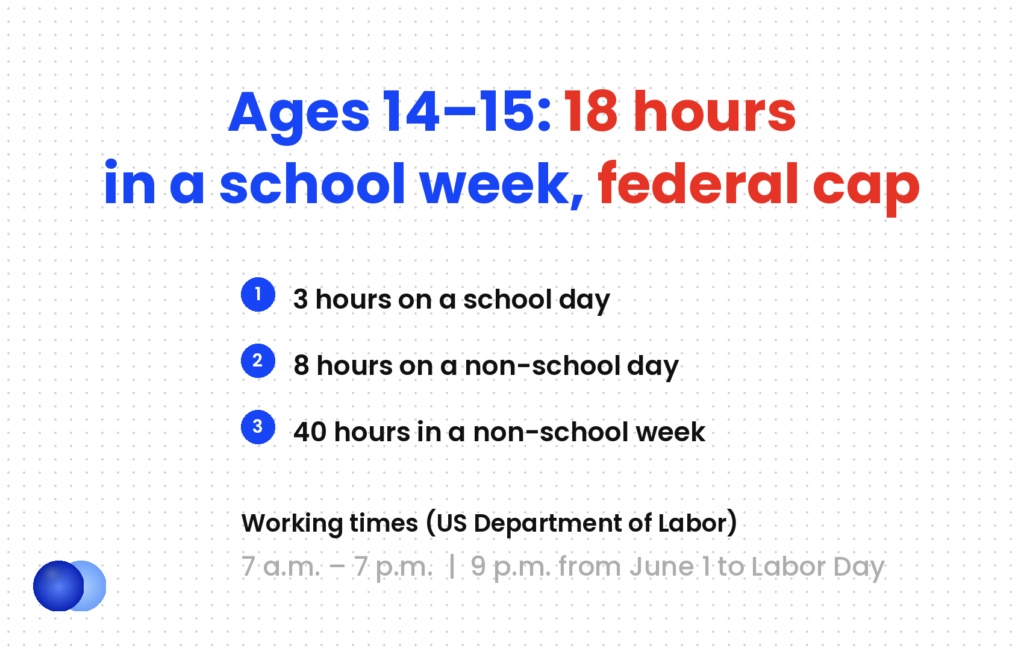
Because most teen jobs are shift jobs, and the schedule is the hardest thing for a manager to fill. Federal law also limits how many hours 14- and 15-year-olds can work, so a manager has to check your hours before anything else. Stating them up front answers the first question.
Look at where young people work. The Bureau of Labor Statistics found that in July 2025, 25% of employed 16- to 24-year-olds worked in leisure and hospitality and another 17% in retail. Those are shift jobs, and a manager reading your high school resume is often trying to cover Saturday mornings, not searching for talent.
Age adds a second layer. The Department of Labor's child labour fact sheet sets these federal limits for 14- and 15-year-olds in non-agricultural jobs:
| Rule for ages 14–15 (federal) | Limit |
|---|---|
| Hours on a school day | 3 |
| Hours in a school week | 18 |
| Hours on a non-school day | 8 |
| Hours in a non-school week | 40 |
| Working times | 7 a.m. – 7 p.m. (9 p.m. from June 1 to Labor Day) |
The same fact sheet says that where federal and state law both apply, the stricter standard wins. Many states add their own rules, and some ask minors for a work permit or employment certificate. Check your state labour department's site rather than trusting a summary.
What this means for your page
The practical fix: a line such as "Available weekends and up to 15 hours a week during term; full-time June to August" removes the manager's first worry in one sentence. Keep it honest; promising hours you cannot legally or realistically work costs you the job later.
Put the availability line where the eye lands
Put availability in the summary, in the top third of the page, not in a footer. A manager filling weekend shifts reads the top of each page and stops. Name days and hours, not adjectives: "Sat–Sun, 8 a.m.–6 p.m." beats "flexible schedule". If your hours change when school ends, give both versions and the date they switch.
Should a high school resume be one page?
Yes. One page is right for students, and it does not contradict the finding that recruiters prefer two pages for experienced candidates. That preference rewards people with enough relevant history to fill page two. A teenager stretching to two pages is padding, and padding reads worse.
ResumeGo found recruiters preferred two-page resumes 2.3 times over one-page ones. That preference fits candidates with years of relevant work to show; it is not a rule that every resume should reach two pages.
A high school resume usually holds one or two jobs, a few activities and a school record. Spread across two pages, that looks thin, and page one must stand alone anyway, because a quick scan rarely reaches page two. For a first job, one full, dense page beats two sparse ones every time. The one page resume guide covers how to fit it without shrinking the text.
Adult layout rules still apply: margins of 0.75–1 inch, 11pt body text, and cut the weakest activity before shrinking the font.
Which resume format works best for a first job?
A hybrid layout in a single column: a short summary and skills line at the top, then education and experience in reverse date order with month and year dates. Never use a functional resume, even with little experience; it parses worst and reads as if you are hiding something.
Students with thin histories often get told to use a functional resume, which groups skills and drops dates. It is a trap. Functional layouts parse at roughly 70–85% against 92–97% for chronological and hybrid formats, and recruiters read a missing timeline as concealment. The resume format types comparison sets out the numbers.
A hybrid gives you both halves. The summary and skills lines let you lead with what you can do; the dated sections underneath prove it happened. For a teenager, that often means education sits above experience, which is fine.
Single column, text-based file. Two-column templates and skill bars scramble when chain stores and franchise systems read them automatically. Use month and year for every date, such as "Jun 2025 – Aug 2025", because year-only ranges fail on several major parsers.
What does a high school resume template look like?
Plain text, one column, six headed sections, month-and-year dates. Copy the template below into any editor, replace every bracket, and delete any section you cannot fill honestly. It stays well under the 600-word ceiling and fits on one page.
Copy this, replace the brackets, and delete anything that does not apply. Plain text is deliberate: if it survives a paste into Notepad, it will survive an applicant tracking system too.
Copyable plain-text template
` [FIRST LAST NAME] [City, State] | [Mobile number] | [[email protected]]
SUMMARY [Grade] student at [School] with [one strength, e.g. two summers of childcare experience]. Available [days and hours during term]; [full-time / hours] from [Month] to [Month].
EDUCATION [School Name], [City, State] Expected graduation: [Month Year] | GPA: [x.x, only if 3.0+] Relevant classes: [one or two that connect to the job]
EXPERIENCE [Role], [Employer or "Self-employed"] | [Mon Year] – [Mon Year]
- [Action verb] + [what you did] + [number or result]
- [Action verb] + [responsibility someone trusted you with]
[Volunteer Role], [Organisation] | [Mon Year] – [Mon Year]
- [What you did, with hours or people served]
ACTIVITIES [Team / Club], [Role if any] | [Mon Year] – Present
- [One line showing commitment or responsibility]
SKILLS [Skill], [Skill], [Skill], [Language, level] `
Leave out an objective statement, "references available upon request", your date of birth and unrelated hobbies. If asked for references, a coach, teacher or family you babysat for is normal at this stage. The line between an interest that earns its space and one that wastes it is covered in our guide to hobbies and interests on a resume.
What do high school resume examples look like?
The three short examples below are illustrative, not real people. Each shows one situation: no paid work yet, informal jobs, and a first job leading to a second. Copy the kind of evidence each uses, such as hours, people or money handled, never the exact wording.
These are made-up composites to show structure; a copied line reads as generic.
Example 1: No paid work yet (age 15, first job)
` SUMMARY Sophomore at Lincoln High School and JV soccer player. Available Sat–Sun and up to 12 hours a week during term; full-time Jun–Aug.
EXPERIENCE Volunteer, Riverside Food Pantry | Sep 2025 – Present
- Sort and shelve donations for 3 hours every Saturday
- Help check in about 40 families per shift
`
Example 2: Informal work (age 16, café or retail)
` EXPERIENCE Babysitter, Self-employed | Jun 2024 – Present
- Care for three children aged 4–9 for two regular families
- Manage bedtime routines and handle cash for weekly payments
Lawn Care, Self-employed | Apr 2025 – Sep 2025
- Mowed and edged 6 neighbourhood lawns every week
`
Example 3: First job leading to a second (age 17)
` EXPERIENCE Crew Member, Rosa's Pizza | Jun 2025 – Present
- Take phone and counter orders during Friday rush of 80+ orders
- Trusted to close the till after six weeks
`
Vague: "Babysitter, 2024–2025. Responsible for watching kids. Hard-working and responsible."
Specific: "Babysitter, Self-employed · Jun 2024 – Present. Care for three children aged 4–9 for two families, twice a week. Rebooked every week for two years."
The second version has month-and-year dates, real numbers and proof of trust (repeat bookings). "Responsible" now appears as evidence instead of an adjective.
How do you hand in a resume for a first job?
Three ways: online through a chain's application portal, in person at a local business, or by email. Bring a printed copy even when you applied online. Follow up once, about a week later. A short note or cover letter helps most when the application gives you a place for one.
Chain stores and restaurants usually run online applications. Upload your file if there is a slot and save the posting, because it may vanish before the interview.
Local businesses often skip job boards entirely. Forbes contributor Sarah Hernholm notes that small independent employers often hire through word of mouth or walk-in applications. Visit on a quiet afternoon, ask for the manager and hand over a printed page.
Email works when a business lists an address. Put your name and the role in the subject line and a short message in the body. For that message, the cover letter with no experience guide shows how to lead with school and volunteering.
Follow up once, around a week to ten days after applying, with a short, polite message; the how to follow up on a job application guide has wording.
State your real availability, with days and hours, in the top third of the page, and update it each season.
Switch to a functional layout or year-only dates to disguise a short history; a short history is expected at your age.
Last summer was the weakest summer for teen hiring we have ever recorded. What is striking is that it happened without a recession.
What a resume cannot fix
If you would rather fill in fields than format a document, the Rezoom resume builder keeps a single-column layout by default; its free plan exports plain text, which is all this template needs.
No page can fix the market itself. Fewer teen jobs exist than in any recent summer, and a perfect page will still meet some silence. Apply widely, include small local businesses, and treat every volunteer shift as the next line on the page. The resume for part time job guide picks up where this one ends, once you have that first job to build on. When you move on from school applications, the college student resume guide does the same job for coursework and campus roles.
Frequently asked questions
What should I put on a high school resume with no experience?
Education, volunteering, activities, informal work such as babysitting, and a clear availability line. All count if you date them and use numbers.
Should a high school resume be one page?
Yes. Two pages suit experienced candidates with enough relevant history to fill the second page. For a student, one dense page reads stronger than two sparse ones.
Should I include my GPA?
Include it if it is 3.0 or above or if the employer asks. Otherwise leave it out.
Do I need to put my age on my resume?
No. If an employer needs to confirm your age for work-hour rules, the application or interview will ask.
How old do you have to be to get a job?
Federal law sets 14 as the basic minimum for most non-agricultural jobs, with hour limits until 16. States can set stricter rules or require a work permit, so check your state's rules before applying.
Should I use a functional resume if I have little experience?
No. Functional layouts parse worst and look as if you are hiding something. A hybrid layout with a short summary and dated sections works better.
Is babysitting real experience for a resume?
Yes. Treat it like any job: title, "Self-employed", month-and-year dates, and bullets with numbers such as how many children and how often families rebooked you.
Do I need a cover letter for a part-time job?
Often not for chain applications. When you apply by email or there is space for a message, a short note naming the role and your availability helps.



Comments