

Summary
A resume reference page is a separate one-page document formatted to match your resume, holding three to four people with name, title, company, relationship and contact details. Employers ask for it late — often alongside a background check, which usually means a verbal offer is close. The briefing matters more than the formatting: an unprepared reference gives generic answers, and generic reads as a reservation.
When an employer asks for your resume reference page, something specific has happened.
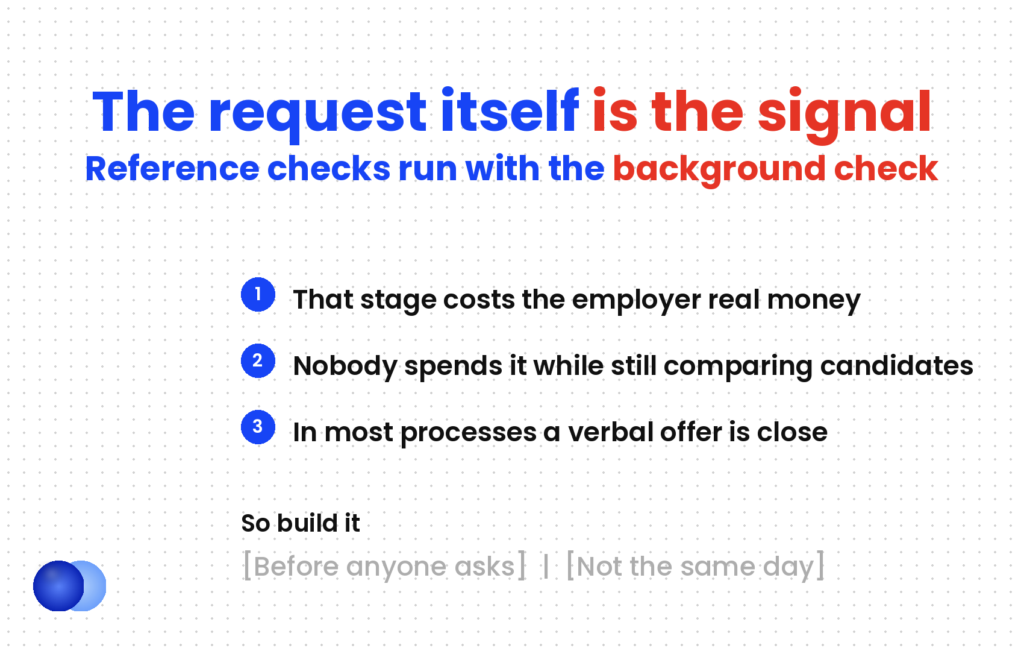
Reference checks typically run alongside or just after a background check begins — which is the stage where a company has stopped comparing candidates and started verifying one. In most processes, that request means a verbal offer is close.
So the page matters twice: as a document that has to look right, and as the last thing standing between a decision and an offer. Here is how to build it, and the part that actually decides whether it helps.
What is a resume reference page?
A separate one-page document listing three to four professional references, formatted to match your resume exactly. It holds each person's name, job title, company, your relationship to them, and their contact details — and you send it only when an employer asks.
In practice, it is a companion document rather than a resume section. "References available upon request" does not belong on a resume, which is a settled question and a separate one.
What makes the page work is that it reads as part of the same set. Same font, same font size, same margins, and your contact header replicated exactly — name, phone, email, LinkedIn. Title it "Professional References" or simply "References."
A hiring manager receiving a page in a different typeface with a different header experiences a small, unnecessary friction. Matching costs nothing and removes it.
When do employers ask for it?
Usually after the final interview, once you are a serious finalist. Some ask at the close of the first interview, and government, healthcare and security-cleared roles often require them upfront. Prepare the page before you start interviewing so a request never catches you assembling it.
| Stage | How common | What it means |
|---|---|---|
| With the application | Rare, mostly government and security roles | A process requirement rather than a signal |
| After the first interview | Occasional | They are shortlisting seriously |
| After the final round | The norm | You are a finalist |
| Alongside a background check | Very common | A verbal offer is usually close |
That last row is the useful one. A background check costs the employer money and a reference call costs a manager fifteen minutes of someone else's time. Neither happens while they are still comparing candidates.
This is the same test that makes signs an interview went well readable: the reliable signals are the ones that cost the employer something. A reference request is among the most expensive things they do before an offer.
Build it before you need it
The request usually arrives with a same-day or next-day expectation, because the recruiter is trying to close. Assembling a page at that moment means chasing three people for current job titles and phone numbers while the clock runs — and it means those three people find out you are interviewing at the worst possible moment. Build the page when you start applying, and the request becomes a two-minute forward instead of an afternoon.
What format should the page use?
One page, your resume's header at the top, three to four entries in a consistent block format. Each entry: full name, job title, company, contact details, and one line on your working relationship. Save as PDF named Firstname-Lastname-References.pdf.
A resume reference page entry has four parts, in order:
Full name — as they use it professionally.
Job title and company — their current one, not the one they held when you worked together.
Contact details — email and phone. Ask which they prefer, and give that one first.
One line of context — how you worked together, and for how long.
Priya Rao Director of Analytics, Wexford Group [email protected] · +44 7700 900123 Direct manager for three years; oversaw the warehouse migration I led.
That italic line is the part most people leave out and the part that does the most work. It tells the hiring manager what this person can speak to, which means they ask better questions — and it means Priya is not asked about something she never saw.
Meanwhile, format every entry identically. Inconsistent blocks on a page of four people is the kind of small thing a detail-oriented hiring manager notices at exactly the moment they are checking whether you are detail-oriented.
Who should you choose?
People who directly observed your work — former managers first, then senior colleagues, clients or mentors. One senior reference who knows your work in detail outweighs three who can only speak in generalities. Match the reference to what the role needs.
On a resume reference page, quality beats quantity more clearly than almost anywhere else in a job search.
Former direct managers. The strongest, because they can speak to performance rather than impressions.
Senior colleagues or cross-functional partners. Good, particularly for collaboration and influence.
Clients. Strong for consulting, agency and freelance work, where a client saw the outcome.
Mentors and professors. Fine where the relationship involved observed work rather than acquaintance.
Entry level. Professors from relevant courses, internship supervisors including unpaid ones, and volunteer supervisors with real responsibilities. Avoid a page made only of character references from people who never saw you work.
Swap references by role, the same way you tailor a resume. The person who can describe your analytical work is not always the right call for a leadership position.
Confirm each person's current title and preferred contact method before you send the page. A wrong title or a dead phone number reads as carelessness at the exact moment someone is verifying your reliability.
List a senior name who barely knows you for the prestige. A VP who says "I believe they worked in the analytics team" damages you more than a direct manager saying something specific helps.
How do you brief them?
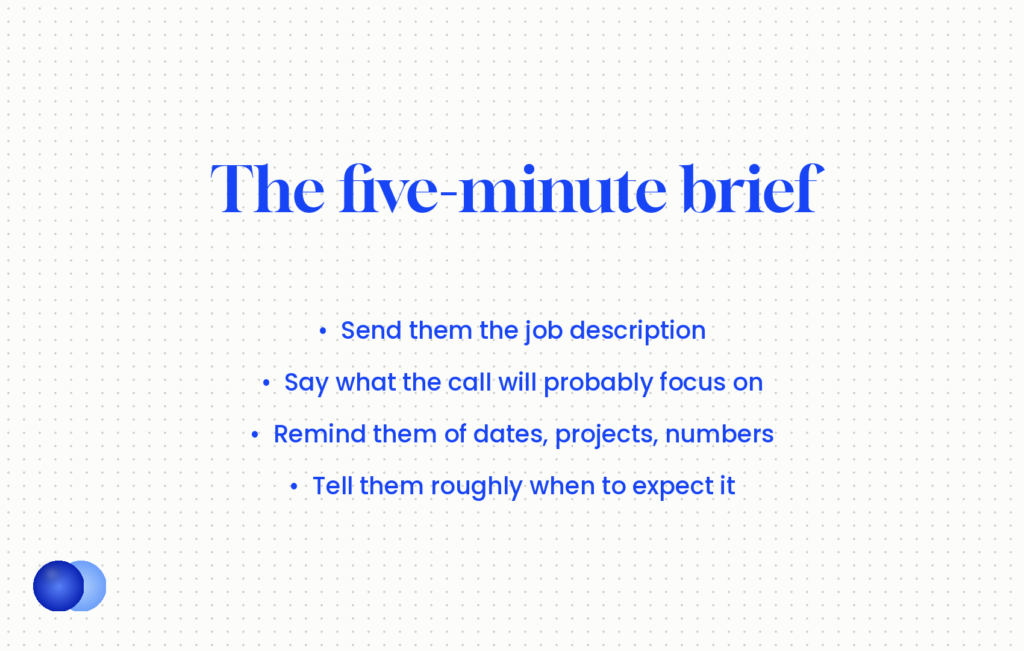
Send the job description, remind them what you worked on together, and tell them roughly when to expect the call. A reference who has not been briefed gives generic answers, and generic reads as a reservation — the same way a generic resume does.
Above all, this is the part that decides whether the page helps or quietly hurts, and it takes one email.
An unprepared reference is not disloyal. They are simply caught cold, and the honest response to being caught cold is vague: "Yes, they worked here. Good employee. I'd recommend them." A hiring manager hears that and wonders what is missing.
The brief that fixes it has four parts:
1. The role. Paste the job description or a link.
2. What to emphasise. "They'll probably ask about the migration — that's the closest thing to what this role does."
3. A reminder of specifics. Dates, project names, numbers. Two years on, they will not remember that the close went from twelve days to five.
4. Timing. "You'll likely hear from them this week."
That email takes five minutes and converts a generic endorsement into a specific one. It is the highest-return five minutes anywhere in the late stages of a process.
A surprised reference who was not briefed on the role will give generic answers.
What do reference checks actually ask?
Dates and title verification first, then performance, reliability and whether they would rehire you. Many large employers have narrowed to confirming dates and job title only, for legal reasons — which is worth knowing before you assume a reference call is a deep conversation.
Notably, two different things happen under the same name.
Verification. Dates of employment, job title, sometimes salary. Many large employers restrict their own HR departments to this, so a reference call to a corporate line may confirm nothing more.
A real reference conversation. Performance, working style, how you handled difficulty, whether they would hire you again. This happens with individual managers rather than HR departments.
That distinction matters for who you list. A former manager who has since left that company can speak freely; the same manager still inside a large employer may have to route the call to HR, which will confirm only your dates.
What should you do now?
Build the page today, confirm three or four people, save it as a PDF alongside your resume, and update it once a year. It takes twenty minutes and removes the one document that otherwise gets assembled under time pressure.
Four steps to a resume reference page you never assemble under pressure:
1. Choose three to four people. Managers first, matched to the roles you are targeting.
2. Ask them properly. Not "can I list you" — "would you be comfortable being a strong reference for roles in operations analytics?" The word "strong" gives them an easy way to decline, which is information you want early.
3. Build the page. Your resume header, four consistent entries, PDF, named properly.
4. Update it yearly. Titles change, people move, phone numbers go dead. A reference page assembled two years ago is a page of small errors.
Finally, keep it with the rest of the application set — the resume you have checked with an AI resume checker, the tracker where you log which version went where, and this. Three documents, ready before anyone asks for any of them.
Frequently asked questions
What is a resume reference page?
A separate one-page document listing three to four professional references with each person's name, job title, company, your relationship to them and their contact details, formatted to match your resume.
How many references should I list?
Three to four. One senior reference who knows your work in detail outweighs three who can only speak in generalities, so choose for depth rather than count.
What should each reference entry include?
Full name, current job title and company, email and phone, and one line describing how you worked together and for how long. That last line is the one most people omit.
When do employers ask for references?
Usually after the final interview. Reference checks often run alongside a background check, which typically means a verbal offer is close. Government, healthcare and security-cleared roles sometimes ask upfront.
Should the reference page match my resume?
Yes. Same font, same margins, same contact header. It should read as part of the same set, and matching costs nothing.
How do I ask someone to be a reference?
Ask whether they would be comfortable being a *strong* reference for a specific kind of role. The word gives them an easy way to decline, which is information you want before a hiring manager calls.
Should I brief my references?
Always. Send the job description, remind them of specifics you worked on together, and tell them when to expect the call. An unbriefed reference gives generic answers, and generic reads as a reservation.
Can I use a colleague instead of a manager?
Yes, particularly for collaboration and influence. But lead with former direct managers where you can, since they can speak to performance rather than impressions.



Comments