Resume Format Types: The Debate Is Over, With One Caveat
Three resume format types compared on parse rate: chronological and hybrid clear 92%, functional drops to 70-85%. Here is which one to use and when.

On this pageWhat are the three resume format types?
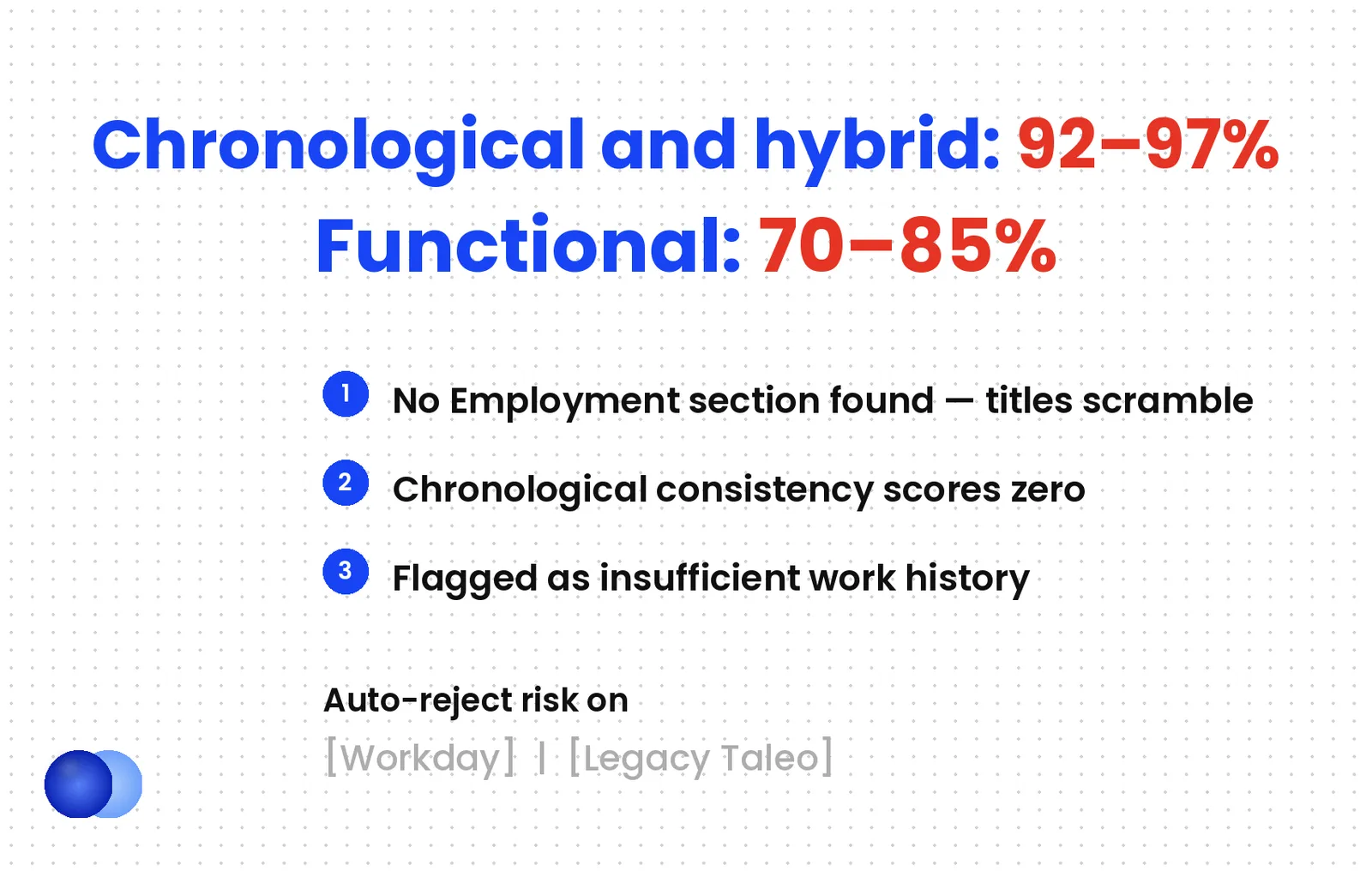
Three resume format types exist and the parsing data has largely settled which to use. Chronological and hybrid layouts parse at 92 to 97% across major platforms; functional drops to 70 to 85% and carries auto-reject risk on Workday and legacy Taleo. The mechanism is specific: a parser looking for an employment section finds none, scores chronological consistency at zero, and flags insufficient work history.
For twenty years, choosing between resume format types was a judgement call. Chronological for steady careers, functional if your history was awkward, combination if you wanted both. Senior candidates have different needs, so see the best resume format for experienced professionals. Outside the United States the document often has a different name, and we explain what CV stands for.
Parsing data has largely settled it. Chronological and hybrid layouts parse at 92 to 97%1 across the five major platforms. Functional drops to 70 to 85% and carries auto-reject risk on Workday and legacy Taleo deployments. Layout is only half of it, so decide how far back your work history should go before you settle on a format.
To see these formats applied to real jobs, browse our resume examples. If you are just starting out, Rezoom's student and entry-level resume examples show the chronological layout with little work history.
One caveat before the comparison: a statistic that appears in almost every article on this topic does not hold up, and it is worth naming.
What are the three resume format types?
Chronological lists work experience in reverse date order with achievements under each role. Functional groups achievements by skill and de-emphasises dates and employers. Hybrid, also called combination, leads with a skills summary and follows it with a standard chronological history.
| Format | Structure | Parse rate | Use it when |
|---|---|---|---|
| Chronological | Experience in reverse date order | 92–97% | Almost always — this is the default |
| Hybrid / combination | Skills summary, then chronological history | 88–97% | Career change, gaps, skills-heavy roles |
| Functional | Achievements grouped by skill, dates minimised | 70–85% | Almost never |
The parse-rate column is the part that has changed. These formats were once three defensible choices for three situations. Now one of them fails a mechanical test the other two pass. Hybrid is also the layout most people reach for when returning to work after a career break, because it leads with skills without hiding the dates.
Why does the functional format fail?
Because parsers look for a structured employment section and a functional resume does not have one. The failure chain is specific: no Employment or Work Experience section found, titles and dates extract scrambled or missing, chronological consistency scores zero, and the record gets flagged as insufficient work history.
Importantly, the failure is mechanical rather than a matter of taste, which is why it is so consistent.
A parser processes your file2 looking for structured sections — Contact, Experience, Education, Skills. When achievements sit under headings like "Leadership" and "Analysis" instead of under employers with dates, the extraction has nothing to anchor to. Skills come back detached from the jobs where you used them, and the employment record comes back thin or empty.
Meanwhile, recruiters reach the same conclusion by a different route. Training teaches them to distrust de-emphasised dates and employers, because the usual reason for hiding those is a gap, a short tenure, or a title that does not support the claims above it. So a functional resume triggers suspicion from the human even when it survives the parse.
That combination — poor parsing plus active distrust — is why it is a poor choice for nearly any candidate in 2026, including the ones it was originally designed for. How an ATS works covers the extraction step in more detail.
Career changers and candidates with gaps feel the strongest pull toward the functional format, precisely because their history looks awkward. That instinct picks the layout with the worst parse rate and the most recruiter suspicion — the two groups who most need to survive screening choose the format least likely to let them. Hybrid gives the same emphasis without either cost.
About that 75% figure
A claim that 75% of resumes are rejected by applicant tracking systems before a human sees them appears throughout this topic. No primary study supports it, estimates in circulation range from 75% to 98%, and no major vendor publishes such a rate. Treat format advice built on it with caution.
Worth stopping on, because it props up a great deal of the advice about resume format types.
In practice, the number circulates as fact and traces back to nothing verifiable. One source in this very topic5 notes the range in circulation runs from 75% to 98% — a spread that large is itself evidence that nobody is measuring the same thing, or measuring at all. The 75% ATS rejection myth covers where it came from.
Consequently, this matters here for a practical reason. Advice that leans on an inflated rejection rate tends to recommend defensive, over-optimised formatting. The parse-rate data is real, it is more modest, and it points somewhere simpler: use a structure the parser expects and spend your remaining effort on content. Over-optimised formatting is itself one of the more common resume mistakes.
Which format should you use?
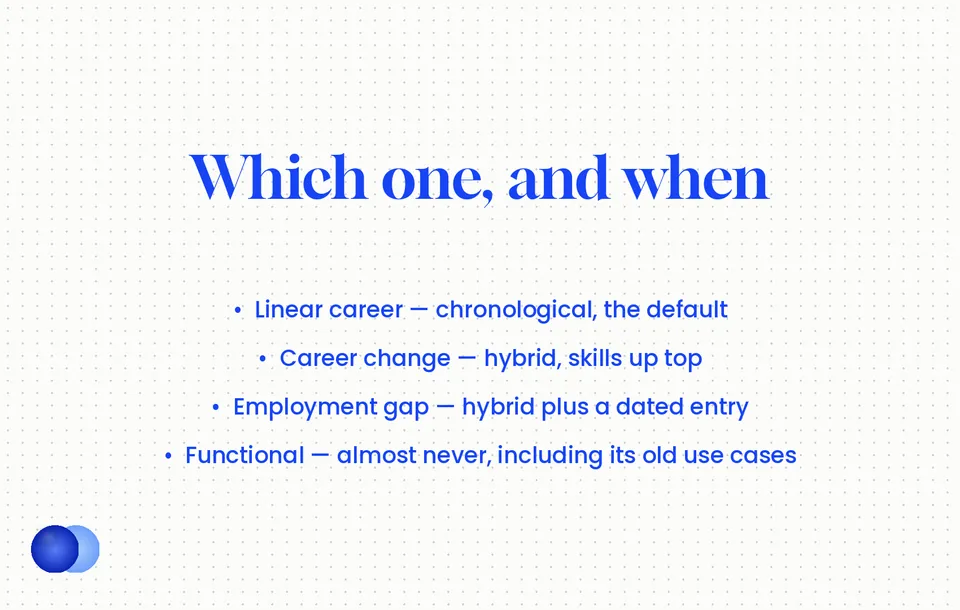
Chronological unless you have a specific reason not to. Hybrid when a career change, an employment gap, or a skills-heavy role means your recent titles do not tell the story. Functional almost never, because the situations it was designed for are exactly the ones it now damages.
Choosing between resume format types comes down to four situations: Applying abroad adds one more variable, and the international resume format guide covers what each market expects.
Linear career, relevant recent roles. Chronological. It is the default for a reason — recruiters read it fastest and it parses best. Recent graduates usually fit here too, with education placed first, as these college graduate resume samples show.
Career change. Hybrid. A skills summary at the top reframes how a reader interprets the history below it, without hiding the timeline. That is the whole argument in the career change resume.
When the history needs reframing
Employment gap. Hybrid, plus a dated entry for the gap itself. Functional makes gaps worse, not better — the parser reads the missing employment section as insufficient work history, which is a stronger negative than the gap would have been. What goes in that dated entry is the other half of the job — here is how to explain an employment gap without apologising for it.
Skills-heavy technical role. Hybrid. A Core Skills section near the top parses early and lifts keyword match, while the chronological history still supplies the tenure and progression a recruiter scores.
Functional: A "Project Management" heading with four achievements underneath, drawn from three different employers across six years. Employers and dates listed separately at the bottom. Hybrid: A Core Skills line naming project management, stakeholder reporting and Jira. Then each of the three employers in reverse order, with the relevant achievement under the job where it happened. Identical content. The second version anchors every claim to a date and an employer, which is what both the parser and the recruiter are looking for.
Do
- Change format between applications if it helps. Nothing commits you to one layout for a whole search — a hybrid for a career-change target and a chronological for a same-field role is a reasonable thing to maintain.
Don’t
- Use two columns in any format. Parsers read left to right across the full page width, so a sidebar interleaves with your work history. Single-column layouts pass at markedly higher rates.
Free ATS score, the text the software extracts and your missing keywords. No sign-up.
What matters more than the format?
Single-column layout, standard section headings, consistent dates and a file the parser can read. A chronological resume in two columns performs worse than a hybrid in one. Format choice sets the ceiling; layout and content decide whether you reach it.
Three things outrank the choice between resume format types, and people routinely get the order backwards.
Single column. The largest single formatting variable. Multi-column layouts scramble extraction in every format.
Standard headings. Experience, Education, Skills. Creative labels are one more thing a parser can miss, and they buy nothing.
A readable file. An image-based PDF has no text layer at all — whether to send PDF or Word covers the distinction that actually matters there, which is not the extension.
Finally, get those three right and the format choice becomes what it should be: a decision about emphasis rather than about survival. The same plain structure suits the letter that goes with it; see these cover letter examples for students.
Recruiters are trained to be sceptical of functional resumes: if dates and employer names are de-emphasised, the resume may be hiding a gap, a short tenure, or a title that doesn't match the claims.
Smart Resume Analyzer, format comparison 2026
Once you have settled the structure, check the result rather than assuming it. An ATS resume checker run against a specific posting shows what the parser extracted from your actual file, which is the only version of this question that applies to you.
Frequently asked questions
What are the three resume format types?
Chronological lists experience in reverse date order. Functional groups achievements by skill and de-emphasises dates. Hybrid, or combination, leads with a skills summary followed by a chronological history.
Which resume format is best in 2026?
Chronological for most candidates, hybrid for career changes, gaps or skills-heavy roles. Both parse at 92 to 97% across major platforms, while functional drops to 70 to 85%.
Why are functional resumes bad?
A parser looking for a structured employment section finds none, extracts titles and dates poorly, scores chronological consistency at zero, and flags insufficient work history. Recruiters separately distrust de-emphasised dates.
Is a functional resume good for hiding employment gaps?
No — it makes them worse. The parser reads the missing employment section as insufficient work history, which is a stronger negative than the gap itself. Use a hybrid with a dated entry for the break.
What format should a career changer use?
Hybrid. A skills summary at the top reframes how a reader interprets your history, without hiding the timeline that a parser and recruiter both need.
Do two-column resumes work?
Not through a portal. Parsers read left to right across the full page width, so a sidebar interleaves with your work history. Single-column layouts pass at markedly higher rates in every format.
Is 75% of resumes really rejected by ATS?
No primary study supports that figure, and circulating estimates range from 75% to 98%. Treat format advice built on an inflated rejection rate with caution.
Can I use different formats for different applications?
Yes. Nothing commits you to one layout for a whole search, and maintaining a hybrid for career-change targets alongside a chronological for same-field roles is entirely reasonable.
Sources
We opened and read each page below. The small numbers in the text point here. Pages that carry no publication date show n.d.
- Resume Optimizer Pro2026
2026 benchmark testing across five platforms: chronological and hybrid parse at 92-97%,…
- StylingCV2026
Functional resume failure chain — parser finds no Employment section, scrambles titles…
- Smart Resume Analyzer2026
Recruiters are trained to distrust functional resumes because de-emphasised dates suggest a…
- Dinjob2026
Career changers should use a combination format that leads with transferable skills…
- BestJobSearchApps2026
Notes that circulating ATS rejection estimates range from 75% to 98%; standard…
Mohammad has spent more than ten years designing consumer products and leads product at Rezoom, deciding what gets built and what gets left out. His guides cover the whole job search, from resume sections and cover letters to interview answers and career moves.
Goodi, M. (2026, October 23). Resume Format Types: The Debate Is Over, With One Caveat. Rezoom. https://rezoom.io/resume-format-types/