Returning to Work Resume: There Is a Channel Built for You
A returning to work resume doesn't have to defend the break. Over 110 US employers run returnships where the break is the entry requirement.

On this pageWhat is a returnship?
Most advice on returning to work treats the career break as something to defend on a standard application. A second route exists: more than 110 US companies run formal returnship programmes where a break of a year or more is the eligibility criterion rather than the obstacle, with conversion to full-time roles reported between 65% and 90%. The resume for that route is built differently.
Almost every guide to the returning to work resume is about damage control — how to explain the gap, how to minimise it, how to reassure an employer who might hold it against you. When the break began with a layoff, timing matters more than wording — the penalty on a resume after being laid off starts at about month six.
That advice is fine as far as it goes. It also skips something significant: more than 110 US companies now run formal returnship programmes1 where a career break of a year or more is the eligibility requirement. Not something to overcome. The thing that qualifies you.
You can adapt a layout from our resume examples for your target job.
Roughly a third of Fortune 100 companies operate one. This article covers both routes — the resume for standard applications, and the different resume for the channel built for exactly your situation.
What is a returnship?
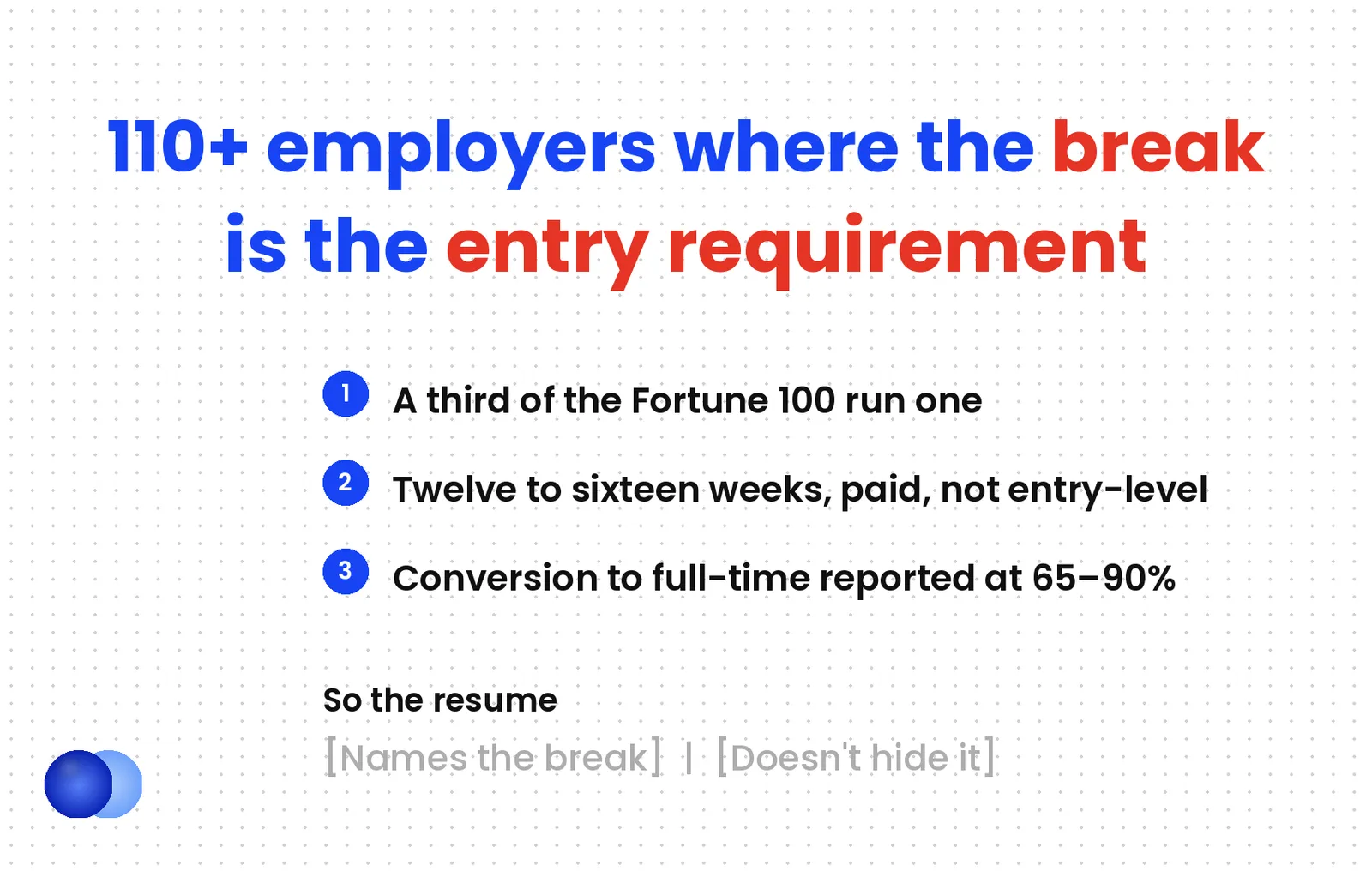
A paid 12 to 16 week programme for experienced professionals returning after a break of one or more years, with structured training, mentorship and real project work. Reported conversion to full-time roles runs between 65% and 90%, and unlike an internship these are not entry-level positions.
In practice, the mechanics matter, because "returnship" sounds like an internship and is not one.
Paid and senior. Participants typically bring five to twenty years of experience from before their break. Pay reflects that — though the reported figures vary enormously, and that is worth flagging rather than glossing over.
Time-boxed. Twelve to sixteen weeks at most companies. Wells Fargo runs ten; JPMorgan and Morgan Stanley run sixteen.
Designed to convert. Employers enter these with the intent to hire. Reported conversion sits between 65% and 90% depending on the programme.
Goldman Sachs is generally credited with starting the model over a decade ago. It spread to technology, and iRelaunch — which has worked with more than 250 companies since 20073 — reports what it calls an institutional shift toward treating career breaks as a normal part of a career path.
| Company | Length | Notes |
|---|---|---|
| Amazon | 16 weeks | Rolling applications; separate "Rekindle" programme in India |
| Goldman Sachs | ~10 weeks | The original programme |
| JPMorgan Chase | 16 weeks | Fixed cohorts |
| Morgan Stanley | 16 weeks | Fixed cohorts |
| Wells Fargo (Glide) | 10 weeks | Fixed cohorts |
Returnship applications succeed when the hiring manager can immediately picture you doing the role. If you were an accountant before your break, apply to accounting returnships rather than treating the programme as a chance to pivot. Career changes through a returnship are possible and materially harder, because the programme aims to restore an existing capability rather than build a new one. Pivot after you are back in, not on the way in.
What does the pay actually look like?
Reported figures vary by a factor of two, so treat any single number carefully. ZipRecruiter's 2026 data puts the national average near $46 an hour; Glassdoor reports an average closer to $48,000 a year. Both describe real programmes, and the spread reflects how different these roles are.
Worth being precise, because people quote the flattering number alone.
The high figure. ZipRecruiter's 2026 data puts the national average around $95,651 a year, or roughly $46 an hour. In high-cost areas, Bay Area returnships frequently exceed $60 an hour.
The low figure. Glassdoor reports an average closer to $48,000 annually.
Those describe the same category and differ by roughly double. Composition likely explains it — seniority, sector and location vary hugely across 110 programmes. So check the specific programme rather than budget from an average, and to remember that returnship pay is still typically more than double a standard internship.
How is a returning to work resume different for a returnship?
It names the break plainly and early, because the break is the eligibility criterion. State the dates, the reason in a few words, and what you did to stay current — then lead with the professional identity you held before, since the programme is designed to restore it.
Notably, the standard advice to minimise the gap is exactly wrong here.
A returnship reviewer2 is checking three things: that you have a break of the required length, that you have relevant prior experience, and that you are ready to work. Hiding the first one makes you harder to qualify.
Name the break. "Career Break, 2021–2026 — full-time caregiving" as a dated entry in your work history. If you also cared for other families’ children for pay, Rezoom's babysitting resume examples show how to list it as a job.
Lead with your prior identity. Not "seeking to re-enter the workforce" but "Financial Analyst with six years in corporate accounting." The programme exists to restore that person.
Show currency. A course, a certification, freelance work, a volunteer role with real responsibility, a personal project. Something dated inside the break period.
Keep your prior achievements quantified. They did not expire. The close you cut from twelve days to five in 2020 is still evidence.
What about standard applications?
The same structure, with the gap handled in one clause rather than as a heading. State it explicitly and briefly, pivot immediately to what you did to stay current, then let your prior experience carry the document. Duration matters more than reason.
Most applications still go through normal channels, and a returning to work resume there differs in emphasis rather than in kind.
The rule from how to explain an employment gap applies directly: the penalty tracks duration rather than cause, and silence is worse than explanation. A dated Career Break entry does the work without turning your resume into a defence.
Two habits to drop
Two things to avoid, both common:
Apologising. "Although I have been out of the workforce…" volunteers a weakness nobody raised. The career change resume makes the same point — translation beats pleading.
Leading with an objective. An objective states what you want. A summary states what you offer, which is the stronger position for anyone asking an employer to look across a gap. If a role explicitly asks for one, see how to write a career change resume objective that still leads with what you offer.
Apologetic: "Dedicated professional seeking to re-enter the workforce after taking time off to raise my family. Eager to apply my skills in a supportive environment."
Direct: "Financial Analyst with six years in corporate accounting, including two years leading month-end close for a 40-person finance team. Career break 2021–2026 for full-time caregiving; completed the Advanced Excel and Financial Modeling certificate in 2025. Targeting analyst roles in mid-market finance."
The second names the break in eight words and spends the rest on evidence. It hides nothing and apologises for nothing.
Do
- Include unpaid work that had real responsibility — treasurer of a school association, running a volunteer rota for thirty people, managing a fundraising budget. Scope and outcomes count regardless of whether anyone was paid.
Don’t
- Pad the break with vague filler like "kept skills current through independent study". If you cannot name a course, a project or a date, leave it out and let the dated entry stand on its own.
Free ATS score, the text the software extracts and your missing keywords. No sign-up.
How do you time a returnship application?
Early, and often several months ahead. Many programmes run fixed cohorts with applications opening three to four months before the start date, reviewed in batches. Amazon accepts applications year-round; most others do not. Late applicants routinely find the cohort filled.
Broadly, three practical points decide outcomes more than the resume does:
Check the cycle. Fixed-cohort programmes at Amazon and Goldman typically open three to four months before the start. Missing a window means waiting six months or a year.
Apply in the first batch. Reviews happen in batches, and cohorts fill.
Use the intermediaries. Path Forward, iRelaunch and reacHIRE work with employers to run these programmes and list openings across multiple companies — a faster route than checking 110 careers pages individually.
What if a returnship is not available to you?
The same resume works for standard applications, and the market context is more favourable than the anxiety suggests. Labour force participation for mothers with children under 18 reached 74% in 2024, matching the record high, and employers report increasing recognition of what returners bring.
Returnships cluster in large corporate employers, in specific sectors, and in specific cities. If your field, location or timing does not line up, the standard route is not a consolation prize.
Finally, two things worth knowing about that route.
The stigma has genuinely moved. iRelaunch's assessment is that employers increasingly recognise the attributes of professionals who took breaks — experienced, educated, and in a stable life stage. That is a description of an argument employers are already making, not one you have to construct.
Preparation transfers. Interview questions about your break are predictable enough to script, and 30 to 45 seconds of context, activity and readiness answers almost all of them. The STAR method covers the questions that follow, and your pre-break work is entirely valid material for them.
The biggest factor is a greater recognition by employers of the attributes of professionals who have taken career breaks.
Carol Fishman Cohen, CEO of iRelaunch
Where should you start?
Build the resume once with the break stated plainly, check that it parses, then apply to both channels in parallel. Returnship cohorts have long lead times, so applying to one does not mean waiting on it.
Four steps to a returning to work resume that serves both channels: Retirees returning to paid work can follow the same sequence in the guide to a resume after retirement.
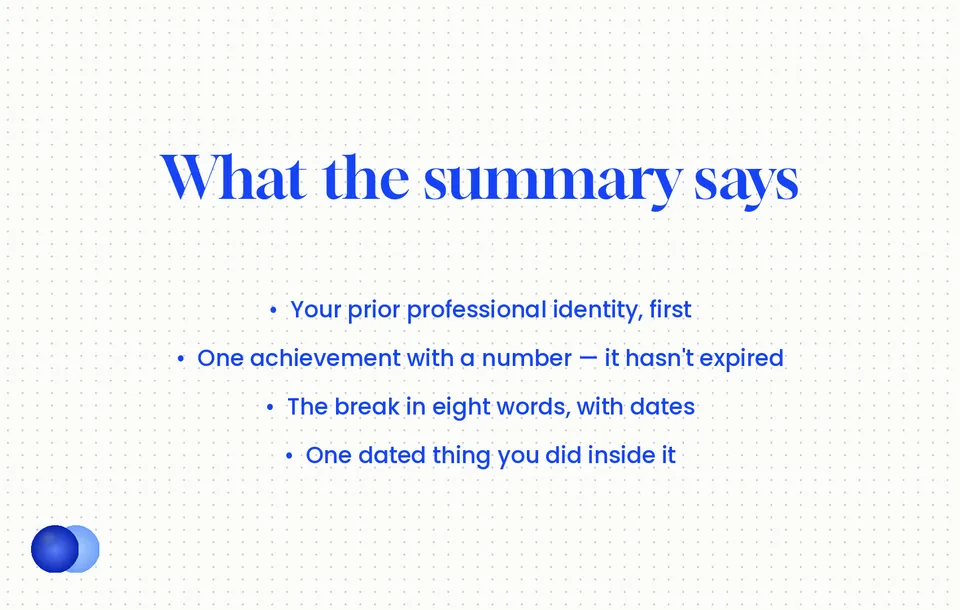
1. Write the summary first. Prior professional identity, one quantified achievement, the break in one clause, what you did during it.
2. Add a dated Career Break entry. In your work history, with the years.
3. Check it parses. A resume with an unusual structure is worth testing rather than assuming — an ATS resume checker against a real posting shows what extracted and what the language missed.
4. Apply to both channels. Returnship cohorts open months ahead, so an application there does not pause your standard search.
The reframe that matters: your break is not a hole in a document. In one entire hiring channel it is the entry criterion, and in the other it is a fact that needs eight words and no apology.
Frequently asked questions
How do you write a resume after being a stay-at-home parent?
Lead with your prior professional identity and a quantified achievement, name the break as a dated entry with the reason in a few words, and show one dated thing you did during it — a course, a project, volunteer work with real responsibility.
What is a returnship?
A paid 12 to 16 week programme for experienced professionals returning after a break of a year or more, with structured training and mentorship. Conversion to full-time roles is reported between 65% and 90%.
How many companies offer returnships?
More than 110 US companies in 2026, including Goldman Sachs, Amazon, JPMorgan, Microsoft and Johnson & Johnson. Roughly a third of Fortune 100 companies run one.
How much do returnships pay?
Reported figures vary by roughly double — ZipRecruiter's 2026 data puts the average near $46 an hour, while Glassdoor reports closer to $48,000 a year. Check the specific programme rather than budgeting from an average.
Should I hide my career break on my resume?
No, and particularly not for a returnship, where the break is the eligibility criterion. On standard applications a dated Career Break entry works better than an unexplained gap.
Can I change careers through a returnship?
It is possible and significantly harder. These programmes are designed to restore an existing capability, so apply to the field you left and pivot once you are back in.
Does unpaid work count on a returning to work resume?
Yes, when it had real scope. Treasurer of an association, running a volunteer rota, managing a fundraising budget — outcomes and responsibility count regardless of pay.
When should I apply to a returnship?
Three to four months before the cohort starts, in the first review batch. Amazon accepts applications year-round; most fixed-cohort programmes do not, and late applicants find them filled.
Sources
We opened and read each page below. The small numbers in the text point here. Pages that carry no publication date show n.d.
- MomUp2026
More than 110 US companies run formal returnship programmes in 2026 with…
- Career Returns2026
Return-to-work programmes convert at 65-90%; applications succeed when the hiring manager can…
- WorkingNation2026
iRelaunch has worked with more than 250 companies since 2007; CEO Carol…
- The Interview Guys2026
Amazon runs a 16-week programme with rolling applications and a separate Rekindle…
- Dreambound2026
BLS reported labour force participation for mothers with children under 18 reached…
- The Power Pause2026
Path Forward, iRelaunch and reacHIRE operate as full-service intermediaries listing openings across…
Mohammad has spent more than ten years designing consumer products and leads product at Rezoom, deciding what gets built and what gets left out. His guides cover the whole job search, from resume sections and cover letters to interview answers and career moves.
Goodi, M. (2026, October 17). Returning to Work Resume: There Is a Channel Built for You. Rezoom. https://rezoom.io/returning-to-work-resume/