Freelance Resume: The Format Is Serial, Your Work Isn't
Freelance resume entries with no company name fail to parse 40% of the time. One umbrella entry with clients as sub-bullets parses at 95%. The full fix.

On this pageWhat is the biggest freelance resume mistake?
A resume assumes one employer at a time. Freelancing is parallel — several clients at once, overlapping dates, no ladder of titles. The translation is a single umbrella entry with clients as sub-bullets, which parse testing across eight platforms found correct 95% of the time against 88% for per-client entries. The largest single failure is leaving the company name blank, which breaks parsing 40% of the time.
A freelance resume has to solve a shape problem. The resume is a serial document — one employer, then the next, in a line.
Freelancing is parallel. Six clients at once, overlapping dates, no ladder of titles, and a career that does not narrate itself as progression. Forcing that into a format built for the other shape is the whole problem — and the fix is mechanical rather than a matter of writing well.
For layouts built for specific jobs, browse our resume examples.
Around 72.9 million Americans freelance, so recruiters see this constantly. The ones who struggle are the ones whose format fights the parser.
What is the biggest freelance resume mistake?
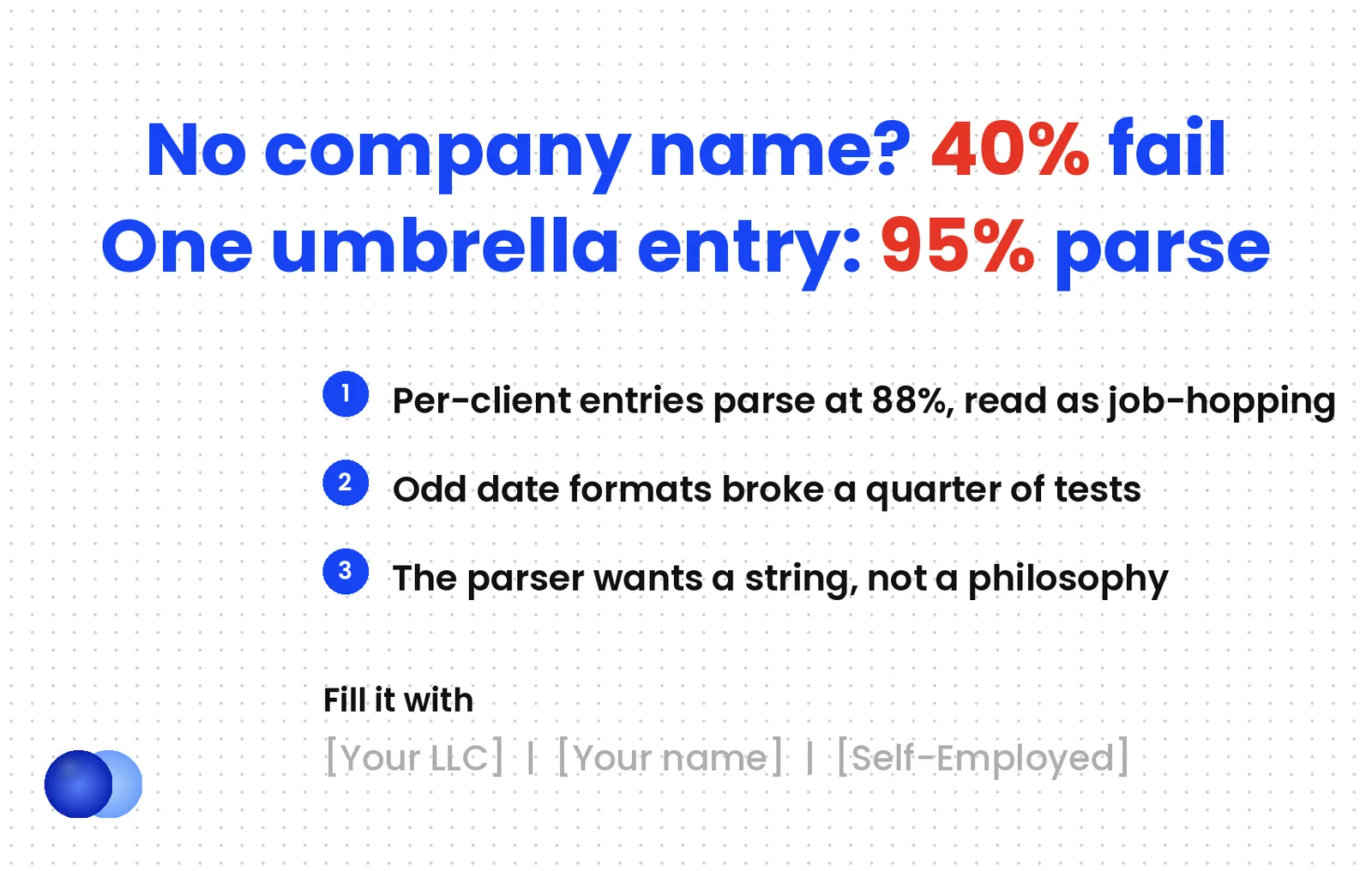
Leaving the company name blank. Parse testing across eight major platforms found entries without an employer name failed to parse correctly 40% of the time. Applicant tracking systems require that field, and a freelancer's instinct is to leave it empty because there was no employer.
In practice, this is the single most costly error in the category, and it comes from an entirely reasonable assumption. It belongs to the same family of resume mistakes that quietly sink an application.
You did not work for a company, so the company field1 feels wrong to fill in. But the parser is not asking a philosophical question — it is looking for a string to put in a database column, and an empty column breaks the record.
Fill it with one of three things:
Your LLC or business name. "Torres Marketing Consulting" if you have one.
Your name plus a descriptor. "Okafor Consulting" or "J. Rivera Design."
"Self-Employed." Plain, accurate, and it parses.
Some resumes combine two: Torres Marketing Consulting (Self-Employed). That gives the parser a clean employer string and tells the human immediately what kind of work it was. The same setup works for small service gigs, as in this guide to listing dog walking experience on a resume.
Should you list clients separately or under one heading?
Under one heading. Testing across Workday, Greenhouse, Lever, iCIMS, Taleo, BambooHR, JazzHR and Breezy HR found a single umbrella entry parsed correctly 95% of the time, against 88% for per-client entries — and eight separate short entries also read as job-hopping to a human.
| Format | Parse accuracy | Human reading |
|---|---|---|
| Single umbrella entry, clients as sub-bullets | 95% | Coherent, one role |
| One entry per client | 88% | Eight one-month jobs |
| No company name | 60% | Often absent from the extracted record |
| Unconventional date formats | 75% | Confusion about overlap |
Helpfully, both readers agree here, which is unusual.
A parser handles one employer with one date range far more reliably than eight fragments, some of which platforms split unpredictably.
The human sees a consultant with a six-year practice rather than someone who could not hold a job for more than three months.
The shape that works
The structure that produces both:
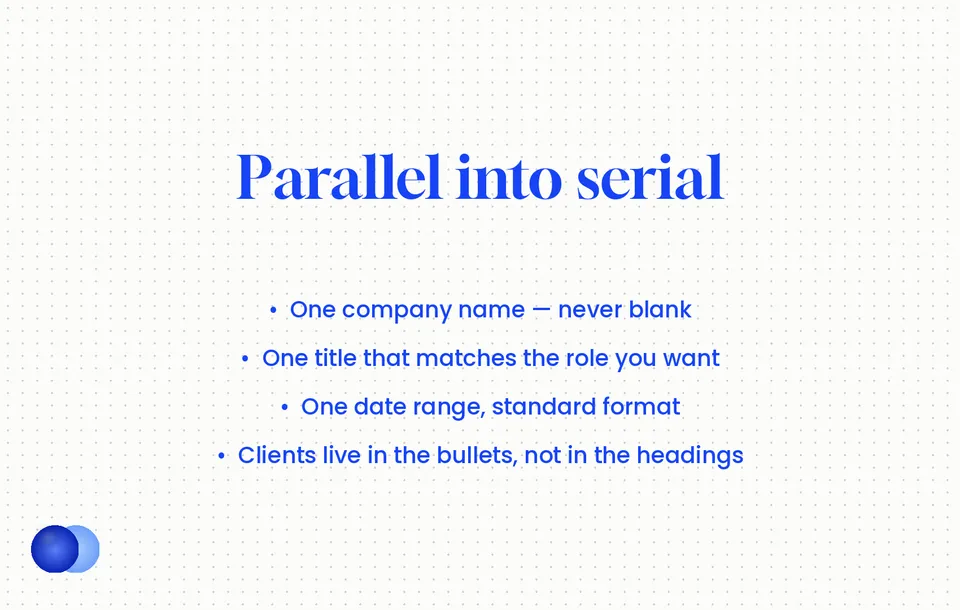
` Torres Marketing Consulting (Self-Employed) Independent Marketing Consultant | Mar 2020 – Present · Rebuilt paid search for a Series B healthtech client, cutting cost per lead from $180 to $96 · Ran lifecycle email for a Fortune 500 retailer across 14 regional programmes · Maintained 94% client retention over six years, with 78% of new business from referrals `
One employer string, one title, one date range, clients inside the bullets. That is the translation from parallel to serial. App-based work condenses the same way; putting DoorDash on a resume shows which platform stats belong in the bullets.
An NDA does not force you into vagueness. "Series B healthtech company", "Fortune 500 retailer" and "regional NHS trust" all give a recruiter what they actually need — the scale and sector of the work — without naming anyone. A bullet that says "worked with a range of clients across industries" tells them nothing; one that says "three fintech startups, two of them pre-Series A" tells them almost as much as the names would.
What title should you use?
A standard one that matches your target role — "Independent Marketing Consultant", "Freelance Web Developer", "Contract Data Analyst". One source reports "Freelancer" carries negative associations for around 31% of hiring managers against 78% viewing "Independent Consultant" positively, though that figure comes from a single vendor rather than a published study.
Meanwhile, two things matter more than the perception question, and both are mechanical.
Match the target role. If you are applying for a marketing manager position, "Independent Marketing Consultant" contains the words the search is looking for. "Creative Problem Solver" contains none of them. For the opening line itself, these marketing resume objective examples apply the same keyword logic.
Keep it to one title. "Owner / Developer / Designer / All-Around Creative" is a real thing freelancers write and a parser handles badly. Pick the one that matches the job you want.
On the perception data: treat it as directional rather than settled. The reasoning is sound — "Independent Consultant" sounds like a business and "Freelancer" sounds like an arrangement — but a single vendor survey is not the same as evidence, and the parsing argument is stronger anyway.
How many clients should you list?
Three to five, chosen per application. A resume is a highlight reel rather than a client list, and listing every project you ever touched buries the ones that matter for this specific role.
Curation does more work here than anywhere else on a freelance resume, because you have more material than most candidates and less space to put it.
Pick by relevance, not by prestige.2 The Fortune 500 logo matters less than the project that resembles what this employer needs done.
Lead every bullet with an outcome. Not "provided marketing consulting to various clients" but the number that changed.
Reorder per application. The engagement that leads for a growth role is not the one that leads for a client-services role. Reordering three bullets takes two minutes and is most of what tailoring means.
For a growth marketing role: Lead with the paid search rebuild and the cost-per-lead number. For an account management role: Lead with the 94% retention rate and 78% referral rate. Same six years, same clients, same truth. The first two bullets change, and they are the ones most likely to get read.
Do
- Use standard
Mar 2020 – Presentdates. Unconventional formats caused parsing errors in a quarter of tests, and overlapping freelance work makes date confusion more likely than it would be otherwise.
Don’t
- Extend a wound-down practice to "Present" because you have not started something new. End the entry at the month you stopped taking clients, and handle the period after it as a gap — which is a smaller problem than an inaccuracy someone checks.
Free ATS score, the text the software extracts and your missing keywords. No sign-up.
What if you freelanced alongside a full-time job?
Keep it compact and place it below the salaried role. Note the part-time nature so the dates make sense, and let the full-time position carry the weight. Overlapping dates are fine when the reason for the overlap is legible.
On a freelance resume, two placement rules cover almost every case.
Freelancing alongside employment. The salaried role goes first, in full. The freelance entry sits below it, shorter, with something that signals concurrency — "Freelance Web Developer (part-time, alongside full-time role)". Without that note, overlapping dates read as an error. For the full ordering rules, see how to list two jobs at the same time on a resume.
Freelancing between roles. Treat it as a normal employment entry with the umbrella structure. It is work, it fills the period, and it needs no explanation — which is also why freelancing is a genuinely good answer to an employment gap when it happened.
Does freelance experience count?
In almost every case, yes. Freelance work demonstrates client management, business development, self-direction and delivery under constraint — and with 72.9 million Americans freelancing, hiring managers see it routinely. The exception is work entirely irrelevant to the target role that also fills no gap.
Finally, worth answering directly, because the anxiety behind the question shapes how people write.
Freelance experience is professional experience. What varies is whether a particular engagement is relevant to a particular application, which is the same question that governs whether a salaried role earns its place.
The skills it demonstrates are ones employers name explicitly: client management, scoping, pricing, delivery without supervision, and business development. A candidate who found their own clients has done something most salaried applicants have not.
Entries without a company name failed to parse correctly 40% of the time — always include a company name field.
Freelance resume parse testing across eight ATS platforms, 2026
What format should the whole resume use?
Combination — a skills section near the top, then the umbrella freelance entry in reverse chronological order. Single column, standard headings, no tables or text boxes. The skills block gets parsed early and gives a recruiter your capability before the structure of your work history.
The combination format suits freelancers for a specific reason rather than as a general preference. Freelancers who lead with samples should also see how a portfolio compares with a resume.
Your work history does not communicate progression5 the way a salaried one does — there is no junior-to-senior ladder to read. A skills block near the top supplies what the chronology cannot, and the umbrella entry below it supplies the evidence.
Three supporting rules, all mechanical: single column, because multi-column layouts scramble in every format; standard headings, because creative labels are one more thing a parser can miss; and no tables or text boxes, which parse unreliably everywhere. The three resume formats covers the parse-rate differences in more detail.
Then check it rather than assume. A freelance resume has more unusual structure than most, which makes it exactly the kind of document worth running through an ATS resume checker against a real posting — the umbrella entry either extracted cleanly or it did not, and that is a two-minute answer.
Frequently asked questions
How do you list freelance work on a resume?
As a single umbrella entry with a company name, one job title, one date range, and clients or projects as sub-bullets. That format parsed correctly 95% of the time in testing across eight major platforms.
What company name do you use for freelance work?
Your LLC name, your name plus a descriptor, or simply "Self-Employed". Never leave it blank — entries with no employer name failed to parse correctly 40% of the time.
Should I list each client as a separate job?
No. Per-client entries parsed correctly 88% of the time against 95% for a single umbrella entry, and eight short entries read as job-hopping to a recruiter.
Should I use the title "Freelancer"?
Prefer a standard title matching your target role — "Independent Marketing Consultant" or "Freelance Web Developer". These contain the words a recruiter searches for, which matters more than the perception argument.
How many clients should I list?
Three to five, chosen for relevance to the specific application. A resume is a highlight reel rather than a client list.
What if an NDA stops me naming a client?
Name the sector and scale instead — "Series B healthtech company", "Fortune 500 retailer". That gives a recruiter the context they need without naming anyone.
How do I show freelancing alongside a full-time job?
Place the salaried role first and the freelance entry below it, noting the part-time nature. Without that note, overlapping dates read as an error rather than as concurrency.
Does freelance work count as professional experience?
Yes, in almost every case. It demonstrates client management, business development and delivery without supervision, and with 72.9 million Americans freelancing, hiring managers see it routinely.
Sources
We opened and read each page below. The small numbers in the text point here. Pages that carry no publication date show n.d.
- ResumeGeni2026
Parse testing across Workday, Greenhouse, Lever, iCIMS, Taleo, BambooHR, JazzHR and Breezy…
- Resume Optimizer Pro2026
Use an umbrella heading with major clients as sub-entries; name the sector…
- Resume Optimizer Pro2026
End a wound-down practice at the month you stopped taking clients rather…
- SelfEmployed.com2026
The combination format has become the dominant choice for self-employed professionals, leading…
- TechnCV2026
Freelance careers do not follow the linear narrative traditional resumes are designed…
Mohammad has spent more than ten years designing consumer products and leads product at Rezoom, deciding what gets built and what gets left out. His guides cover the whole job search, from resume sections and cover letters to interview answers and career moves.
Goodi, M. (2026, October 22). Freelance Resume: The Format Is Serial, Your Work Isn't. Rezoom. https://rezoom.io/freelance-resume/