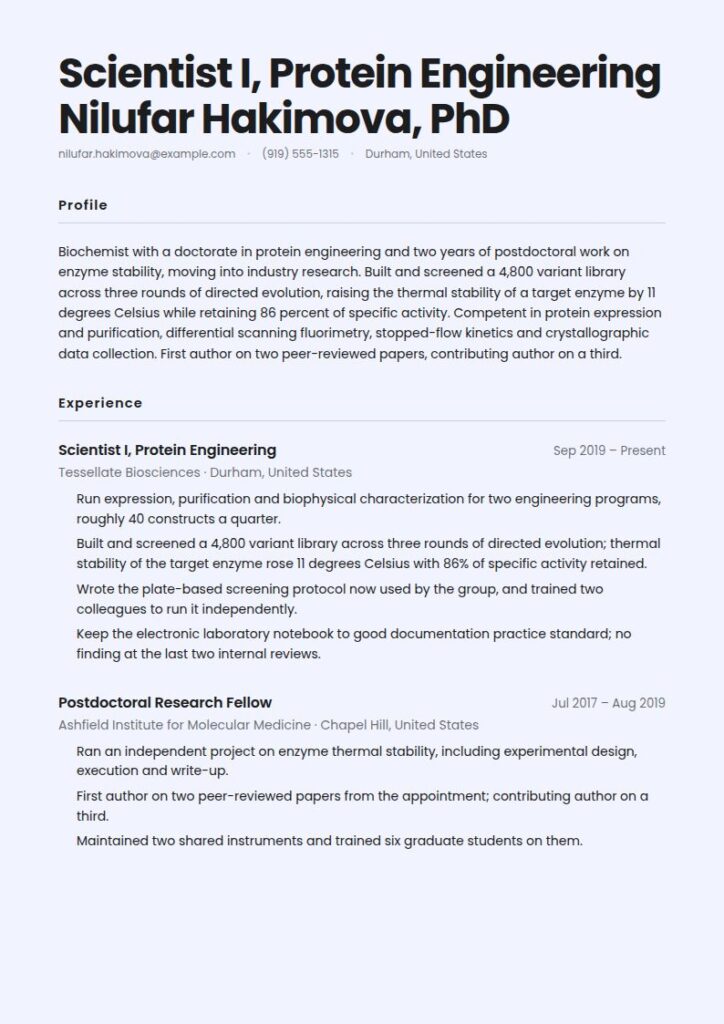
Scientist I, Protein Engineering Nilufar Hakimova PhD
Scientist I, Protein Engineering
[email protected] | (919) 555-1315 | Durham, United States
Profile
Biochemist with a doctorate in protein engineering and two years of postdoctoral work on enzyme stability, moving into industry research. Built and screened a 4,800 variant library across three rounds of directed evolution, raising the thermal stability of a target enzyme by 11 degrees Celsius while retaining 86 percent of specific activity. Competent in protein expression and purification, differential scanning fluorimetry, stopped-flow kinetics and crystallographic data collection. First author on two peer-reviewed papers, contributing author on a third.
Work Experience
09/2019 - Present, Scientist I, Protein Engineering, Tessellate Biosciences, Durham, United States
- Run expression, purification and biophysical characterization for two engineering programs, roughly 40 constructs a quarter.
- Built and screened a 4,800 variant library across three rounds of directed evolution; thermal stability of the target enzyme rose 11 degrees Celsius with 86% of specific activity retained.
- Wrote the plate-based screening protocol now used by the group, and trained two colleagues to run it independently.
- Keep the electronic laboratory notebook to good documentation practice standard; no finding at the last two internal reviews.
07/2017 - 08/2019, Postdoctoral Research Fellow, Ashfield Institute for Molecular Medicine, Chapel Hill, United States
- Ran an independent project on enzyme thermal stability, including experimental design, execution and write-up.
- First author on two peer-reviewed papers from the appointment; contributing author on a third.
- Maintained two shared instruments and trained six graduate students on them.
Education
08/2011 - 05/2017, Doctor of Philosophy, Biochemistry, University of Wisconsin-Madison, Madison, United States
Dissertation on the thermal stability of engineered enzymes. Predoctoral fellowship, Hartsook Science Trust, 2014 to 2016, $84,000.
09/2007 - 06/2011, Bachelor of Science, Biochemistry, University of Washington, Seattle, United States
Skills
Protein expression and purification, 90
Directed evolution and library construction, 80
Differential scanning fluorimetry, 85
Stopped-flow kinetics, 75
Crystallographic data collection, 65
Statistical modeling in R, 75
Languages
English, native
Uzbek, native
Russian, advanced
Certificates
10/2019, Laboratory Safety and Chemical Hygiene, Tessellate Biosciences environmental health and safety program
Renewed annually.
Summary
A scientist resume is a two page document built from a much longer CV: the research program you ran, the techniques and instruments you are competent in, the publications, patents and grants stated at exactly the level you earned, and what the work produced. This guide gives you three adaptable versions and bracketed federal pay data for the published science occupations.
Scientist resume examples by experience level
A scientist resume is a two page document cut from a record that is usually much longer. In short, the CV lists everything; the resume argues for one job.
That cut is the whole difficulty. For example, a twelve page CV is a complete and honest account of a career and is unreadable to a hiring manager with forty files and a specific problem. The resume keeps the research program, the techniques, a short selected publication list and the outcomes, each stated at exactly the level you earned rather than one notch above.
Resume guide for a scientist resume
To start, this guide and the corresponding scientist resume example will cover:
- First, how to write a scientist resume, section by section
- How to state publications, patents and grants honestly and still make them count
- Then, three adaptable summaries: early career, established and principal scientist
- Also, what an industry reader checks that an academic reader does not
- Finally, why the market and pay have to be read across several published occupations
How to write a scientist resume
Overall, six blocks: contact header, summary, a research program block, techniques and instrumentation, selected output, and education with training. Two pages, almost always: one page is too little to describe a research program, and four means you are still writing a CV.
Above all, the decision that shapes everything is which document the posting asked for. In general, faculty searches, national laboratory postings and fellowship applications want a CV with a complete publication list; a company posting, however, wants a resume. If the posting is ambiguous, send the resume and offer the full list.
| Block | What it answers | Where it goes |
|---|---|---|
| Research program | What question, for how long, with what result? | Under the summary |
| Techniques and instrumentation | Can this person run our assays on our equipment next month? | Its own block, grouped |
| Selected output | Publications, patents and grants at the earned level | After experience, kept short |
| Training | Degree, postdoctoral work, certifications | Last, with dates |
The industry reader is checking whether you can be handed a problem
An academic reader evaluates a record: what you published, where, and how the field received it. An industry reader asks a narrower question, which is whether you can be handed a defined problem with a deadline and a budget and return an answer other people can build on.
Everything they check follows from that. Can you run the assay or the instrument without six months of training? Have you worked to a protocol someone else wrote, and written one someone else followed? Have you handed a method to a colleague and had it work in their hands? Have you ever stopped a line of work because the data said to?
None of those is a publication. All fit on a resume as sentences with numbers, and almost every academic candidate leaves them off in favor of a longer publication list.
Run the finished file through the ATS resume checker before you send it. Most large research employers parse applications into a system first.
Choosing the best resume format for a scientist resume
Reverse chronological, two pages, with a research program block under the summary and a techniques block on page one, because the reader wants the techniques without turning over.
Functional formats fail here. Research is cumulative and the reader is judging depth, which is a function of how long you stayed with a problem; as a result, a format that detaches the work from the years erases exactly that. If your record includes a career break, a change of field or a long postdoctoral period, say so in one plain line and move on.
Include your contact information
| ✅ Right | ❌ Wrong |
|---|---|
| Nilufar Hakimova, PhD | Dr. Nilufar Hakimova |
| Principal Scientist, Protein Engineering | Accomplished research scientist and published author |
| Protein expression, directed evolution, biophysical characterization | Expert in a wide range of laboratory techniques |
| (919) 555-1315, [email protected], Durham, NC | (919) 555-1315, [email protected] |
Under the name, give three techniques, chosen for the posting. That way, a reader scanning for a skill match finds it in two seconds, which is the whole purpose of the line.
Make use of a summary
Four lines: field and years, the research program in one clause, two or three techniques, and one outcome that is not a publication.
Biochemist with a doctorate in protein engineering and two years of postdoctoral work on enzyme stability, moving into industry research. Built and screened a 4,800 variant library across three rounds of directed evolution, raising the thermal stability of a target enzyme by 11 degrees Celsius while retaining 86 percent of specific activity. Competent in protein expression and purification, differential scanning fluorimetry, stopped-flow kinetics and crystallographic data collection. First author on two peer-reviewed papers, contributing author on a third.
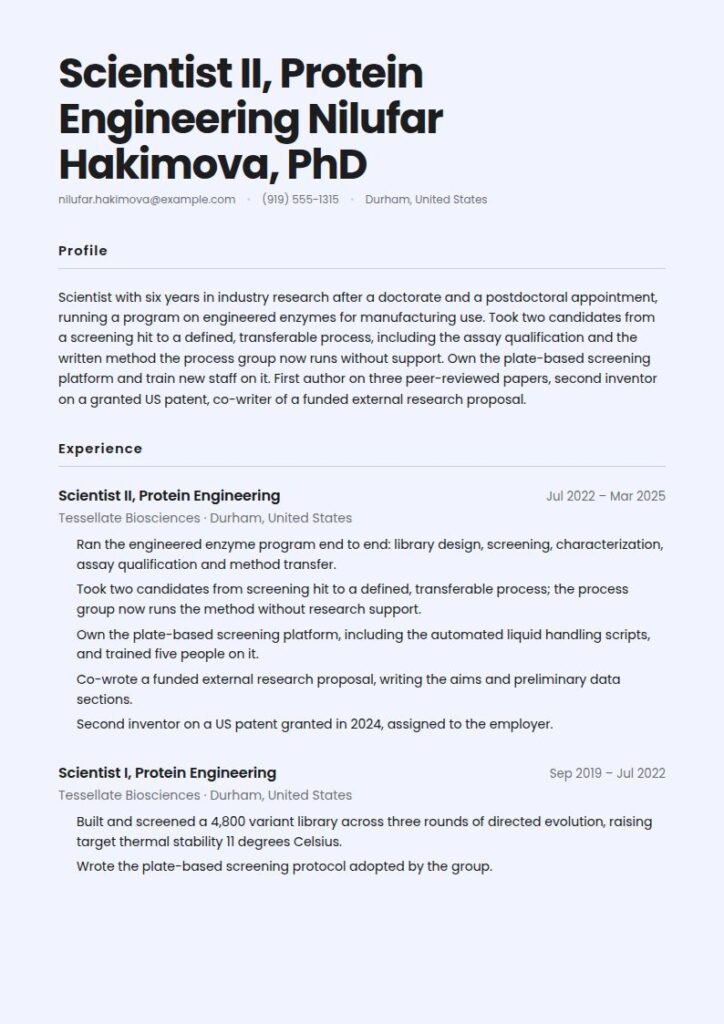
Scientist with six years in industry research after a doctorate and a postdoctoral appointment, running a program on engineered enzymes for manufacturing use. Took two candidates from a screening hit to a defined, transferable process, including the assay qualification and the written method the process group now runs without support. Own the plate-based screening platform and train new staff on it. First author on three peer-reviewed papers, second inventor on a granted US patent, co-writer of a funded external research proposal.
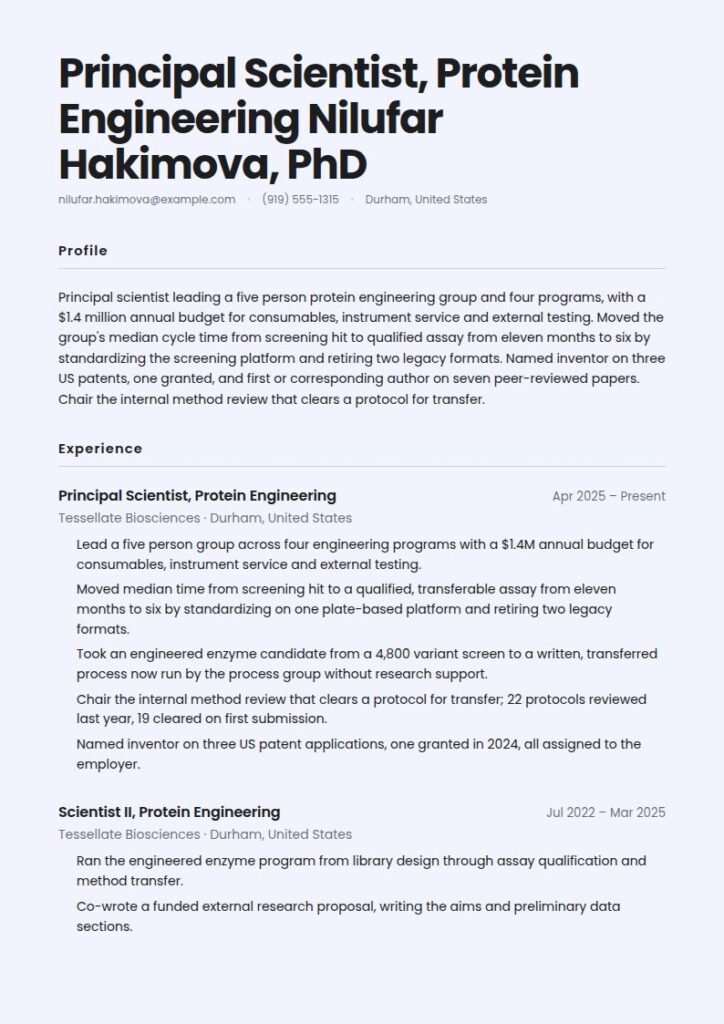
Principal scientist leading a five person protein engineering group and four programs, with a $1.4 million annual budget for consumables, instrument service and external testing. Moved the group's median cycle time from screening hit to qualified assay from eleven months to six by standardizing the screening platform and retiring two legacy formats. Named inventor on three US patents, one granted, and first or corresponding author on seven peer-reviewed papers. Chair the internal method review that clears a protocol for transfer.
Right vs wrong: the same scientist summary, twice
| ✅ Right | ❌ Wrong |
|---|---|
| Six years in industry research after a doctorate and a postdoctoral appointment. | Accomplished scientist with extensive research experience across multiple disciplines. |
| Took two candidates from a screening hit to a defined, transferable process. | Contributed to several high-impact projects with significant scientific outcomes. |
| First author on three peer-reviewed papers and second inventor on a granted US patent. | Widely published researcher with a strong publication record. |
By contrast, the right column is checkable and specific about level. Meanwhile, the left reads as someone who does not want to say which papers were theirs.
Outline your research experience
For each role, give employer or institution, the group or program, the city and dates. Then four or five bullets, each carrying a scale, a technique or an outcome. Write research as work, because that is what it is.
| Instead of | Use |
|---|---|
| Conducted research on enzyme engineering | Designed and screened a 4,800 variant library across three rounds of directed evolution |
| Published several papers | First author on three peer-reviewed papers; full list available |
| Experienced with protein characterization | Run differential scanning fluorimetry, stopped-flow kinetics and analytical size exclusion as routine assays |
| Managed laboratory operations | Own a $1.4M annual budget for consumables, instrument service and external testing, plus four instruments |
| Mentored students | Trained nine people on the screening platform, including two who now run it independently |
Principal Scientist, Protein Engineering, Tessellate Biosciences, Durham, NC, April 2025 to Present
Lead a five person group across four engineering programs, with a $1.4 million annual budget for consumables, instrument service and external testing.
Moved the group's median time from screening hit to a qualified, transferable assay from eleven months to six by standardizing on a single plate-based platform and retiring two legacy formats.
Took an engineered enzyme candidate from a 4,800 variant screen to a written, transferred process now run by the process group without research support.
Chair the internal method review that clears a protocol for transfer; 22 protocols reviewed last year, 19 cleared on first submission, and named inventor on three US patent applications, one granted, all assigned to the employer.
Place your publications, patents and grants without overclaiming
In fact, this is the section that decides a scientist resume, and it is where academic candidates most often damage a strong file. Yet the damage is rarely deliberate: it comes from words that mean one thing in a laboratory and something stricter to a reader who checks.
Fortunately, three rules cover almost all of it. First, state your exact position on every output. Say whether the thing happened or is pending. Second, give the full list only where it was asked for.
Authorship, stated exactly
Three to five selected publications belong on a resume, chosen for relevance to the posting rather than prestige, with your role unambiguous in each.
| What you were | What you may write | What you must not write |
|---|---|---|
| First author | First author, with the year and venue type | Nothing stronger exists; you do not need to add "lead" |
| Joint or co-first author | Co-first author, and say the convention was shared | First author without the qualifier |
| Corresponding author | Corresponding author, which signals you ran the work | Senior author, unless your field uses that term precisely |
| Middle author | Contributing author, and name what you contributed | "Published in" phrasing that implies you led it |
| Preprint | Preprint, with the server type and date | Peer-reviewed, or the journal it is under review at |
| Submitted or in revision | Submitted, or in revision, with the date | In press, unless it has been accepted |
Exactness is not only a matter of integrity, although that would be reason enough. An interviewer will ask what you personally did on one of those papers, and the answer either matches the line or ends the conversation.
Journals and metrics, handled carefully
Third, name the venue plainly and do not decorate it. Impact factors, h-index and citation counts read as padding to an industry reader, and an academic reader can look them up faster than you can type them. If a paper mattered, say what it enabled: a method other groups adopted, a reagent that was requested, a result someone built on.
Patents
Similarly, patents carry a level too, and the levels are not interchangeable. For an application, say filed with the year, not held. If the work is published, give the year and that stage. Once it is granted, say so with the year, which is the only stage on which the bare word patent is safe. Also give your inventor position, and say it is assigned to the employer, which it almost always is.
One granted patent with your inventor position stated is worth more on an industry resume than a long list of applications described loosely.
Grants and funding
Funding is one of the strongest lines available to a scientist, because it is externally reviewed, dated and checkable. It is also where role inflation is commonest.
| Your actual role | The line to write |
|---|---|
| Principal investigator | Principal investigator, with the amount, the period and the funder type |
| Co-investigator | Co-investigator, with the amount and the period |
| Named personnel on the award | Named personnel, with your role on the award |
| Wrote sections of a funded proposal | Co-wrote a funded proposal, with the amount and what you wrote |
| Submitted, not funded | Leave it off a resume; it belongs in a fellowship application, not here |
Funding is rare enough to be worth stating precisely
In fiscal year 2025 the National Institutes of Health received 62,592 research project grant applications and made 8,161 competing awards, a success rate of 13.0 percent, with the R01-equivalent rate also at 13.0 percent (National Institutes of Health, Fiscal Year 2025 by the Numbers, published 12 March 2026).
That is the context a reader brings to a funding line. Roughly one application in eight is funded, which makes any awarded grant a selective, dated and verifiable fact about you, and makes the difference between principal investigator, co-investigator and named personnel worth stating exactly.
It also explains why a resume should not list unfunded submissions. Where most applications are declined, a submitted-not-funded line says nothing about you and invites the one question you do not want to spend interview time on.
Selected publications: First author, three peer-reviewed papers in protein engineering journals, 2019, 2022 and 2024. Co-first author, one peer-reviewed methods paper, 2021. Contributing author, four further papers. Full list of 14 on request.
Patents: Named inventor on three US patent applications, one granted (2024), two pending, all assigned to the employer. Second inventor on the granted application.
Funding: Predoctoral fellowship, Hartsook Science Trust, 2014 to 2016, $84,000. Co-wrote a funded external research proposal for the enzyme stability program, 2023, writing the aims and the preliminary data sections.
Peer review and service: Reviewed 11 manuscripts for two journals in two years; session chair at one national meeting.
Build a snapshot of your key skills
Twelve to sixteen entries in four groups, with techniques and instrumentation first, because that is what a hiring scientist scans for.
Techniques: Protein expression and purification, Directed evolution and library construction, Enzyme kinetics, Differential scanning fluorimetry, Analytical size exclusion chromatography, Crystallographic data collection
Instrumentation: Plate readers and automated liquid handling, Stopped-flow spectrophotometry, Fast protein liquid chromatography, Mass spectrometry sample preparation and interpretation
Data and computation: Experimental design and power analysis, Statistical modeling in R, Python for data handling, Structure visualization, Electronic laboratory notebooks
Working practice: Protocol writing and method transfer, Assay qualification, Budget and instrument service management, Training and supervision, Laboratory safety and chemical hygiene
Be honest about level here. A technique you have run 200 times and one you watched once are both true statements, and only one survives an interview. In practice, reserve the top of any skill scale for things you could teach.
List your education and certifications
Degree, field, institution and year, then the postdoctoral appointment, then anything with a renewal cycle.
Doctor of Philosophy, Biochemistry, University of Wisconsin-Madison, Madison, WI, 2017. Dissertation on the thermal stability of engineered enzymes.
Bachelor of Science, Biochemistry, University of Washington, Seattle, WA, 2011.
Postdoctoral Research Fellow, Ashfield Institute for Molecular Medicine, Chapel Hill, NC, 2017 to 2019. Enzyme stability and library screening.
Training: Laboratory safety and chemical hygiene, current. Good documentation practice, 2023. Project management for scientists, 2024.
Write the postdoctoral appointment in the work history as well as here, with bullets and numbers. It is employment, it is often the most productive period in a scientific career, and burying it under education makes you look less experienced than you are.
Choose the right layout and design
As for layout, single column, 11 point, plain headings, no photograph, two pages, with the techniques block on page one. Therefore, do not import a CV template with running headers, a publications section formatted as a bibliography, or a two-column layout. Research employers parse applications before anyone reads them, and bibliographic formatting is the fastest way to arrive as unreadable text.
Cut the CV to two pages and keep the full list available on request. State your exact authorship position on every selected publication. Say filed, published or granted for each patent, with your inventor position. Give your exact role on every funded grant. Write the postdoctoral appointment as a job with numbers. Name the techniques and instruments you could run next month without training. Give one outcome that is not a publication.
Do not list every paper you have ever been on. Do not write "published in" a journal when you were a middle author. Do not call a preprint peer-reviewed or a submission in press. Do not list unfunded applications. Do not include impact factors, h-index or citation counts. Do not send a CV to a company posting that asked for a resume, or a resume to a faculty search that asked for a CV.
Scientist job market and outlook
Notably, the Bureau of Labor Statistics publishes no Occupational Outlook Handbook profile for "scientist", because it is a category rather than an occupation. Federal data is organized by discipline, so the honest reading is to look up the occupation your work actually sits in and treat the spread between disciplines as the real picture.
| Occupation | Employment, 2025 | Projected change, 2025 to 2035 | Annual openings | Median annual wage, May 2025 |
|---|---|---|---|---|
| Medical scientists | 181,000 | 13 percent growth, 22,700 jobs | ~10,500 | $103,410 |
| Biochemists and biophysicists | 35,200 | 12 percent growth | ~2,900 | $127,410 |
| Chemists | 84,900 | 6 percent growth | Not shown here | $91,240 |
| Materials scientists | 8,600 | 8 percent growth | Not shown here | $117,790 |
| Physicists and astronomers | 25,600 | 7 percent growth | ~1,500 | $166,880 |
| Microbiologists | Not shown here | Not shown here | Not shown here | $87,990 |
Source: U.S. Bureau of Labor Statistics, Occupational Outlook Handbook, May 2025 wage data and 2025 to 2035 projections, pages last modified 27 August 2026.
The largest published research occupation is mostly not in universities
Among medical scientists, the largest published research occupation at 181,000 jobs in 2025, the biggest employers were research and development in the physical, engineering and life sciences at 32 percent, hospitals at 22 percent, and colleges, universities and professional schools at 12 percent, then medical and diagnostic laboratories at 6 percent and pharmaceutical and medicine manufacturing at 4 percent (BLS Occupational Outlook Handbook, May 2025).
Universities are the third largest employer of the occupation, not the first. It is also projected to grow 13 percent between 2025 and 2035, much faster than average, with about 10,500 openings a year (same source).
The point for your resume is practical. If four in five people doing your kind of work are outside a university, a document written entirely in academic conventions is written for the smallest slice of the market. Keep the record honest and write it in the language the majority employer uses: program, deliverable, method transfer, budget, timeline.
What salary you can expect as a scientist
In other words, there is no median for "scientist" because there is no such occupation in federal data. What there is, across the published science occupations, is a wide discipline-driven spread as of May 2025: physicists and astronomers at a combined median of $166,880, biochemists and biophysicists at $127,410, materials scientists at $117,790, medical scientists at $103,410, chemists at $91,240, microbiologists at $87,990 and environmental scientists at $82,220 (BLS Occupational Outlook Handbook, May 2025 wage data, published 27 August 2026).
Even within a single occupation, the spread is wide again. For instance, medical scientists had the lowest 10 percent under $64,800 and the highest 10 percent over $177,780, and biochemists and biophysicists the lowest 10 percent under $74,290 and the highest over $201,110 (same source).
Find the occupation your job sits in, use its current median as the anchor, and negotiate the rest on the specifics this page told you to write down: the techniques you can run without training, the method you transferred, the patent you are named on, the budget you held, the people you trained. Those are priced individually, so a resume that leaves them off leaves the negotiation to the degree certificate.
Key takeaways for a scientist resume
- In the end, cut the CV to two pages and keep the full publication list on request.
- State your exact authorship position on every selected publication.
- Say filed, published or granted for each patent, with your inventor position.
- Likewise, give your exact role on every funded grant and leave unfunded submissions off.
- Then put techniques and instrumentation on page one, at the level you could teach.
- Finally, write the postdoctoral appointment as a job, with numbers.
- Include one outcome that is not a publication; that is what an industry reader is buying.
Build your scientist resume in 15 minutes with our AI resume builder.
Related resume examples
- Career change resume
- General resume
- Entry-level resume
- One-year experience resume
- Technical writer resume
- Grant writer resume
- Translator resume
- Journalist resume
- Buyer resume
- National sales controller resume
- Title insurance coordinator resume
- Self-employed resume
If your work sits in one named discipline, the chemist resume example and the research assistant resume example go deeper on methods and instrumentation. Pair this page with a matching scientist cover letter.
Scientist resume questions, answered
Should I send a CV or a resume?
Send what the posting asked for. Faculty searches, national laboratory postings and fellowship applications generally want a CV with the complete publication list; company postings want a two page resume. When a posting is ambiguous, send the resume and add a line offering the full list, because a hiring manager can always ask for more and will rarely read twelve pages to find out whether they want to.
How many publications should I list on a resume?
Three to five, chosen for relevance to the posting rather than prestige, with your exact authorship position on each and a note that the full list is available. A resume is an argument for one job, and a long list dilutes the three entries that actually support it.
I am a middle author on almost everything. What do I write?
Write contributing author and then say what you contributed: the assay, the structures, the statistical analysis, the reagent. That is more useful to an industry reader than a first authorship on something unrelated, because it names a capability rather than a credit. Middle authorship is the normal shape of a collaborative record, and it is a weakness only if you try to disguise it.
How do I show industry readiness when all my experience is academic?
Look for the work you already did that was not the science. You wrote protocols other people followed, trained new members of the group, managed a budget line or an instrument service contract, met an external deadline for a report or a renewal, and stopped a line of work when the data said to. Each is one sentence with a number, and together they answer the question an industry reader actually has.
What do I do about a long postdoctoral period or a career break?
State it plainly and place it accurately. A postdoctoral appointment is a job, so write it in the work history with bullets and numbers rather than hiding it under education. A career break gets one line with the dates and a neutral reason. The reader's real concern is whether your techniques are current, which the techniques block answers and the dates do not.