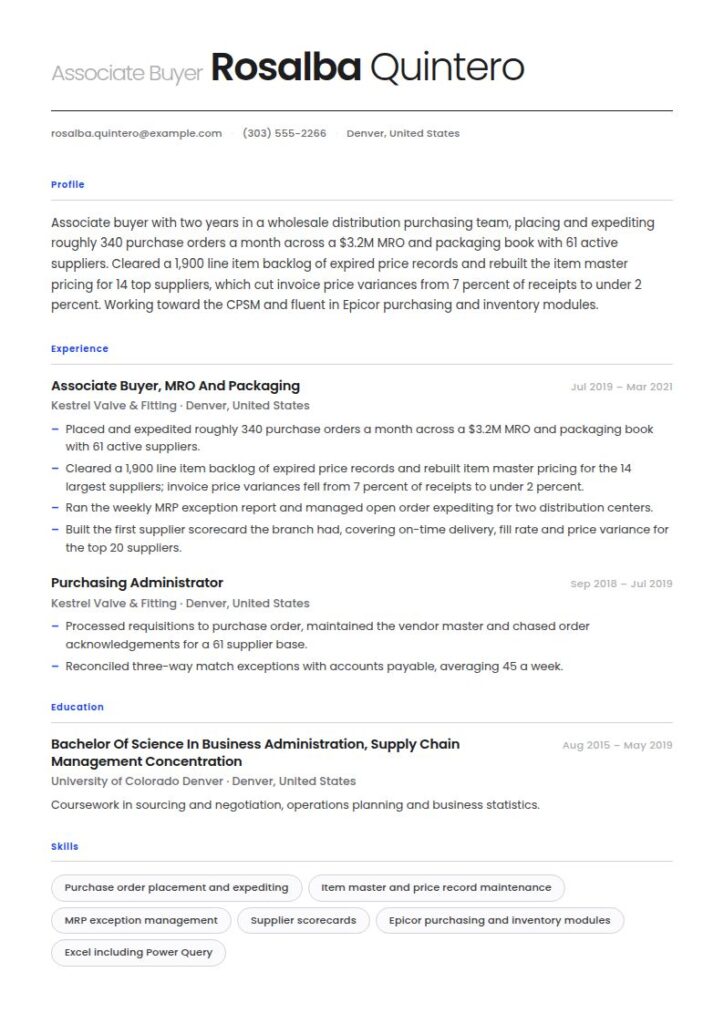
Associate Buyer Rosalba Quintero
Associate Buyer, MRO and Packaging
[email protected] | (303) 555-2266 | Denver, United States
Profile
Associate buyer with two years in a wholesale distribution purchasing team, placing and expediting roughly 340 purchase orders a month across a $3.2M MRO and packaging book with 61 active suppliers. Cleared a 1,900 line item backlog of expired price records and rebuilt the item master pricing for 14 top suppliers, which cut invoice price variances from 7 percent of receipts to under 2 percent. Working toward the CPSM and fluent in Epicor purchasing and inventory modules.
Work Experience
07/2019 - 03/2021, Associate Buyer, MRO and Packaging, Kestrel Valve & Fitting, Denver, United States
- Placed and expedited roughly 340 purchase orders a month across a $3.2M MRO and packaging book with 61 active suppliers.
- Cleared a 1,900 line item backlog of expired price records and rebuilt item master pricing for the 14 largest suppliers; invoice price variances fell from 7 percent of receipts to under 2 percent.
- Ran the weekly MRP exception report and managed open order expediting for two distribution centers.
- Built the first supplier scorecard the branch had, covering on-time delivery, fill rate and price variance for the top 20 suppliers.
09/2018 - 07/2019, Purchasing Administrator, Kestrel Valve & Fitting, Denver, United States
- Processed requisitions to purchase order, maintained the vendor master and chased order acknowledgements for a 61 supplier base.
- Reconciled three-way match exceptions with accounts payable, averaging 45 a week.
Education
08/2015 - 05/2019, Bachelor of Science, Business Administration, Supply Chain Management concentration, University of Colorado Denver, Denver, United States
Coursework in sourcing and negotiation, operations planning and business statistics.
Skills
Purchase order placement and expediting, 85
Item master and price record maintenance, 85
MRP exception management, 65
Supplier scorecards, 60
Epicor purchasing and inventory modules, 75
Excel including Power Query, 75
Languages
English, native
Spanish, native
Certificates
02/2021, Certified in Planning and Inventory Management (CPIM), in progress, ASCM
Part 1 passed February 2021. Part 2 scheduled.
Summary
A buyer resume is a one to two page document that states the size and shape of the spend you manage: annual dollars, active suppliers, line items and the categories they sit in. This guide gives you three adaptable versions, the certification ladder from ISM, ASCM and the public procurement bodies, and current Bureau of Labor Statistics pay and outlook.
Buyer resume examples by experience level
In short, a buyer resume is a one to two page document that states how much money you spend on someone else's behalf, across which categories, with how many suppliers, and what you took out of the price.
Everything else is supporting material. In practice, a purchasing manager reading applications wants one thing quickly: is this person's book bigger, smaller or the same shape as the one I am hiring for? As a result, a resume that answers that in the summary line gets read to the end. By contrast, one that opens with "results-driven procurement professional" makes the reader go hunting, and most do not hunt.
Resume guide for a buyer resume
To start, this guide and the corresponding buyer resume example will cover:
- First, how to write a buyer resume, section by section
- Then, the four numbers that describe your book, and where to put them
- Also, three adaptable summaries: associate buyer, buyer and category manager
- Which certification actually moves a file, and what each one requires
- Finally, what the job market looks like and what you can expect to earn
How to write a buyer resume
Overall, six sections: contact header, summary, spend and category profile, experience, education and certifications, and systems. In general, one page for your first five years, two once you own a category and can cite multi-year savings.
In particular, the spend and category profile is the section most buyer resumes are missing, and it is the one that turns a list of duties into a job description a reader can price.
| Section | What it is answering | Where it goes |
|---|---|---|
| Spend and category profile | How big is this person's book, and in what? | Directly under the summary |
| Experience | What did they negotiate, and against what baseline? | Reverse chronological, a number in every bullet |
| Certifications | Have they cleared a named professional bar? | With the issuing body and the year |
| Systems | Can they work in our ERP on day one? | Short block, named platforms and modules |
Write savings against a baseline, or do not write savings
"Delivered $1.2M in savings" is the single most common line on a buyer resume and the least useful, because savings is not a measurement until you say what it is measured against.
Name the baseline in the same sentence. Against the prior contract price, against the incumbent's renewal quote, against budget, against the last purchase price on the same part number, or against a market index. Then give the period and the spend it applied to: "Cut landed cost on a $4.1M resin category by 9 percent against prior contract pricing over an 18 month re-tender."
Interviewers in this field push on baselines because finance pushes on them. A candidate who has already named theirs on the page reads as someone who has defended a savings number in a room with a controller in it, which is the actual skill.
Run the finished file through the ATS resume checker before you send it. Procurement postings are frequently filtered on category keywords and ERP module names, and those are exactly the terms people bury in prose.
Choosing the best resume format for a buyer resume
Reverse chronological. After all, the reader is tracking the growth of your book across employers, and any format that hides the sequence hides the growth.
For example, one page covers a purchasing assistant and a first buyer role comfortably. Move to two pages when you can fill the second with category detail: the named categories, the tender history, the supplier consolidations, and multi-year savings with baselines attached. A second page of adjectives is worse than a tight first page.
Functional formats fail here because the same job title covers wildly different scope: a buyer at a 40-person manufacturer and a buyer at a national retailer share nothing except the word. In other words, dates and employers are how a reader calibrates that.
Include your contact information
| ✅ Right | ❌ Wrong |
|---|---|
| Rosalba Quintero, CPSM | Rosalba Quintero |
| Buyer, Direct Materials | Results-driven procurement professional |
| $14M annual spend, 92 active suppliers | Experienced in purchasing and vendor management |
| (303) 555-2266, [email protected], Denver, CO | (303) 555-2266, [email protected] |
Put the credential letters after your name if you hold them. Also, CPSM, CPIM, CPPB and NIGP-CPP are recognized on sight by the people hiring buyers, and the two seconds a reader spends decoding them is two seconds spent on you.
Make use of a summary
For the summary, four lines: your title and the spend you carry, the categories, the supplier and line item count, and one savings figure with its baseline.
Associate buyer with two years in a wholesale distribution purchasing team, placing and expediting roughly 340 purchase orders a month across a $3.2M MRO and packaging book with 61 active suppliers. Cleared a 1,900 line item backlog of expired price records and rebuilt the item master pricing for 14 top suppliers, which cut invoice price variances from 7 percent of receipts to under 2 percent. Working toward the CPSM and fluent in Epicor purchasing and inventory modules.
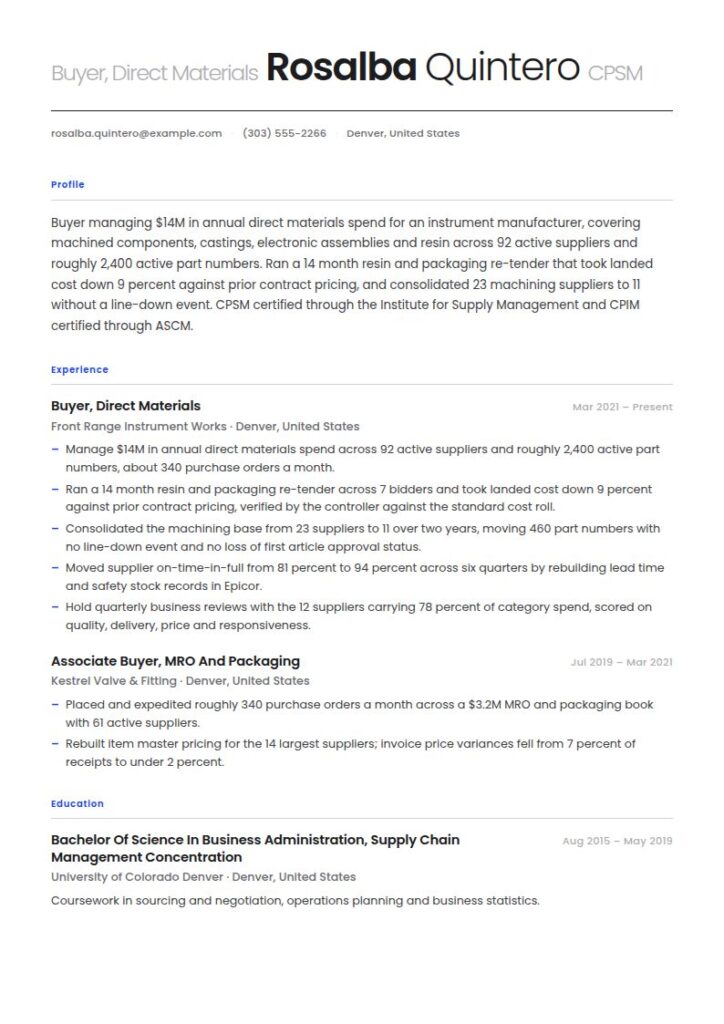
Buyer managing $14M in annual direct materials spend for an instrument manufacturer, covering machined components, castings, electronic assemblies and resin across 92 active suppliers and roughly 2,400 active part numbers. Ran a 14 month resin and packaging re-tender that took landed cost down 9 percent against prior contract pricing, and consolidated 23 machining suppliers to 11 without a line-down event. CPSM certified through the Institute for Supply Management and CPIM certified through ASCM.
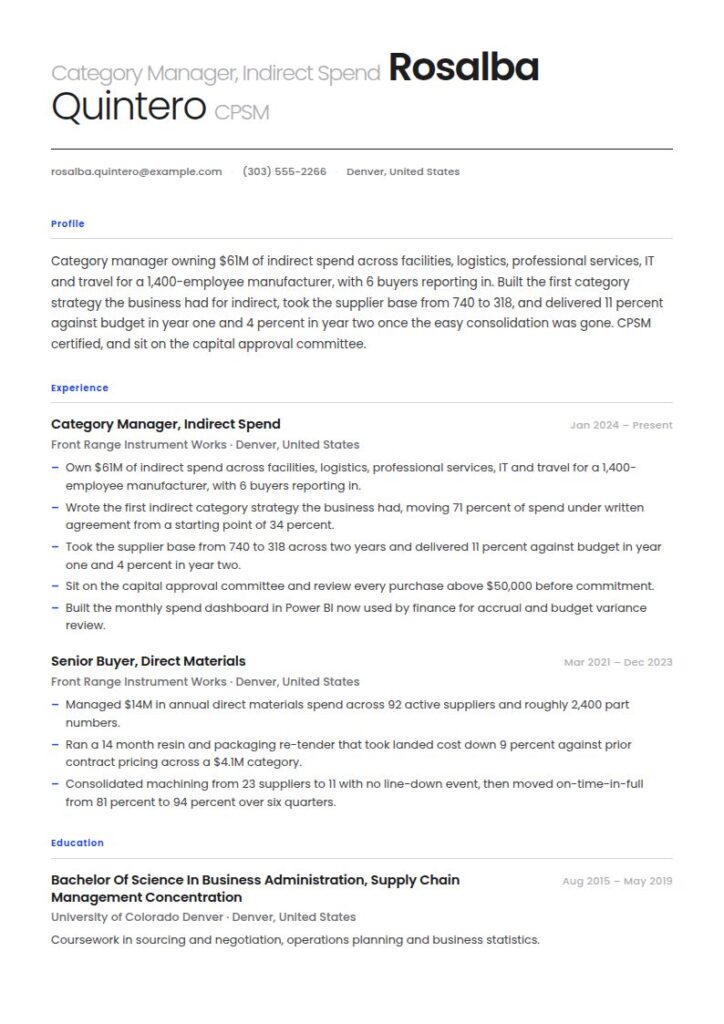
Category manager owning $61M of indirect spend across facilities, logistics, professional services, IT and travel for a 1,400-employee manufacturer, with 6 buyers reporting in. Built the first category strategy the business had for indirect, took the supplier base from 740 to 318, and delivered 11 percent against budget in year one and 4 percent in year two once the easy consolidation was gone. CPSM certified, and sit on the capital approval committee.
Right vs wrong: the same buyer summary, twice
| ✅ Right | ❌ Wrong |
|---|---|
| Buyer managing $14M in annual direct materials spend across 92 active suppliers. | Results-driven procurement professional with a proven track record. |
| Machined components, castings, electronic assemblies and resin, roughly 2,400 active part numbers. | Experience purchasing a wide variety of goods and services. |
| Took landed cost down 9 percent against prior contract pricing over a 14 month re-tender. | Delivered significant cost savings for the organization. |
| Consolidated 23 machining suppliers to 11 without a line-down event. | Skilled in vendor management and supplier relationships. |
The right column can be compared to the open role in about four seconds. The left column cannot be compared to anything, which is why it gets skipped.
Outline your experience
Employer, city and state, your title, dates by month and year, then one scope line and four or five bullets. Next, the scope line is the employer's shape: what they make or sell, how big, and what you were responsible for buying.
| Instead of | Use |
|---|---|
| Managed supplier relationships | Ran quarterly business reviews with the top 12 suppliers, 78 percent of category spend |
| Negotiated with vendors to reduce costs | Re-tendered a $4.1M resin category, 9 percent down against prior contract pricing over 14 months |
| Processed purchase orders | Placed and expedited roughly 340 purchase orders a month across 2,400 active part numbers |
| Improved on-time delivery | Moved supplier on-time-in-full from 81 percent to 94 percent over six quarters by rebuilding lead time records in the ERP |
| Reduced the number of suppliers | Consolidated 23 machining suppliers to 11 with no line-down event and no change to first article approval status |
| Worked on cost savings projects | Owned the annual savings plan for a $14M book and reported it monthly against budget to the controller |
Buyer, Direct Materials, Front Range Instrument Works, Denver, CO, March 2021 to Present
Precision instrument manufacturer, 340 employees, two plants, roughly $96M in revenue. Own the direct materials book.
Manage $14M in annual spend across machined components, castings, electronic assemblies and resin: 92 active suppliers, roughly 2,400 active part numbers, about 340 purchase orders a month.
Ran a 14 month resin and packaging re-tender across 7 bidders and took landed cost down 9 percent against prior contract pricing, verified by the controller against the standard cost roll.
Consolidated the machining base from 23 suppliers to 11 over two years without a line-down event, moving 460 part numbers and keeping first article approval intact on all of them.
Moved supplier on-time-in-full from 81 percent to 94 percent across six quarters by rebuilding lead time and safety stock records in Epicor rather than expediting case by case.
Hold quarterly business reviews with the 12 suppliers that carry 78 percent of category spend, with a scorecard covering quality, delivery, price and responsiveness.
Put your spend, your categories and your supplier count on the page
This is the block that decides whether your resume is read as the right size. It is four numbers and one list, in about six lines, yet almost nobody includes it.
Annual spend under management. The total dollars that pass through your decisions in a year. Say whether it is direct, indirect or both, because those are different jobs: direct spend is judged on landed cost, quality and line availability, indirect spend on consolidation, contract coverage and maverick spend. A buyer who has done one should not imply both.
Active supplier count. How many suppliers you actually transact with, not how many are in the vendor master. The gap between those two numbers is itself a story worth one line if you closed it.
Line items or part numbers. A $14M book across 2,400 part numbers is a different job from a $14M book across 40. The first is an expediting and data problem, the second is a negotiation problem, and the reader cannot tell which you have done unless you say.
Named categories. Write them as a list, in the words your industry uses. "Machined components, castings, electronic assemblies, resin" is searchable and specific. "Various raw materials and components" is neither.
Spend under management: $14M annual direct materials, plus $2.3M indirect at the plant level
Categories: machined components, investment and sand castings, electronic assemblies and cable harnesses, engineering resin, corrugate and protective packaging
Supplier base: 92 active suppliers, 11 under long-term agreement, top 12 carry 78 percent of spend
Volume: roughly 2,400 active part numbers, about 340 purchase orders a month
Savings record: 9 percent on a $4.1M resin and packaging re-tender against prior contract pricing, 2021 to 2022. 4 percent on machined components against prior purchase price, 2023 to 2024. Both verified against the standard cost roll.
Incoterms and sourcing: domestic and Mexico, FCA and DDP, three suppliers under consignment
Buyer certifications from ISM and ASCM
Meanwhile, the certification ladder sits alongside this block, and the three bodies are worth telling apart.
First, the Institute for Supply Management issues the CPSM. It requires three exams plus either a regionally accredited bachelor's degree with three years of full-time professional supply management experience, or five years of that experience without a degree, and it runs on a three year cycle maintained with 60 continuing education hours (Institute for Supply Management, CPSM certification page, accessed 17 September 2026). ISM also issues the CPSD for supplier diversity work.
ASCM issues the CPIM, which sits closer to planning and inventory than to negotiation. It is two parts that must be completed within three years of each other, and it is maintained with a certification maintenance application every five years (ASCM, CPIM certification page, accessed 17 September 2026). If your job is materials planning as much as buying, the CPIM says that more accurately than the CPSM does.
Public sector buyer certifications
Public sector buying, however, runs on its own ladder. The Universal Public Procurement Certification Council issues the CPPB, which asks for either a two year post-secondary credential plus three years of procurement experience within the previous ten, or five years without the credential, in both cases with at least half the experience in the public sector, plus 72 contact hours of procurement coursework, and it is examined in 180 multiple choice questions over three and a half hours with recertification every five years (Universal Public Procurement Certification Council, CPPB program page, accessed 17 September 2026).
NIGP issues the NIGP-CPP separately, accredited by the ANSI National Accreditation Board under accreditation number 9151 (NIGP, certification page, accessed 17 September 2026). If you are applying to a city, a county, a school district or a state agency, one of these two is often written into the posting as a requirement or a preference, and neither ISM nor ASCM substitutes for it.
Build a snapshot of your key skills
For skills, list ten to fourteen named entries in three groups: commercial, systems, and compliance. Name only what you could be tested on, because buying interviews are practical.
Commercial: Competitive tendering and RFQ management, Cost breakdown and should-cost modeling, Supplier negotiation and contract renewal, Supplier consolidation, Total landed cost analysis, Supplier scorecards and quarterly business reviews
Systems: Epicor purchasing and inventory modules, SAP Ariba sourcing, Coupa requisitioning, Excel to an advanced level including Power Query, Power BI spend dashboards
Materials and compliance: MRP exception management, Safety stock and lead time parameter setting, Incoterms 2020, Supplier quality and first article approval, Conflict minerals and REACH declarations, Blanket orders and consignment agreements
List your education and certifications
Degree, institution, city and state, year. Then certifications with the issuing body, the credential number if you have one, and the year earned.
Bachelor of Science, Business Administration, Supply Chain Management concentration, University of Colorado Denver, Denver, CO, 2019
Certifications: Certified Professional in Supply Management (CPSM), Institute for Supply Management, earned 2023, current through 2026. Certified in Planning and Inventory Management (CPIM), ASCM, earned 2022. Incoterms 2020 practitioner workshop, 2024.
A bachelor's degree is the typical entry-level education for buyers and purchasing agents, while purchasing managers typically need several years of related work experience on top of it (BLS Occupational Outlook Handbook, page last modified 27 August 2026). If you do not have the degree, the certification route is the one that answers the screening question, and the CPSM explicitly publishes a five year experience path for exactly that case.
Choose the right layout and design
As for layout, single column, 10.5 to 12 point, month and year dates, no photograph, no skill rating bars. Spend figures and supplier counts in plain digits so they survive parsing.
Put annual spend under management in the header or the first line of the summary. Say whether the spend is direct, indirect or both. Give the active supplier count and the part number or line item count. Name the categories in industry words. Attach every savings figure to a baseline and a period. Name the ERP and the specific modules. Put credential letters after your name.
Do not write a savings number with no baseline. Do not count the whole vendor master as your supplier base. Do not describe yourself as results-driven or as a proven negotiator. Do not claim a category you supported on one tender as a category you own. Do not use a two-column template for a portal that parses to structured fields. Do not round a spend figure upward past what the finance system would show.
Buyer job market and outlook
A large occupation growing faster than the workforce average, with heavy replacement demand and a wide pay spread driven by sector.
| Measure | Value |
|---|---|
| Purchasing managers, buyers and purchasing agents, 2025 | 604,400 |
| Projected change, 2025-35 | 6 percent, +34,400 |
| Projected annual openings | ~53,600 |
| Typical entry-level education | Bachelor's degree |
| Median annual wage, buyers and purchasing agents, May 2025 | $77,710 |
| Median annual wage, purchasing managers, May 2025 | $148,080 |
Source: U.S. Bureau of Labor Statistics, Occupational Outlook Handbook, Purchasing Managers, Buyers, and Purchasing Agents, 2025-35 projections and May 2025 wage data, page last modified 27 August 2026.
Where buyers actually work, and what that is worth
Buyers and purchasing agents are not distributed evenly. Manufacturing employs 22 percent of them, wholesale trade 14 percent, government 13 percent, management of companies and enterprises 8 percent and retail trade 7 percent (BLS Occupational Outlook Handbook, page last modified 27 August 2026).
The medians move with the sector and not by a small amount. Government pays a median of $95,780, management of companies and enterprises $83,990, manufacturing $77,890, wholesale trade $71,640 and retail trade $57,840 (BLS, May 2025).
That is a $37,940 spread between the top and bottom of the same job title. It is the strongest argument for the certification ladder in this article: government is the highest paying setting on the list and it is also the setting most likely to write CPPB or NIGP-CPP into the posting. If you are in retail buying and looking at that table, the public sector path is a real move, and the coursework hours take eighteen months to accumulate.
What salary you can expect as a buyer
On pay, the median annual wage for buyers and purchasing agents was $77,710 as of May 2025. The lowest 10 percent earned less than $48,380 and the highest 10 percent more than $128,870 (BLS Occupational Outlook Handbook, May 2025 wage data, page last modified 27 August 2026).
Across the whole profile, including purchasing managers, the median was $81,670 a year, or $39.27 an hour (BLS, May 2025).
Even so, the promotion track is where the money is. For instance, purchasing managers had a median of $148,080, with the lowest 10 percent under $92,490 and the highest 10 percent over $223,280 (BLS, May 2025). That is roughly twice the buyer median, and BLS notes purchasing managers typically need several years of related work experience rather than an additional degree, which makes it a track you walk rather than one you re-qualify for.
In addition, three things on the page move your own number inside that range. The size of the book, because a $61M category manager and a $3M associate buyer are priced differently and both are called buyers. The sector, because the table above shows a $37,940 gap that has nothing to do with skill. And the savings record with baselines attached, because that is the only number on a buyer's resume that a hiring manager can convert directly into what you are worth to them.
Key takeaways for a buyer resume
- Above all, put annual spend under management in the header or the first summary line.
- Say whether the spend is direct, indirect or both; they are different jobs.
- Give the active supplier count, the part number count and the named categories.
- Attach every savings figure to a baseline and a period, or leave it off.
- Name the ERP and the modules you work in, not just "ERP experience".
- Put the certification letters after your name, and match the body to the sector.
- Keep it reverse chronological, and let the growth of the book show.
Build your buyer resume in 15 minutes with our AI resume builder.
Related resume examples
- National sales controller resume
- Title insurance coordinator resume
- Career change resume
- Self employed resume
- General resume
- Entry level resume
- One year experience resume
- Technical writer resume
- Grant writer resume
- Translator resume
- Amazon resume
- Work from home resume
Pair it with a matching buyer cover letter.
Buyer resume questions, answered
How long should a buyer resume be?
One page for a purchasing assistant or a first buyer role. Two pages once you own a category and can fill the second with tender history, supplier consolidations and multi-year savings with baselines. The test is whether every line on it carries a number or a category name.
What is the most important number on a buyer resume?
Annual spend under management, stated as direct, indirect or both. It is the number that tells a reader whether you are the right size for the role, and it is the one most candidates leave out in favor of a savings figure with nothing to compare it to.
Do I need the CPSM to get hired as a buyer?
Not usually for a first buyer role, where a bachelor's degree is the typical entry-level education (BLS Occupational Outlook Handbook, page last modified 27 August 2026). It matters more in two cases: when you do not have the degree, since the Institute for Supply Management publishes a five year experience path without one, and when you are competing for a category manager post where it is often listed as preferred.
What certification do I need for public sector buying?
The Universal Public Procurement Certification Council issues the CPPB, which asks for three years of procurement experience with a two year post-secondary credential or five years without, at least half of it in the public sector, plus 72 contact hours of coursework (UPPCC, CPPB program page, accessed 17 September 2026). NIGP separately issues the NIGP-CPP, accredited by the ANSI National Accreditation Board under accreditation number 9151 (NIGP, certification page, accessed 17 September 2026). Read the posting: agencies name the one they want.
How do I write savings if my employer will not let me publish the figures?
Use percentages and relative scale instead of absolute dollars. "Reduced landed cost on the largest category in the book by 9 percent against prior contract pricing over 14 months" carries the same information without a dollar figure. Give the baseline and the period either way, because those are what make the percentage mean something.
Is buyer a growing occupation?
Yes, modestly. BLS projects 6 percent growth for purchasing managers, buyers and purchasing agents between 2025 and 2035, a rise from 604,400 to 638,800, with about 53,600 openings a year on average over the decade, most of them from workers leaving the occupation (BLS Occupational Outlook Handbook, page last modified 27 August 2026).