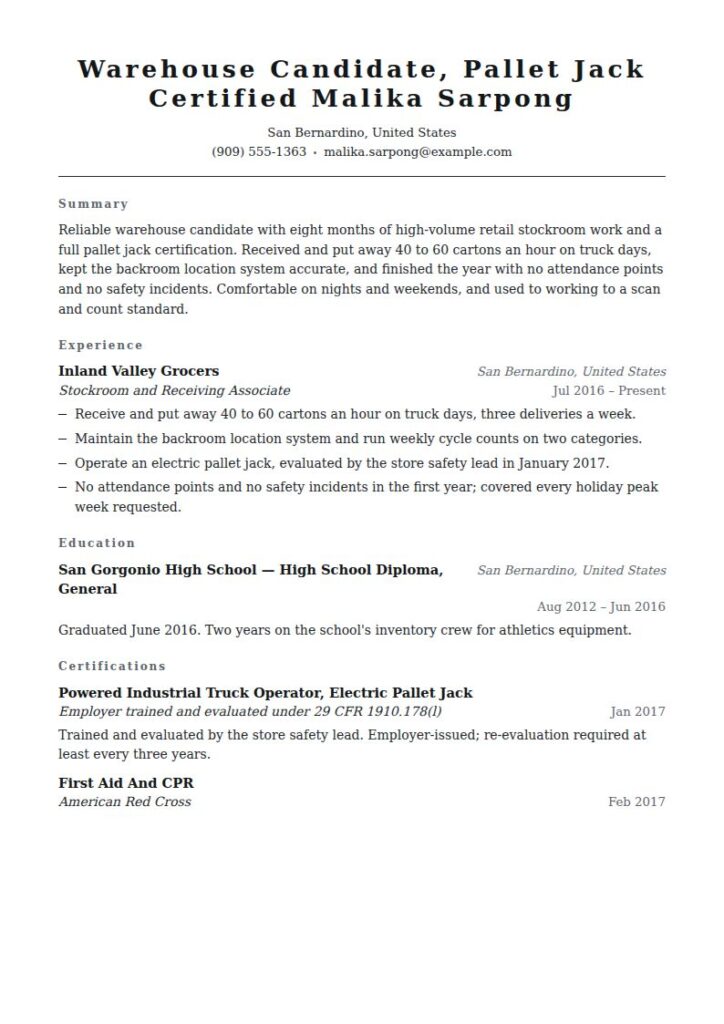
Warehouse Candidate, Pallet Jack Certified Malika Sarpong
Stockroom and Receiving Associate
[email protected] | (909) 555-1363 | San Bernardino, United States
Profile
Reliable warehouse candidate with eight months of high-volume retail stockroom work and a full pallet jack certification. Received and put away 40 to 60 cartons an hour on truck days, kept the backroom location system accurate, and finished the year with no attendance points and no safety incidents. Comfortable on nights and weekends, and used to working to a scan and count standard.
Work Experience
07/2016 - Present, Stockroom and Receiving Associate, Inland Valley Grocers, San Bernardino, United States
- Receive and put away 40 to 60 cartons an hour on truck days, three deliveries a week.
- Maintain the backroom location system and run weekly cycle counts on two categories.
- Operate an electric pallet jack, evaluated by the store safety lead in January 2017.
- No attendance points and no safety incidents in the first year; covered every holiday peak week requested.
Education
08/2012 - 06/2016, High School Diploma, General, San Gorgonio High School, San Bernardino, United States
Graduated June 2016. Two years on the school's inventory crew for athletics equipment.
Skills
Receiving and put-away, 75
Electric pallet jack operation, 70
Handheld RF scanner use, 75
Cycle counting and location accuracy, 70
Safe lifting technique, 85
Night and weekend shift availability, 95
Languages
English, native
Twi, native
Spanish, intermediate
Certificates
01/2017, Powered Industrial Truck Operator, Electric Pallet Jack, Employer trained and evaluated under 29 CFR 1910.178(l)
Trained and evaluated by the store safety lead. Employer-issued; re-evaluation required at least every three years.
02/2017, First Aid and CPR, American Red Cross
Summary
An Amazon resume means a warehouse and fulfillment center resume: the units you move, the systems you scan into, the safety record behind it and the equipment you are certified on. This guide gives you three adaptable versions, the split between the hourly application and the corporate one, and current Bureau of Labor Statistics pay and outlook for material handling work.
Amazon resume examples by experience level
In practice, people searching for an Amazon resume are almost always after one of two documents: a warehouse and fulfillment center resume, or a corporate application to a large logistics and technology employer. This guide is the first, with a section on how the second differs, because the same company hires both and the two files look nothing alike.
To be clear, this page is not affiliated with, endorsed by or connected to Amazon.com, Inc. or any of its subsidiaries, and it contains no inside knowledge of any hiring process. Instead, everything it says about the company comes from pages the company publishes openly, cited and dated. Nothing about internal job levels, internal pay bands or interview questions appears here, because none of that is published, and a guide that invents it is guessing at your expense.
What the page does contain, however, is the underlying occupation, which is one of the largest bodies of work in the United States and has a resume shape of its own.
Resume guide for an Amazon resume
To start, this guide and the corresponding Amazon resume example will cover:
- First, how to write a warehouse and fulfillment center resume, section by section
- Then, the three numbers that decide a warehouse file: rate, accuracy and safety
- Also, three adaptable summaries: first warehouse job, associate and shift lead
- Next, why the hourly application and the corporate application are different documents
- Finally, what the market looks like and what you can expect to earn
How to write an Amazon resume
In short, five sections: contact header, summary, warehouse experience, equipment and certifications, and skills. One page; there is no second page in this occupation until you are supervising, and even then one page usually wins.
Typically, the reader is a staffing coordinator or operations manager with a headcount plan and a start date, checking three things in the first ten seconds: can this person work the shift, can they hit a rate, and have they been safe.
| Section | What it is answering | Where it goes |
|---|---|---|
| Shift availability | Can they work nights, weekends, peak? | Contact header, one line |
| Rate and accuracy | Units an hour, pick accuracy, scan compliance | Directly under the summary, and in every bullet |
| Safety record | Recordable incidents, near-miss reporting, lifting compliance | One line, stated plainly |
| Equipment | Which powered industrial trucks, and when last evaluated | Its own block |
| Systems | Warehouse management system, scanners, labeling | Skills block |
Put three numbers on the page: rate, accuracy and safety
Warehouse work is measured continuously, so you already have numbers even if nobody has shown them to you. Ask, or reconstruct them.
Rate: units picked, packed, stowed or received per hour against the shift standard. "Averaged 168 units an hour against a 145 standard" is a complete claim.
Accuracy: pick or pack accuracy as a percentage over a period. "99.7% pick accuracy across 14 months" beats "detail-oriented" in every screen there has ever been.
Safety: incidents and near-miss reports filed. "Zero recordable incidents in three years; filed 11 near-miss reports" is unusual because it shows you report rather than hide, which is what a safety manager is hiring for.
Run the finished file through the free Rezoom ATS resume checker before you send it. Large employers parse applications into a structured record before anyone reads them.
Choosing the best resume format for an Amazon resume
As a rule, reverse chronological, one column, one page, plain text.
Skip the functional format even if your history has gaps. Warehouse hiring is used to gaps, seasonal work and short tenures; however, it is not used to a document that hides dates. So write seasonal roles as seasonal, with months, and the gaps stop being a question.
Similarly, the employer's own published resume guidance points the same way. For example, Amazon tells applicants that "a successful resume should focus on your actions and results" with "relevant data to help quantify your success", and to keep the document "well-organized" in "straightforward language" (About Amazon, resume writing tips, published 3 April 2024). That is written for corporate applications, and it describes what a warehouse screen wants too.
Include your contact information
| ✅ Right | ❌ Wrong |
|---|---|
| Malika Sarpong | Malika Sarpong |
| Warehouse Associate. Forklift and pallet jack certified | Hard worker looking for an opportunity |
| Available nights, weekends and peak season | Available anytime |
| San Bernardino, CA. (909) 555-1363. [email protected] | San Bernardino, CA. (909) 555-1363. [email protected] |
Above all, shift availability goes in the header, not the cover letter. Sites staff around fixed shift patterns and the reader is matching you to one; that is why "Available nights, weekends and peak season" is the line that moves a file forward. Also use a plain email address built from your name.
Make use of a summary
For the summary, write three or four lines: the work, the years, one rate number, and the safety line.
Reliable warehouse candidate with eight months of high-volume retail stockroom work and a full pallet jack certification. Received and put away 40 to 60 cartons an hour on truck days, kept the backroom location system accurate, and finished the year with no attendance points and no safety incidents. Comfortable on nights and weekends, and used to working to a scan and count standard.
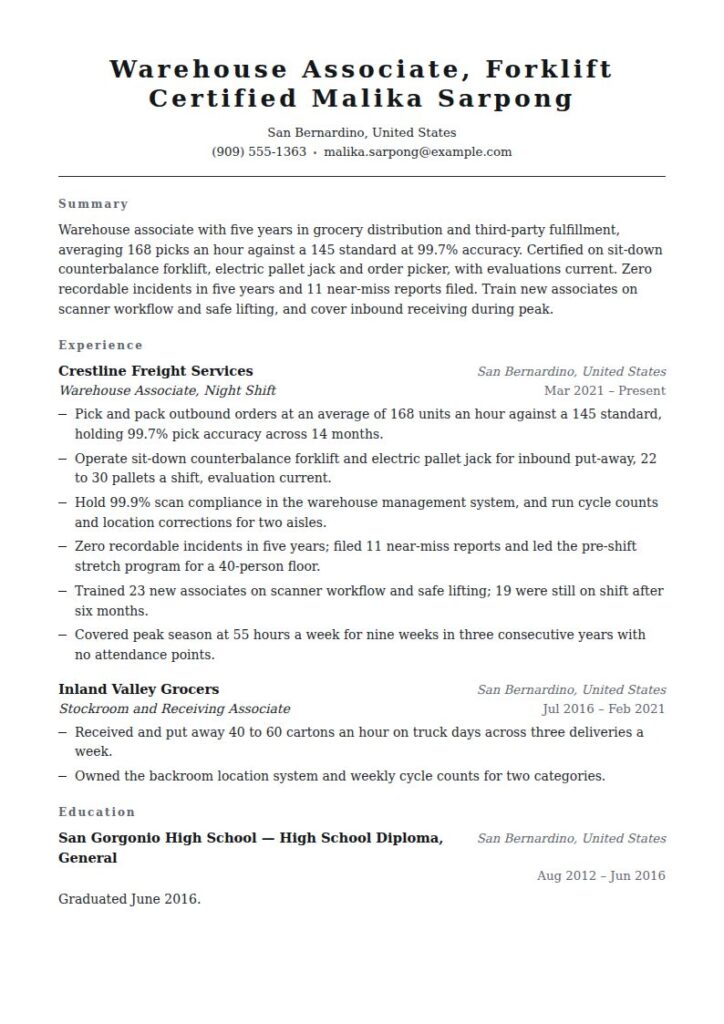
Warehouse associate with five years in grocery distribution and third-party fulfillment, averaging 168 picks an hour against a 145 standard at 99.7% accuracy. Certified on sit-down counterbalance forklift, electric pallet jack and order picker, with evaluations current. Zero recordable incidents in five years and 11 near-miss reports filed. Train new associates on scanner workflow and safe lifting, and cover inbound receiving during peak.
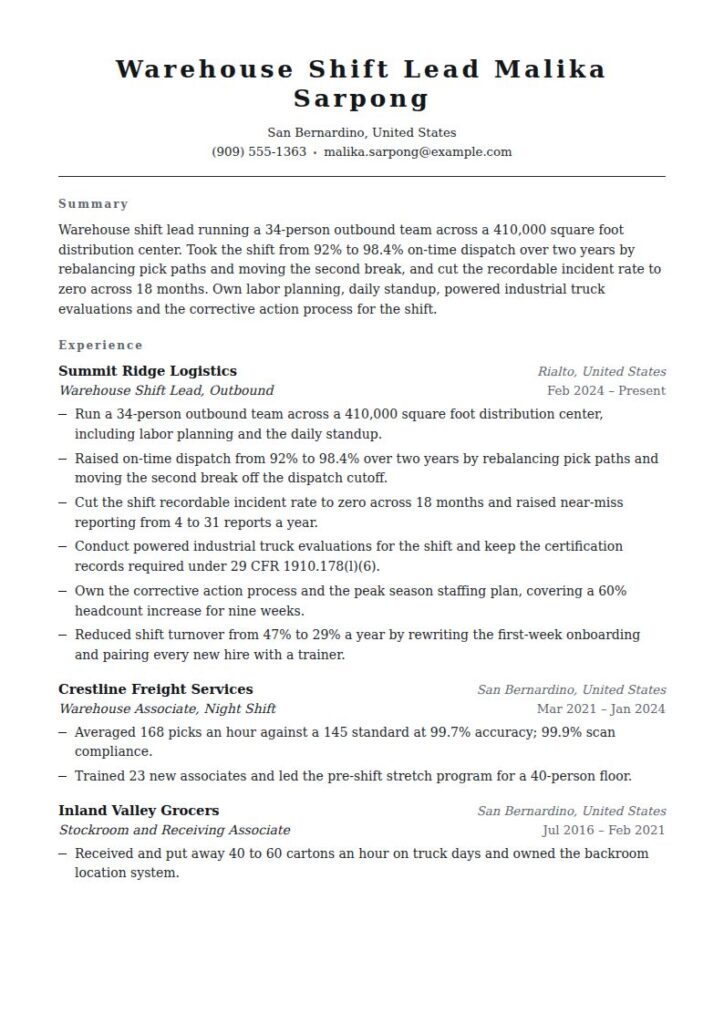
Warehouse shift lead running a 34-person outbound team across a 410,000 square foot distribution center. Took the shift from 92% to 98.4% on-time dispatch over two years by rebalancing pick paths and moving the second break, and cut the recordable incident rate to zero across 18 months. Own labor planning, daily standup, powered industrial truck evaluations and the corrective action process for the shift.
Right vs wrong: the same warehouse summary, twice
| ✅ Right | ❌ Wrong |
|---|---|
| Warehouse associate with five years in grocery distribution and third-party fulfillment. | Hardworking team player with warehouse experience. |
| Averaging 168 picks an hour against a 145 standard at 99.7% accuracy. | Able to work quickly and accurately in a fast-paced environment. |
| Certified on sit-down counterbalance forklift, electric pallet jack and order picker, evaluations current. | Experience with various warehouse equipment. |
| Zero recordable incidents in five years and 11 near-miss reports filed. | Strong commitment to workplace safety. |
By contrast, the right column can be verified in one call to a previous site. Meanwhile, the wrong column is what almost every application says.
Outline your warehouse experience
Site, city, role, shift and dates including months. Then three to five bullets, each with a number attached to a process.
| Instead of | Use |
|---|---|
| Picked and packed orders in a warehouse | Picked 168 units an hour against a 145 standard at 99.7% accuracy across 14 months, night shift |
| Operated a forklift | Operated sit-down counterbalance and reach truck for inbound put-away, 22 to 30 pallets a shift, evaluation current |
| Followed safety procedures | Zero recordable incidents in five years; filed 11 near-miss reports and led the shift stretch program |
| Used a scanner and computer system | Worked to scan compliance of 99.9% in a warehouse management system, including cycle counts and location corrections |
| Helped train new employees | Trained 23 new associates on scanner workflow and safe lifting; 19 still on shift after six months |
Warehouse Associate, Night Shift, Crestline Freight Services, San Bernardino, CA, March 2021 to Present
Pick and pack outbound orders at an average of 168 units an hour against a 145 standard, holding 99.7% pick accuracy across 14 months.
Operate sit-down counterbalance forklift and electric pallet jack for inbound put-away, 22 to 30 pallets a shift, with powered industrial truck evaluation current.
Hold 99.9% scan compliance in the warehouse management system, and run cycle counts and location corrections for two aisles.
Zero recordable incidents in five years; filed 11 near-miss reports and led the pre-shift stretch program for a 40-person floor.
Trained 23 new associates on scanner workflow and safe lifting; 19 were still on shift after six months. Covered peak season at 55 hours a week for nine weeks in three consecutive years with no attendance points.
The hourly application and the corporate application are two different files
In fact, this is where most people searching for an Amazon resume go wrong, and the fix is straightforward once the two are separated. On one side, the hourly warehouse route is a high-volume, fast process, and the company publishes where it runs. Applicants are directed to amazon.com/localjobs, told they can "text NEWJOB to 31432" for alerts, and told "roles will be posted weekly from October through December on hiring.amazon.com" during the holiday period, when it said it was adding 250,000 seasonal, full-time and part-time roles with seasonal employees earning "over $19 per hour on average" (About Amazon, published 13 October 2025). A resume is often not the gate in that route, but it is worth having: it is what you attach when a site asks, what you hand over at a hiring event, and what you use for the next role up.
On the other hand, the corporate route is a different document, and the company publishes the standard it is read against. Amazon states that its 16 Leadership Principles "aren't just lip service or corporate values on a wall, they're the foundation of every hiring decision (and our culture)", describes the process as an application, an initial screening phone call and then an interview loop of four to six rounds, and recommends the STAR framework of situation, task, action and result for behavioral questions (About Amazon, interview guide, updated 8 April 2025). In addition, the same guidance tells candidates to "include precise metrics and data that quantify your impact" and to use "I" rather than "we" so individual contribution is visible.
Amazon Leadership Principles in a corporate file
The principles are published by name: Customer Obsession; Ownership; Invent and Simplify; Are Right, A Lot; Learn and Be Curious; Hire and Develop the Best; Insist on the Highest Standards; Think Big; Bias for Action; Frugality; Earn Trust; Dive Deep; Have Backbone, Disagree and Commit; Deliver Results; Strive to be Earth's Best Employer; and Success and Scale Bring Broad Responsibility (Amazon Leadership Principles, company careers site).
One more published element matters before you write. Specifically, the company describes a Bar Raiser as "a program that empowers Amazon employees to serve as objective third-party advisers during the interview process", with "more than 3,600 Bar Raisers" (About Amazon, published 30 October 2019). At least one person in the process therefore has no stake in filling your specific role, which is an argument for evidence over enthusiasm.
| Question | Hourly warehouse file | Corporate file |
|---|---|---|
| Length | One page, often not required at all | One to two pages |
| What leads | Shift availability, rate, safety record | A result with a number in the first bullet |
| Evidence | Units an hour, accuracy, incidents, equipment | Scope, scale, money, percentage change, and your own part in it |
| Structure of a bullet | Process, number, period | Situation, action, measurable result |
| What gets checked | Previous site, attendance, certification currency | Basic and Preferred Qualifications in the posting, line by line |
That last cell is the most actionable thing here. In particular, the company's resume guidance tells applicants to read the "Basic and Preferred Qualifications" of a posting, tailor to them, and list accomplishments rather than responsibilities (About Amazon, published 3 April 2024). Even so, almost nobody rewrites their file against those two sections.
Put shift availability and travel distance in the header. Give a rate number with the standard you were measured against. State pick or pack accuracy as a percentage over a period. State your safety record including near-miss reports filed. Name every powered industrial truck class you are certified on and when the last evaluation was. Write seasonal roles as seasonal, with months.
Do not claim a certification as portable; operator certification is issued by an employer, not carried between them. Do not invent a rate you cannot support if a previous site is called. Do not describe yourself as hardworking, reliable and motivated; every file does. Do not build the resume around a company name instead of the work. Do not leave months off your dates in an occupation where seasonal work is normal.
Build a snapshot of your key skills
For skills, list eight to twelve entries in three groups: operations, equipment and systems, and safety.
Operations: Order picking and packing to rate, Inbound receiving and put-away, Cycle counting and inventory accuracy, Outbound staging and dispatch, Peak season coverage
Equipment and systems: Sit-down counterbalance forklift, Reach truck, Electric pallet jack, Order picker, Handheld RF scanners, Warehouse management system transactions, Labeling and manifesting
Safety and compliance: Safe lifting technique, Near-miss reporting, Lockout and tagout awareness, Pre-shift equipment inspection, Pre-shift stretch program leadership
List your education and certifications
A high school diploma or equivalent if you have one, then certifications, then training. The Bureau of Labor Statistics lists no formal educational credential as the typical entry-level requirement for hand laborers and material movers, with short-term on-the-job training (BLS Occupational Outlook Handbook, page last modified 27 August 2026). Education is rarely the deciding section here; instead, equipment is.
High school diploma, San Gorgonio High School, San Bernardino, CA, 2016
Powered industrial truck operator, trained and evaluated by employer: sit-down counterbalance and electric pallet jack (most recent evaluation March 2025), order picker (most recent evaluation March 2025)
Training: Safe lifting and manual handling. Pre-shift equipment inspection. Warehouse management system transactions and cycle counting. First aid and CPR, American Red Cross (2025).
Your forklift certification belongs to the employer, not to you
This is the most common misunderstanding on a warehouse resume, and getting it right marks you as properly trained. Under 29 CFR 1910.178(l), "the employer shall ensure that each powered industrial truck operator is competent to operate a powered industrial truck safely, as demonstrated by the successful completion of the training and evaluation specified in this paragraph", and "the employer shall certify that each operator has been trained and evaluated", with the certification recording "the name of the operator, the date of the training, the date of the evaluation, and the identity of the person(s) performing the training or evaluation" (Occupational Safety and Health Administration, 29 CFR 1910.178(l)(1) and (l)(6)). Performance must be re-evaluated "at least once every three years" under (l)(4)(iii).
So no card transfers automatically; a new employer has to train or evaluate you itself. Name the truck types, give the date of your most recent evaluation and say who evaluated you. "Sit-down counterbalance and electric pallet jack, evaluated March 2025 by site safety lead" tells a hiring manager you know the rule.
Choose the right layout and design
As for layout, one page, single column, plain type at 11 or 12 point, no photograph, no graphics, no columns. Save as PDF unless a portal asks otherwise, named for yourself and the role. This is also what the employer publishes for its own applications: keep it "text-forward, black and white, and simple" (About Amazon, published 3 April 2024). A two-column template with icons parses worst and reads slowest, and in high-volume hiring both cost you.
Warehouse and fulfillment job market and outlook
It is an enormous occupation with steady growth and heavy turnover, which is why hiring moves fast and why a file with numbers in it stands out.
| Measure | Value |
|---|---|
| Hand laborer and material mover jobs, 2025 | 6,917,800 |
| Projected change, 2025-35 | 4% (as fast as average), +288,900 |
| Projected annual openings | ~904,200 |
| Typical entry-level education | No formal educational credential |
| Median annual wage, May 2025 | $38,220 |
Source: US Bureau of Labor Statistics, Occupational Outlook Handbook, hand laborers and material movers, 2025-35 projections and May 2025 wage data, page last modified 27 August 2026.
Which title you hold is worth more than which company you work for
Inside hand laborers and material movers the May 2025 medians differ by title: refuse and recyclable material collectors $49,690, machine feeders and offbearers $41,220, laborers and freight, stock and material movers $40,240, stockers and order fillers $37,330, packers and packagers $36,280 (BLS Occupational Outlook Handbook, page last modified 27 August 2026).
Industry moves it further. Transportation and warehousing employs 22 percent of the occupation at $44,710, wholesale trade 11 percent at $41,600 and manufacturing 10 percent at $41,370, against retail trade at 35 percent and $36,090 (BLS, May 2025).
The step up is equipment. Material moving machine operators had a median of $46,670 in May 2025, with industrial truck and tractor operators at $46,420 across 841,500 jobs in that group (BLS Occupational Outlook Handbook, page last modified 27 August 2026).
Read those three together and the strategy is clear: get certified on powered industrial trucks, get into transportation and warehousing rather than retail, and put both facts where they are seen in four seconds.
Where the jobs sit:
| Setting | Share of employment | Median annual wage (May 2025) |
|---|---|---|
| Retail trade | 35% | $36,090 |
| Transportation and warehousing | 22% | $44,710 |
| Administrative and support and waste management | 11% | $36,200 |
| Wholesale trade | 11% | $41,600 |
| Manufacturing | 10% | $41,370 |
Source: US Bureau of Labor Statistics, May 2025.
What salary you can expect
The median annual wage for hand laborers and material movers was $38,220 as of May 2025, or $18.38 an hour, with the lowest 10 percent under $30,190 and the highest 10 percent over $52,340 (BLS Occupational Outlook Handbook, page last modified 27 August 2026).
For this employer the published figures are higher than the occupational median and stated openly. Amazon announced on 16 September 2026 that it was raising minimum starting pay for full-time core operations employees to $20 an hour, with average pay reaching nearly $24 an hour and average total compensation of more than $32 an hour including the value of benefits, in a total investment of more than $1.5 billion. In addition, the same announcement lists healthcare from $5 a week and a Prime membership among the benefits counted (About Amazon, 16 September 2026).
Still, treat that as a published number, not a promise to you. After all, it is an average across a large operations workforce, not an offer, and it varies by site, shift and role.
Over time, one published benefit changes the arithmetic of a warehouse job. The company's Career Choice program is "open to the vast majority of Amazon hourly full-time and part-time employees after 90 days of employment", pre-pays tuition and reimburses books and fees up to an annual amount, and works with more than 400 education partners; more than 250,000 employees worldwide have taken part since it launched in 2012 (About Amazon, published 5 September 2023, last modified 23 October 2025). If warehouse work is a route to something else for you, a documented tuition benefit with a 90-day qualifying period is a plan rather than a hope.
Key takeaways for an Amazon resume
- Write the occupation, not the brand: this is a warehouse and fulfillment center resume.
- Put shift availability in the header, because staffing is matching you to a pattern.
- Then give three numbers: rate against standard, accuracy over a period, and safety record.
- Name every powered industrial truck you are evaluated on, with the evaluation date.
- Say that certification is employer-issued rather than portable; it shows you know the rule.
- For a corporate application, therefore, rewrite the file against the posting's Basic and Preferred Qualifications.
- Keep it one page, plain text, single column, with months on every date.
Build your warehouse resume in 15 minutes with our AI resume builder.
Related resume examples
- General resume
- Entry-level resume
- Part-time job resume
- Career change resume
- One-year experience resume
- Volunteer resume
- Farm worker resume
- Buyer resume
- Self-employed resume
- Freelancer resume
- Journalist resume
- Audio engineer resume
Pair it with a matching Amazon cover letter.
Amazon resume questions, answered
Is this page affiliated with Amazon?
No. This page is not affiliated with, endorsed by or connected to Amazon.com, Inc. or any of its subsidiaries. Every statement about the company is taken from a page the company publishes openly and is cited with its date. Nothing here describes internal job levels, internal pay bands or interview questions, because none of those are published.
Do I even need a resume for a warehouse job?
Often not to start, since high-volume hourly hiring runs through a short online form. Have one anyway: it is what you attach when a site asks, what you bring to a hiring event, and what you use for the step up into a lead, trainer or equipment role.
What do I put on a warehouse resume with no warehouse experience?
Any work measured by volume, accuracy or shift: retail stockroom, grocery, kitchen, landscaping, moving, farm work, delivery. Write the numbers: cartons received an hour, trucks unloaded, hours in a peak week, attendance record. Then availability, then any lifting or equipment training.
How should I write about a forklift certification?
Name the truck types and the date you were last evaluated, and say who evaluated you. Under 29 CFR 1910.178(l)(6) the employer certifies the operator, and the record must name the operator, the training date, the evaluation date and the person who did it, with re-evaluation at least once every three years under (l)(4)(iii). Because it is employer-issued, no card transfers automatically.
How is a corporate application different?
It is longer, it leads with results rather than availability, and it is read against the posting. Amazon publishes that its 16 Leadership Principles are "the foundation of every hiring decision", recommends the STAR format for behavioral answers, and asks candidates to use "I" rather than "we" and to include "precise metrics and data that quantify your impact" (About Amazon, interview guide, updated 8 April 2025). It also tells applicants to read the posting's Basic and Preferred Qualifications and tailor to them (About Amazon, 3 April 2024).
Is warehouse work a growing field?
Yes, modestly, and the openings figure matters more than the growth rate. Employment of hand laborers and material movers is projected to grow 4 percent between 2025 and 2035, adding 288,900 jobs, but there are about 904,200 openings a year, mostly from turnover rather than growth (BLS Occupational Outlook Handbook, page last modified 27 August 2026). That is why hiring is fast, and why a file with a rate, an accuracy figure and a safety record is read as unusual.