General Assignment Reporter Idrissa Camara
General Assignment Reporter
[email protected] | (216) 555-1351 | Elyria, United States
Profile
General assignment reporter with two years at a weekly covering municipal government, schools and public safety across four townships. File 3 to 4 stories a week, about 160 bylines a year, and maintain the outlet's public meeting calendar and agenda tracker. Filed 22 state public records requests in 2025 and obtained the fire department response-time data that ran as a two-part series. No published corrections in the past 12 months.
Work Experience
09/2013 - Present, General Assignment Reporter, Ridgeline Weekly, Elyria, United States
- Cover municipal government, schools and public safety across four townships; file 3 to 4 stories a week, about 160 bylines a year.
- Filed 22 state public records requests in 2025 under the Ohio Public Records Act and obtained the fire department response-time data behind a two-part series.
- Maintain the newsroom's public meeting calendar and agenda tracker, covering 11 recurring boards and commissions.
- Shoot and edit photographs and short video for the web on roughly half of my own assignments.
- No published corrections in the past 12 months.
05/2013 - 08/2013, Editorial Intern, Ridgeline Weekly, Elyria, United States
- Wrote 31 bylined briefs and two features over a summer, chiefly on township zoning and school board decisions.
- Built the searchable index of five years of council minutes still used by the newsroom.
Education
08/2009 - 05/2013, Bachelor of Arts, Journalism, minor in Political Science, Ohio University, Athens, United States
Campus daily: city government reporter for three semesters, roughly 120 bylines. Student press association records-law workshop, 2012.
Skills
Beat reporting on deadline, 70
State public records requests, 65
Public meeting and agenda coverage, 80
AP Stylebook, 85
Spreadsheet analysis for reporters, 55
Photography and mobile video for the web, 70
CMS publishing and headline writing, 75
Languages
English, native
French, advanced
Mandinka, native
Certificates
04/2014, Public Records and Open Meetings Law Workshop, Ohio News Media Association
Annual state press association training on records requests, exemptions and appeals.
Summary
A journalist resume is a one to two page document naming the beat you cover, what you file and how often, the records and data work behind the stories, and a clips link an editor can open. This guide gives you three adaptable versions, the verification and corrections standard editors screen on, and current Bureau of Labor Statistics pay and outlook for the occupation.
Journalist resume examples by experience level
In short, a journalist resume is a one to two page document that names the beat you cover, the volume and cadence of what you file, the records and data work behind your best stories, and a link to clips an editor can open in one click.
In practice, editors hire on two things at once. The first is whether you can produce: a named beat, a weekly rhythm, a portfolio going back more than a season. The second is whether you are safe to publish: whether you verify before you file, whether you understand what you can promise a source, and whether your corrections history is short and honest. The second loses more candidates than the first, and almost nobody writes to it.
Resume guide for a journalist resume
To start, this guide and the corresponding journalist resume example will cover:
- First, how to write a journalist resume, section by section
- Then, why the beat and the filing cadence belong above the job titles
- Also, three adaptable summaries: early career, beat reporter and accountability reporter
- Next, how to show records and FOIA work without naming a single source
- Finally, what the job market looks like and what you can expect to earn
How to write a journalist resume
Overall, six sections: contact header with a clips link, summary, reporting experience, beat and coverage record, education and training, and skills. As a rule, one page for your first five years. After that, two once you have a beat you own and an investigation worth its own block.
The order matters because an editor reads for continuity of coverage, not job titles. For example, two years on county government at one outlet beats four jobs in four years with no beat named in any of them.
| Section | What it is answering | Where it goes |
|---|---|---|
| Clips link | Can I read your work right now, without emailing you? | Contact header, first line of links |
| Beat and cadence | What do you cover, and how much do you file? | Directly under the summary |
| Reporting experience | What did your stories change, and who did the work? | Reverse chronological, with numbers |
| Records and data | Can you get documents nobody handed you? | Its own bullets inside experience |
| Corrections and standards | Are you safe to publish? | One short line, stated plainly |
Put the filing cadence on the page, because editors are staffing a budget
An editor filling a beat is filling a hole in a daily or weekly story budget. They need to know what arrives and how often.
Write it as a rate, not as a claim: "Filed 4 to 6 stories a week on county government, courts and public safety, roughly 230 bylines a year." That single line answers the only staffing question the hiring editor has, and it is a number almost no applicant provides.
Then split it. Daily turnarounds and enterprise pieces are different products, and an editor is buying a mix: "Of those, 12 to 15 a year were enterprise pieces over 1,500 words, built on records."
Run the finished file through the free Rezoom ATS resume checker before you send it. Large media groups and public broadcasters run applications through a parser before an editor opens anything.
Choosing the best resume format for a journalist resume
Use reverse chronological, one column, with the clips link high enough that it never gets scrolled past.
Functional formats fail here because the timeline is the credential. A beat is something you hold for a stretch of time, and a format that hides when you held it reads as a format hiding gaps. The exception, however, is a freelance career, where the spine becomes the outlets you file for most often with volume attached to each, and one-off pieces live in the clips file.
Include your contact information
| ✅ Right | ❌ Wrong |
|---|---|
| Idrissa Camara | Idrissa Camara |
| County Government and Public Safety Reporter | Award-winning storyteller and truth seeker |
| Cleveland, OH. (216) 555-1351 | 4419 Wexford Avenue, Apt 6B, Cleveland, OH 44109 |
| [email protected]. Clips: idrissacamara.example.com/clips | [email protected]. Twitter, Instagram, TikTok, Bluesky |
Above all, one clips link, and it has to work. A dead portfolio link on a journalism resume is the same failure as a typo in a lede; as a result, editors read it the same way. Choose one social handle if any, and only if it is a professional reporting account.
Make use of a summary
For the summary, four lines: beat and geography, years, what you file and how often, and one story that produced a measurable result.
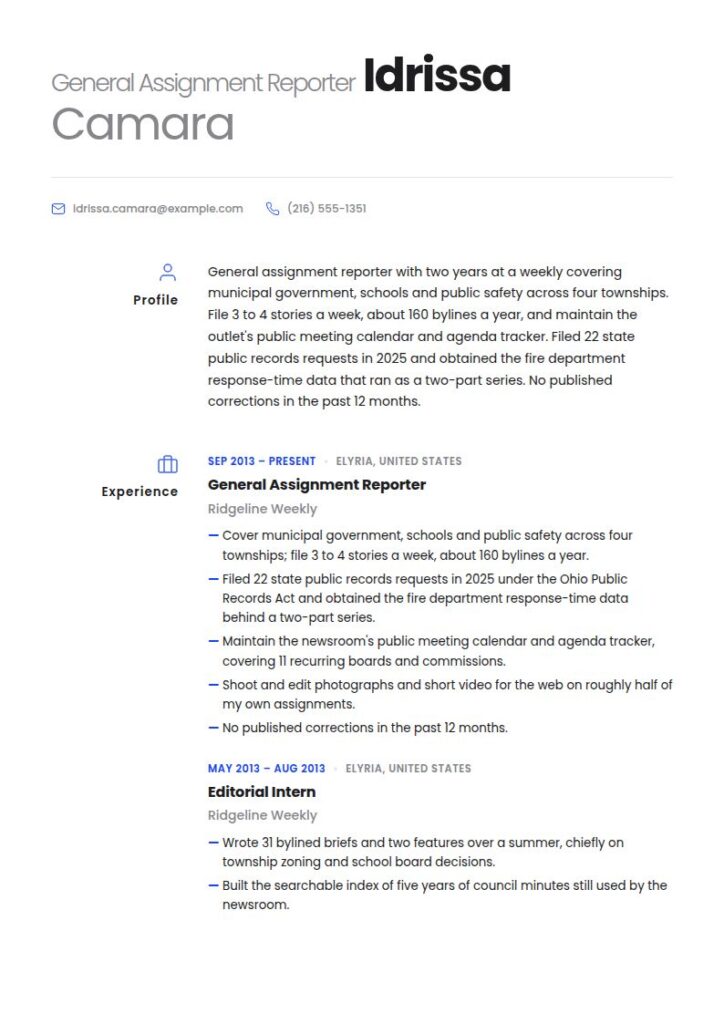
General assignment reporter with two years at a weekly covering municipal government, schools and public safety across four townships. File 3 to 4 stories a week, about 160 bylines a year, and maintain the outlet's public meeting calendar and agenda tracker. Filed 22 state public records requests in 2025 and obtained the fire department response-time data that ran as a two-part series. No published corrections in the past 12 months.
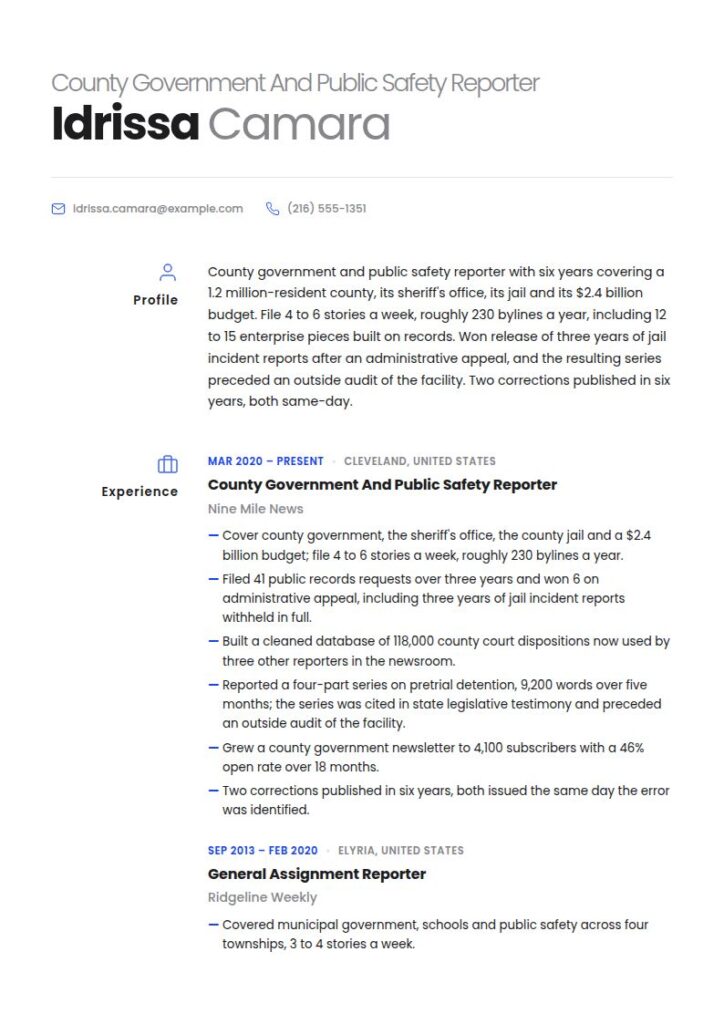
County government and public safety reporter with six years covering a 1.2 million-resident county, its sheriff's office, its jail and its $2.4 billion budget. File 4 to 6 stories a week, roughly 230 bylines a year, including 12 to 15 enterprise pieces built on records. Won release of three years of jail incident reports after an administrative appeal, and the resulting series preceded an outside audit of the facility. Two corrections published in six years, both same-day.
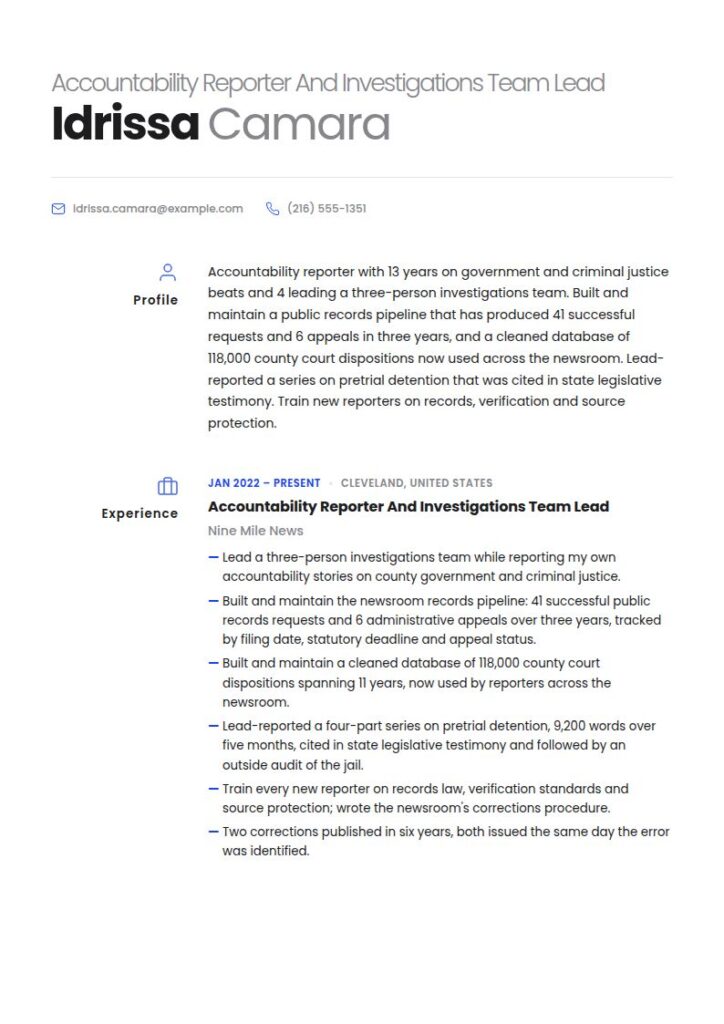
Accountability reporter with 13 years on government and criminal justice beats and 4 leading a three-person investigations team. Built and maintain a public records pipeline that has produced 41 successful requests and 6 appeals in three years, and a cleaned database of 118,000 county court dispositions now used across the newsroom. Lead-reported a series on pretrial detention that was cited in state legislative testimony. Train new reporters on records, verification and source protection.
Right vs wrong: the same journalist summary, twice
| ✅ Right | ❌ Wrong |
|---|---|
| County government and public safety reporter with six years covering a 1.2 million-resident county. | Experienced journalist with a passion for telling important stories. |
| File 4 to 6 stories a week, roughly 230 bylines a year, 12 to 15 of them enterprise. | Skilled at writing compelling content across a variety of topics. |
| Won release of three years of jail incident reports after an administrative appeal. | Strong investigative instincts and a commitment to the truth. |
| Two corrections published in six years, both same-day. | Known for accuracy and attention to detail. |
The right column is checkable. That way, an editor can open the clips, count the bylines, find the series and read the corrections. That is the whole test, and the wrong column asks to be taken on trust instead.
Outline your reporting experience
For each role, give outlet, city, your title, the beat, and dates. Then three to five bullets. In turn, each names a beat, a story type or a document set, and carries a number.
| Instead of | Use |
|---|---|
| Wrote articles on local issues | Covered county government, courts and public safety for a 1.2 million-resident county, 4 to 6 stories a week |
| Conducted interviews and research | Filed 22 state public records requests in a year and won 3 on administrative appeal |
| Covered breaking news | Led breaking coverage of a 14-hour jail lockdown, first outlet to publish the incident report |
| Worked with editors on long-form pieces | Reported a four-part series on pretrial detention over five months, 9,200 words, built on 118,000 court dispositions |
| Used social media to engage readers | Built a 4,100-subscriber county government newsletter with a 46% open rate over 18 months |
| Helped train newer staff | Trained 6 reporters on records requests and verification, and wrote the newsroom's corrections procedure |
County Government and Public Safety Reporter, Nine Mile News, Cleveland, OH, March 2020 to Present
Cover county government, the sheriff's office, the county jail and a $2.4 billion budget; file 4 to 6 stories a week, roughly 230 bylines a year.
Filed 41 public records requests over three years and won 6 on administrative appeal, including three years of jail incident reports that had been withheld in full.
Built a cleaned database of 118,000 county court dispositions now used by three other reporters in the newsroom.
Reported a four-part series on pretrial detention, 9,200 words over five months; the series was cited in state legislative testimony and preceded an outside audit of the facility.
Two corrections published in six years, both issued the same day the error was identified, with the correction note explaining what changed.
That last bullet is deliberate. A short, dated corrections line is a stronger accuracy claim than any adjective, and it signals that you treat corrections as part of the job.
Your beat, your bylines, and the sources you can never name
In fact, this is the block that separates reporters from writers, and almost nobody builds it.
A beat is not a topic. Instead, it is a defined area of coverage with named institutions in it, a documented rhythm, and a relationship with the records those institutions hold.
Beat: County government and public safety, Cuyahoga County and four inner-ring suburbs. Institutions covered: county council and executive, sheriff's office, county jail, medical examiner, municipal and common pleas courts.
Cadence: 4 to 6 stories a week, roughly 230 bylines a year. 12 to 15 enterprise pieces a year over 1,500 words.
Records work: 41 public records requests filed over three years under the Ohio Public Records Act, 6 won on administrative appeal, 2 federal FOIA requests to the Bureau of Prisons. Maintain a request tracker with filing date, statutory deadline and appeal status.
Data: Cleaned and merged 118,000 county court dispositions across 11 years; built the newsroom's jail population time series from monthly reports.
Standards: Two published corrections in six years, both same-day. Follow the SPJ Code of Ethics on verification, attribution and anonymity.
Records work belongs on the page because it is the hardest part of the job to fake and the easiest to verify. Federal agencies alone received 1,707,197 FOIA requests in fiscal year 2025, a 13.7 percent increase on the year before, and processed a record 1,635,055 of them (US Department of Justice, Office of Information Policy, published 2 July 2026). Knowing how to write a request that is granted, and how to appeal one that is not, is a reportable skill with a paper trail behind it.
Protecting confidential sources on a journalist resume
Now the part that has to be said plainly. Confidential sources never appear on a resume. Not by name, not by title, not by a description specific enough to identify them, not in a clips file, not in an interview when an editor asks how you got the story. The SPJ Code of Ethics tells journalists to "reserve anonymity for sources who may face danger, retribution or other harm, and have information that cannot be obtained elsewhere" (Society of Professional Journalists, Code of Ethics, revised 6 September 2014). A promise of confidentiality made under that standard is not conditional on whether you still work there.
The legal ground under that promise is thinner than most people assume. For instance, the Reporters Committee for Freedom of the Press records shield law statutes in 40 states and the District of Columbia, and no federal shield law at all (Reporters Committee for Freedom of the Press, reporter's privilege compendium, as published 2021). In other words, protection depends on which court you are standing in.
So write the records, the data, the institutions and the outcome. Therefore, never write the person, and never hint at how few people it could have been.
Name the beat, the institutions inside it and the geography. Give the filing rate as a number per week and per year. Put one working clips link in the header. Count your records requests, your appeals and your wins. State your corrections record if it is short, with the year. Say which style guide and standards code your newsroom works to.
Do not name, describe or narrow down a confidential source anywhere, including in an interview. Do not list every story you have ever written; the clips file is for that. Do not call yourself award-winning without naming the award and the year. Do not claim an investigation you contributed one interview to; say what you reported. Do not leave a dead portfolio link on the page.
Build a snapshot of your key skills
For skills, list ten to fourteen entries in four groups: reporting, records and data, production, and standards.
Reporting: Beat development, Source cultivation, Breaking news on deadline, Long-form and series reporting, Interviewing under pressure
Records and data: State public records requests and appeals, Federal FOIA, Court docket research, Spreadsheet analysis and cleaning, SQL for newsroom datasets, Campaign finance and property records
Production: CMS publishing, Photography and mobile video for the web, Audio recording for podcast and radio cut-ins, Newsletter writing, Headline and SEO fundamentals
Standards and tools: AP Stylebook, SPJ Code of Ethics, Corrections procedure, Pre-publication legal review, Encrypted messaging and document handling
Keep the standards line. In particular, it is the group that tells a hiring editor you have thought about the part of the job that creates liability.
List your education and training
Degree, institution, city and year. Then the professional training that is specific to reporting: records law, data journalism, investigative technique, safety training.
Bachelor of Arts, Journalism, minor in Political Science, Ohio University, Athens, OH, 2013
Training: Public records and open meetings law, state press association annual workshop (2023). Data journalism bootcamp, SQL and spreadsheet analysis for reporters (2022). Investigative reporting workshop, documents and databases track (2021). Hostile environment and first aid training for journalists (2024).
Standards: AP Stylebook. Work to the SPJ Code of Ethics.
On education, the Bureau of Labor Statistics lists a bachelor's degree as the typical entry-level education, with no required work experience and no formal on-the-job training (BLS Occupational Outlook Handbook, page last modified 27 August 2026). Even so, journalism is the common major, not the only one: a degree in the subject you cover, plus clips and records work, competes well for a specialist beat.
Choose the right layout and design
As for layout, single column, plain type at 10 to 12 point, clear headings, no photograph, no columns, no infographic of your skills as percentage bars.
Export as PDF unless the posting says otherwise, named for yourself and the beat. Keep the clips link as live text rather than a QR code: an editor reading on a laptop will click, and will not photograph your resume.
Journalist job market and outlook
A small, declining occupation with a wide pay spread, which makes the beat and the platform you work on more decisive than the job title.
| Measure | Value |
|---|---|
| News analyst, reporter and journalist jobs, 2025 | 47,100 |
| Projected change, 2025-35 | -6% (decline), -2,800 |
| Projected annual openings | ~3,400 |
| Typical entry-level education | Bachelor's degree |
| Median annual wage, May 2025 | $62,200 |
Source: US Bureau of Labor Statistics, Occupational Outlook Handbook, news analysts, reporters and journalists, 2025-35 projections and May 2025 wage data, page last modified 27 August 2026.
Say the decline out loud rather than writing around it. Meanwhile, employment is projected to fall 6 percent between 2025 and 2035, with about 3,400 openings a year almost entirely from people leaving the occupation (BLS, 27 August 2026). That is why a resume naming a beat and a filing rate beats one describing a love of storytelling.
The contraction is geographic before it is occupational
The Medill Local News Initiative counted 213 news desert counties with no local news outlet at all in 2025, up from 206 the year before, and a further 1,524 counties served by a single source. About 50 million Americans now have limited to no access to local news, and 136 newspapers closed during 2025, more than two a week (Medill Local News Initiative, The State of Local News 2025, published 20 October 2025).
Read that against the BLS industry shares. Newspaper publishers still employ 28 percent of the occupation at a median of $49,220, while media streaming distribution services and social networks employ 21 percent at $80,180 and television broadcasting 18 percent at $64,150 (BLS, May 2025).
The practical reading for your resume is that the declining segment is also the lowest-paid one, and that the transferable assets are the records skill, the data skill and the beat knowledge rather than the masthead. Write those first.
Where the jobs sit:
| Setting | Share of employment | Median annual wage (May 2025) |
|---|---|---|
| Newspaper publishers | 28% | $49,220 |
| Media streaming distribution services and social networks | 21% | $80,180 |
| Television broadcasting | 18% | $64,150 |
| Self-employed | 17% | Not published |
| Radio broadcasting | 4% | $50,290 |
Source: US Bureau of Labor Statistics, May 2025.
What salary you can expect as a journalist
On pay, the median annual wage for news analysts, reporters and journalists was $62,200 as of May 2025, or $29.91 an hour. The lowest 10 percent earned less than $36,240 and the highest 10 percent more than $144,140 (BLS Occupational Outlook Handbook, page last modified 27 August 2026).
That is a spread of roughly four to one between the tenth and ninetieth percentile, and most of it is platform and market size rather than seniority. The gap between the newspaper median of $49,220 and the streaming and social media median of $80,180 is about 63 percent, and it opens before you have negotiated anything.
In addition, seventeen percent of the occupation is self-employed, and BLS does not publish a median for that group. If you freelance, your rate card is the negotiation, so the resume's job is to justify it: volume, turnaround, beat knowledge, records capability and the fact that you have never cost an editor a retraction.
Inside a staff band, four things move an offer: a named beat with institutional knowledge, demonstrated records and data skill, a second language relevant to the coverage area, and the ability to shoot, record or produce as well as write. Also, each belongs on the page as a fact with a number, not as an adjective.
Key takeaways for a journalist resume
- Name the beat, its institutions and its geography before you name any job title.
- Give the filing cadence as a rate: stories a week, bylines a year, enterprise pieces a year.
- Then put one working clips link in the header and check it the morning you send.
- Count the records requests, the appeals and the wins; that is the hardest skill to fake.
- State a short corrections record with dates, because accuracy claims without evidence read as decoration.
- Never name, describe or narrow down a confidential source, on the page or in the interview.
- Say the market plainly and lead with the transferable skills, because the occupation is projected to shrink.
Build your journalist resume in 15 minutes with our AI resume builder.
Related resume examples
- Writer resume
- Copywriter resume
- Freelance writer resume
- Technical writer resume
- Grant writer resume
- Translator resume
- Freelancer resume
- Self-employed resume
- General resume
- Career change resume
- Volunteer resume
- Audio engineer resume
Pair it with a matching journalist cover letter.
Journalist resume questions, answered
How long should a journalist resume be?
One page for your first five years. Two once you hold a beat, have an investigation worth its own block, or have led a team. The clips file carries the work; the resume carries the pattern.
How many clips should I link to?
One link, to a page you control, with six to ten pieces on it. Lead with the best enterprise story, then show range: a records-driven piece, a deadline piece, a difficult interview. If an outlet has paywalled or delisted your work, keep PDFs on your own page with the publication and date on each.
Can I list a story that involved a confidential source?
You can list the story, its length, its subject and its outcome. You cannot describe the source in any way that narrows the field, including in an interview. The SPJ Code of Ethics reserves anonymity for sources facing "danger, retribution or other harm" (Society of Professional Journalists, revised 6 September 2014), and that promise does not expire when you change jobs. Editors read a candidate who hints as one who will eventually tell.
Should I put my corrections record on a resume?
If it is short, yes, with the period attached: "Two corrections in six years, both same-day." The SPJ Code asks journalists to "acknowledge mistakes and correct them promptly and prominently", and a candidate who volunteers that number is telling an editor they run a process rather than hoping nothing goes wrong. If your record is not short, leave it off and do not substitute a claim of flawless accuracy.
What do I put on a journalist resume with no staff experience?
Student newsroom, campus paper, internships and freelance work, written as jobs with beats and volume attached. Then the records: file two or three public records requests before you apply and put the count and the outcome on the page. A candidate with 40 bylines, a named beat and two granted requests is a more concrete proposition than one with a degree and a list of adjectives.
Is journalism a shrinking field, and should the resume acknowledge it?
Employment is projected to decline 6 percent between 2025 and 2035, from 47,100 jobs to about 44,300, with roughly 3,400 openings a year (BLS Occupational Outlook Handbook, page last modified 27 August 2026). The resume should not argue with that. It should answer it, by leading with the skills that travel: records and FOIA work, data cleaning and analysis, a documented filing rate, and beat knowledge of institutions that still need covering.