Idrissa Camara County Government and Public Safety Reporter Cleveland, 44109, United States [email protected] · (216) 555-1351
17 September 2026
Ms. Delphine Hartsock Managing Editor Foundry Street Media Cleveland, United States
Application for County Government Reporter, Foundry Street Media
Dear Ms. Hartsock,
I am applying for the county government reporter post at Foundry Street Media. I have covered county government and public safety for six years: the council and executive, the sheriff's office, the jail and a $2.4 billion budget, at 4 to 6 stories a week and roughly 230 bylines a year. Twelve to fifteen of those each year are enterprise pieces built on records.
The story I would point you to is the pretrial detention series. The county had refused three years of jail incident reports in full, so I filed again, narrowed the request to the fields that were clearly public, and took the denial to administrative appeal. The reports came out eleven months after the first request. The series ran to 9,200 words over four parts, drew on a database of 118,000 court dispositions I had cleaned the year before, and was cited in state legislative testimony. The county commissioned an outside audit of the facility four months later.
I have read your last two quarters of county coverage and the gap I would fill is the jail itself, which shows up in your budget stories but not on its own. I would bring the request tracker and the dispositions database with me, and I would want to spend the first month on the medical contract, which is where the last three incident report batches kept pointing.
My clips are at idrissacamara.example.com/clips, with the series first and three deadline pieces after it. I have published two corrections in six years, both the same day the error was found. I can give six weeks' notice. Thank you for reading.
Sincerely, Idrissa Camara
Summary
A journalist cover letter names the beat you can take over, what you file and how often, and one story you got by filing for records rather than waiting for a call back. This guide gives you a full adaptable letter, the clips order that works, what changes between a staff job and a freelance pitch, and the openings that get a strong file read twice.
Journalist cover letter examples by experience level
A journalist cover letter is a one-page letter telling an editor which beat you can take over, what you will file into their story budget each week, and one story you got because you knew how to ask for the documents.
Editors read applications the way they read pitches: in a hurry, looking for the specific thing. A letter opening with a love of storytelling has not made one.
Guide to a journalist cover letter
This guide and the corresponding journalist cover letter example will cover:
- How to structure the letter, paragraph by paragraph
- Why the beat and the weekly rate belong in the first three sentences
- What counts as evidence when you cannot name a source
- Which clips to attach, and the order to put them in
- What changes between a staff application, a freelance pitch and a nonprofit newsroom
How to write a journalist cover letter
| Paragraph | Its job | Length |
|---|---|---|
| Opening | The post, the beat you can cover, and what you file in a week | 2 to 3 sentences |
| Evidence | One story: how you got it, what it took, what changed | 4 to 5 sentences |
| Fit | Something specific about their coverage, and what you would add | 3 to 4 sentences |
| Close | Clips link, availability, thank you | 2 sentences |
Open with the beat and the rate, because an editor is filling a budget
The hiring editor has a story budget with a hole in it: somebody used to cover the county, or the schools, or the statehouse, and now nobody does. Answer that in the first three sentences: "I cover county government and public safety: the council, the sheriff's office, the jail and a $2.4 billion budget, at 4 to 6 stories a week." That is the staffing question, answered before they have to ask it.
Then give the part that is hardest to buy: "Of those, 12 to 15 a year are enterprise pieces built on records." Daily volume is available in the market; volume plus documents is not.
A journalist cover letter example you can adapt
Dear Ms. Hartsock,
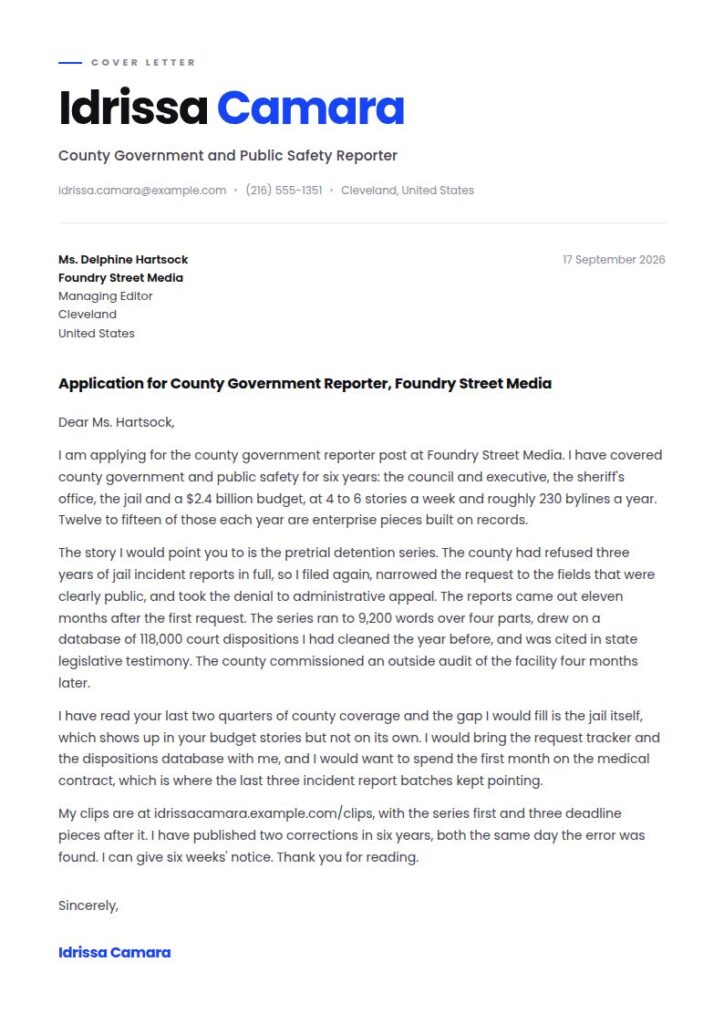
I am applying for the county government reporter post at Foundry Street Media. I have covered county government and public safety for six years: the council and executive, the sheriff's office, the jail and a $2.4 billion budget, at 4 to 6 stories a week and roughly 230 bylines a year. Twelve to fifteen of those each year are enterprise pieces built on records.
The story I would point you to is the pretrial detention series. The county had refused three years of jail incident reports in full, so I filed again, narrowed the request to the fields that were clearly public, and took the denial to administrative appeal. The reports came out eleven months after the first request. The series ran to 9,200 words over four parts, drew on a database of 118,000 court dispositions I had cleaned the year before, and was cited in state legislative testimony. The county commissioned an outside audit of the facility four months later.
I have read your last two quarters of county coverage and the gap I would fill is the jail itself, which shows up in your budget stories but not on its own. I would bring the request tracker and the dispositions database with me, and I would want to spend the first month on the medical contract, which is where the last three incident report batches kept pointing.
My clips are at idrissacamara.example.com/clips, with the series first and three deadline pieces after it. I have published two corrections in six years, both the same day the error was found. I can give six weeks' notice. Thank you for reading.
Sincerely, Idrissa Camara
Openings that work
| Instead of | Use |
|---|---|
| I am passionate about telling stories that matter | I cover county government and public safety at 4 to 6 stories a week |
| I am writing to express my interest in the reporter position | I am applying for the county government post, and the jail is the part I know best |
| I have a proven track record of impactful journalism | The county refused the incident reports in full; I won them on appeal eleven months later |
| I would love to bring my skills to your newsroom | I have read your last two quarters of county coverage, and the jail is not in it |
What counts as evidence when you cannot name a source
The strongest sentence in a journalism cover letter is almost never about a source. It is about a document, a dataset or a deadline.
| Kind of evidence | What it looks like in a sentence |
|---|---|
| Records | Won three years of jail incident reports on administrative appeal, eleven months after the first request |
| Data | Cleaned and merged 118,000 court dispositions across 11 years, now used by three reporters |
| Volume | 4 to 6 stories a week, roughly 230 bylines a year, 12 to 15 of them enterprise |
| Outcome | Series cited in state legislative testimony; outside audit commissioned four months later |
| Standards | Two corrections in six years, both same-day, each with a note explaining what changed |
None of those requires describing a person, and that is not a stylistic preference. The Society of Professional Journalists asks reporters to "reserve anonymity for sources who may face danger, retribution or other harm" (SPJ Code of Ethics, revised 6 September 2014), and a promise made under that standard survives the job you made it in. An editor who watches a candidate hint at a source has learned everything they need to know.
The clips you attach, and the order
Three to five, not everything, and the order is an argument. Lead with the enterprise piece that took records or data, because it is the hardest thing to fake. Follow it with a deadline piece showing you can turn in two hours, then a piece from the beat they are hiring for, then, if the outlet does audio or video, one proving you can produce as well as write.
Host them yourself. Paywalls, redesigns and shutdowns take clips offline constantly, and a link that fails during a hiring window is one nobody chases.
Staff jobs, freelance pitches and nonprofit newsrooms
For a staff job, lead with the beat and the weekly rate, because you are bought as capacity. For a freelance pitch, lead with the story, its reporting status and what it will cost in time. For a nonprofit or grant-funded newsroom, read the published mission and funding page first and name the coverage area you would serve. In all three, name one real thing from their recent coverage.
Do not name, describe or narrow down a confidential source anywhere in the letter. Do not send a letter with no outlet name in it. Do not claim an investigation you contributed one interview to. Do not describe yourself as award-winning without naming the award and the year. Do not attach every clip you have; three to five in a considered order is the argument.
Write to a contracting industry without apologizing to it
Employment of news analysts, reporters and journalists is projected to fall 6 percent between 2025 and 2035, from 47,100 jobs, with about 3,400 openings a year almost entirely from replacement (BLS Occupational Outlook Handbook, page last modified 27 August 2026).
The geography of that decline is sharper than the headline. The Medill Local News Initiative counted 213 counties with no local news outlet at all in 2025 and a further 1,524 with only one, with 136 newspapers closing during the year, more than two a week (Medill Local News Initiative, The State of Local News 2025, published 20 October 2025).
Two things follow. The editor is under-resourced, so capacity is the pitch: what arrives, how often, with how little supervision. And the skills that move between shrinking and growing parts of the industry are records, data and beat knowledge, not the masthead on your last byline.
Length, format and sending it
One page, four paragraphs, 250 to 400 words. Paste it into the body of the email as well as attaching it, because editors read on phones. Name the file for yourself and the beat: idrissa-camara-county-reporter-cover-letter.pdf. Use the same numbers as your resume; our journalist resume example uses the figures here.
Address a person. Newsroom mastheads are public, and "Dear Hiring Manager" on an otherwise specific letter reads as one sent to nine outlets.
Key takeaways
- Name the beat and the weekly filing rate in the first three sentences.
- Give one story and say how you got it, not how you felt about it.
- Use a document, a dataset or a deadline as evidence, never a source.
- Name one real gap in their recent coverage that you would fill.
- Attach three to five clips in a deliberate order, on a page you control.
- State a short corrections record with the period attached.
- Address a named editor and keep it to one page.
Write your journalist cover letter in 10 minutes with our AI cover letter builder.
Journalist cover letter questions, answered
How long should a journalist cover letter be?
One page, four paragraphs, 250 to 400 words. Editors read applications the way they read pitches, and a pitch that takes three paragraphs to reach the story has already failed.
Do I need a cover letter if the application asks for clips?
Yes. The clips show what you produced; the letter says what you can cover next, at what rate, and what you would do in the first month. An editor cannot read a filing cadence out of five PDFs.
How do I write about an investigation without breaking confidentiality?
Write the documents, the data, the timeline and the outcome. "The county refused three years of incident reports in full; I won them on appeal" describes the work without describing a person. Never add the detail that narrows who talked to you.
What do I write with no staff reporting experience?
Write the student newsroom, the internship and the freelance work as jobs, with beats and volume attached. Then file two or three public records requests before you apply and put the count and result in the letter. Federal agencies alone received 1,707,197 FOIA requests in fiscal year 2025 (US Department of Justice, Office of Information Policy, published 2 July 2026), and a beginner who can write one that gets granted is unusual.
Should the letter mention that the industry is shrinking?
Not as an apology, and not as a theme. Answer it by leading with what transfers: records and FOIA work, data analysis, a documented filing rate, and knowledge of institutions that still need covering. The editor knows the market better than you do; what they do not know is what you file in a week.