Beatriz Andrade Translator, Spanish and Portuguese into English Alexandria, 22314, United States [email protected] · (703) 555-1203
11 September 2026
Ms. Helena Whitfield Vendor Management Calder Regulatory Language Partners Bethesda, United States
Application for English-language linguist pool, Calder Regulatory Language Partners
Dear Ms. Whitfield,
I am applying to join the English-language linguist pool at Calder Regulatory Language Partners. I translate Spanish and Portuguese into English only, and my subject is clinical research and medical device documentation: informed consent forms, investigator brochures, instructions for use, labeling and the correspondence around a submission.
Over the last two years I have delivered about 310,000 words of clinical documentation across those document types, sustaining 2,500 to 3,000 words a day and a 36-hour turnaround on files under 3,000 words. Every file goes out revised by a second linguist under an ISO 17100 process. The change I would most want to bring with me is a small one that mattered: I moved terminology queries ahead of the translation step rather than after delivery, and post-delivery correction requests across the portfolio fell from 31 a year to 4. I hold a three-year zero-rejection record on two vendor quality scorecards.
Your posting mentions memoQ and a shared term base across the life sciences team, which is how I already work. I maintain a 9,400-entry bilingual term base of my own and would be glad to align it with yours rather than run it alongside. I can also take the revision seat on Spanish into English files, which is often the harder role to staff.
I am ATA-certified in both pairs, Spanish into English and Portuguese into English. I do not interpret and take no spoken assignments. I can take a test piece this week and have capacity from the first of next month. My rate card and references are available on request, and my current client work is under non-disclosure agreement so I have described it by document type rather than by name. Thank you for your time.
Sincerely, Beatriz Andrade, M.A.
Summary
A translator cover letter names your language pairs with their direction, the subject you translate, the volume and turnaround you hold, and the tools you work in. This guide gives you a full adaptable letter, the confidentiality line that keeps client material off the page, and the openings that get a file read rather than filed.
Translator cover letter examples by experience level
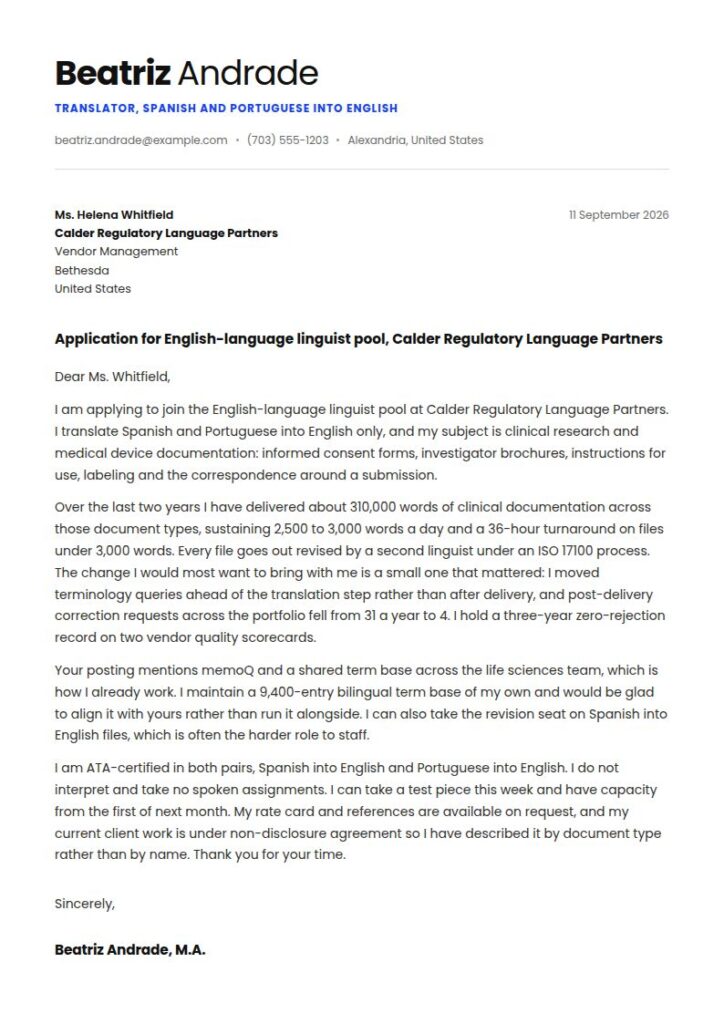
A translator cover letter is a one-page letter telling a project manager or vendor manager which direction you translate in, what subject you own, how fast you deliver, and what tools you work inside.
It has an unusual job compared with most cover letters. The reader is not weighing your character. They are deciding whether to add you to a vendor database under a set of searchable fields, and your letter is the thing that fills those fields in the right order.
Guide to a translator cover letter
This guide and the corresponding translator cover letter example will cover:
- How to structure the letter, paragraph by paragraph
- Why the direction of your pair belongs in the first sentence
- How to show volume and turnaround without quoting a client document
- What changes when you write to an agency rather than a direct client
- The openings that get a file read rather than filed
How to write a translator cover letter
| Paragraph | Its job | Length |
|---|---|---|
| Opening | The role, your pairs with a direction, and your subject | 2 to 3 sentences |
| Evidence | Volume, turnaround, revision process, one measured result | 4 to 5 sentences |
| Fit | Their subject area or tooling, and what you would take on | 3 to 4 sentences |
| Close | Certification, availability, rates on request, thank you | 2 sentences |
Put the direction in the first sentence, every time
Translators work with written communication and interpreters work with spoken communication (U.S. Bureau of Labor Statistics, Occupational Outlook Handbook, last modified 27 August 2026), and the two titles get used interchangeably by people booking the work.
So the first sentence has to do two jobs at once: say which of the two you are, and say which way the language runs. "I translate Spanish and Portuguese into English" settles both in eight words.
If you also interpret, name the interpreting credential separately in the closing paragraph. If you do not, say so plainly somewhere in the letter. It sounds like a small point until the week an agency books you for a remote deposition and you have to withdraw.
A translator cover letter example you can adapt
Dear Ms. Whitfield,
I am applying to join the English-language linguist pool at Calder Regulatory Language Partners. I translate Spanish and Portuguese into English only, and my subject is clinical research and medical device documentation: informed consent forms, investigator brochures, instructions for use, labeling and the correspondence around a submission.
Over the last two years I have delivered about 310,000 words of clinical documentation across those document types, sustaining 2,500 to 3,000 words a day and a 36-hour turnaround on files under 3,000 words. Every file goes out revised by a second linguist under an ISO 17100 process. The change I would most want to bring with me is a small one that mattered: I moved terminology queries ahead of the translation step rather than after delivery, and post-delivery correction requests across the portfolio fell from 31 a year to 4. I hold a three-year zero-rejection record on two vendor quality scorecards.
Your posting mentions memoQ and a shared term base across the life sciences team, which is how I already work. I maintain a 9,400-entry bilingual term base of my own and would be glad to align it with yours rather than run it alongside. I can also take the revision seat on Spanish into English files, which is often the harder role to staff.
I am ATA-certified in both pairs, Spanish into English and Portuguese into English. I do not interpret and take no spoken assignments. I can take a test piece this week and have capacity from the first of next month. My rate card and references are available on request, and my current client work is under non-disclosure agreement so I have described it by document type rather than by name. Thank you for your time.
Sincerely, Beatriz Andrade, M.A.
Openings that work
| Instead of | Use |
|---|---|
| I am a passionate language professional fluent in three languages | I translate Spanish and Portuguese into English only, specializing in clinical research documentation |
| I am writing to express my interest in your translation opportunities | I am applying to join your English-language linguist pool for life sciences |
| I have excellent attention to detail and always meet deadlines | 2,500 to 3,000 words a day on regulated text, 36-hour turnaround under 3,000 words |
| I have worked with many prestigious clients | Two clinical research organizations and a device manufacturer, all under non-disclosure agreement |
Evidence you can give without naming a client
The source document belongs to whoever commissioned it, and most of it arrives under a confidentiality obligation. That rules out excerpts, screenshots, document titles and, in most cases, client names. It does not rule out evidence.
| Kind of evidence | What it looks like in a sentence |
|---|---|
| Volume | About 310,000 words of clinical documentation across two years |
| Production rate | 2,500 to 3,000 words a day sustained on regulated text |
| Turnaround | 36 hours on files under 3,000 words, including revision |
| Document types | Informed consent forms, investigator brochures, instructions for use, labeling |
| Process | Every file revised by a second linguist under an ISO 17100 workflow |
| Quality record | Post-delivery corrections down from 31 a year to 4; zero rejections across two scorecards |
| Terminology | A 9,400-entry bilingual term base maintained across the portfolio |
Every row there is a fact about your work rather than about the client's document, which is exactly the line confidentiality draws.
Writing to an agency rather than a direct client
Write to an agency in database fields: pairs with direction, subjects, daily capacity, tools, certification, availability and whether you revise. Offer a test piece, because that is how the decision is actually made. Write to a direct client in outcomes instead: what the document is for, what happens if it is wrong, and how your process protects them. Say your rate card is available rather than quoting a number into a letter.
Do not open with your love of languages. Do not list every subject you have touched, since range without depth reads as no specialization. Do not attach a sample of confidential work, even redacted. Do not claim interpreting unless you hold an interpreting credential. Do not send the same letter to an agency and a direct client; they are buying different things.
Where the work is, and what it pays
BLS publishes interpreters and translators as a single occupation. In May 2025 it held 73,900 jobs with a median annual wage of $60,170, the lowest 10 percent under $37,070 and the highest 10 percent over $103,660, against a median of $50,980 for all occupations (BLS Occupational Outlook Handbook, May 2025). Employment is projected to grow 2 percent from 2025 to 2035, an increase of 1,500 jobs, with about 6,000 openings a year (BLS, 2025 to 2035 projections, published 27 August 2026).
The employment mix explains who reads your letter. Professional, scientific and technical services holds 30 percent of employment at a median of $60,850, self-employed workers 28 percent, educational services 15 percent at $61,230, hospitals 7 percent at $63,000, and government 5 percent at $74,320 (BLS, May 2025).
Nearly a third of the work sits inside language service providers, and more than a quarter of the occupation is self-employed. That is why the agency letter and the direct-client letter are different documents, and why writing one of them for both audiences wastes the better opportunity.
Length, format and sending it
One page, four paragraphs, 250 to 400 words. PDF unless the portal says otherwise, named for yourself, your pairs and your subject: beatriz-andrade-es-pt-en-life-sciences-letter.pdf.
Address a person. Vendor managers and language leads are usually named on an agency's own site, and a letter that opens "Dear Sir or Madam" undercuts the precision you are selling.
Keep the numbers identical to the ones on your resume. Our translator resume example uses the same volume, turnaround and certification figures as this letter, so the pair reads as one account.
If you are applying through a vendor portal that asks for rates, fill that field and leave the number out of the letter. A rate written into prose is hard to revise later and it anchors the conversation before anyone has seen your work.
Key takeaways
- Name the direction of your pairs in the first sentence, and say you translate rather than interpret.
- Give your subject specialization by document type, not as a field of interest.
- Prove capacity with volume, daily rate of production and turnaround.
- Describe confidential work by type and volume; never quote or attach it.
- Name the tools, because an agency is matching you to a workflow.
- Offer a test piece, since that is the step the decision actually turns on.
- Address a named person and keep the letter to one page.
Write your translator cover letter in 10 minutes with our AI cover letter builder.
Translator cover letter questions, answered
How long should a translator cover letter be?
One page, four paragraphs, 250 to 400 words. Vendor managers read these in batches against a database, so density beats length. Anything that does not fill a field in that database is probably cuttable.
Should I attach a translation sample with my cover letter?
Not from client work, and not even redacted, because the source document is the client's property and usually covered by a non-disclosure agreement. Offer a test piece instead, which is how agencies prefer to assess anyway, or link to a portfolio built from published work you have the right to share or from public-domain source texts.
Do I need to mention certification in the letter?
Yes, with the body and the direction it covers. ATA certification is offered in specific language combinations, each in a stated direction, so "ATA-certified, Spanish into English" is a precise claim and "ATA-certified translator" is not (American Translators Association, retrieved 17 September 2026). If you hold an interpreting credential too, name it separately.
What do I write with no professional translation experience yet?
Write the work you have done as work: volunteer translation for a community organization with word counts and document types, a graduate translation practicum, subtitling or localization projects, and any subject knowledge from a previous career. A science or legal background with a modest word count is a stronger opening than a large word count with no subject at all.
Should I put my rates in the cover letter?
No. Put them in the rate field of the portal or offer a rate card on request. A number written into prose anchors the negotiation before the agency has seen a test piece, and it dates the letter the moment you raise it.