Tamar Boghossian Lead Keeper, Carnivore and Hoofstock Area Tucson, 85719, United States [email protected] · (520) 555-1273
17 September 2026
Dr. Imogen Ashgrove Curator of Mammals Sablewood Zoological Gardens Boulder, United States
Application for Lead Keeper, Carnivores, Sablewood Zoological Gardens
Dear Dr. Ashgrove,
I am applying for the Lead Keeper, Carnivores post at Sablewood Zoological Gardens. I have worked AZA-accredited collections for 16 years, the last six leading a carnivore and hoofstock area of 9 staff and 58 animals across 16 species, and before that holding a string of 24 that included African lion, spotted hyena, reticulated giraffe and Grevy's zebra.
The work I would most want to bring to Sablewood is the husbandry training program. When I took the area over it had 4 husbandry behaviors on file; it now has 31, including voluntary blood draw with two African lions and hoof presentation with reticulated giraffe, and immobilizations for routine care in the area fell from 9 a year to 2 over those four years. That came from writing protocols before training them, a weekly training meeting with the whole area, and treating record quality as part of the behavior rather than paperwork afterwards.
I have followed your carnivore complex since it opened and noticed your team has published on mesh training in the mixed species yard. That is the problem I would most like to work on, because shared space makes individual behaviors harder to maintain and it is where our own program slowed. I also hold and monthly audit the ZIMS records for my area, and act as institutional representative for one Species Survival Plan program.
I completed the AZA courses in Environmental Enrichment, Animal Training Applications and Institutional Records Keeping, and I hold a Class B commercial driver license for transports. I can start with eight weeks' notice. Thank you for reading.
Sincerely, Tamar Boghossian
Summary
A zoo keeper cover letter names the species you have worked, the husbandry you own, the behaviors you have trained and what each one replaced. This guide gives you a full adaptable letter, the openings that work with a curator, and what to write when your experience is internships and volunteer hours rather than a paid keeper title.
Zoo Keeper cover letter examples by experience level
A zoo keeper cover letter is a one-page letter telling a curator which species you have held, what you were responsible for on that string, what you have trained, and why you want their collection.
That last one sorts the pile. Keeper posts draw large numbers of applications, and most of those letters would work for any zoo in the country.
Guide to a zoo keeper cover letter
This guide and the corresponding zoo keeper cover letter example will cover:
- How to structure the letter, paragraph by paragraph
- Why the species and the string belong in the first two sentences
- What counts as evidence when you have internships rather than a keeper title
How to write a zoo keeper cover letter
| Paragraph | Its job | Length |
|---|---|---|
| Opening | The post, your string and the species you have held | 2 to 3 sentences |
| Evidence | One behavior or husbandry result, with the species and what it replaced | 4 to 5 sentences |
| Fit | Something real about their collection, and what you would bring to it | 3 to 4 sentences |
| Close | Courses, records systems, availability, thank you | 2 sentences |
Lead with the taxon, not the vocation
A curator hiring for a carnivore string is reading for whether you have stood in a carnivore holding area and know what the protocol feels like.
So the first sentence carries the species: "I am applying for the Keeper, Carnivores post. I have held a carnivore and African hoofstock string of 24 animals across 7 species for six years, including African lion, spotted hyena and reticulated giraffe."
If your experience is in another taxon, say what transfers: the safety protocol, the training method and the record work all carry across, but the reader will not assume it.
A zoo keeper cover letter example you can adapt
Dear Dr. Ashgrove,
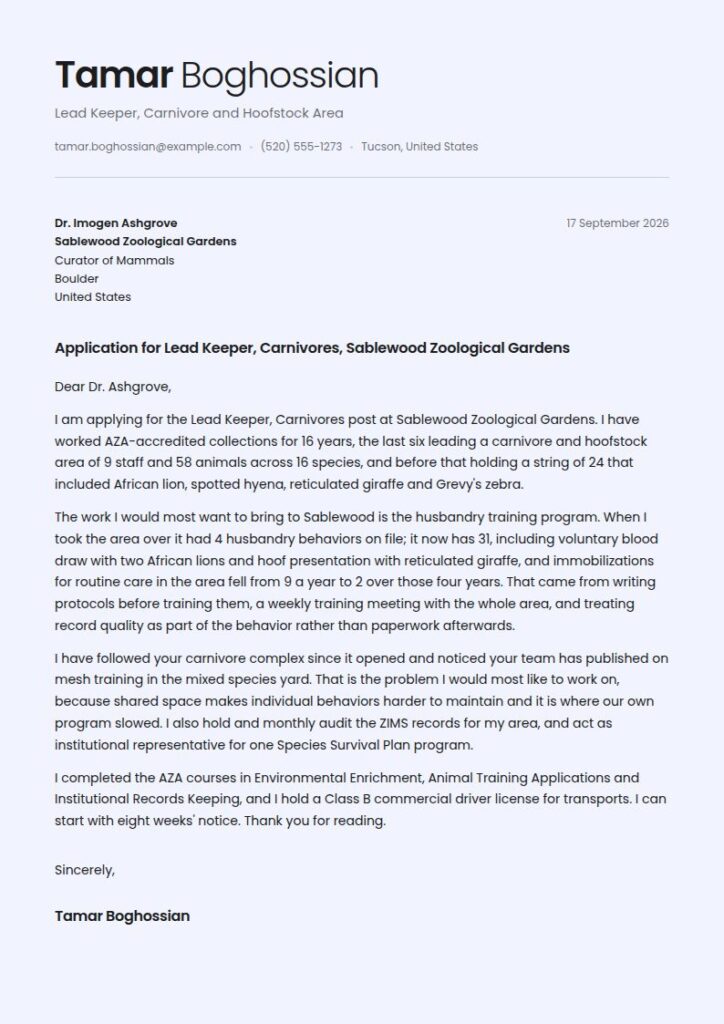
I am applying for the Lead Keeper, Carnivores post at Sablewood Zoological Gardens. I have worked AZA-accredited collections for 16 years, the last six leading a carnivore and hoofstock area of 9 staff and 58 animals across 16 species, and before that holding a string of 24 that included African lion, spotted hyena, reticulated giraffe and Grevy's zebra.
The work I would most want to bring to Sablewood is the husbandry training program. When I took the area over it had 4 husbandry behaviors on file; it now has 31, including voluntary blood draw with two African lions and hoof presentation with reticulated giraffe, and immobilizations for routine care in the area fell from 9 a year to 2 over those four years. That came from writing protocols before training them, a weekly training meeting with the whole area, and treating record quality as part of the behavior rather than paperwork afterwards.
I have followed your carnivore complex since it opened and noticed your team has published on mesh training in the mixed species yard. That is the problem I would most like to work on, because shared space makes individual behaviors harder to maintain and it is where our own program slowed. I also hold and monthly audit the ZIMS records for my area, and act as institutional representative for one Species Survival Plan program.
I completed the AZA courses in Environmental Enrichment, Animal Training Applications and Institutional Records Keeping, and I hold a Class B commercial driver license for transports. I can start with eight weeks' notice. Thank you for reading.
Sincerely, Tamar Boghossian
Openings that work
| Instead of | Use |
|---|---|
| I have always loved animals and dreamed of working in a zoo | I have held a carnivore and hoofstock string of 24 animals across 7 species for six years |
| I am writing to express my interest in your keeper position | I am applying for the Keeper, Carnivores post and have worked lion, hyena and giraffe |
| I have experience with animal care and enrichment | I trained voluntary blood draw with two African lions, taking routine bloodwork off immobilization |
| I would be a valuable addition to your team | I noticed your team has published on mesh training in the mixed species yard |
What counts as evidence
The unit of evidence here is a behavior, a species and a consequence.
| Kind of evidence | What it looks like in a sentence |
|---|---|
| Trained behavior | Trained voluntary hoof presentation with three reticulated giraffe, so hoof care is done awake |
| Program change | Took the area from 4 husbandry behaviors on file to 31 in four years |
| Clinical consequence | Immobilizations for routine care in the area fell from 9 a year to 2 |
| Scale | Hold a string of 24 animals across 7 species, including three prescription diets |
| Records | Enter daily husbandry records in ZIMS and submit weight data to two SSP studbooks |
| Safety | Hold carnivore access sign-off and act as area lead in the escape drill |
| Hours, when that is what you have | 700 hour internship plus 1,200 volunteer hours in rehabilitation |
Use the last row if you have no keeper title yet. Hours are a real unit and nobody counts them.
Writing the letter when your experience is internships
This is the normal starting position, and BLS says so: "Volunteering and internships at zoos and aquariums are excellent ways to gain" animal experience, and most zoos require a bachelor's degree in biology, animal science or a related field (BLS Occupational Outlook Handbook, last modified 27 August 2026).
So write the internship as a job, not an apology before one. Name the string, the species, the hours and one thing you were trusted with alone. A candidate with 1,900 documented hours who can describe a shift protocol accurately is a genuine applicant.
Name the species and the string in the first two sentences. Give one trained behavior with the species and what it replaced. Say which records system you use. Name one real thing about their collection. Count your internship and volunteer hours. Say when you could start, since keeper posts are filled against a rota date.
Do not open with a childhood story about a zoo visit. Do not call yourself passionate about conservation without a line that shows it. Do not claim a behavior you supported rather than trained. Do not send the same letter to twelve collections; curators talk to each other.
What the published numbers do and do not cover
There is no Bureau of Labor Statistics profile for zoo keepers. The job appears inside the animal care and service workers profile, which says "Zookeepers care for animals in zoos. They plan diets, feed animals, and monitor the animals' eating patterns" and that most zoos require a bachelor's degree in biology, animal science or a related field (BLS Occupational Outlook Handbook, last modified 27 August 2026).
The line zoo keepers are counted in is animal caretakers: a median annual wage of $35,360, or $17.08 an hour, in May 2025, with the lowest 10 percent under $27,250 and the highest 10 percent over $50,060. Arts, entertainment and recreation, the industry group zoos and aquariums sit in, paid a median of $37,460 and held 5 percent of animal caretaker employment, the smallest of the four industries listed. The occupation overall is growing: animal care and service workers are projected to rise from 413,000 jobs in 2025 to 459,100 in 2035, an 11 percent increase, with about 69,400 openings a year (BLS Occupational Outlook Handbook, May 2025 wages and 2025 to 2035 projections, published 27 August 2026).
Read together, that is an honest picture. The broad occupation is growing quickly, but most of the growth is in kennels, grooming, shelters and pet care rather than zoos. The zoo slice is small, asks for a degree, and pays on the caretaker line.
Length, format and sending it
One page, four paragraphs, 250 to 400 words. PDF unless the portal says otherwise, named for yourself and the post.
Address the curator or area manager by name. Staff structures are usually public on the institution's site and in annual reports, and a named address is the cheapest signal of effort available. Use the same species counts and behavior claims as your resume so the two agree; our zoo keeper resume example is written with the figures used here.
Key takeaways
- Species and string in the first two sentences.
- One trained behavior, with the species and what it replaced.
- One real detail about their collection or animal program.
- The records system you use and what you enter into it.
- Internship and volunteer hours counted and named.
- AZA courses with the year, and any transport or access credentials.
- One page, addressed to a person, with a start date in the last paragraph.
Write your zoo keeper cover letter in 10 minutes with our AI cover letter builder.
Zoo keeper cover letter questions, answered
How long should a zoo keeper cover letter be?
One page, four paragraphs, 250 to 400 words. Curators read these alongside an application form carrying your dates and education, so the letter's job is what the form cannot hold: what you have trained, what you own, and why this collection.
What do I write if I have never held a paid keeper post?
Write the hours. A 700 hour internship on a named string, 1,200 volunteer hours in wildlife rehabilitation, three seasons as a summer keeper aide: all real and countable. Name the species, one protocol you ran without supervision, and the records you entered. BLS names volunteering and internships as the ways into this work (BLS, last modified 27 August 2026), so you are describing the normal route, not excusing a gap.
Should I mention conservation in the letter?
Only with something specific attached. "I care about conservation" is in every letter. "Institutional representative for a Species Survival Plan program for three years, submitting studbook data for two transfers" is a fact, and AZA manages nearly 300 SSP Programs, each with a population studbook developed with the Population Management Center (Association of Zoos and Aquariums). If you have a real connection to that work, write it as a job.
How do I write about a species I have not worked?
Honestly, in terms of what transfers. Say which taxon you come from, then name what crosses over: dangerous animal access protocol, operant conditioning method, crate and transport conditioning, record keeping, diet formulation with a veterinary team. Curators hire across taxa constantly; what they will not forgive is a letter implying experience you do not have.
Does it matter whether the institution is AZA accredited?
It matters for context rather than tone. About 10 percent of the nearly 2,150 USDA-licensed animal exhibitors are AZA accredited and members repeat the full process every five years (Association of Zoos and Aquariums), so accredited posts attract heavy competition. Write the same letter either way. Coming from a non-accredited collection, be precise about the protocols, records and training you ran there.